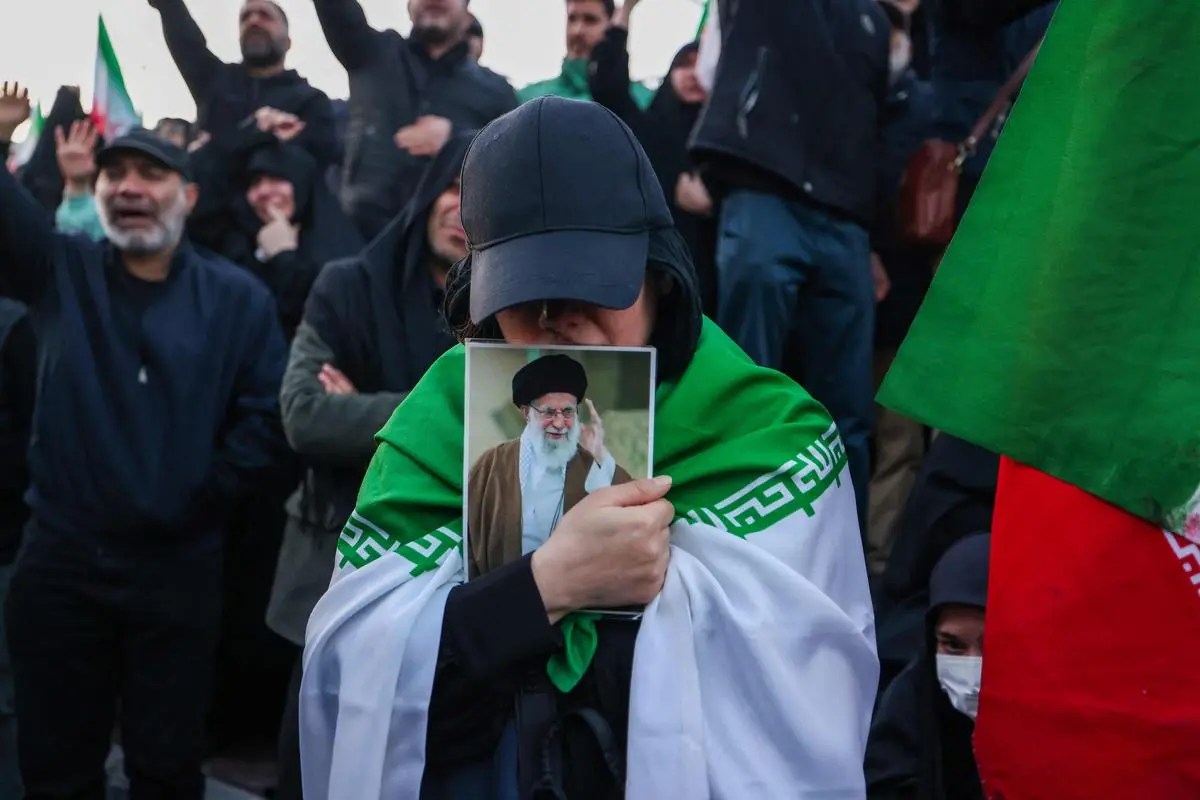
To eulogise and lament the demise of a barbarous despot and a brutal regime, which trampled on its own citizens and destroyed its own country economically, socially and politically, is sheer folly. – Makarand R. Paranjape
While Iranians all over the world, and to the extent possible within Iran, are celebrating the fall of a horrible despot and his regime of terror, Left-liberals in both the US and India are in mourning over the Ayatollah’s demise. How can one explain this strange and perplexing paradox?
Iranian women are rejoicing over the downfall of one of the most oppressive and misogynistic regimes in the world, yet US and Indian feminists—who, without the enforced hijab in Iran, would have faced certain imprisonment, even torture—are lamenting the fall of Iran’s patriarchal despots.
Iranian women have endured decades of policed veiling, gender segregation, and brutal crackdowns on protests, such as the 2022 uprising following Mahsa Amini’s death in custody for “improper hijab”. The regime’s misogyny was systemic, with laws permitting child marriage, quasi-prostitution disguised as temporary marriage (sigheh or nikah mut‘ah) and stoning for adultery (zina-e-mohsen).
Yet, when news broke of Khamenei’s death and the subsequent collapse of key regime figures, feminists both in the US and India decried the “militaristic patriarchy” of US and Israeli forces. The same feminists, who champion bodily autonomy, aligned with a theocracy that denied it.
Similarly, organised gay and LGBTQ groups, who could have faced execution in the Islamist Republic of Iran, are wailing the end of Iran’s theocratic dictatorship. Some on social media even pointed out how one of the greatest postmodernists, Michel Foucault, not only praised the regime in Iran but visited the country. I am not sure they knew he was homosexual—or did they simply choose to ignore it in so famous a foreign supporter?
The irony is stark: those who could be hanged from cranes in Tehran are now indirectly defended by activists enjoying protections in liberal democracies, all in the name of intersectional anti-oppression.
Communists were executed by Islamists not only in Iran, but in many other parts of the world. The Iranian regime’s early years saw the mass execution of Leftists, including members of the Tudeh Party, who were purged in the 1980s for ideological deviations from Khomeini’s Shia Islamism. Globally, Islamists have clashed with Communists, viewing Marxism as atheistic heresy. Yet today, Communist sympathisers in the West echo Iran’s anti-American slogans, seeing the regime as a victim of capitalist encirclement.
American Communists are taking the “Death to America” line right in New York City today, thanks to the patronage of their mayor, misusing the latitude of free speech given to them by the laws of the very country they excoriate. Speaking of the mayor, he promptly issued a statement condemning his own country and president.
I do not recall him shedding a tear for any of the prisoners of conscience tortured and killed in Iranian jails or castigating the horrifying attacks of Iran’s proxies in the region. Oh, I stand corrected; he did condemn Hamas much later, after facing repeated criticism. The day after the raid of 7 October 2023, he actually denounced Israel for its apartheid and occupation, not to mention its declaration of war against Hamas. Now this same mayor questions the legality of US and Israeli actions against Iran.
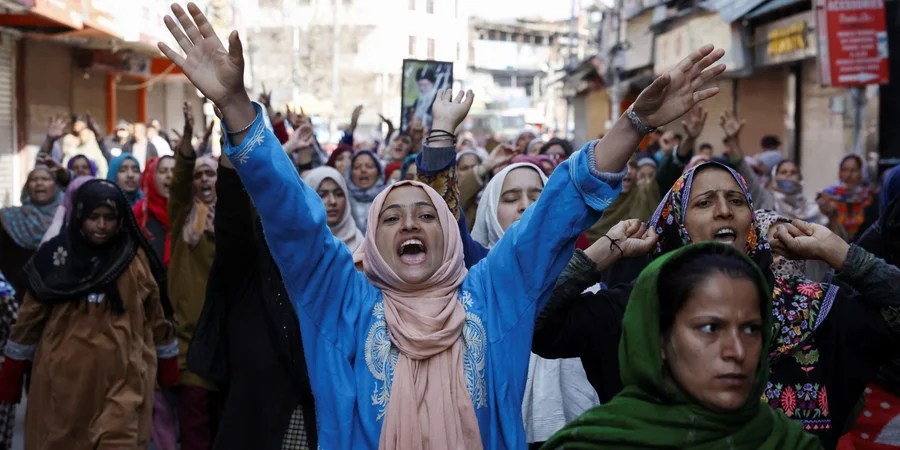
It is strange, to say the least, that the fallen regime has all kinds of supporters, East and West, many of whom are not even remotely connected to, let alone know much about, Iran. The Shia reaction in the subcontinent, by contrast, is understandable, even if, arguably, irrelevant to international geopolitics.
This global phenomenon of Left-liberal outrage over US-Israeli actions, which we may term the “Iran Paradox”, grows even stranger when we realise how many Muslim, especially Arab, states have actually condemned Iran’s retaliatory strikes, not the initial US-Israeli strikes. Even China and Russia, despite whatever verbal or political support they might extend in the totally marginalised and disunited United Nations, did not come to Iran’s aid in its time of dire need. The Ayatollah’s rule of terror, in other words, was left friendless in the end. Such, indeed, is the fate of dictators around the world.
Western liberalism, if we can even call it that, with its fading echoes elsewhere, reveals a profound disconnect with ground realities. Indeed, global political discourse shows that ideological alignments trump human rights or even historical realities.
At its core, the Iran Paradox stems from the frightened prejudice of sore losers, a Left which, some say not without reason, is both intellectually and morally bankrupt. It has nothing to fall back upon except its hatred for the US and Israel.
They are the ultimate villains—imperialist, colonialist and, worst of all, capitalist. Any regime opposing this axis, no matter how repressive, becomes, by default, a symbol of resistance.
Founded in 1979, the Islamic Republic of Iran, under Ayatollah Khomeini, positioned itself as an anti-imperialist bulwark, chanting “Death to America” and “Death to Israel”. They took their latter responsibility a bit too seriously, exporting death through proxies like Hezbollah in Lebanon and Hamas in Gaza.
Now, in closing, to India’s weak and splintered opposition—especially the increasingly irrelevant Congress and its differently enabled band of ideological fellow-travellers. Preaching moral lessons to Prime Minister Narendra Modi, who embraced Israeli Prime Minister Benjamin Netanyahu on the eve of the strike on Iran, is one thing.
But to eulogise and lament the demise of a barbarous dictator and a brutal regime, which trampled on its own citizens and destroyed its own country economically, socially and politically, is, as outspoken critics are wont to put it, sheer folly.
Yes, India did business with Iran, but that does not mean we should sing hosannas to its deceased leaders while ignoring their crimes against humanity. Let us not even comment on those virtue-signalling by issuing strong denunciations of the US and Israel. Actions speak louder than words. Besides, who is listening to them? Firstpost, 4 March 2026
› Prof. Makarand R. Paranjape is an author and columnist.
 VOICE OF INDIA