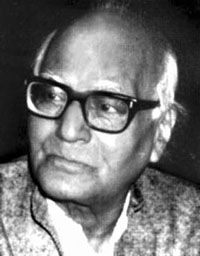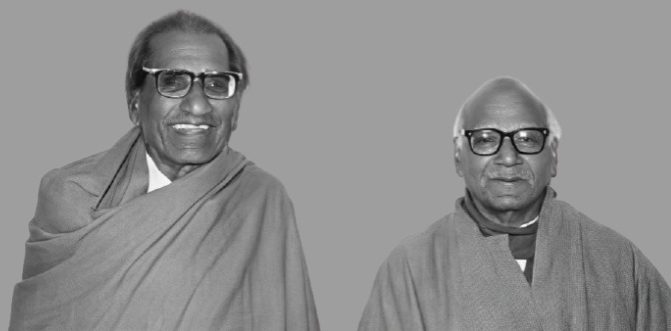
Ram Swarup and Sita Ram Goel: Intellectual kshatriyas who wielded the pen like a sabre – Shankar Saran

Sita Ram Goel & Ram Swarup

Wake up, folks, wake up! As intimidated as you are by the fear of going against the stream and looking racist, you don’t understand or don’t want to understand that a reverse crusade is on the march. As blinded as you are by the myopia and the stupidity of the politically correct, you don’t realise or don’t want to realise that a war of religion is being carried out. A war they call Jihad. A war which is conducted to destroy our civilisation, our way of living and dying, of praying or not praying, of eating and drinking and dressing and studying and enjoying life. As numbed as you are by the propaganda of the falsehood, you don’t put or do not want to put in your mind that if we do not defend ourselves, if we do not fight, the Jihad will win. It will win, yes, and destroy the world that somehow or other we have been able to build. – Oriana Fallaci in The Rage and the Pride

Violence does not live alone and is not capable of living alone: it is necessarily interwoven with falsehood. Between them lies the most intimate, the deepest of natural bonds. Violence finds its only refuge in falsehood, falsehood its only support in violence. Any man who has once acclaimed violence as his method must inexorably choose falsehood as his principle. – Alexander Solzhenitsyn in his 1970 Nobel lecture. 

Writing against the current in a democratic society poses problems of a different kind. Pondering at the range and depth of writings of Ram Swarup (1920-1998) and Sita Ram Goel (1926-2003), and the approach of our academia and media towards them gives an inkling of the problem.

In a totalitarian political system—Fascist, Communist or Islamist—a non-conformist writer can hardly publish anything. Even writing in private is a dangerous venture. But in a country with complete freedom of speech, with a ‘politically correct’ intellectual ambience, an inconvenient author can be silently buried in indifference. Not even the most open minded readers would know of his existence. Speaking of the Soviet case, Solzhenitsyn had observed that “the environment is dense and sticky: it is incredibly difficult to make even the smallest movements because it immediately takes the environment with them.” In contrast, the atmosphere in democratic countries is “like a rarified gas, or almost a vacuum: there it is easy to wave one’s arms, jump, run, turn somersaults—but it all has no effect on anybody else, everyone else is doing exactly the same in a chaotic manner.”

Without understanding this difference, we can never comprehend why even sixty years’ of original work of the rare duo of Ram Swarup and Sita Ram Goel hardly left a mark on the intellectual scene of our country. Both died largely unsung. It is not a small measure of the regrettable situation that even a solitary biographical sketch of them each came from a Belgian scholar, Koenrad Elst. No Bharatiya scholar, journalist or student wrote one. Neither in their lifetime, nor after they passed away. Our media did not even bother to take note of the demise of Sita Ram Goel in 2003. The chief reason for this unfortunate state of affairs is that their work remained largely unknown to the general public of our country. Both were original and non-conformist thinkers. Our governments as well as the academic class felt quite at ease in ignoring them. Media happily followed suit.

There was a time in the Soviet Union when Solzhenitsyn was vilified. His works were considered ‘concoction’, ‘betrayal’, ‘disease’ and what have you. Even in the Soviet Literary Encyclopaedia of 1973 his name found no place at all (this, after he was already world-famous with Ivan Danisovich, and the Nobel Prize). He simply did not exist.

In this country, a very similar attitude was applied towards Ram Swarup and Sita Ram Goel as far as our academic class is concerned. Goel found no mention in intellectual debates and writings on issues he published for decades. If rarely someone mentioned his name, it was scornfully dismiss him as ‘communal’. Hence unwanted, irrelevant. It is a mark of the pathetic condition of our social sciences that after the demise of the Soviet Union, and opening up of the Soviet and East European archives, our Marxist professors were not dragged on the coals for their propagandistic writings masquerading as scholarly ones. Nothing happened by way of re-examining their highly distorted writings on history, political science or economics. On the contrary they are still ruling the roost! By corollary, even after the demise of communism, Sita Ram Goel and Ram Swarup are not accorded their due place in the scholarly arena for their realistic, incisive and farsighted analyses of the communist systems. Perhaps after the advent of a Saudi Gorbachev, this might be done.

Disaster at Inception: The English Takeover

Ram Swarup and Sita Ram Goel wrote on Communism, Marxism, Maoism, Islam, Christianity and Hindutva. In this country all these are politically sensitive subjects. As is well-known, to the first five issues it is considered politically correct to be respectful, even reverential. As for the last one, it is best to disregard, if not mock openly. Reasons are various for this pitiable situation in this otherwise intellectually rich country.

A misconception regarding the Islamic mentality on the part of the national leaders since the 1920s was one. Getting the very first prime minister heavily enamoured by Marxism, Soviets and Islam was another. It has to be understood that the founding moments of any institution, law or system invariably become crucial to set the tone and standards for a long time to come. For a free Bharat the period of, say, 1947-56 was such a founding one because so many of our intellectual or socio-political traditions laid down by the Communist-and-Islam-leaning first prime minister.

Jawaharlal Nehru: India’s First Prime Minister

English becoming the intellectual language of the country, even after freedom from the British rule, was the third reason. It summarily and effectively excluded more than 95% of the population from participating in influential intellectual exercises. Thus a possible corrective to ideologically marred theories, propositions etc was foreclosed at the very inception. English ensured that even if a Bharatiya citizen is wise, experienced, knowledgeable and articulate, he or she can do nothing to check or persuade an erring intellectual or a whole intellectual group—unless he can do it in English. Besides, he must also hold a high chair to be heard.

Discourse in any language other than English in this country, howsoever rich and invaluable, simply does not touch the influential, decision making classes. Thus, intellectual pursuits became an undeclared monopoly of a minuscule few, who, even if grossly errant, ignorant or misguided on a matter in hand, could still set the standards for the entire country to follow—history writing and NCERT textbooks since inception are a case in point. The rest of the population simply came to accept, in naïve belief, a la Soviet citizens of yore, that whatever is emanating from the high chairs of a council, academy, commission, university, centre or ministry is certainly better informed. “They must know better who speak and write in English” became the common, if disastrous, sentiment among the Bhartiya public.

In the subjects mentioned above, that never was the case. The philosophy, understanding and experiences of the common Bhartiya masses were vastly different from the English-wielding intellectual elite about, say, the ways of socio-economic change or the Islamic character. Yet they could do nothing, thanks to the monopoly of English in matters academic or policy, to correct the academic and political decision makers. This restrictive, anti-Bharat role of English in a free Bharat is hardly considered in analysing why such a “politically correct” intellectual atmosphere came to rule here.

Original Critiques of Islam, Christianity and Communism

In such a politically correct intellectual environment Ram Swarup and Sita Ram Goel jointly represented diametrically opposite views. The dominating political and intellectual classes which followed a different path, naturally detested this. It is, therefore, not surprising that the duo’s rich contribution was wholly ignored. Both started publishing their critical works with the advent of freedom in 1947. It is out of the purview of this essay to compare the parallel views of the duo and those of the ruling intellectual-political classes of our country. Suffice it to say that time has proven most of the analyses and conclusions of Ram Swarup and Sita Ram Goel right.

Of the nature and role of Marxism-Leninism, Soviet system, Maoist practice, and Communist economies, it is now irrefutably evident that whatever our first prime minister and Left-leaning economists, social scientists believed for decades (some still do) were indeed mere superstitions. As far the Islamic problem is concerned, anyone can judge the farsighted analyses the duo presented till the end of their lives. Life has shown, decade after decade, that from Gandhi to Atal Bihari Vajpayee, every leader or preacher seriously erred, with very tragic consequences, in assessing the Islamic problem. In their case, wishes were not horses.  Every concession, every leniency, all hosannas to Islam did never bring a single positive result. As Sita Ram Goel put so succinctly, in one of his last contributions:

“A study of Hindu-Muslim relations since the foundation of the Indian National Congress in 1885 tells us that Muslims have been making demands—ideological, political, territorial—and Hindus conceding them all along. Yet the Muslim problem remains with us in as acute a form as ever. With the advent of petrodollars and the emergence of V.P. Singh, Laloo Prasad, Mulayam Singh and Kanshi Ram on the political scene, Muslims have become as aggressive and intransigent as in the pre-partition period.”

To understand the nature of the problems we are facing today on this score, and also to value the scholarly contribution of Ram Swarup and Sita Ram Goel, it would be helpful to see what some other gifted observers have concluded the world over. Oriana Fallaci, whom Milan Kundera calls the ideal of the 20th century journalism, has been saying this for the last twenty-five years. She is a remarkable writer inured to living with all races and habits and beliefs, accustomed to opposing any fascism and any intolerance without any taboos.

She is indignant towards all those who did not smell the bad smell of a war to come and who tolerated the abuses that “the sons of Allah” were committing in Europe with their terrorism. Her straight reasoning:

“What logic is there in respecting those who do not respect us? What dignity is there in defending their culture or supposed culture when they show contempt for ours?”

She puts the likes of Osama bin Laden on par with Hitler and Stalin, firmly arguing that fascism is not an ideology, but behaviour. She warns that the fight with this fascism “will be very tough. Unless we Europeans stop shitting in our pants and playing the double-game with the enemy, giving up our dignity. An opinion I respectfully offer to the Pope too.”

Do we comprehend what Fallaci is stating? Most of the members of our intellectual class would not. Let alone fighting a war, on the intellectual plane, they tend not even to see the international phenomenon and problem. As if every disaster perpetrated by the sons of Allah in any corner of the world is a mere accident and not manifestations of a single ideology.

Bamyan Buddhas

Bamiyan Buddha Destruction

Question: Why do some people remain unfazed even by violence of such magnitudes as 9/11, Bamiyan, Godhra or Nadimarg in Kashmir? They readily try to explain away such violence blaming some “primary” cause and thus shield the barbaric perpetrators. But the very same people hysterically cry “fascism” on even an ordinary statement that the Ayodhya temple movement is a national sentiment. Why such double standards?

Political correctness is not the whole answer. Love for one’s own comfort, ignorance and laziness also play the part for many a people. As Solzhenitsyn aptly said in the context of condemning the nuclear tests conducted by France and China, that the double standards were “not only because of moral squint, but simply out of cowardice. Because from an expedition into the Chinese desert or to the Chinese coast nobody would return—and they know it”. The same is truer of keeping silent on everything Islamic, fascist or terrorist, while crying hoarse about even non-acts of “Hindu fascism”. As the great author wrote, “They only protest when there is no danger to life, when the opponent can be expected to give in and when there is no risk of being condemned by ‘Leftist circles’—it is always better, of course, to protest with them.” This is highly apt to describe the noisy secularists of Bharat.

We have different scales of values for wickedness and punishment. According to one, killing of an innocent-looking terrorist—Ishrat Jahan for instance—or a missionary indulging in illegal proselytizing activities—Graham Staines—shatters the imagination and fills the newspaper columns with rage. While according to another, systematic cleansing of Hindus from the territory of Kashmir, Assam and Nagaland, burning an entire train coach with Hindu pilgrims in Godhra, mushrooming of Islamic terrorist dens in the border areas of West Bengal, Bihar and UP—all this gets no attention much less alarm. No condemnation, no seminar, no books, no documentation and, of course, no campaigns on the lines of “fight against saffronisation”.

Whenever an Islamic assault becomes impossible to ignore and at least our editorial classes feel compelled to write something of a criticism they never forget to mention “Hindu extremism” in the same vein. It is pure fiction, an added insult to meek Hindus who have been at the receiving end all along for centuries. No one speaks for them with force, with extra-constitutional methods. Hence no question of a Hindu “extremism”.

But in editorials, Islamic violence is never condemned on its own merit, it is wilfully clubbed with a Hindu one. This artificial balancing flies in the face of hard, horrible facts. There has never been a single act on the part of the Sangh Parivar which can even remotely match, either in words or deeds, those of the Islamic ones: Lashkar-e-Toiba, Student Islamic Movement of Bharat (SIMI), Deendar Anjuman, Hizb-ul-Muzahideen, Tablighi Jamat et al. Yet the politically correct editorial and academic classes of this country present Hindu “extremism” and Islamic terrorism on par. Worse, for some, the former is the cause of the latter. Therefore, the bigger culprit is the (Hindu) Sangh Parivar. Hence all fight is against “saffronisation” and none against “Islamisation” of every possible thing—land, people, culture, dress, food, language, thought and manners.

What kinds of scales are used in this artificial balancing of Islamic intolerance with an imaginary Hindu one? The first unit on one scale may be ten, but the first unit on another scale may be ten to the sixth power, that is, one million. It is high time our politically correct eminences understood these two non-comparable scales of valuation of the volume and moral meanings of events. It is impossible to accept the ideology of Osamas bin Ladens even remotely comparable to that of say, Pravin Togadia. One is causing a “Une grande Peur” (A great Fear) all over the Western world and the non-Islamic Eastern world. While the other causes nothing because she merely expresses the frustration of common Hindus. An angry Hindu at best draws a derisive laugh among the Islamic world steeped in unimaginable violence. Unimaginable both in methods and scale.

An Excellent Guide

If we want to understand the things in perspective, there is no better guide than Ram Swarup and Sita Ram Goel. Yes, not even Bernard Lewis or Daniel Pipes has done it with such perfection as the duo (Lewis et al are marred by their West-centric approach, ignoring the role Islam played in Bharat and the difficult Hindu struggle with it for centuries).

Oriana Fallaci has presented the scenario very well on an empirical plane. Addressing those who remained indifferent or harboured illusions about the Talibani destruction of the Buddha statues in Bamiyan she asked,

“Who is next, that the ‘idols’ of Bamiyan have been blown up like twin towers? The other Unfaithful who pray to Vishnu or Shiva, Brahma, Krishna, Annapurna? … Do they hate only the Christian and Buddhists, those voracious sons of Allah, or do they aim to subjugate our whole planet?”

Unfortunately, there are still very few scholars in the West to delve into the issue on a realistic plane.

It is no exaggeration that on philosophical, historical and analytical planes, Ram Swarup and Sita Ram Goel have presented superior analyses about the Islamic malady. To realise all this, we must first know exactly and thoroughly whatever has been happening all these decades in every corner of the world—from Afghanistan to Sudan, from Palestine to Pakistan, from Malaysia to Iran, from Egypt to Iraq, from Algeria to Senegal, from Syria to Kenya, from Libya to Chad, from Lebanon to Morocco, from Indonesia to Yemen, from Saudi Arabia to Somalia. Only then can one comprehend the hollowness of the artificial balancing of “both Hindu and Muslim” communalism/extremism, which is a routine, mindless practice in our country. In practice, it is nothing but a profound help to the Islamic jihadi politics and terrorism targeting Bharat.

Penetrating Analysis of Islamic Terrorism

The phenomenon of the modern phase of Islamic terrorism arose in the late nineteen sixties. Beginning with September 1970 “Arab terrorism” came to be known in the entire world. No academic or journalist, howsoever politically correct, could then imagine balancing that terrorism with anything else. It was original and Islamic. Balancing it with some US, Israeli or Hindu deeds are a much later invention.

After the beginning of a Euro-Arab dialogue in 1975, and dubious agreements thereafter, petrodollars came pouring into the Western media and academia. The money readily brought subtle and not so subtle messages and conditions. Only then did this kind of artificial balancing began to appear in print. First in France, then in the whole of Europe and American universities. Today from the Harvard University to the London School of Economics to the Jawaharlal Nehru University, from the New York Times to the Economist to the Times of India there are any number of scholars and hacks who compete with each other to explain that anything but Islam is responsible for the acts of Islamic terrorism. That Islam is nothing but basically a religion of peace and brotherhood. And woe betide those who dares contradict this!

That exactly was the refrain towards Ram Swarup and Sita Ram Goel of our left-secular hacks and professors. Keeping eyes wide shut towards the Islamic nature of so many international problems—violence, bigotry, terrorism, intolerance, etc.—has made the West more vulnerable. It is not the problems attached to gaining insight that made it difficult for the West, but lack of will to say the right thing. The same can be said more assertively about our own country, for we especially prefer the comfortable to the difficult.

Though it has also to do with the traditional Hindu character that remains concerned mostly with swaddharm (one’s own Dharma), and altogether ignored studying and understanding the various religions of the others, the creeds of those aggressors who, driven by permanent hostility and purpose to convert, repeatedly attacked Bharat. This careless attitude to deeply study Islam, Christian missionaries or Communism also played the part for the astonishing Hindu ignorance of Islamic or Communist theory and practices. This in turn, makes the game of the invaders, aggressors, revolutionaries and infiltrators an easy one.

However, as in Europe, here too, the spirit of Munich has been leading the search for insight. The spirit of concessions and compromise, and of cowardice, self-deception by prosperous leaders, scholars and responsible individuals. They all have lost the will to set limits, to be firm. This course has never in the past led to the desired results, including preservation of peace and justice. The experience of Gandhi and the Partition are the most visible examples. But it seems that human emotions are stronger than even the clearest lessons of the past.

Enfeebled Hindu professors, editors and leaders—George Fernandes, the former Defence Minister provided the latest example of Hindu meekness by swallowing and concealing the insults inflicted at the US airports—of Bharat paint sentimental pictures of how violence will generously allow itself to be softened up.

That is not to be.

Primary Sources of Islamic Terror

It is not without reason that of 52 Islamic countries in the world today there is not a single one professing democracy. All are dictatorships and semi-dictatorships of one or another kind, declaredly following Islam. Yes, coercion, intolerance, violence, conquest and propaganda are intrinsic to Islam. From the very beginning, at the place of its birth itself, it could not gain ground except by violence and treachery. So much so that the Arabs, “who had been hitherto upright and chivalrous, became a great scourge and cruel invaders and rulers. Their ethical code suffered a great decline. They began to live on the labour and sweat of others.”

Reading Koran and other authentic primary sources of Islamic literature, one can easily discern that lying and treachery in the cause of Islam has received divine approval. Any hesitation to perjure oneself in that cause is represented as weakness. Consider this. During a synod that the Vatican held in October 1999 to discuss the rapport between Christians and Muslims, an eminent Islamic scholar addressed the stunned audience declaring with placid effrontery, “By means of your democracy we shall invade you, by means of our religion we shall dominate you.” The meaning is clear as daylight.

This typical treachery is on display everywhere in Europe. Islamic migrants force themselves on European people misusing the democratic and humanitarian laws of the respective countries, viciously threatening with “I know my rights” to the local inhabitants. The same “rights” they don’t have, and don’t care to have in their Islamic countries of origin. Some of the perpetrators of 9/11 were on the watchlist of the FBI and CIA. Yet, residing in the USA itself, they could carry out their inhuman mission because the humanitarian laws of the country allowed them the luxury to learn piloting, move around, meet and conspire, and finally to bring down the twin towers of New York.

This is what the Islamic scholar meant.

But as in Bharat so in the West, scholars, leaders and editorial classes have tried to downplay this essential fact. They fail to recognise or don’t want to recognise that a reverse crusade is going on. It is forced on Europe and the USA. Yet their policymakers are trying their best to appease the aggressors. The aggression is an ever-growing reality that the Western leaders senselessly feed and back up. Witness their treatment to Pakistan. Whatever the Bush administration has been looking for in Iraq, to punish Saddam Hussain, were abundantly available in Pakistani territory. Undisguised, under the very US eyes. But instead of taking serious note of it, and appropriate action, they offered Pakistan to be an ally of the NATO! Which attitude is the reason why those crusaders increase in numbers, boss around more and more. They will demand more and more and bully with greater intensity. Till the point of subduing us. Therefore, dealing with them is impossible. Attempting a dialogue, unthinkable. Showing indulgence, suicidal. And he or she who believes the contrary is a fool.

Therefore, the fact must not to be lost sight of, even for a moment, that Islam is more an imperialist, dictatorial, political ideology. It brooks no reform. It severely punishes even members of its own fold, howsoever superior or honourable in knowledge and position for the mere crime of attempting reform.

At this point, it is very important to note that Muslim population and Islam are not the synonymous terms. Just as Marxism-Leninism and Soviet people were not. As criticising Marxism-Leninism-Stalinism-Maoism was not an insult or vilification of the Soviet people or Chinese people, so criticising Islam is not “spreading hate” against Muslims. It is a clever ploy of Islamist scholars, leaders, jihadis as well as Left-secular propagandists in Bharat that they arouse the Muslim masses against any such criticism as though it is directed against them.

Muslims are in most cases as victims of the Imams, Ayatollas, Amirs as the common Russians and Chinese were at the hands of their Marxist masters, the chairman or general secretaries. This ploy has to be fought tooth and nail.

Inasmuch as Islam is a political ideology with a complete social, political, juridical system of its own, it is as liable to criticism and scrutiny as any other political creed. More so as its political ambitions and juridical regulations are never confined to Muslims alone. It has clear rules, regulations and directions applied to non-Muslim masses whether for the moment it is ruling a country or not. Thus the political ideology of Islam, even otherwise, directly affects non-Muslims of the world.

Therefore, not only the Muslim but non-Muslims also have every right to criticise Islam. But the Islamic scholars and ulema using all kinds of pretexts and deceptions, shifting and contradictory—bearing the situation in a given country in mind—deny this right to non-Moslems and Moslems alike. However, as Ram Swarup said so meaningfully, once intellectual freedom is gained for the Moslem masses, rest is only a matter of time. Most Islamic rulers and scholars perceive this very well. Which is why they are hell-bent not to give intellectual freedom to their own brothers in faith, their Moslem subjects. They use every kind of violence, threats, regulations, logics and ploys to deny this.

Why?

The words of Solzhenitsyn quoted in the beginning of this article explain it. It also explains why violence is intrinsic to Islam. Make no mistake. Islamic violence is not a reaction to this or that deed of the West or the Jews or the Hindus. It is because Islam has no intellectual or verbal argument to offer on any point. The erstwhile Soviet scholars used to quote Marxism-Leninism like a spell on all questions. Even if it answered none. Likewise, Islamic scholars quote Koran in every matter, without the slightest regard for or reference to common human reason. That can hardly satisfy inquiring minds, whether non-Moslem or Moslem. That is why Islam regularly employs intimidation and violence to subdue anyone and everyone, anywhere and everywhere, anytime and everytime.

If these essential points are glossed over as have been done in Bharat throughout the 20th century by many respectable leaders and scholars, the Islamic problem can never be understood, let alone solved. Therefore, neither theoretical illusions nor practical difficulties—read fear—should come in way for recognising and fighting this war. As the great living fighter writes,

“In Life and in History there are moments when fear is not permitted. Moments when fear is immoral and uncivilised. And those who out of weakness or stupidity—or the habit of keeping one’s foot in two shoes—avoid the obligations imposed by this war, are not only cowards: they are masochists.”

These are the same values—freedom from ignorance and freedom from fear—that Ram Swarup and Sita Ram Goel tried to instil in us in their gentle, yet firm way. They were intellectual warriors—heroes of our time. – Dharma Dispatch, 24 April 2019

This essay was first published in the volume, “India’s Only Communalist: In Commemoration of Sita Ram Goel,” edited by Dr. Koenraad Elst 

Shankar Sharan is an Indian author and professor of Political Science at the National Council of Educational Research and Training (NCERT) in New Delhi. 
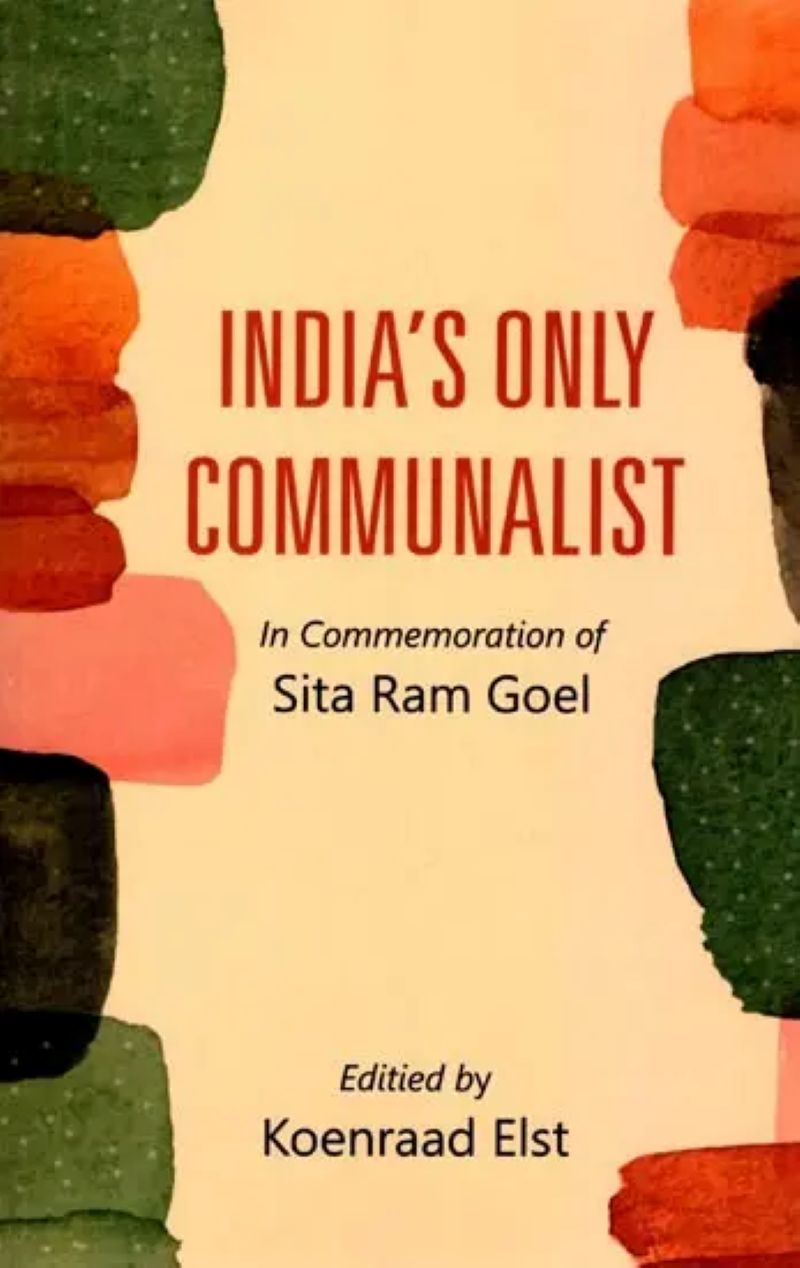
India's Only Communalist: In Commemoration of Sita Ram Goel

Ram Swarup and Hinduphobia – Koenraad Elst

hindu-hate

As Socrates taught: evil is, upon closer analysis, a case of ignorance. Never attribute to malice what can be explained by incompetence. – Dr Koenraad Elst   

Let us consider what Ram Swarup said about Hindu-bashing, or what is nowadays called “Hinduphobia”. The word, though in existence since more than a century, was not yet in vogue as Hinduism’s ad hoc counterweight against the omnipresent propaganda term “Islamophobia”. But the phenomenon was already dominant in India and increasingly present abroad.

In fact, it was quite old. Several tribes of Muslims with a doctrinally motivated hatred for the Hindus, followed by the Portuguese Christians with a similar aversion, had actively persecuted Hinduism for centuries. They represent a permanent source of anti-Hindu violence that now takes the form of occupation of parts of the Hindu homeland by the Islamic states of Pakistan and Bangladesh; of Pakistani incursions; of terrorism and of rioting. But while they bludgeoned Hindu society and inflicted huge human and material losses on it, they did not penetrate it or take control of its institutions.

Tribes of haters

The British, by contrast, could rule India with more limited violence largely outsourced to native sepoys, but their influence penetrated far more deeply. Firstly, they managed to pit several Hindu sub-groups against the mainstream: most obviously the Sikhs, for whom the status of separate religion was made of whole cloth, promoted as a social reality and underpinned at the scholarly level. In several booklets, Ram Swarup went against this colonial-engineered separatism by documenting how, as per their own scriptures and history, Sikhism was a self-identified sect of Vedic Hinduism.

The creation of bad blood between Buddhism and mainstream Hinduism only took the institutional form of keeping Sri Lanka and later Burma outside of British India, but was far more influential at the scholarly level. There, the underlying paradigm of all Buddhist studies and of Indian histories as instilled through the schools became: “Hinduism bad, Buddhism good.”  Even before 1947, “Christian missionaries (…) were presenting Buddhism (as they have been doing with Sikhism) as (…) a revolt against ‘Brahmanism’ and the “Hindu” caste system.” (Hinduism and Monotheistic Religions, p.519, originally 1991) They had no use for the Buddha, except for making him into a stick to beat Hindu society with. The Macaulayites and Marxists followed this example: “they tried to use their learning and position to undermine Hinduism (…) and show that there was little difference between Marxism and Buddhism. Now Communist historians are telling us that Hindus demolished Hindu temples.” (p.519) 

Likewise with the Dalits and tribals, who came to benefit from an incipient reservation system, and with the non-Brahmin Tamils. The then-popular Aryan Invasion Theory was used to pit them against the upper castes and the North Indians. The thrust of the exercise was invariably to put Hindus into the dock and make them feel guilty for their very existence. Needless to say, this caste-based discrimination with a good social conscience has only become more encompassing over the years, and the [Aryan Invasion] paradigm still is the official one.

But the second effect was even more detrimental to Hindu assertiveness: “The British took over our education and taught us to look at ourselves through their eyes. They created a class Indian in blood and colour, but anti-Hindu in its intellectual and emotional orientation. This is the biggest problem rising India faces—the problem of self-alienated Hindus, of anti-Hindu Hindu intellectuals.” (p.45) 

Then again, in numerical terms, this impact on Hindu society was still quite small even by 1947. Many millions in the countryside had never seen a Briton, less than 1% of the population spoke good English. If the Indian leadership had wanted, it could have undone this influence in a matter of decades.

Ram-SwarupA crucial factor here was the choice of language. Ram Swarup himself was quite at home with British culture and thought, being most influenced by British liberalism: Bertrand Russell, George Bernard Shaw, Aldous Huxley, George Orwell. In his case, this didn’t stop him from fighting for freedom from British rule, with active participation in the Quit India Movement. But for less independent minds, gulping down English influence would only end up estranging them from their Hindu roots, as it had done in the case of Jawaharlal Nehru. The vote in the Constituent Assembly’s Language Committee should have been crucial: 50% voted for Sanskrit, 50% for Hindi (which was given victory by the deciding vote of the chairman), and 0% for English. For the generation that had achieved independence, it was completely obvious that decolonisation implied abolishing the coloniser’s language. Yet by 1965, when this abolition was due to become effective, the English-speaking elite had gathered enough power to overrule this solemn commitment. Ever since, the influence of English and of the thought systems conveyed by it has only gone on increasing, and at some levels, India is becoming a part of the Anglosphere—hardly what the freedom fighter envisioned. Today, most Anglophone secularists are nearly as knowledgeable about Hindu culture as first-time foreign tourists who have crammed up the Lonely Planet’s few pages summarising India’s religious landscape.

Marx and Mao

Compare with China, not formally colonised but having been repeatedly humiliated by colonial incursion, yet now again proud and assertive. Of course it has retained its language, and adopting a foreign language as medium for education or the judiciary is simply unthinkable. Ram Swarup, who wrote several books criticising the record of Maoism, wouldn’t emphasise this, but it is one thing the Communists undoubtedly achieved: a clean break with the colonial age. Under the nationalist regime (1912-49), China was increasingly under Anglo-American influence, and the Christian missions could operate on a large scale. Nationalist leader Jiang Jieshi (who later was to give an award to Ram Swarup’s and Sita Ram Goel’s anti-Communist think tank Society for the Defence of Freedom in Asia) was a Christian along with much of his family. By contrast, when Mao Zedong came to power, all missionaries were imprisoned, killed, or at best banished.    

On the other hand, by importing Marxism, China was opening itself up to another Western doctrine, and actively imposing it on its population. The same counted for those circles in India that came to espouse Marxism. Under Nehru, it started influencing the power-wielding circles, and from Indira Gandhi onwards, it achieved control over education policy and much of cultural policy. This ideology was “more Eurocentric than regular imperialism. It used radical slogans but its aims were reactionary. … Marx fully shared the contempt of the British imperialists for India. He fully subscribed to the theses of colonial scholarship that India was not a nation, had no history and was meant for subjugation. Marxism was Macaulayism at its most hostile. It blackened Indian history systematically. It gave to [the] Indian social and political system its own format, the one it had learnt from its European teachers. It saw in Hinduism not … a great spiritual civilisation but only communalism.” (p.45-46) 

Newer forms of Marxist or soft-Marxist thought (critics speak of “cultural Marxism”) remain entrenched in the Indian institutions, and are more powerful than ever in the relevant departments of Western universities. Their construction of Indian reality remains dominant and is more than ever spread to the new Hindu generations, leading to more culpabilisation c.q. sense of shame for Hinduism. 

Race to the exit

The trends unambiguously traced to colonial policies have not been reversed by the Nehruvian regime, but have instead been continued and magnified. Thus, the British policy of separating Hindu subsets from general Hinduism has continued with an affirmation at different times of minority status for Buddhism, Sikhism, the Arya Samaj, Jainism, Virashaivism and Sarna “animism”. In every case, the administrative separation was fortified with a change in discourse: the need for a non-Hindu identity was in each case buttressed by an increased blackening of Hinduism. This anti-Hindu attitude has even crept into Hindu organisations without the institutional ambition of minority status, e.g. the ISKCON (Hare Krishna) calls itself non-Hindu, except when it is canvassing for donations from Hindu communities.

When Ram Swarup wrote against separatism among the Sikhs, it was an interesting intellectual entertainment for his readers, but had no impact at all on policy-making. The Narasimha Rao government managed to neutralise armed Sikh separatism, but did nothing to change Sikh separatist thought, so that there remains a constant threat of its political revival. In a healthy society, we might expect power-wielders to listen to sages like Ram Swarup, but this was not the case; just as it is still not the case today.

As described in Ram Swarup’s booklet The Ramakrishna Mission in Search of a New Identity, the Ramakrishna Mission, besieged by the Communist-supported Teachers’ Union in its school network, felt compelled as a matter of survival to relieve this pressure. In India, by virtue of Article 30 of the Constitution, minority schools (and similarly, places of worship) are autonomous and immune from government take-over, whereas classification as Hindu makes them vulnerable to nationalisation. But the RK Mission did not try to have the discrimination against Hindu schools abolished, did not appeal to Hindu society, but did the dishonourable thing of trying to escape by seeking minority status, like a rat leaving a sinking ship. The Bengal High Court gave it the coveted minority status, then finally (or so it seemed) the Supreme Court denied it, entirely in accordance with RK Mission founder Swami Vivekananda’s assertion of Hindu pride. 

Superficial Hindus might jubilate that this was a victory for Hindu unity, but Ram Swarup warned that the Mission would now have to live down the anti-Hindu attitudes which it had come to espouse. Here again, some of its swamis make all the right noises for the respective audiences they address, sometimes calling themselves Hindu, but the “we are not Hindus” animus has not disappeared: when Mamata Banerjee’s Trinamool Congress won the state elections ending decades of Communist rule, the Mission asked her for minority status. And promptly it received her assurance that it would henceforth be treated as a minority, thus de facto overruling the “final” Supreme Court verdict. Ram Swarup always emphasised that institutional arrangements are unimportant in themselves, merely the materialisation of convictions and mentalities. If you want to stop the race to the exit, it is imperative to change people’s unfavourable impression of Hinduism. 

Down with conspiracy thinking

A final point for the attention of the rather hot-headed Hindu activists and polemicists. They always see conspiracies against Hinduism, e.g. the Aryan Invasion Theory was a “British concoction”, the Partition of India was “imposed by machinations by the British” who had “brainwashed” the Muslim League leadership. In this case, “Hinduphobia” is deemed to be an expression of an intractable “hatred” that for some reason (in the case of Westerners, “racism”) animates Hinduism’s numerous enemies. This fuming hot air in Hindu discourse puts off many neutral observers and produces Hinduphobes. But in all of Ram Swarup’s works, there is not a single example of this approach. 

For a single example, he describes a novel about the Buddha’s wife Yashodhara, Lady of the Lotus, by a well-meaning American, William E. Barrett. It has totally fictitious episodes about the couple’s visits to the quarters of the Untouchables: “They were revolted by the sight. They saw that ‘the traffic in the streets was, in the main, animal.’” And about the sight of hungry people: “Next day when they were in bed, light dawned on Siddharta that ‘No one has to be hungry … and no one should live as these people live.’” (p.527) In reality, the Buddha was not particularly interested in the difference between rich and poor, high and low; he taught that suffering was basic to the human condition in general. He did not propagate liberation from poverty, but liberation from the human condition. The socialist reinterpretation of the Buddha as a social rebel conflicts with the Buddha’s teachings. It is typical for the post-religious worldview to reduce religion to socio-economic considerations, i.e. to cultivate ignorance about the existential passions that have generated religions.   

The most interesting part of Ram Swarup’s account is: “The author was not hostile to India but he was doing his best to depict Hindus and their history as he knew it.” (p.528) This is crucial to understanding “Hinduphobia”: while some classes of people, say mullahs and missionaries, have an interest in blackening Hinduism, most people don’t. They just go by the information they have been fed. This American novelist has been fed the fable that the Buddha was a rebel against Hindu societal reality, so that is what he puts into his story: Buddhism social, Hinduism oppressive. As Socrates (translated into Hindi as Satyakām Sokratez by Ram Swarup’s friend Sita Ram Goel) taught: evil is, upon closer analysis, a case of ignorance. Never attribute to malice what can be explained by incompetence.   

Dr Koenraad Elst is an historian. linguist and orientalist from Belgium who visits India to study and lecture.

hindu-phobia

Ram Swarup: The greatest Hindu thinker since Sri Aurobindo – Aravindan Neelakandan

Ram Swarup

Whether it is Dharmic darshanas, global Pagan revival, study of Western philosophies and theologies from Hindu perspective, study of language from Hindu framework or, resistance to monopolistic ideologies—Ram Swarup has gifted every aspiring Hindu with vision, values and tools for his or her search . – Aravindan Neelakandan

The globalised environment today has created both challenges and opportunities for local, natural cultures. Among such natural cultures and spiritual traditions, Hindu Dharma represents the largest and the longest-continuing traditions. In fact, Hindus are the last standing nation of such a natural culture and spirituality.

With predatory and monopolistic forces threatening such a theo-diversity-laden ecosystem as Hindu Dharma and society, how should Hindus respond?

How do Hindus interact with other cultures and be a blessing to humanity while being rooted in their traditions, and without insulating themselves?

The answer may well lie with the works of Ram Swarup, who should be considered and can be considered as the greatest Hindu thinker and seer after Sri Aurobindo.

In many ways, he carried forward the thinking and vision of both Sri Aurobindo and Swami Vivekananda into the future, meeting head-on the challenges of the present and showing the thinking Hindu the opportunities embedded in every challenge.

For many millennial Hindutvaites, Ram Swarup would be known as the mentor of Sita Ram Goel.

The duo was like Sri Krishna and Arjuna in the dharma kshetra of life and rashtra.

Just as Sri Krishna is far more than the charioteer of Arjuna and Gitacharya, though that is a core dimension of the avatar, Ram Swarup was the mentor and guide of Sita Ram Goel and the sattvic energy behind Voice of India, but he was also much more than that.

And it will benefit the Hindu society to go through these other dimensions of Sri Ram Swarup as his centennial celebrations commence this year. And with the Ram Swarup foundation, we will also understand and utilise the work of Sita Ram Goel better.

In 1981, through Voice of India, he published The Word as Revelation: Names of Gods.

By any reckoning, this work should be considered a milestone in both study of religions and the study of languages.

Here, Ram Swarup takes linguistics to a different plane entirely. The magnificent view that Ram Swarup shows here is not partisan to any sectarian group of humanity.

Though he has limited his study to what he calls the “Indo-European” languages, he points out that “if speech and meaning are deeply human phenomena and if they follow deeply-laid patterns of the mind and heart, then they must share certain common characteristics, however differently clothed, and certain truths must hold good for them all”.

Going through this book, one is immersed into the beauty of words and their meaning—where the perspective is deeply Hindu, and the phenomenon studied is universal.

The book has two parts. In Part I, he explores how words are formed and what creates the relation between a word and its meaning.

He states:

“The process of naming is complicated and deeply psychological. It operates at subconscious level. Different elements that go into making of a name—the referent, the sound, the meaning—all tend to coalesce in the mind so much so that it is difficult to separate them from one another. … The process of naming may also be too much forced or fanciful; it may not be keeping with the deeper wisdom of the mind.”

What Ram Swarup talks about is an important aspect which educationists who are working to provide science and technical education in mother languages should pay attention to.

For example, in Tamil Nadu, the Dravidianists have only one purpose in their attempt to create Tamil terms for science and technology; it is not taking the concepts to the child but to remove Sanskrit from the words they coin. But still, they must use the term “kanakku” for mathematics which in turn is derived from Sanskrit gana and ganitham.

Similarly, “botany” is “thavaraviyal”, which in turn is derived from the Sanskrit sthavara.

Our tradition, from poet Kalidasa to sage Kumaragurupara, has handed over the relation between the word and the meaning as Shakti and Shiva and pure consciousness as the substratum from which the word and the meaning arise.

Sri Ramana Maharishi takes this further and hints at a roadmap for preserving linguistic diversity through this common spiritual matrix. In his famous Aksharamanamalaihe speaks of the non-dual union as the union of azhaku and sundaram—both being Tamil and Sanskrit terms for the same aspect: beauty.

In Part II of the book, Ram Swarup studies the names of gods. Here, he shows how humanity reaches its greatest linguistic possibilities in arriving at the names of the divine. Language, through the names of the divine, becomes a tool to elevate human consciousness to reach more “profound heights”.

The way Ram Swarup harmonises the spiritual elements in various traditions of the world is very important for every Hindu. He has provided a solid foundation for engaging in a proper dialogue with mutual respect for non-Hindu religions.

In discussing the names of the Vedic gods, he points out that all gods have multiple names and the knowledge of these multiple names is an important and holy knowledge.

Then he says:

“In all spiritual traditions, there is something analogous to it. The God of the Jews has many names. … But according to Jewish mysticism, God has also a secret name which should not even be uttered. Therefore, the Jews simply called it ‘the Great Name’ or ‘the Great Precious Name’ or just ‘the Name’. … Islam too admits of God’s Names though it denies His Forms. But the admission receives a certain narrowing at the hands of the more orthodox and faithful. … Socrates presents this idea in the language of understanding. He proclaims the awe, mystery and unknowability of Gods and their names but also tells us how these are ultimately names of man’s own intentions and meanings. … According to Hindu thought too, the names of Gods are not names of external beings. These are names of the truths of man’s highest Self.”

One can see how softly but sharply Ram Swarup creates a Hindu framework for the study of monopolistic religions—preserving whatever spiritual components they have and pointing out where the sublime truth is lost to rigidity inevitable to monopolistic theology.

His critique of the emergence of monopolistic rigidity traces to Paul who represented “a passionate attachment to a fixed idea which is closed to wider viewpoints and larger truths of life”.

To him, this was more an ideology than a spiritual idea. From the very early days to the present, this had worked in aid of imperialism. If rigidity and closing minds to larger truths of existence plague monotheism “polytheism too is subject to the despiritualizing influence of externalizing mind”.

As against these two, he points out that the Vedic approach “gives unity without sacrificing diversity … a deeper unity and deeper diversity beyond the power of ordinary monotheism and polytheism”.

Ram Swarup writes:

“God transcends every one of His Names; He also lives fully and indivisibly in each one of them. In one Name we should be able to see all the Names; in one God, we must be able to see all the Gods; otherwise, our knowledge of a God and His Names is not sufficient. We must also be able to see that a God exceeds all his Forms and Names, individually and collectively. The heart of a God is an enigma.”

Here is an interesting self-experiment for the inquisitive reader.

After reading the chapters on the names of gods in The Word as Revelation, one should read the science fiction short story The Nine Billion Names of God (1953) by Arthur C Clarke.

It will be rewarding to see how Ram Swarup’s framework transforms the way the short story gets internalised.

Another must read is On Hinduism: Reviews and Reflections (2000). Published posthumously, the book has eight long essays and contains his very early writing on Hinduism.

Here is an example of the alertness and conceptual clarity of Ram Swarup. One of the essays is “Buddhism vis-a-vis Hinduism“, originally published in July 1958.

Impressed by this essay, Rajaji wrote the following in Swarajya (21 May 1966):

“I read with great interest Sri Ram Swarup’s scholarly paper on the intimate connection, amounting almost to identity, between the Buddhistic philosophy and the Vedanta of the Upanishads. Hindu conformism sensed the danger lurking in a close identity with a school of thought which may well be misunderstood to be denial of God and soul. … Sri Ram Swarup’s paper explains how Hinduism saved itself from the dangers of its own philosophical dialectics through the cult of Bhakti and surrender. …”

Ram Swarup responded to this much later in a detailed footnote when he was updating the essay for a new reprint.

He wrote:

“[Rajaji] was a sage and a great spokesman of Hinduism. His views command our greatest respect. But I beg to make one clarification. Sri Rajagopalacharya agrees that there was a great affinity between the Vedanta and the Buddhist philosophy, but according to him Hinduism saw in it a danger at being misunderstood and identified with a school which denied God and soul; and it met the danger by developing the school of Bhakti and surrender. I believe Hinduism sensed no such danger and it did not panic into Bhakti and surrender because of any such danger. The fact is Bhakti and surrender even as a ‘school’ are older than Buddhism. … At no point there was any intention of keeping Buddhism ‘out of pale’. … [Hindus] protected Buddhism and defended it when it was threatened; they gave refugee to Buddhists when they were persecuted in Persia, Khurasan, Iraq, Mosul by king Gushtap and his descendants—in the same manner they are doing it at present to Buddhist Chakmas fleeing from persecution in Bangladesh.”

The importance of this response cannot be overstated. The idea that Bhakti movement was a reactionary movement against Buddhism and Jainism is one of the cornerstones of colonial and Marxist indology. It had been internalised by almost all scholars of Hinduism of that time. This continues to this day.

Well-meaning Hindu scholars too fell into this trap and spoke of Bhakti as a response to either Buddhist-Jain movements or Islamist invasion and persecution.

While Bhakti did allow a strong resistance movement against Islamist invasion, that was not its origin or motive. Nor did Bhakti movement in Tamil Nadu or elsewhere emerge as a strategy or response to counter Buddhism.

Ram Swarup stands for eternity as the pioneering Hindu scholar, whose deeply penetrating Hindu insight identified this fallacy and cautioned students of Hindu Dharma against this.

Every aspiring young Hindu intellectual should also read his essay “Development in Huxley’s Thought: Hindu-Buddhist influences“, which is also in this collection.

This essay, running to almost 40 pages, is an excellent guide for anyone who wants to study Hindu influence on the Western philosophical traditions, particularly in modern times.

Here is Ram Swarup’s analysis of Aldous Huxley’s critique of Christian art.

“Despite non-representative Christian mystics like Eckhart, Tauler and Ruysbroeck, the profound inner mystic landscape and its elements could not find their expression in Christian art. Huxley observes that there is nowhere ‘equivalents of those Far Eastern Buddhas and Bodhisattvas who incarnate, in stone and print, the experience of ultimate reality.’”

Ram Swarup, pointing out that Huxley stops here and does not get into the deeper cause, analyses further:

“Christian artists were talented and innovative; they performed all the tasks set for them by their religion and fulfilled all its needs for what they were worth. … Similarly, they discovered important techniques like perspective and foreshortening by which they could portray the third dimension and render horizons and depth in space. … The fact is that Christian art failed at a deeper level. It failed not in execution but in conception and vision and this failure was at bottom failure of Christian theology in which mysticism is rudimentary and peripheral. … A deeper iconography needed the support of a deeper theology and vision. This explains why Christian art has no equivalents of Far Eastern Buddhas and Bodhisattvas as Huxley notices.”

Another important work of his which too was published posthumously is Meditations Yogas, Gods, Religions.

In the essay, “Gods, God, Unity, Unit” which deals with the origin of Hindutva, some striking parallels between what Ram Swarup puts forth and the way some pioneering neuro-psychological studies look at the evolution of religions, have been shown.

Ram Swarup proves to possess a perspective which, in hindsight, was more scientific and holistic than that of the Western psychologists.

Whether it is Dharmic darshanas, global Pagan revival, study of Western philosophies and theologies from Hindu perspective, study of language from Hindu framework, literary criticism, resistance to monopolistic ideologies, Dharmic ecology—Ram Swarup has gifted every aspiring Hindu with vision, values and tools for his or her search.

It is amazing that a person could do all these in one life.

There was no Internet then. He neither sought nor had any cult following as many have and seek now. He worked in solitude, his writing was his sadhana, his tapas, his yajna—the fruits of which shall always be there for generations of seekers.

Thus, among us lived a rishi. And he was born a hundred years ago. – Swarajya, 14 October 2020

Aravindan Neelakandan is an author, psychology and economics major, and contributing editor at Swarajya.

Ram Swarup's Books


Ram Swarup: Outline of a biography – Koenraad Elst

Ram Swarup

The wittiest mind in Delhi

In the long run, Ram Swarup will probably prove to have been the most influential Hindu thinker in the second half of the 20th century. He has, at any rate, been a crucial influence on most other Hindu Revivalist authors of the last couple of decades.

Ram Swarup was born in 1920 as the son of a rais/banker in Sonipat, Haryana, in the Garg gotra of the merchant Agrawal caste. He was a good student and earned a degree in Economics from Delhi University in 1941. He joined the Gandhian movement and acted as the overground contact (“postbox”) for underground activists including Aruna Asaf Ali during the Quit India agitation of 1942. He spent a week in custody when a letter bearing his name was found in the house of another activist, the later homeopath Ram Singh Rana. After his release, and until the end of the war, he worked as a clerk in the American office in Delhi which had been set up in the context of the Allied war effort against Japan.

In that period, his wit made him quite popular in progressive circles in the capital. He was a declared socialist, a great fan of Aldous Huxley and a literary imitator of George Bernard Shaw. In 1944, he started the “Changers’ Club”, alluding to Karl Marx’s dictum that philosophers have interpreted the world instead of changing it. Of course, it was never more than a discussion forum for a dozen young intellectuals, including the future diplomat L. C. Jain, the future Planning Commission member Raj Krishna, future Times of India editor Girilal Jain, and historian Sita Ram Goel. At that time, Ram Swarup was a committed atheist, and in the Changers’ Club manifesto he put it in so many words: “Butter is more important than God.”

The Changers’ Club published two essays, both by Ram Swarup: Indictment, a highly critical review of the failed 1942 Quit India movement, and Mahatma Gandhi and His Assassin, written immediately after the murder of the Mahatma by the Pune-based journalist and Hindu Mahasabha activist Nathuram Godse on 30 January 1948. Written from a purely Gandhian perspective, its main thesis was that a society of small men cannot stand the presence of such a great man for very long: martyrdom was only befitting a man of Gandhiji’s greatness. Ram Swarup showed no interest in Godse’s motives, but he did appreciate that after the disaster of Partition, the urge to exact some punishment somewhere, though misguided (and in targeting Gandhi, misdirected), was a sign that Hindu society was not entirely dead, for suffering a calamity like the Partition and swallowing it without reaction would be a sure sign of virtual death.

At that time, the Changers’ Club was already disintegrating because its members plunged into real life, e.g. L. C. Jain became the commander of the largest camp for Partition refugees and organized the rehabilitation of Hindu refugees from the North-West Frontier Province in Faridabad, outside Delhi. In 1948-49 Ram Swarup briefly worked for Gandhi’s English disciple Mira Behn (Miss Madeleine Slade) when she retired to Rishikesh to edit her correspondence with Gandhiji. The project was not completed, but he was to remain close to Gandhism for the rest of his life.

Anti-Communism

Just around the time of Independence, Ram Swarup developed strong opinions about the ideology which was rapidly gaining ground among the intelligentsia around him: Communism. His first doubts developed in connection with purely Indian aspects of Communist policy. When the CPI defended the Partition scheme with contrived socio-economic arguments, he objected that the Partition would only benefit the haves among the Muslims, not the have-nots. His doubts deepening, he moved in a direction opposite to the ideological fashion of the day, and became one of India’s leading anti-Communists.

In 1949, Ram Swarup and Sita Ram Goel set up their own anti-Communist think-tank in Calcutta, then as now the centre of Indian Communism. It was called the Society for the Defence of Freedom in Asia. Among its first publications was Ram Swarup’s book Russian Imperialism: How to Stop It, written during the conquest of China by Mao Zedong, when the onward march of Communism seemed unstoppable. The book drew the attention of top Congress leaders worried about Jawaharlal Nehru’s steering the country in a pro-Soviet direction.

Still in 1949, Home Minister Sardar Vallabhbhai Patel decided to set up a think-tank specifically devoted to monitoring Communism, the Democratic Research Service, which was formally started in November 1950. (Related in Minoo Masani: Against the Tide, p.54.) It was sponsored by the industrialist Birla family, and initially led by Morarji Desai, who passed the job on to Minoo Masani (1905-98), a Parsi and former co-founder of the Congress Socialist Party (1934), later founder of the pro-Western Swatantra Party (1959-75). It was as secretary of the DRS that Ram Swarup prepared a History of the Communist Party of India, which Masani published in his own name.

A lot of bad blood developed between Masani and Ram Swarup, who quit the DRS to join Sita Ram Goel in Calcutta. Meanwhile, the DRS continued to be operative, but beyond publishing the meritorious periodical Freedom First, it never became very dynamic. In his memoirs about the anti-Communist struggle, Against the Tide, Masani did not even mention Ram Swarup or Sita Ram Goel, much less acknowledge Ram Swarup’s hand in the History of the CPI.

There was yet another anti-Communist centre in India, the Congress for Cultural Freedom, an international network with chapters in most countries of the free world. In India, it published the periodical Quest (Calcutta) and, for the Chinese public, China Report (New Delhi); Girilal Jain was among its Indian collaborators. However, it lost all credit when, in 1966-67, it was found out to be financed by the CIA (though by early 1966, its financing had been taken over by the Ford Foundation). (See K. Vanden Berghe: Het Congres voor de Vrijheid van de Cultuur, Onze Alma Mater, Leuven, 1997/2, p.193-211.)

The most authentic and effective Indian centre of fact-finding and consciousness-raising about the Communist menace was and remained undoubtedly the Society for the Defence of Freedom in Asia. Though routinely accused of being lavishly financed by the CIA, this organization started with just Rs. 30,000, half of which was brought in by Goel personally, and continued its work with the help of donations by friends, its budget seldom exceeding Rs. 10,000. It published some important studies, which were acclaimed by leading anti-Communists in the West and Taiwan, and on one occasion vehemently denounced in the Pravda and the Izvestia. Until its closing in December 1955, the centre was the main independent focus of ideological opposition to Communism in the Third World.

Ram Swarup’s main books on Communism are:

  • Let us Fight the Communist Menace (1949);
  • Russian Imperialism: How to Stop It (1950);
  • Communism and Peasantry: Implications of Collectivist Agriculture for Asian Countries (1950, but only published in 1954);
  • Gandhism and Communism (1954);
  • Foundations of Maoism (1956).

His Gandhism and Communism, which emphasized the need to raise the struggle against Communism from a military to a moral and ideological level, was brought to the attention of Western anti-Communists including several US Congressmen, and some of its ideas were adopted by the Eisenhower administration in its agenda for the Geneva Conference in 1955.

Later, Arun Shourie wrote about Ram Swarup’s struggle against Communism: “Ram Swarup, now in his seventies, is a scholar of the first rank. In the 1950s when our intellectuals were singing paeans to Marxism, and to Mao in particular, he wrote critiques of communism and of the actual—that is, dismal—performance of communist governments. He showed that the ‘sacrifices’ which the people were being compelled to make had nothing to do with building a new society in which at some future date they would be heirs to milk and honey. (…) He showed that the claims to efficiency and productivity, to equitable distribution and to high morale which were being made by these governments, and even more so by their apologists in countries such as India, were wholly sustainable, that in fact they were fabrications. Today, any one reading those critiques would characterise them as prophetic. But thirty years ago, so noxious was the intellectual climate in India that all he got was abuse, and ostracism.” (“Fomenting reaction”, in A. Shourie: Indian Controversies, p.293.)

Ram Swarup as a Hindu Revivalist

Initially, Ram Swarup saw Gandhism as the alternative to Communism, and he has never really rejected Gandhism. He continued to explore the relevance of Gandhism to real-life problems, e.g. in his booklet Gandhian Economics (1977). Gandhian inspiration is also palpable in his The Hindu View of Education (1971), the text of a speech given before the convention of the RSS student organization Akhil Bharatiya Vidyarthi Parishad. But gradually, he moved from the Gandhian version of Hinduism to a more comprehensive understanding of the ancient Hindu tradition.

His first booklet on Hindu religion was written just after Dr. Bhimrao Ambedkar’s conversion to Buddhism in 1956: Buddhism vis-a-vis Hinduism (1958, revised 1984). It took a moderate view of the much-debated relation of Buddhism to its mother tradition, affirming that the Buddha was a Hindu (just as Jesus was a Jew), but conceding that Buddhism had a typical atmosphere setting it apart from the Hindu mainstream.

By the late 1970s, his focus had decisively turned to religious issues. Apart from a large number of articles published in Organiser, in Hinduism Today (Honolulu), and in some mainstream dailies (in the 1980s The Telegraph, The Times of India and the Indian Express, in recent years mostly the Observer of Business and Politics and the Birla family’s paper Hindustan Times), Ram Swarup’s contribution to the religious debate consists of the following books:

  • The Word as Revelation: Names of Gods (1980), on the rationale of polytheism;
  • Hinduism vis-a-vis Christianity and Islam (1982, revised 1992);
  • Christianity, an Imperialist Ideology (1983, with Major T.R. Vedantham and Sita Ram Goel);
  • Understanding Islam through Hadis (1983 in the USA by Arvind Ghosh, Houston; Indian reprint by Voice of India, 1984); in 1990, the Hindi translation was banned;
  • Foreword to a republication of D. S. Margoliouth’s Mohammed and the Rise of Islam (1985, original in 1905);
  • Foreword to a republication of William Muir’s The Life of Mahomet (1992, original in 1894);
  • Woman in Islam (1994); Hindu Dharma, Isaiat aur Islam (1985, Hindi: “Hindu Dharma, Christianity and Islam”); Hindu View of Christianity and Islam (1993, a republication of the above-mentioned forewords to books on Mohammed by Muir and Margoliouth plus an enlarged version of Hinduism vis-a-vis Christianity and Islam).

Syed Shahabuddin, who had managed to get Salman Rushdie’s The Satanic Verses banned (September 1988), made an attempt to get Hindu View of Christianity and Islam banned as well, but a prompt reaction by Arun Shourie in his weekly column and a petition of intellectuals led by Prof. K. S. Lal contributed to the defeat of this attempt. (See K. Elst: “Banning Hindu Revaluation”, Observer of Business and Politics, 1-12-1993, and S. R. Goel, ed.: Freedom of Expression, 1998).

  • Ramakrishna Mission. Search for a New Identity (1986), a critique of the RK Mission’s attempt to redefine itself as “non-Hindu”;
  • Cultural Alienation and Some Problems Hinduism Faces (1987);
  • Foreword to Anirvan: Inner Yoga (1988, reprint 1995);
  • Hindu-Sikh Relationship (1985);
  • Foreword to the republication of Sardar Gurbachan Singh Talib, ed.: Muslim League Attack on Sikhs and Hindus in the Punjab, 1947 (1991; the original had been published in 1950 by the Shiromani Gurdwara Prabandhak Committee, Amritsar), also separately published as Whither Sikhism? (1991);
  • Hindu-Buddhist Rejoinder to Pope John-Paul II on Eastern
  • Religions and Yoga (1995), a rejoinder to a papal statement opposing yogic spirituality.

Departing

Ram Swarup was a quiet and reflective type of person. He never married, never went into business, hardly ever had a job, never stood for an election, never joined an organization or party. When I first met him in 1990, he lived in a rooftop room in the house of the late industrialist Hari Prasad Lohia, a sponsor of a variety of Hindu sages (including even Bhagwan Shree Rajneesh). He had been living with the Lohia family in their Calcutta or Delhi property since 1955; in 1996 he moved to his late brother’s house. At any rate, his biography is not very eventful apart from his daily yoga practice and his pioneering intellectual work.

He had been in rather good health when unexpectedly, he was found dead on his bed after his afternoon nap on 26 December 1998. The family doctor gave brain hemorrhage as the cause of death. He left no children but many Hindus felt orphaned when the flames consumed Ram Swarup’s earthly remains.

» Dr Koenraad Elst is a Belgium historian and orientatist who publishes with Voice of India.