Chanakya was real, brilliant, and indispensable to India’s civilisational memory, no matter how inconvenient that fact may be for the modern political fantasist Devdutt Pattanaik. – Dr. Prosenjit Nath
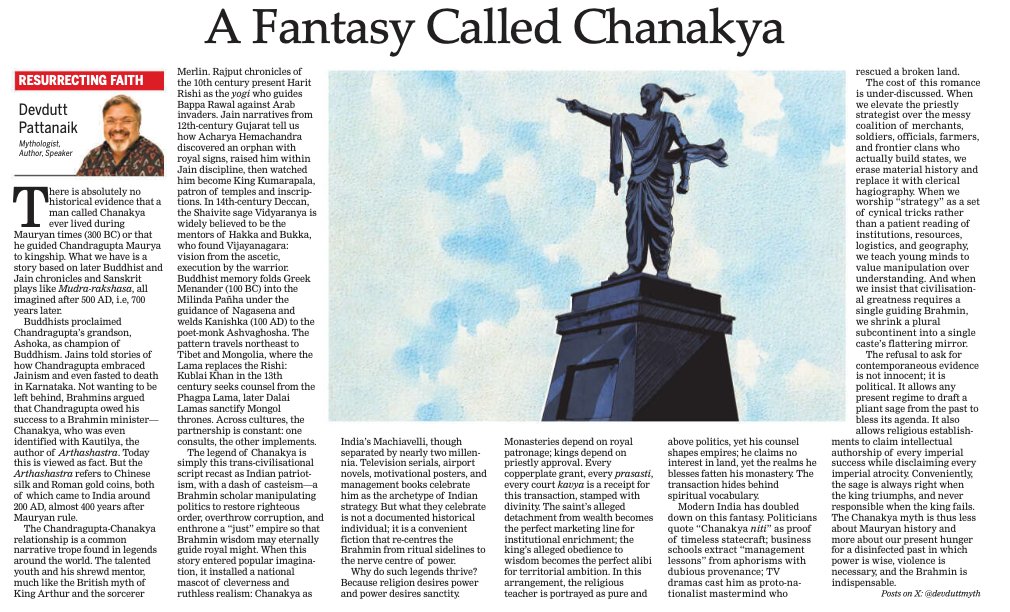
I read Devdutt Pattanaik’s article “A fantasy called Chanakya” in The New Indian Express (9 Nov. 2025). Had Chanakya himself been alive, Pattanaik’s fantasies would have survived about as long as the kusa grass Chanakya famously uprooted when he vowed to destroy the Nandas. Beneath the polished prose and familiar rhetoric lies an old ideological trick: confuse the reader with multiple names, shout “interpolation” often enough, wrap it all in modern caste politics, and hope a historical figure vanishes.
But history does not work that way. The moment one actually looks at primary sources, Pattanaik’s thesis collapses flat.
Let us begin precisely where he does not want readers to look: the Arthaśāstra itself. The text explicitly identifies its author in unmistakable terms: “विष्णुगुप्तेन आर्यकौटिल्येन च सम्पादितम्”—compiled by Viśnugupta, the noble Kautilya. And again: “समाप्तं कौटिलीयम् अर्थशास्त्रम्”—here ends the Arthaśāstra of Kautilya.
Pattanaik’s sleight of hand rests on manufacturing two doubts. First that since the author is called “Kautilya”, Chanakya must be fictional. Second, that if the Arthaśāstra can be pushed centuries later, Chanakya cannot belong to the Mauryan age or guide Chandragupta Maurya. Both doubts evaporate the moment chronology is taken seriously.
Ashoka’s edicts from the 3rd century BCE describe an empire run through mahamatras, welfare officials, judicial ethics, administrative surveillance, animal-protection days, and moral governance—all core elements laid out systematically in the Arthaśāstra. The Mauryan state cannot be built on a Kautilyan framework if that framework supposedly did not exist until 500 CE. The empire itself is the evidence. Kautilya must predate Ashoka, exactly as tradition maintains—at least the late 4th century BCE.
Then comes the Spitzer Manuscript, the oldest known Sanskrit manuscript (1st–2nd century CE), which contains unmistakable references to the Arthaśāstra. Its discovery location is devastating for Pattanaik’s narrative: a Buddhist monastery in Kizil, Xinjiang—thousands of kilometres from any imagined “Brahmin power structure”. Why would Buddhist monks preserve and study a supposedly late “Brahminical propaganda text”? They would not, unless the text was already ancient, authoritative, and indispensable. This single fact shatters the claim that Kautilya was invented centuries later.
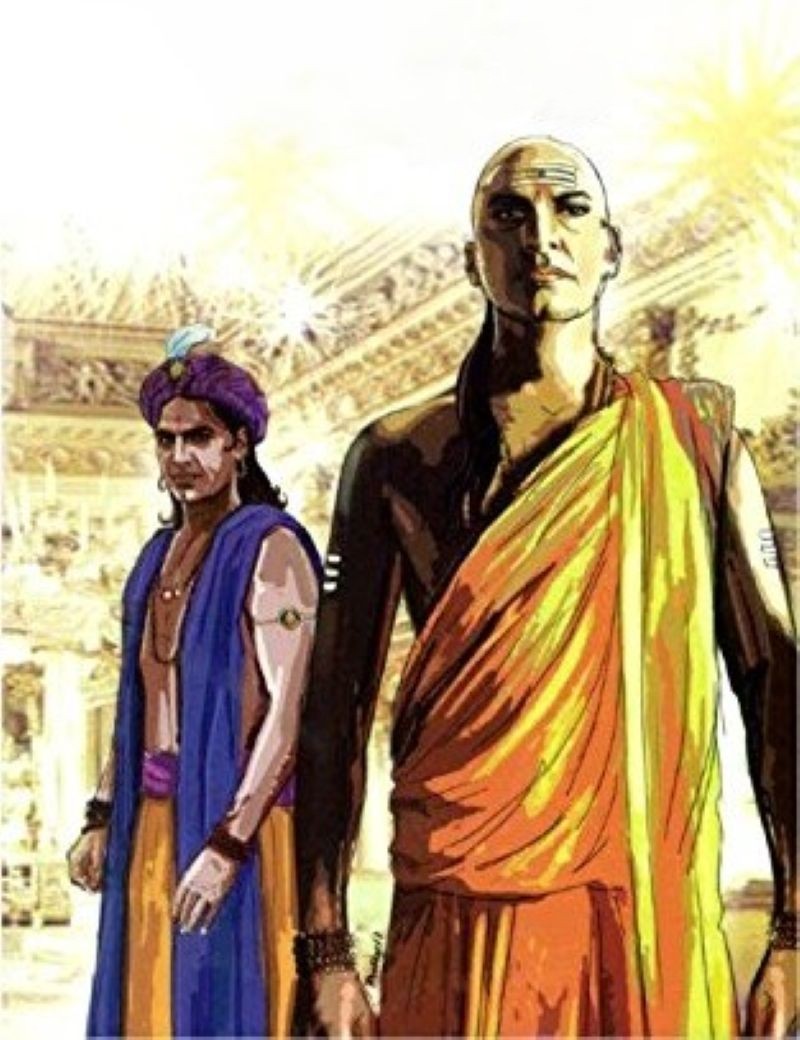
But the knockout punch arrives with the Kāmandakīya Nītiśāra (4th century CE), authored by the Buddhist scholar Kāmandaki. He explicitly and admiringly states that Viśnugupta/Kautilya—the author of the Arthaśāstra—was the very strategist who overthrew the Nandas and established Chandragupta Maurya. This is not a Hindu text, nor a Brahminical self-glorification exercise. A Buddhist intellectual, with no incentive to mythologise a Brahmin minister, identifies Kautilya and Chanakya as the same revolutionary statesman. That is the missing bridge Pattanaik refuses to acknowledge.
The convergence does not stop there. Buddhist sources such as the Mahāvaṃsa and Divyāvadāna describe Chandragupta’s Brahmin mentor. Jain texts like the Nisītha-Cūrṇi and Hemacandra’s Pariśiṣṭaparvan narrate the same overthrow of the Nandas by Chanakya for Chandragupta. Gupta-era dramas like Mudrārākṣasa assume the identity of Kautilya and Chanakya is already common knowledge. Kashmiri traditions such as the Tantrākhyāyikā immortalise Chanakya as the archetype of political genius. Across Buddhist, Jain, Hindu, and regional traditions—often rivals, sometimes hostile—the same man performs the same acts under different names. That is not myth-making; it is historical convergence, the strongest form of evidence when dealing with antiquity.
Pattanaik makes much of multiple names, as if this were suspicious. It is not. In the ancient world, it was normal. Confucius was also Kong Qiu, Kongzi, and Zhongni. In India, Viśnugupta is the personal name, Kautilya the gotra or scholastic name, and Chanakya the patronymic. One man. Many names. Total consistency. Claiming otherwise is like arguing that Zhongni disproves Confucius.
The remaining tactics are equally flimsy. References to “China” and Roman dināra are used to push the Arthaśāstra centuries forward. Yet scholars like K.P. Jayaswal showed long ago that “Cina” refers to the Sina/Shina Himalayan region near Gilgit, not Han China—hence terms like kauseya and cinapatta, which are not Chinese words. Later interpolations do exist, just as they do in Homer, Euclid, or the Pentateuch. No serious scholar claims interpolations prove the author never existed. Pattanaik deploys this argument selectively because he needs the text to be late to sever it from Chanakya.
Finally, the caste obsession collapses entirely. The earliest sources identifying Chanakya as a Brahmin are Buddhist and Jain traditions—historically critical of Brahmin authority. If “Brahmins invented Chanakya”, why do rival traditions independently preserve the same identity centuries earlier? Because they were transmitting historical memory, not manufacturing propaganda.
To be clear: Chanakya, Kautilya, and Viśnugupta are not three different people. They are three traditional names for one historical genius—the architect of the Mauryan Empire. When multiple competing traditions over two millennia remember the same man overthrowing the same dynasty for the same emperor, coincidence becomes absurd. History, in this case, is unanimous.
Devdutt Pattanaik’s article is not courageous scholarship. It is ideological provocation dressed up as history—a soggy biscuit of pseudo-academia that dissolves the moment primary sources are allowed to speak. And they speak loudly: Chanakya was real, brilliant, and indispensable to India’s civilisational memory, no matter how inconvenient that fact may be for modern political fantasies. – News18, 1 January 2026
› Prosenjit Nath is a technocrat, political analyst, and author. He writes on national, geopolitical, and social issues.
Hinduism, as a non-Abrahamic tradition, remains open season in many Western academic spaces. This double standard isn’t just unjust—it’s intellectually dishonest. – Sankrant Sanu
On the streets of New York, Audrey Truschke—then assistant professor of South Asian history at Rutgers University—stood with a megaphone and declared to a crowd: “Prime Minister Narendra Modi and his political party, the BJP, openly adhere to Hindutva.”
She then launched into her historical comparison: “Hindutva came about roughly 100 years ago. … It was inspired in its early days by Nazism. Did I say Nazis? Yeah, I said Nazis.” She emphasised: “I want to be clear that I am talking about real, actual, historical Nazis.”
Then came the most inflammatory claim: “Early Hindutva espousers openly admired Hitler. … They praised Hitler’s treatment of the Jewish people in Germany as a good model for dealing with India’s Muslim minority.”
With this inflammatory rhetoric, she branded India’s ruling BJP and its adherence to Hindutva as Nazi-like—by extension tarring the hundreds of millions of Indians who democratically elected this government, as fascists. It wasn’t scholarship; it was street theatre designed to demonise an entire community. For Hindus across America, this wasn’t just academic discourse—it was public vilification. To rub salt into the wound, the department of history at Rutgers gleefully posted Truschke’s diatribe on their Facebook feed with the endorsement: “That’s what we call public history.”
Now, with her latest book India: 5,000 Years of History on the Subcontinent hitting shelves this month, Truschke’s troubling methodology is reaching an even wider audience. The timing couldn’t be more urgent for examining what happens when academic platforms become weapons of ideological warfare.
The Hitler Analogy: History stripped of context
Truschke’s accusation draws from a controversial passage in We or Our Nationhood Defined, published in March 1939 and attributed to M.S. Golwalkar of the RSS. The reality is more complex than her megaphone moment suggests.
The book wasn’t authored by Golwalkar but paraphrased and translated by him. The historical context matters crucially: in 1939, the full extent of Nazi atrocities against Jews was not yet known. The Holocaust — the systematic extermination of six million Jews—wouldn’t begin until 1941. For many colonised peoples worldwide, including some Indians, Hitler was viewed primarily as an enemy of Britain—their colonial oppressor.
The passage reflects the ideological uncertainty of that era, when colonised peoples worldwide were grappling with competing definitions of nationalism and looking to various models of national reorganisation. More importantly, the RSS has explicitly disavowed this misattributed quote, and decades of subsequent Hindutva writings have evolved far beyond these early formulations. But such nuance doesn’t fit Truschke’s narrative.
Most perversely, her Hitler comparison erases a remarkable historical truth: Hindus have never persecuted Jews. For over two millennia, India has been a haven for Jewish communities—in Kerala, Maharashtra, and Bengal. While Jews faced pogroms in Europe, ghettos in the Middle East, and extermination in Nazi camps, they found safety and dignity in Hindu-majority India.
To draw parallels between Hindutva and Hitler isn’t just inflammatory—it’s a moral inversion of history that anachronistically applies knowledge of the Holocaust to judge a misattributed quote from an earlier period—and then use that nearly 100-year-old aside to define a contemporary political movement. This is not academic history; it is political pamphleteering.
A pattern of distortion
This isn’t an isolated incident. Truschke’s 2017 book Aurangzeb: The Life and Legacy of India’s Most Controversial King whitewashes a well-documented record of temple destruction, discriminatory taxation, and forced conversions. Despite abundant evidence from Aurangzeb’s own firmans (imperial decrees) documenting systematic iconoclasm and forced conversion of Hindus, she claims he “simply left temples alone” and was a protector of Hindus, dismissing documented destructions as merely following “an Indian stance dating back, at least, to the Chalukyas and Pallavas”.
This false equivalency ignores a crucial theological distinction. When Aurangzeb’s contemporary sources praise him for hitting against the “infidels” and spreading Islam through “holy war,” these aren’t political calculations—they’re expressions of religious doctrine. In Islamic theology, idol worship is the gravest sin, making temple destruction an act of piety. Hinduism contains no such mandate. Political motivations aren’t identical to doctrinal imperatives.
Truschke dismisses scholars like Jadunath Sarkar as unreliable while downplaying Persian sources that contradict her narrative. Her approach isn’t history—it’s revisionism designed to obscure inconvenient truths.
Her recently published India: 5,000 Years of History on the Subcontinent promises more of the same: selective citations, interpretive sleights, and wholesale demagoguery. We can expect the 600-page tome to follows the familiar pattern—Hinduism cast as irredeemably oppressive, Islam framed as emancipatory. There’s little interest in balance, complexity, or competing narratives. It is only in the politicised ghetto of “South Asian Studies”, where practicing Hindus have little voice, that an academic would get away with this level of propaganda.
Silencing students, stifling dialogue
At a recent Georgia Tech event, a Hindu student described confronting Truschke at Princeton about her portrayals. Instead of engaging his respectful questions, she dismissed his concerns as “Hindutva propaganda” and shut him down. The room fell silent—a moment of intimidation, not academic exchange.
Hindu students at Rutgers report similar experiences: hesitating to speak in her classes, fearing they’ll be branded bigots for defending their faith. Many now avoid her courses entirely. In 2021, students petitioned against her teaching Hinduism, citing her claim that the Bhagavad Gita “rationalises mass slaughter” and her suggestion linking Hindus to the January 6 Capitol riot.
Rutgers defended her academic freedom and promised dialogue with the Hindu community. That dialogue never materialised.
The double standard problem
American universities rightfully crack down on antisemitism, Islamophobia, and anti-Black racism. Yet when Hindu students raise similar concerns, institutions often look away, or worse, actively endorse such writing.
Truschke positions herself as the victim of “Hindu nationalist trolls” while sidestepping legitimate concerns from students who feel unsafe in her academic spaces. When she tweeted that Lord Rama was a “misogynistic pig”—later claiming scholarly translation—even Robert Goldman, the scholar she cited, publicly rejected her framing. One wonders how the academy would react if a professor used the same language about a different revered figure, say Prophet Mohammad.
The damage spreads beyond academia. Hindu students report being mocked as “cow piss drinkers”, stereotyped as “Brahmin oppressors”, or casually equated with fascists. When they respond, they’re accused of extremism—silenced not by force, but by fear.
Drawing the line
This isn’t about suppressing legitimate criticism of Hindutva politics. It’s about distinguishing between scholarly critique and rhetorical abuse.
Truschke’s defenders, including Romila Thapar and Sheldon Pollock, argue that attacking Hindutva isn’t Hinduphobia. In practice, targeting Hindutva often disguises targeting Hindus.
When Truschke abuses Rama, she is attacking an iconic figure in the Hindu tradition, revered across the length and breadth of India. There can be no better evidence of what her target is.
Would such treatment be tolerated toward any other faith community?
The answer is obvious. Hinduism, as a non-Abrahamic tradition, remains open season in many Western academic spaces. This double standard isn’t just unjust—it’s intellectually dishonest.
The path forward
Universities must confront this hypocrisy. If “safe spaces” truly exist for all, Hindu students deserve the same dignity afforded every other community. That means distinguishing between legitimate academic inquiry and inflammatory demagoguery—whether delivered through peer-reviewed journals, street megaphones, or 600-page histories now being peddled as the history of India.
Academic freedom must be balanced with academic responsibility. Scholars have the right to challenge religious and political traditions, but they also have an obligation to maintain scholarly standards, engage in good faith, and create inclusive learning environments.
With Truschke’s latest work now in circulation, the stakes have never been higher. Her interpretive framework isn’t confined to specialised academic journals—it’s shaping how a new generation learns about Indian civilisation.
Until universities address this imbalance, the promise of inclusive academia remains hollow. Hindu Americans will continue raising their voices—not to suppress debate, but to demand what every community deserves: fairness, intellectual honesty, and basic respect.
The megaphone may be loud, but truth has a voice of its own. – News18, 16 June 2025
› Sankrant Sanu is an author, entrepenour, and researcher based in Seattle nad Gurgoan.
No country can become a great nation, a world guru and a world leader on borrowed ideas, borrowed cultures and borrowed systems. The greatness and leadership is built upon the solid foundation and the pride of their own past. – Dr. Makkhan Lal
History, history writing and history teaching have, indeed, become newsworthy not only in India but also in most other parts of the world. The reasons may be varied—construction of a national history curriculum in India, England and Wales, the design of national history standards in the US, the content of history textbooks in Japan, China, Korea, Pakistan, Israel, and Germany, the approach to invasion of Latin American countries by the Europeans, the development of new curricula in the successor states of the former USSR, or even the rewriting of history textbooks in Russia after the collapse of the former USSR. Issues of identities, heritage, and citizenship, all rooted in the past, have become the hot stuff of politics.
Similarly, an issue can be raised about the conquest of peaceful people belonging to Inca, Aztec and Maya civilisations by the gun-trotting Europeans. Whether the victory should be viewed as the discovery of a new world and new economic resources for Europe, as is generally viewed by European and North American historians, or it should be seen as the destruction of the independently developed three native civilisations by technologically more advanced nations that have an unending lust for looting others’ treasures and making other people subservient.
A South American historian may well say: “It may be a subject of celebrations for Europeans but for us it is a subject of mourning because just in a few years the Europeans destroyed our civilisation developed over several thousands of years!”
Why study history
Questions have often been raised that when there are so many problems and differences of opinions among historians why should we study history at all.
History is all about the past. In almost every country, city, town and village throughout the world, a large number of existing buildings were built in the past to meet the needs and aspirations of people, now dead. This is most obvious in existing temples, churches, mosques, fireplaces, houses, public buildings, and so on. The systems of governments, political ideas, religious beliefs, art, architecture, cultural practices, educational systems, customs and behaviours are all products of the past, recent or remote.
The past is all-pervasive which, indeed, means that we cannot escape from it. The past signifies what actually happened—events that have taken place, societies that have risen and fallen, ideas and institutions, eating habits, dressing habits, etc. History is precisely the study of this human past. The past is our heritage; we are part of it and the past is part of us in all aspects: Be it culture, behaviour, religious faith and practices, be it rituals, be it the tradition of political, social and economic systems. It is reflected in our day-to-day living.
History is also about roots. It provides societies and individuals with a dimension of longitudinal meaning over time which outlives the human life span. It connects us with our past. History also allows us to peep into the future by providing precedents for contemporary actions and forewarning against the repetition of past mistakes. From its sense of continuity, history offers the apparent form and purpose to the past, the present and the future. In the words of E.H. Carr: “The past is intelligible to us only in the light of the present, and we can fully understand the present only in the light of the past.” He further says that history is needed “to enable man to understand the society of the past and to increase his mastery over the society of the present.” There is a need for history. It has a deeper social value and meaning.
The study of history is not a luxury. It is a necessity. This necessity has been best summed up by Arthur Marwick. He writes: “Individuals, communities, societies could scarcely exist if all knowledge of the past is wiped out. As memory is to the individual, so history is to the community or the society. Without memory, individuals find great difficulty in relating to others, in finding their bearings, in taking intelligent decisions—they lose their sense of identity. A society without history would be in a similar condition. … A society without knowledge of its past would be like an individual without memory. … It is only through a sense of history that communities establish their identity, orientate themselves, understand their relationship to the past and to other communities and societies. Without history (knowledge of the past), we, and our communities, would be utterly adrift on an endless and featureless sea of time.”
We all move ahead through the past of our own cultures, own civilisations, and values and it is this accumulation of ideas and experience, transmitted through education and sheer daily living that gives our thoughts meaning and the patterns and purpose of our actions. It is not that we live in the past but we are defined by it, and so the success of even the most forward-looking developments must inevitably rest on their relation to the ideas and practices of the society they are meant to serve. Science may forget its own history, but a society cannot.
History is neither a simple chronicle of the past nor a list of rulers and kings and the narratives of their rules. The past is not simply a collection of distinct ages or a hotchpotch of facts. History is an extremely complex discipline. Another point that needs to be emphasised is that a historian’s job is not that of a cook who prepares dishes as per the liking of his customers and adds spices accordingly. It is not the job of a historian to write politically correct history. His obligation is to write factually correct history.
It will be helpful if all historians remember what Sir Jadunath Sarkar wrote about the job of a historian: “I would not care whether the truth is pleasant or unpleasant, and in consonance with, or opposed to, current views. I would not mind in the least whether the truth is, or is not, a blow to the glory of my country. If necessary, I shall bear in patience the ridicule and slander of friends and society for the sake of preaching the truth. But still, I shall seek truth, understand truth, and accept the truth. This should be the firm resolve of a historian.”
This brief discussion on the nature of history as an academic discipline should make it abundantly clear that history is neither a static discipline nor can the writings on and of history be put into a set mould. Each generation views and writes about the past in the light of its own experience. Therefore, all interpretations and explanations are and must be as temporary and provisional as the descriptions. But in all these endeavours the sanctity of truth and facts should not be forgotten. Unanimity or one’s efforts to make others surrender is a recognisable characteristic of dictatorships, and not that of a free state. Open and continuing discussions and debates are the essence and strength of history and, for that matter, a great strength of an open society of an intellectually vibrant nation.
And now a word of caution! There is a tendency among historians to act as judges and give moral sermons. Historians must write and rewrite history. They are not supposed to be moral judges. Benedetto Crose has rightly said: “Those, who on the plea of narrating history, bustle about as judges, condemning here and giving absolution there, because they think that this is the office of history … are generally recognised as devoid of historical sense.”
Problems in history writing
Historians recognise that they are all culturally and socially influenced in their endeavour to write history but make all efforts to deny that their work is culturally, or socially, determined or constructed. As has been discussed briefly in the Introduction, EH Carr in chapter two of his book What is History provides a useful summary on this aspect of history writing. He quotes Donne Devotion that society and individuals are inseparable. “No man is an island, entire of itself, every man is a piece of the continent, a part of the main.” Like any other individual, a historian too is a social phenomenon, both the product and the conscious and unconscious spokesperson of the society to which he belongs. It is in this capacity that he approaches the facts of the historical past.
Therefore, we must not forget that we cannot fully understand or appreciate the work of a historian unless we have first grasped the standpoint from which he himself approaches it, and that standpoint is itself rooted in social and historical background. It is, therefore, essential that before we study history, we must study the historian and study his historical and social environment. When some historians claim that they are writing scientific history, or that only their version of history is correct, one must conclude immediately that the historians are not only being untruthful but are also hiding their political agenda under the garb of a “scientific” history. There exists nothing like scientific history. On similar lines, Benedetto Croce also spoke with his characteristic bluntness:
“The historian must have a point of view, … an intimate personal conviction regarding the conception of the facts which he has undertaken to relate. … It suffices to read any book of history to discover at once the point of view of the author if he is a historian worthy of the name and knows his own business. … Absolutely historical historians do not and cannot exist. Can it be said that Thucydidus and Polybius, Livy and Tacitus, Machiavelli and Guicciardini, Giannone and Voltaire were without morals and political views; and in our own time, Guizot or Thiers, Macaulay or Balbo, Renke or Mommson? … If the historian is to escape from this inevitable necessity of taking sides, he must become a political and scientific eunuch; and history is not the business of eunuchs. … Historians who profess to wish to interrogate the facts without adding anything of their own, are not to be believed.”
The problem with Marxist historiography and its relationship with history is much more curious. For Marx and his followers, i.e. Marxist historians, the problem of history is not just understanding “what happened”, “how it happened” and “why it happened”. For them, the problem is “how to change the world” by the use of history. At the core of this view lie two fundamental beliefs. Firstly, the Marxists believe in five universal stages of history.
These five stages are:
Primitive Communism
Slavery
Feudalism
Capitalism
Communism
Secondly, they believe that the society we inhabit is a bad bourgeois society and, fortunately, this society is in a state of crisis. The good society which lies just around the corner can be easily attained if only “we” work systematically to destroy the language, the value, the culture, the ideology of this “bourgeois” society. This necessitates a massive, radical left-wing political programme, and everything the historians write, every criticism they make, is determined by that overriding objective. In this, the post-modernists are exceptions. They are fully convinced of the utterly evil nature of the “bourgeois” society but have lost all hope of change and have fallen back into destructive nihilism. They assert that the only way to achieve Marxism is to destroy society if it cannot be changed.
Marxist historians have failed to understand and appreciate the fact that the society we live in has evolved through a complex historical process, very different from the Marxist formula of the rise of feudalism over slavery and bourgeoisie overthrowing the feudal aristocracy. It is highly complex with respect to the distribution of power, authority, and influence. Just as it was not formed by the simple overthrow of aristocracy by the bourgeoisie, so, in its contemporary form, it does not consist simply of a bourgeois ruling class and a proletariat. The idea that we are now in the final period of the late-capitalist crisis is simply absurd. Marxists have been looking forward to the final capitalistic collapse for over a century—in 1848, 1866, 1918, 1946, 1963 and 1968, to mention just a few dates, but as fate would have it, they are themselves doomed forever.
Statements like “The pursuit of history is, whether practitioners choose to acknowledge it or not, a political occupation,” indeed, is not only exceptional but also far-fetched. At the same time, we have to acknowledge that the experience of colonisation around the world has shown that domination by a more powerful culture—which defines its reality in quite different ways—either totally destroys, or at least drives, the less powerful ones into a subservient role. What was considered culturally “valid” can be rendered “invalid”, and the politically weaker ones are somehow required to modify their reality to fit within the constraints of the new codes.
We, as historians, must learn to recognise: “The past is perceived in different ways by different cultures. Methods of interpreting, recording, managing and protecting the past also differ between cultures. … The way people define their existence, their world view and their creation stories, and how they value, interpret, manage and transmit their past will continue to be handed on from generation to generation.”
Conclusions
Let us remember that no country can become a great nation, a world guru and a world leader on borrowed ideas, borrowed cultures and borrowed systems. The greatness and leaderships are built upon the solid foundations and the pride of the past; deeper the foundations, taller are the superstructures. Even globalisation is built upon this foundation. Many countries are part of globalisation on a much larger scale than India without abandoning their history, culture and heritage. It is on this basis they are able to assert their authority and influence the world order. – Firstpost, 6 January 2022
› Prof. Dr. Makkhan Lal is a historian and the founder director of the Delhi Institute of Heritage Research and Management.


 VOICE OF INDIA