A reasonable date for Adi Shankara – Venu Gopal Narayanan

Adi Shankaracharya

We see that there is nothing in Shankara’s works which contradict his dating to the 6th century BCE, nor historical evidence to either support or disprove a belief that Bimbisara, the Buddha, and Mahavira were his contemporaries. – Venu Gopal Narayanan

Historians have spent a century trying to determine when Adi Shankaracharya lived. Thus far, a total lack of archaeological evidence has frustrated their efforts. Instead, many have employed linguistic tools to assume that he lived sometime in the 8th to 9th centuries of the common era (CE).

While these arguments may appear convincing to the lay reader, they are all no more than inconclusive guesstimates; the simple truth is that we do not yet know when this remarkable mind bound our sacred land together using the logic of Advaita.

On the other hand, the Kanchi Kamakoti Peetham at Kanchipuram, in Tamil Nadu, maintains a list of head seers which says that it was founded by Shankara in 509 BCE. That is about 1500 years earlier than modern guesstimates.  The lineage list of the Govardhana Matha in Puri, Odisha, starts in 484 BCE. Similarly, the Dwaraka Matha in Saurashtra, Gujarat, maintains that it was established in 475 BCE.

The natural response for a Left Liberal thinker would be to declare a date of 6th century BCE as preposterous, and instantly dismiss it out of hand as some hoary tradition with no scientific basis. But the dharmic approach would be to test this thesis: what would be the impact on our history as we know it, if Shankara had indeed lived in the time of King Bimbisara of Magadha, Gautama the Buddha, and Mahavira the Tirthankara?

The most important test is whether such a date clashes with the dates of those texts referred to by Shankara in his works. Let us take the main ones:

One, the Brahma Sutra of Rishi Badarayana, which encapsulates the essence of the Upanishads—the concept of Brahman, and Vedanta—into dense aphorisms. Its opening line is, athato brahma jignyasa (then, therefore, the enquiry into Brahman). The basis of Shankara’s Advaita is his commentary on this work, called the Brahma Sutra Bhashya.

In the absence of any evidence, historians have dated this text with “great accuracy” to either the 5th or 2nd centuries BCE, or the 5th century CE.

Two, the Purva Mimamsa Sutra of Rishi Jaimini, who was an older contemporary of Rishi Badarayana. It aphoristically condenses the essence of the Brahmanas, Vedic texts detailing rituals and the concept of Dharma. Its opening line is, athato dharma jignyasa (then, therefore, the enquiry into Dharma). According to some legends, Shankara bested Mandana Mishra, the greatest proponent of Mimamsa, in a debate once, to establish the validity of Advaita with the ritualists.

Dating this text with any degree of assurance is an absolute non-starter because of nil epigraphical evidence till the medieval period. All we know is that it was composed in the same time period as the Brahma Sutra, since one cross-references the other.

Three, the Bhagavad Gita, and by extension, the two Epics. Shankara interpreted this celestial song using the logic of Advaita to demonstrate that it is the epitome of Vedic thought.

Once again, certain schools of historiography have gone to great pains to try and peg the Gita to a time after the Buddha, all without evidence of course. Assumptions chase conjectures through hoops of linguistics and philology to emerge as fact on the stages of academia.

There is a central reason why so much futile effort is expended: the date of the Vedas has to be held to 1500 BCE. Only then can horse-riding Aryans move from the steppes of Central Asia to the subcontinent. Only then can a yawning gap be created between the Vedic age and the supposedly earlier, supposedly different-in-every-way, Harappan/ Sindhu-Saraswati era.

Only then can Videgha Madhava of the Satapatha Brahmana carry Agni eastwards from the Saraswati River, around 1000 BCE, clear the forests along the Gandak, and settle his steppe folk in the Gangetic Plains. Now, in a tearing rush, the civilization can take root, compose the Upanishads, give birth to kingdoms, dynasties, legends, and initiate a lengthy intellectual journey which leads some millennia later to Shankara and Advaita.

However, if Shankara can be dated to the 6th century BCE, this elaborately fabricated historiography goes for a toss. Instead, and to the horror of our Marxist brethren, the date of Agni’s eastward journey gets pushed back by a thousand years at least, to well before the date they set for the Rig Veda, and bang in the middle of the Harappan era.

What Aryan invasion or migration theory then? This is what happens when our history is written for us by others, and what will persist if we allow that nefarious process to continue blithely forth without rigorous, scholarly contestation.

But mindsets are rapidly changing. The old assumptions are being hotly questioned, on merit. New data and new research show that Sanskrit is older than the Indus Valley Civilization, and, that Pali had evolved as a separate language by 4000 years ago. The discovery of the Sinauli chariot is both a new chapter of our ancient history waiting to be written, and the rewriting of conventional historiography; and one which points towards a far older date for Vidhega Madhava’s eastward passage.

Thus, we see that there is nothing in Shankara’s works which contradict his dating to the 6th century BCE, nor historical evidence to either support or disprove a belief that Bimbisara, the Buddha, and Mahavira were his contemporaries. But if this is so, then it turns some preconceived notions on their heads.

Rather than someone who contested the metaphysical intricacies of Buddhism only when it was deep into terminal decline in the subcontinent, which is how Shankara is popularly portrayed in modern scholarship, it means that he could have been there at the start, when the proliferation of heterodox sects began.

A date of 6th century BCE actually makes a lot more sense than one of 8th to 9th CE, because the motivations become a lot clearer, for bringing Brahman and Dharma—in essence, knowledge and action—together under one philosophical roof, for reinforcing the supremacy of the Vedas, and, for logically establishing with clear deductions, the umbilical Vedantic linkages between the Vedas, the Upanishads, and the Bhagavad Gita. It is all the philosophical protection Sanathana Dharma has ever needed to fend off the vagaries of history, and to preserve our way of life in our sacred land.

We may probably never know for sure which era Shankara lived in, but it feels good to imagine that a Malayalee sannyasi from Kaladi may have met and conversed with some great Biharis, in Sanskrit, in Uttar Pradesh, at a time of tremendous intellectual churn. – Swarajya, 25 February 2024

Venu Gopal Narayanan is an independent upstream petroleum consultant who focuses on energy, geopolitics, current affairs and electoral arithmetic. 

Adi Shankara's Digvijaya Route

Hindu temples existed before the 5th century CE – Monidipa Bose Dey

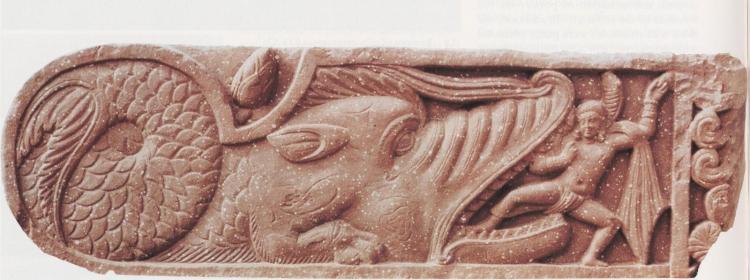
Sonkh Temple Artefact (Mathura, 1st century CE).

A narrative that keeps appearing in the media is the claim that there were no Hindu temples before the  5th century CE. This claim is false, a myth, and the propaganda is aimed at postulating that most pre-Gupta temple structural ruins were Buddhist in nature – Monidipa Bose Dey

A favourite narrative of the Left scholars that keeps appearing regularly in media is the claim that “there were no Hindu temples before the 5th century CE.” This claim is nothing but a myth, and the propaganda is primarily aimed at postulating that most pre-Gupta temple structural ruins were Buddhist in nature, and Hinduism, Hindu gods/murtis, and Hindu temples are a later development, with the concept of Hinduism and Hindu gods starting from around the Kushana period (1st century). This fake narrative has been force-fed to Indians through constant repetitions of the claim in academia, school and college textbooks, and the publishing of articles on this topic in various journals and media platforms written by so-called scholars.

Unfortunately, many gullible Indians growing up with this constant brainwashing believe this fake claim, thinking Hindus did not have any temples as such before the Gupta period. Recently, in an article, a slightly modified claim was made that large Hindu temples did not exist before the 5th century CE. From “no Hindu temples before 5th century CE” to “no large Hindu temples before 5th century CE,” the shift in narrative is noteworthy.

The standards of civilisation are often measured, among other things, by the then available scientific planning, longevity of structures built, aesthetic appeal, and successful completion of buildings that range from religious to military to residential structures. Seeing the antiquity and the advanced nature of Indian civilisation, it is not surprising to find Indian writers from ancient times quite taken up with the subject of architecture, and this obsession is evident in all forms of literature ranging from the Vedas to the Epics, Puranas, Buddhist texts, Jain texts, Agamic literature, and various historical and even political treatises. With such a vast spectrum of knowledge compiled in books, and India being a country that has always been deeply religious, it is completely illogical to think ancient Indian civilisation would have no Hindu temples.

This article will take a look at the various evidences that clearly show Hindu temples existed in ancient times and did not start from the 5th century CE, as Marxist scholars have always claimed.

Evidence from texts

Texts from ancient India help us to understand the nature of the worship of gods in India and the temples built for them. In the Astadhyayi (around the 4th century BCE), Panini gives names of Vedic deities, such as Agni, Indra, Varuna, Bhava, Sarva, Rudra, Mrda, Aryama, Tvasta, Súrya, Sóma, Indrani, Varunani, Agnayi, Usha, Prthivi, who were worshipped. Bhakti or theistic form of devotion was present in Panini’s time, which is clear by his reference to devotion to Vasudeva and Arjuna, while names like Varunadatta and Aryamadatta indicate sons were named after gods like Varuna and Aryama, to show devotion.

Panini also mentioned the use of images for worship (arcas), which indicate the existence of shrines where these arcas were worshipped.

Patanjali’s Mahabhasya (2nd century BCE), which is a detailed commentary on Panini’s work, mentions the worship of Vasudeva-Krishna as a deity; and specifically mentions temples of Dhanapati (Kubera), Rama (Balarama), and Kesava (Vasudeva), where worship would occur with various elaborate rituals, accompanied by music and dance. From around the same time, there have been found murtis of Kupiro yakho (Kubera yaksa) from Bharhut, and of Balarama from Mathura. A murti with the inscription of four-armed Vasudeva-Visnu carrying gada and chakra in his upper hand and holding a sankha (broken) in the lower hand, from Malhar (Bilaspur in Madhya Pradesh), is dated to the 2nd century BCE. These murtis would all be worshipped in temples of their own.

Kautilya’s Arthasastra refers to various temples within a fortified city that enshrined Shiva, Vaisravana, Asvinikumãras, Sri (Laksmi), and Madeira (a fertility goddess associated with the Mother Goddess sect). The Arthasastra mentions images of Aparajita (Durga), Apratihata (Visnu), and Jayanta (Kumara), which were worshipped by King Bhagabhadra (131 BCE, the fifth Sunga ruler); and Vaishnava shrines erected by Gautamiputra Bhagavata, the ninth Sunga ruler, in his 12th year.

Evidence from inscriptions

Three inscriptions from Nagar (Chittorgarh, Rajasthan), refer to the construction of a stone wall that enclosed a place for worship of Sankarsana and Väsudeva by King Sarvatata of the Kanva dynasty (250-300 BCE). The Nanaghat (Pune) inscription of Naganika of the 1st century BCE refers to Vedic sacrifices by the Satavahana royal family and starts with homages to divinities such as Dharma, Indra, Sankarsana-Vasudeva, Chandra-Surya, and the Lokapalas (Yama, Varuna, Kubera, and Vasava). An inscription from Mora (Mathura) during the reign of Mahaksatrapa Sodasa (10-25 CE) records the installation of murtis of the five Vrsni heroes in a stone temple. Another Mathura inscription of the same time, found engraved on a door-jamb, records the construction of a temple with torana and vedika for Vasudeva.

An inscription from Nandsa (Udaipur, Rajasthan, 226 CE), records the performance of Vedic sacrifices after the construction of temples dedicated to Brahma, Indra, Prajapati, and Visnu.

Structural evidence from Mauryan periods

From the time of Ashoka Maurya (272-232 BCE) to the early Kusana period, various pieces of evidence from rock-cut shrines and from surviving foundations of temples suggest that in those times, temples were built in circular (vitta), elliptical (vettäyata), and apsidal (capakara) forms. The Ajivika caves at Barabar (Gaya, Bihar) of Mauryan times, preserve both circular and elliptical shrines in hut forms with domed or vaulted roofs.

Belonging to the Mauryan period is a circular brick-and-timber shrine (plinth) of the 3rd century BCE, located at Bairat (Jaipur). Temple No. 40 at Sanci was originally an apsidal stone temple of the Mauryan period, raised on a high rectangular plinth, the superstructure likely built of wood that no longer exists.

Structural forms prevalent during the Mauryan period continued into later periods, as found recorded in many bas-reliefs from Sanchi, Mathura, Amaravati, etc. The apsidal plan for temples was more popular than the circular or elliptical plan during this period. Three stone apsidal shrines from the 1st century CE are known from Taxila (Takshasila), while Temple No. 18 at Sanchi was also an apsidal shrine, datable to the 2nd century BCE.

Remains of temples from pre-Shunga and Shunga era

The apsidal temple at Sonkh (Mathura, dated 1st century BCE) was one of such early temples. The Ghosundi inscription (1st century BCE, near Chittorgarh) talks of a temple complex named Narayana-vatika dedicated to Samkarshana-Vāsudeva; foundations of an elliptical structure, dated 2nd century BCE, found at the site of Besnagar in Vidisha is that of a Vaishnava temple; an identical structure discovered at Nagar (Chittorgarh) by Bhandarkar is dated to 350-300 BCE; while the Mora well inscription (1st century CE) refers to a temple in Mathura.

Hindu temple architecture from the post-Mauryan era is known from the remains of the temple foundations, pertaining to their ground plans, found during various archaeological excavations. Unfortunately, the superstructures of these ancient temples were not preserved, because they would often be built of wood or bricks.

Heliodorus Pillar (113 BCE)

One such example of a temple from ancient India is the Vasudeva shrine from the 3rd century BCE (approximately dated 200 BCE), found close to the Heliodorus pillar in Besnagar, near Vidisha, Madhya Pradesh. From a study of the archaeological report of the excavation of this site by D.R. Bhandarkar (ASI Annual Report 1913-14), it is very clear the temple which belonged to the Sunga period was by no means a small one. In fact, the word prasadottoma was found in an inscription on a pillar stump from the site, meaning the temple was the best among the ones in Vidisha, clearly indicating the Heliodorus Garuda pillar was built in front of the most celebrated temple of Vasudeva of that time. Thus, we find archaeological evidence of a large Hindu temple from the 3rd-2nd century BCE.

Another example of a Hindu temple from ancient India is the Vasudeva-Sankarshana temple found in Nagari, Rajasthan. Here, a stone enclosure for a Vasudeva-Sankarshana shrine is mentioned in an inscription which belonged to 300-250 BCE. The site preserves a massive stone enclosure and the plinth of an elliptical brick temple. Below the surface level of this stone enclosure, archaeologists found the remains of an earlier building that dated to 350-300 BCE. The Vasudeva-Sankarsana shrine structure was elliptical in shape with a puja-sila-prakara built around it, and only the lower moulding of the superstructure had survived which was 2 feet high, showing the temple was a large one. The shrine remained an active place for Vaishnava worship until the 7th century CE.

A series of apsidal temples from ancient India were excavated at Sonkh, dating to the 1st century BCE. The apsidal Temple No. 2 at Sonkh had a large stone railing surrounding the shrine that had engravings on both sides. On the southern side of the railing, carved ruins of a stone entrance were found that had two pillars supporting a superstructure of three architraves with voluted ends. An architectural piece from the bottom lintel of the doorway showed carvings depicting a naga and a nagin sitting on thrones, surrounded by attendants and devotees, thus denoting the temple as a Naga shrine.

Yaudheya coinage with temple engraving (ca. 200 BCE).

Numismatic evidence of Hindu temples in 200 BCE

Numismatically speaking, ancient Hindu temple architecture was found depicted on coins and coin moulds marked by the Yaudheyas. The Yaudheyas were a martial republican clan, who were at the peak of their power between 200 BCE to 400 CE, in areas of what is now Haryana, Punjab, and Rajasthan. Being a martial clan, most of the Yaudheya coins depicted the war-god Karttikeya (Brahmanyadeva). Among the many temples seen on Yaudheya coins, one structure with a dome-shaped roof and square plan stands out. It stood on an elevated adhishthana, consisting of four mouldings. The object of worship would have stood in the centre. Double domes were a popular design at that time, as evident from the many coins depicting them, while there are examples of even triple-domed temples. The third image clearly shows a Shiva temple with the Shiva linga at the centre of the sanctum. The existence of Shaiva shrines is confirmed by a four-pillared double-domed structure surmounted by a trident, which is the established emblem of Shiva. The trident on top of a four-pillared double-domed structure also confirms the Shaivite affiliation of such shrines.

Sometimes temples on Yaudheya coins show a dome marked by vertical divisions, which indicate wooden beams on the sanctum roof. A double or triple-domed structure having a square plan shows that the domes would have been covered by slanting slabs giving the sikhara a triangular look. One Yaudheya coin also depicts a structure topped with a vajra-like motif, clearly indicating a shrine dedicated to Indra Deva.

Thus, from the above-presented evidence (texts, archaeological, and numismatics), it is quite clear that Hindu temples were indeed present much before the 5th century CE, and they were often large shrines dedicated to various gods. – News18, 18 February 2024

› Monidipa Bose Dey is a well-known travel and heritage writer. 

Sonkh Temple Foundation

Sonkh Temple Frieze

Was Tipu Sultan really a patriot and great freedom fighter? – Jaithirth Rao

Tipu Sultan

The fact is Tipu was a brilliant military tactician and a weak military and political strategist. He allied with the French, who ended up on the losing side. He was bigoted and had megalomaniac pretensions of a Muslim conquest of India. – Jaithirth Rao

If only the Marxist editors of NCERT textbooks had admitted that Tipu Sultan was a flawed human being, perhaps some of us would not have many problems. The absence of such honesty makes us say: Ay, there’s the rub! In the Marxist version of the earlier sarkari sycophants, Tipu was a patriot, a tolerant, secular ruler, a great freedom fighter and so on. The question of “flaws” simply did not arise.

Tipu’s apologist, the Australian historian Kate Brittlebank, points out that he was virtually unique in being an Indian ruler who died fighting the British and did not take a pension from them. There is a considerable verisimilitude in that statement. But that does not automatically make Tipu a patriot. He allied with the French and if the fortunes of war had been different, India may have come under the rule of the French East India Company—not exactly a sanguine prospect for Indian patriots.

Misplaced patriotism of Tipu Sultan

The ruler of Mysore corresponded with the Sultan of Turkey and was not averse to that exalted person becoming the suzerain of India. At least for many of us, the British Raj was a better happenstance than an Ottoman Raj and that is our view as patriots. The Ottomans are unlikely to have built railways or set up universities, institutions that incidentally came up in the Ottoman Empire decades after they did in British India. Tipu wrote to Zaman Shah Durrani, the third king of the Durrani Empire in Afghanistan, to help throw out the British in India. Some of us see this as evidence of religious bigotry against Hindu Marathas, not secular patriotism.

In emphasising his anti-British credentials, which are taken as self-evident proof of his patriotism, the Delhi-JNU-Aligarh-Rutgers-Australia group of historians seem to forget that the British were not the only enemies of Tipu. In the last siege of Seringapatam (or Srirangapatna, if you so prefer) in 1799, there were more Hyderabad Nizam’s soldiers in the army attacking Tipu’s than those of the East India Company. And I assume that no one can accuse the Nizam of being a Hindu bigot. There were a lot of Maratha soldiers too. In fact, more soldiers loyal to Indian rulers, Hindus and Muslims, fought Tipu than the soldiers of the East India Company, which the Marxists love to hate.

My mother’s family is of “old Mysorean” vintage and many of these tales are stories I have heard from my grandfather Madhava Rao and my many granduncles. Our narrative is that while Tipu’s father and ruler of Mysore Hyder Ali was a usurper, he nevertheless maintained the fiction that he was a deputy of our beloved Wodeyar kings. It is Tipu who started calling himself “Sultan” and who marginalised our traditional rulers completely. The dowager Wodeyar Maharani Lakshmammanni was in correspondence with the British who she saw as legitimate “restorers” of order in our land and who looked upon Tipu as the disloyal, treacherous and, need I say, unpatriotic traitor. The Marxist historians will doubtless dismiss the venerable lady as a Hindu bigot or in current parlance as a supremacist.

Kodavas, Roman Catholics, Nairs, and the British

It is interesting to note how the Marxists of today are making light of the sufferings of Kodavas of Coorg (or Kodagu) and slyly portraying them as British agents. The fact is that most Kodavas hate Tipu who allegedly forcibly converted many of them. The descendants of this community of Kodava “converts” are still around.

Tipu was also brutal towards the Nair community of Travancore and Malabar. Again, forced conversions were the rule. And he followed it up with the destruction of temples. His worst depredations were against the Roman Catholic Christians of Mangalore. Forced marches, forced conversions, abductions of Mangalorean Christian women—all of these are documented and well-known. I wonder if the bishops of today’s crypto-Marxist Roman Church in India will even bother to talk about this. The Leftist historians of the world dismiss Tipu’s cruelty to British prisoners, including the forcible dressing of young drummer boys as girls and the violation of their civil rights as “imperialist propaganda.” It definitely was propaganda. But let us not forget the kernel of truth in these accounts.

The so-called secular historians talk endlessly about Tipu’s support of the Hindu temples of Srirangapatna and Nanjangud and of the Sringeri Mutt. Many of these are documented and cannot and should not be denied. But if the historians are neutral, they should have the integrity and courage to state that some of this support stemmed from Tipu’s faith in these temples possessing unique abilities in the realm of astrological predictions. Tipu was a believer in astrology. I give him credit for that. Will secular historians do the same?

A brilliant tactician but a weak strategist

The other point that the Marxist historians make is that Purnaiah, who was a Brahmin and a minister under Hyder Ali and Tipu, was pro-Tipu. This is true. But the same historians could have and should have added that many Mysoreans believed and still do that Purnaiah was a traitor a few times over!  I have a simple explanation. Purnaiah was perhaps a nobody until Hyder spotted him and his entire rise, including becoming the  Diwan of Mysore, was on account of Hyder and later Tipu. He was simply being loyal to his benefactors. Incidentally, in his later life, Purnaiah was equally loyal to the East India Company. Arthur Wellesley, who later became the Duke of Wellington, respected and admired Purnaiah. My grand-uncle Nagaraja Rao, a devout Brahmin himself, while talking about Purnaiah once told me that “Brahmins have a chameleon-like ability to adjust realistically to the powers that be.” That might sum up the Purnaiah story. Not loyalty or disloyalty, but realism.

Tipu called his government (which from our family’s point of view, was one of usurpers) the Sarkar-e-Khudadad, an Islamic Persian expression indicating that it was the government of God. Tipu deliberately introduced Persian into the land records of his dominion. Is it bigoted on our part to admire the British army officer Mark Cubbon who subsequently changed the rules and reintroduced Kannada and Marathi in the village maps? Who is the traitor? Who is the patriot? Who was benevolent? Who was malevolent? Important questions to ask. No wonder, even today, no political party wants to change the name of Cubbon Park in Bengaluru or remove his statue.

The fact is Tipu was a brilliant military tactician and a weak military and political strategist. He allied with the French, who ended up on the losing side. He was bigoted and had megalomaniac pretensions of a Muslim conquest of India. Hence his outreach to the Turks and the Afghans. He was a parvenu local Muslim and anathema to the Nizam who advertised his Persian ancestry. The Marathas saw him as a thorn in their side. The Nawab of Carnatic Muhammad Ali Khan Wallajah hated Tipu and was his unforgiving enemy. Many of Tipu’s subjects longed for the return of Wodeyar rule.

Hyder Ali was a military and political genius but his son Tipu, lacked his good sense. He allowed a large coalition—the Marathas, the Nizam, the British, the Kodavas, the Maharaja of Travancore and the Nawab of Carnatic to get together against him. He relied on the French who were irresolute and incompetent; he appealed to Turks and Afghans who were otherwise preoccupied and uninterested. He was clever. But unlike his father, he was not intelligent. He lost.

In any event, he was not a great, shining patriot. He was flawed, like most of us are. – The Print, 27 February 2023

Jaithirth Rao is a retired businessperson who lives in Mumbai.

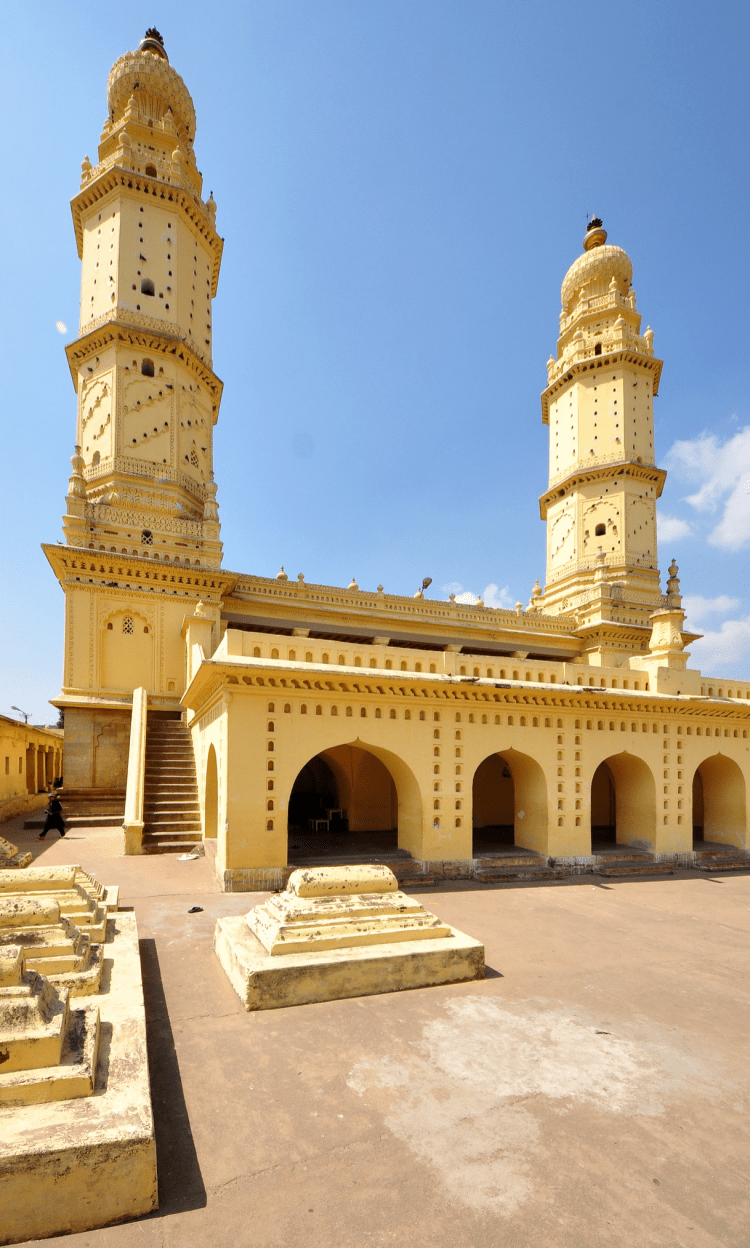
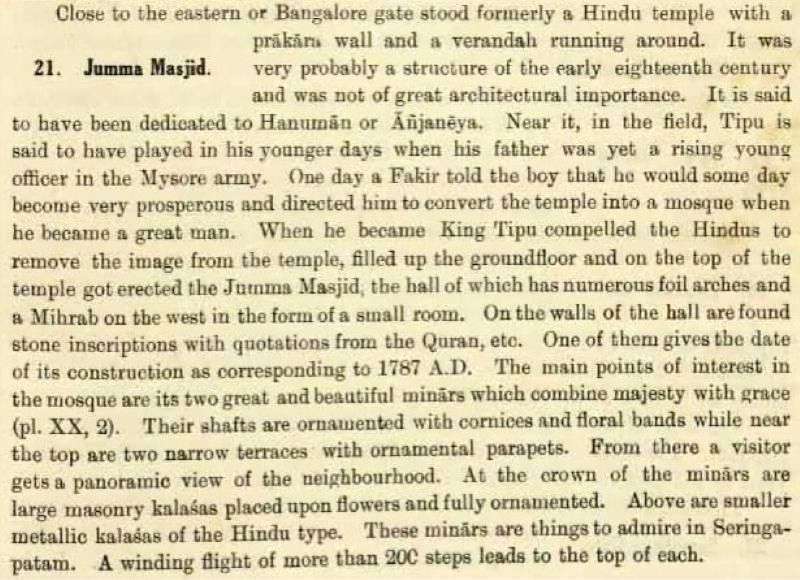
Masjid-i-Ala (Jama Masjid)

Mysore Archaeological Dept Report 1935

Sita Ram Goel Vindicated: ‘Eminent historians’ no longer deny Islamic iconoclasm – R. Jagannathan

Sita Ram Goel

If the “eminent historians” now can acknowledge the reality of Islamic iconoclasm, surely they can promote Hindu-Muslim amity by getting Muslim groups to accept that damage was done in the past, and some remedy is called for in the present to let bygones become bygones. – R. Jagannathan

Our “eminent historians”, mostly from the Left, are showing signs that they are not beyond all education when hit repeatedly on their heads with facts and evidence. The late Sita Ram Goel, who was among the first to debunk the whitewashed versions of India’s Islamic history, stands vindicated.

Before the Babri was demolished, they repeatedly asserted that there was no temple below the mosque. Once the archaeological survey ordered by the Allahabad High Court established beyond doubt that there indeed was a temple below the Babri, their story-line changed from “no temple below the mosque”, to bland assertions that what was under the Babri was another mosque or even a Buddhist stupa. (Read some of what they said then here.)

When evidence kept surfacing of multiple temple demolitions under Islamic rule, the party line was that this was done not for religious reasons but political reasons. False equivalences were drawn between consistent and bigoted Islamic iconoclasm and the occasional damage done to temples or Buddhist and Jain places of worship. The latter were aberrations rather than the norm.

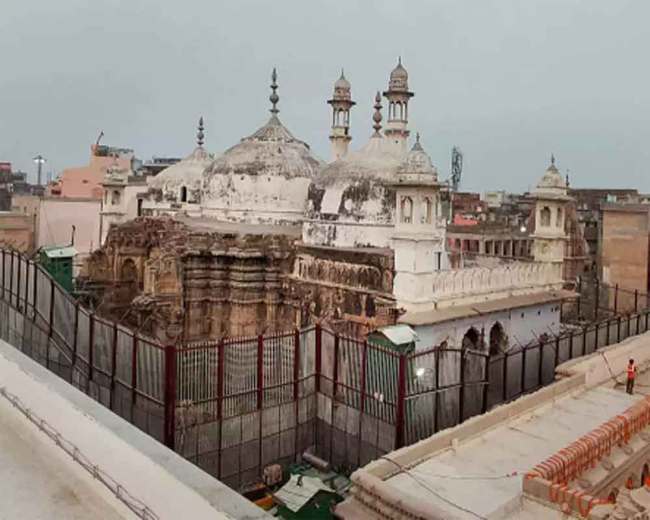
Now, with a survey seeking to establish the presence of Hindu carvings (and possibly a Shiv Linga) inside the Gyanvapi Mosque, these eminences are slowly abandoning the claim that no temples were destroyed.

In The Times of India today (24 May), there is a clear acceptance that Mughal rulers destroyed temples, though the argument has changed.

Irfan Habib, professor emeritus at the Aligarh Muslim University (AMU), is quoted thus: “Mughal emperor Aurangzeb destroyed temples in Varanasi and Mathura to raise mosques. However, the question today is whether what was done in 1670 should be repeated, despite the existence of the Indian Monuments Act. Should we do the same things as Mughal emperors did in the past?” (Read the details here.)

This is progress. Big progress. If we should not do what Aurangzeb did, it is an indirect admission that the Mughal emperor was a bigot. Facts are no longer denied, or conveniently misinterpreted as mere political acts of rulers in the past, though that is not entirely gone.

Shalin Jani of the Delhi University department of history is quoted as saying: “As far as Mughal India is concerned, we know about the politics of temple desecration during those times. We can’t resolve our contemporary problems by looking at the past.”

Well, maybe the Germans got it wrong when they refused to airbrush history or deny Hitler and the Nazi past. Without acknowledging the past, and making some amends, we cannot move forward.

The unwillingness to see religious bigotry behind temple desecration is not entirely gone, but the facts are no longer disputed.

Nadeem Rezavi, professor of mediaeval history at AMU, is clearer. “No one can justify what Aurangzeb did. However, we can’t behave like him and keep demolishing mosques to restore temples. What difference remains then between the Mughal ruler and rulers of today?”

Clearly, Audrey Truschke, who has tried to whitewash Aurangzeb’s reign in her book Aurangzeb: The Man and The Myth, clearly needs to hear what Habib and Rezavi now have to say. Aurangzeb was a bigot. Full stop. His temple desecrations were real, not just political fallout.

Clearly, the work done by Sita Ram Goel in volume two of his two-volume work on Hindu Temples: What Happened To Them  (Vol. 1 & Vol. 2), which examines both the Hindu and Muslim evidence, should now be required reading in all history departments, including AMU.

Later books by Meenakshi Jain (Rama & AyodhyaThe Battle For RamaFlight of Deities & Rebirth of Temples, Vasudeva Krishna and Mathura, have also completely sealed the evidence in favour of the Hindu version of Islamic destruction of key temples. It is also time to revisit the older historical works of R.C. Majumdar and Sir Jadunath Sarkar and not just junk them as “communal historians”.

The only way forward from here is not to live in the past, but to acknowledge it, and negotiate a deal to hand over the Kashi and Mathura temples back to Hindus fully in return for Hindus allowing the rest of the temple desecrations to remain as acknowledged facts of history with no recompense due.

If the “eminent historians” now can acknowledge the reality of Islamic iconoclasm, surely they can promote Hindu-Muslim amity by getting Muslim groups to accept that damage was done in the past, and some remedy is called for in the present to let bygones become bygones. – Swarajya, 4 May 2022

› R. Jagannathan is a senior journalist and editor and the Editorial Director of Swarajya Magazine.

Gyanvapi Mosque back wall being the front wall of the ancient Vishwanath Temple.

How history was made up at Nalanda – Arun Shourie

Arun Shourie

Given what we have seen of Marxist historians even in this brief book, the brazen-faced distortions—to the point of falsehood—do not surprise me. – Arun Shourie

“The mine of learning, honoured Nalanda”—that is how the 16th-17th century Tibetan historian, Taranath, referred to the university at Nalanda. At the time I-Tsing was at the university, there were 3,700 monks. The total complex had around 10,000 residents. The structures housing the university were as splendid and as extensive as the learning they housed. When excavations began, the principal mound alone was about 1,400 feet by 400 feet. Hieun Tsang recounts at least seven monasteries and eight halls. The monasteries were of several storeys, and there was a library complex of three buildings, one of them nine storeys high.

As the Islamic invaders advanced through Afghanistan and north-western India, they exterminated Buddhist clergy, they pillaged and pulverised every Buddhist structure—the very word “but”, the idols they so feverishly destroyed, was derived from “Buddha”. Nalanda escaped their attention for a while—in part because it was not on the main routes. But soon enough, the marauders arrived, and struck the fatal blow. The ransacking is described in the contemporary Tabakat-i-Nasiri by Maulana Minhaj-ud-din.

Minhaj-ud-din rose and came to the notice of the rulers of the time—Qutb-ud-din Aibak and others—because of his raids and depredations, and because of the enormous booty he gathered, booty sufficient for him to set himself up as a plunderer in his own right. “His reputation reached Sultan (Malik) Qutb-ud-din, who dispatched a robe of distinction to him, and showed him honour,” the historian writes. With its high wall, its large buildings, Nalanda seemed like a well-endowed fortress to Ikhtiyar-ud-din and his force. He advanced upon it with two hundred horsemen “and suddenly attacked the place”. Minhaj-ud-din continues,

“The greater number of inhabitants of that place were Brahmans, and the whole of those Brahmans had their heads shaven, and they were all slain. There were a great number of books there; and when all these books came under the observation of the Musalmans, they summoned a number of Hindus that they might give them information respecting the import of those books; but the whole of the Hindus had been killed. On being acquainted (with the contents of the books), it was found that the whole of that fortress and city was a college, and in the Hindu tongue, they call a college, Bihar [vihara].”

“When that victory was effected,” Minhaj-ud-din reports, “Muhammad-i-Bakhtiyar returned with great booty, and came to the presence of the beneficent sultan, Qutb-ud-din I-bak, and received great honour and distinction.…”—so much so that other nobles at the court became jealous. All this happened around the year 1197 AD.

And now the Marxist account of the destruction of this jewel of knowledge. In 2004, D. N. Jha was the president of the Indian History Congress. In the presidential address he delivered—one to which we shall turn as an example of Marxist “scholarship”—this is the account he gives of the destruction of Buddhist viharas, and of Nalanda in particular:

“A Tibetan tradition has it that the Kalacuri King Karna (11th century) destroyed many Buddhist temples and monasteries in Magadha, and the Tibetan text  Pag Sam Jon Zang refers to the burning of the library of Nalanda by some ‘Hindu fanatics’”.

“Hindu fanatics”? The expression struck me as odd. A Tibetan text of the 18th century using so current an expression as “Hindu fanatics”? Especially so because, on Jha’s own reckoning, Hinduism is an invention of the British in the late 19th century? So, what is this “Tibetan text”? What does it say? Had Jha looked it up?

Pag Sam Jon Zang was written by Sumpa Khan-Po Yece Pal Jor. The author lived in 1704-88: that is, 500 years after the destruction of Nalanda.

That is the first thing that strikes one: our historian disregards the contemporaneous account, Tabakat-i-Nasiri, and opts for a text written 500 years after the event. But had he read the text at all? Could a self-respecting Marxist have at all believed what is written in it?

This is how Sarat Chandra Das, the translator and editor of Pag Sam Jon Zang, sets out the account of the destruction of Nalanda as given in this text:

“While a religious sermon was being delivered in the temple that he (Kakuta Sidha, a minister of a king of Magadha) had erected at Nalanda, a few young monks threw washing water at two Tirthika beggars. The beggars being angry, set fire on the three shrines of dharma ganja, the Buddhist university of Nalanda—that is, Ratna Sagara, Ratna Ranjaka including the nine-storey building called Ratnadadhi which contained the library of sacred books” (pg 92).

Two beggars could go from building to building of that huge campus and, with all the monks present, burn down the entire, huge, scattered complex?

And, the account of the relevant passage reproduced above is the one set out by Sarat Chandra Das in his Index. That is, it is just a summary of the actual passage—in an index, it scarcely could be more. What does the relevant section, and in particular the passage about the burning down of the library, say?

The author is giving an account of how Dharma has survived three rounds of destructive attempts. One round was occasioned by the fluctuating relations between Khunimamasta, a king of Taksig (Turkistan?), and Dharma Chandra, a king of Nyi-og in the east. The latter sends gifts. The former thinks these are part of black magic. He, therefore, swoops down from “dhurukha” and destroys “the three bases” of Magadha—monasteries, scriptures and stupas. Khunimamasta drives out and exiles the monks. Dharma Chandra’s uncle sends many scholars to China to spread the teaching. He receives gold as thanksgiving. He uses this and other gifts to appease rulers of smaller kingdoms to join the fight against the king of Taksig (Turkistan?). The uncle thereafter revives “the three bases”. Almost all the shrines are restored and 84 new ones are built. And so, the Dharma survives.

In the next round, “the teacher who taught Prajnaparamita for 20 years is assassinated by burglars from Dhurukha. His blood turned into milk and many flowers emerged from his body. (Thus) he flew into the sky.”

We now come to the crucial passage, the one that Jha has ostensibly invoked. I reproduce the translation of it by Geshe Dorji Damdul in full:

“Again at that time, there was a scholar by the name Mutita Bhadra, who was greatly involved in renovating and building stupas. Eventually he had a vision of Bodhisattva Samantabhadra. He flew to Liyul by holding the garment (of Bodhisattva Samantabhadra) and there he made great contributions to the welfare of sentient beings and the Dharma. Reviving the Dharma that way, the Dharma flourished for 40 years in the Central Land (Magadha?). At that time, during the celebration over the construction of a shrine in Nalanda by Kakutasita, a minister of the king, some naughty novice monks splashed (dish) washing water on two non-Buddhist beggars and also pressed (the two) in-between the door and (the door frame.) Angry over these gestures, one (beggar) served as the attendant to the other who sat in a deep pit for 12 years to gain the siddhi of the sun. Having achieved the siddhi, they threw ashes of a fire puja (havan) they did, on 84 Buddhist shrines. They were all burned. Particularly, when the three dharma ganja of Nalanda—the shrines which sheltered the scriptures—as well got consumed in fire, streams of water ran down from the scriptures of Guhyasamaja and Prajnaparamita, which were housed in the ninth storey of the Ratnadhati shrine. This saved many scriptures. Later, fearing penalty from the king, the two (beggars) escaped to Hasama in the north. However, the two died due to immolation, which happened on its own.”

Surely, no self-respecting Marxist could have made his account rest on not just one miracle—acquiring siddhis and raining fire on to the structures—but two, for we also have the streams of water running down from the scriptures.

But we strain unnecessarily. There is a clue in Jha’s lecture itself. He doesn’t cite the Tibetan text, he does what Marxists do: he cites another Marxist citing the Tibetan text! To see what he does, you must read the lines carefully. This is what we saw Jha saying:

“A Tibetan tradition has it that the Kalacuri King Karna (11th century) destroyed many Buddhist temples and monasteries in Magadha, and the Tibetan text Pag Sam Jon Zang refers to the burning of the library of Nalanda by some ‘Hindu fanatics’”.

As his authority, Jha cites a book by B. N. S. Yadava, Society and Culture in Northern India in the Twelfth Century. What did Yadava himself write? Here it is: “Further, the Tibetan tradition informs us that Kalacuri Karna (11th century) destroyed many Buddhist temples and monasteries in Magadha.”

Jha has clearly lifted what Yadava wrote word for word—at least he has been faithful to his source. But in the very next sentence, Yadava had gone on to say: “It is very difficult to say anything as to how far this account may be correct.”

Words that Jha conveniently left out!

Yadava had continued, “However, we get some other references to persecution.”

He cited two inscriptions and a Puranic reference. And then came to the Tibetan text. Recall what Jha wrote about this text: “… and the Tibetan text Pag Sam Jon Zang refers to the burning of the library of Nalanda by some ‘Hindu fanatics’”.

And now turn to what Yadava wrote about this very text: “The Tibetan text Pag Sam Jon Zang contains a [I am leaving out a word] tradition of the burning of the library of Nalanda by some Hindu fanatics.”

Close enough to pass for plagiarism? But wait, there is originality! Notice, first, that two Hindu beggars have become “Hindu fanatics”. Notice, next, that the words “Hindu fanatics” that Jha had put in quotation marks as if they were the words that the author of the Tibetan text had used to describe the arsonists, were actually the words of his fellow Marxist, Yadava. But the best clue is the word that I omitted from what Yadava had actually written. Yadava’s full sentence was as follows: “The Tibetan text Pag Sam Jon Zang contains a doubtful tradition of the burning of the library of Nalanda by some Hindu fanatics.”

Just as he had left out the words, “It is very difficult to say anything as to how far this account may be correct,” Jha now leaves out the word “doubtful”. And all this in the presidential address to the Indian History Congress.

In a word, there is a Tibetan text written five hundred years after the destruction of Nalanda. Sarat Chandra Das annotates it, and includes in his Index a summary in English of a passage in the text—the summary naturally leaves out telling components of the original passage.

Yadava looks only at the summary in the Index—“non-Buddhist beggars” becomes “Hindu fanatics.”

Yadava notes that the account is based on a “doubtful tradition”.

Jha omits the word “doubtful”.

And we have a presidential address to the Indian History Congress!

Given what we have seen of Marxist historians even in this brief book, the brazen-faced distortions—to the point of falsehood—do not surprise me.

What does surprise me is that no one looked up either the source that Jha had cited or the text.

Indeed, in concluding his section, Yadava had stated:

“A great blow to Buddhism was, no doubt, rendered by the Turkish invasions, leading to the destruction and desertion of the celebrated Buddhist monasteries of Magadha and Bengal. Many Buddhist scholars fled to Tibet and Nepal.” – Indian Express, 28 June 2014

» Arun Shourie is a former Rajya Sabha MP from the BJP and leading public intellectual. This article has been excerpted by the Indian Express from his book, Eminent Historians: Their Technology, Their Line, Their Fraud.

Eminent Historians by Arun Shourie