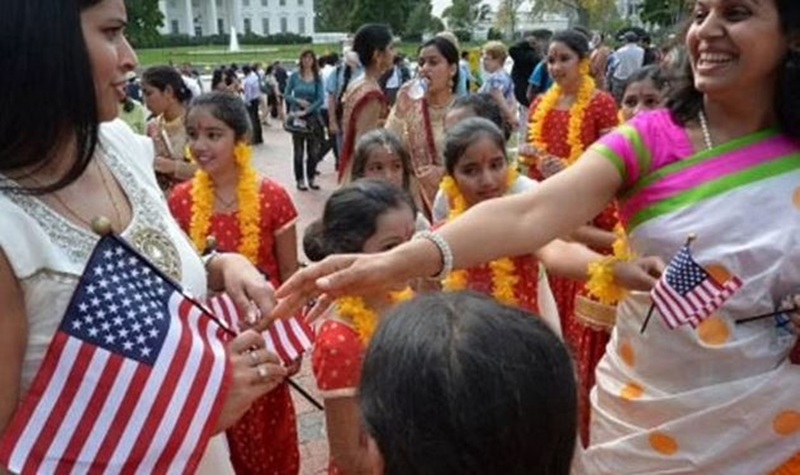
The grievance that Hindu Americans do not lobby for India as Jews do for Israel is both premature and misplaced. Diaspora power is earned over generations, not asserted overnight. As Indian Americans mature politically, their challenge will be to balance pride in their roots with the pluralism that defines their adopted homeland. – Surajit Dasgupt
When Shashi Tharoor raised a seemingly provocative question about the global Hindu community’s inability to lobby for India the way Jews in the US advocate for Israel or Muslims campaign for Palestine, he tapped into a long-standing unease within sections of India’s diaspora. His remarks, made at a public event, drew swift responses from several non-resident Indians (NRIs) and persons of Indian origin (PIOs) in America. They countered that India’s decision-makers seldom consult them before taking major policy decisions—such as buying oil from Russia or voting at the United Nations—and that they are often treated merely as emotional extensions of the homeland rather than as stakeholders in policy outcomes.
At one level, the NRI lament is outlandish. No sovereign country consults its overseas citizens before making foreign or economic policy choices. Yet, Tharoor’s pin prick touched a raw nerve because it revealed a deeper question about influence: Why have Hindu Americans, despite their wealth and education, not attained the political leverage that Jewish-Americans enjoy, or the ideological coherence that binds American Muslims on issues like Palestine?
This comparison is not new, but it is newly urgent. Indian-Americans have risen rapidly in visibility over the past two decades, producing senior officials, business leaders and even members of Congress. Still, their collective political voice remains fragmented. To understand why, it helps to explore how other diasporas—particularly Jewish-Americans—built power over generations. That contrast begins with history.
Jewish experience, American integration
Jewish migration to America began in waves through the 19th century, driven by persecution in Europe and the promise of religious freedom. It was not easy, as American Christians were no less swayed by the notion that Jews were the ‘killers’ of Jesus Christ. One thing that the older Americans perhaps did not throw at the Jews is envy. European Christians—as much as Asian Muslims—were jealous of Jews, seeing the Israelites become the first among the followers of the three Abrahamic faiths to become rich, thanks to the business of interest on money considered evil in Christianity and Islam but not in Judaism. There were enough rich men in the capitalist US to resent Jewish riches.
Yet, the early Jewish settlers faced hostility, discrimination and exclusion. If Europe saw Jews portrayed as villains, American cinema portrayed Jews (and Blacks) as villains too.
Examples from classic English literature
- The Canterbury Tales (c 1400): In “The Prioress’s Tale,” Jewish characters are depicted in a classic antisemitic blood libel, accused of murdering a devout Christian child.
- The Jew of Malta (1590s): Christopher Marlowe’s play features Barabas, a greedy, treacherous, and murderous character, who helped define the “villain Jew” stereotype on the English stage.
- The Merchant of Venice (c 1600): William Shakespeare’s Shylock is the most famous example of this archetype. Though given a humanising monologue, he is characterised as a vengeful moneylender who demands a “pound of flesh” and is ultimately forced to convert to Christianity—a “happy ending” for the Christian characters.
- Oliver Twist (1838): Charles Dickens’s Fagin is a villainous “crafty old Jew” who runs a school for child pickpockets. Dickens initially referred to Fagin as “the Jew” over 250 times, reinforcing the association of criminality with his Jewish identity. After a Jewish reader criticised the portrayal, Dickens removed many of the references in later editions and created a positive Jewish character, Riah, in a later novel.
- Trilby (1894): George du Maurier’s novel features Svengali, a manipulative Jewish rogue and hypnotist who dominates a young woman. The character was so influential that his name entered the English language as a term for a sinister manipulator.
When film emerged in the 20th century, many of these same stereotypes were transferred to the screen.
- Antisemitic caricatures: The early 20th century saw the phenomenon of “Jewface,” vaudeville acts that featured exaggerated Jewish stereotypes with props like putty noses and fake beards. Early cinema adapted many of these tropes.
Nazi propaganda: In the 1930s and 1940s, Nazi Germany weaponised these historical caricatures in its propaganda films to portray Jewish people as satanic, greedy, and inferior. - A 1943 production of The Merchant of Venice in Vienna, for example, depicted Shylock as a demonic figure to support Nazi ideology.
- Controversial adaptations: The 1948 film adaptation of Oliver Twist was denounced by Jewish groups in America for its antisemitic depiction of Fagin, leading to the film’s postponement in the US.
- The “Jewish American Princess” stereotype: Post-war Jewish male writers, and later cinema, popularised the “JAP” stereotype, portraying young, materialistic, and spoiled Jewish women.
That was until several rights movements in the 1960s forced the American racists to climb down their high horses.
Over time, the Jews in America organised themselves into tight-knit communities centred on synagogues, charities and cultural institutions. From the outset, Jewish immigrants recognised the necessity of solidarity to survive in a majority-Christian society. That solidarity evolved into political coordination.
By the early 20th century, Jewish newspapers, cultural organisations and philanthropic networks had formed a vast informal infrastructure for communal representation. After the horrors of the Holocaust, Jewish activism entered a new phase: moral urgency fused with political strategy. Groups such as the American Jewish Committee, the Anti-Defamation League (ADL), and later the American Israel Public Affairs Committee (AIPAC) refined lobbying into an art. They cultivated bipartisan connections, funded research centres and established think-tanks that shaped American opinion about Israel and anti-Semitism.
It took decades of sustained effort. Jewish leaders worked patiently to normalise pro-Israel positions within Washington’s mainstream. When critics today call US Middle East policy “tilted” towards Israel, they overlook how that tilt emerged from generations of community-building, strategic philanthropy and civic participation. The result is not merely influence over foreign policy but a broad societal sympathy for Jewish concerns—a by-product of cultural immersion through education, arts and civil rights movements.
Muslim identity, shared faith
The Muslim-American story is very different but equally instructive. Muslims in the US are far more ethnically diverse—comprising Arabs, South Asians, Africans and converts—yet they have gradually coalesced around faith-based advocacy. Their political influence is still evolving, but organisations such as the Council on American-Islamic Relations (CAIR) and the Islamic Society of North America (ISNA) have given them a public voice.
The Palestinian issue provides a coherent moral and political framework to all Muslims in the US, transcending their respective nationalities, with their advocacy prioritising a global Muslim identity. This communal psychology contributes to their emotional unity. Not the case with the Hindu-American community! Predominantly Indian in origin, Hindus in the US represent a single country but lack an equivalent unifying ideology. Moreover, if individually, Indians constitute no more than 1% of the American population—too small for lobbying—and Pakistanis, Bangladeshis, or Arabs are fewer than Indians, the Islamic collective makes up for the absence of a large number of migrants from one given country.
As a saving grace, Indian-Americans are hardly casteist and their separate denominations—like Vaishnava, Shaiva, Shakta, Smartha, etc—do not manifest in the US to the point where Hindu unity would become a tough ask. However, India’s internal political polarisation often spills into the diaspora, dividing Indian-Americans between secular liberals and those aligned with the ruling Bharatiya Janata Party (BJP).
Indian-American paradox
Indian-Americans are among the most prosperous ethnic groups in the United States, with high median incomes and remarkable educational attainment. Silicon Valley, academia and medicine are full of Indian success stories. Yet political power does not automatically follow economic success. Unlike Jewish or Muslim groups, Indian-Americans have not built long-term institutions for coordinated lobbying. The existing organisations—such as the US-India Political Action Committee (USINPAC) or the Hindu American Foundation (HAF)—operate in silos and often struggle for mainstream acceptance.
There is also a generational factor. The first wave of Indian immigrants in the 1960s and 70s arrived under professional visas, focused on assimilation and career advancement. Political activism was rare. Their children, more culturally confident and socially integrated, are beginning to enter politics—figures such as Pramila Jayapal, Ro Khanna, and Vivek Ramaswamy illustrate this new visibility—but ideological divisions persist. Jayapal’s left-leaning stance on India’s human rights record often clashes with the nationalist sentiment of conservative Hindus. Consider how desperate Ramaswamy was during the Trump campaign to prove Hinduism isn’t too un-Christian, after all!
Most awkwardly, Hindus under the overseas wings of the Sangh Parivar need to work in coordination with Pakistani and Indian Muslims—including with CAIR and ISNA activists—in the US so that the South Asian identity looks significant and prominent enough to pressure the American policy makers.
Even symbolic recognition has come slowly. When one American state declared October 2022 as the “Hindu Heritage Month”, it was celebrated as a milestone. But as the activists who pushed for it admitted, Hispanics took nearly three decades to achieve comparable recognition. Diaspora influence takes time—and unity.
Politics of access, perception of influence
The optics of Prime Minister Narendra Modi’s warm rapport with Donald Trump during the latter’s first presidency created an illusion of extraordinary Indian-American influence. The “Howdy Modi” rally in Houston in 2019, where the two leaders walked hand in hand before a cheering crowd, suggested that the community had arrived as a political force. Yet that perception was misleading. It reflected personal chemistry, not institutional power.
When Trump returned to office for a second term, expectations of deeper India-US alignment quickly met geopolitical reality. Washington’s interests in China, trade and global security do not shift with diaspora enthusiasm. The limits of Indian-American leverage became clear, underscoring how different it is from the entrenched Jewish lobby or even the organised Muslim advocacy on Palestine and civil rights.
Long road to influence
Diaspora influence, as history shows, matures over generations. The Jewish experience offers the clearest example. From the early 20th century to the post-Holocaust era, Jewish-Americans worked through education, philanthropy and coalition-building. They forged alliances with African-Americans during the civil rights movement, ensuring moral reciprocity when they later defended Israel’s legitimacy. Their activism was institutional, not episodic.
For Indian-Americans, such institutional continuity is still forming. The community’s philanthropic energies are vast but scattered. Major donors fund temples, educational foundations and disaster relief, yet few invest strategically in think-tanks or policy advocacy. Nor is there consensus on which issues to champion. Should lobbying focus on India’s image, on global Hindu identity, or on broader multicultural representation? Each objective attracts different constituencies, often at cross purposes.
Cultural perception, historical memory
Then, influence does not depend on money or access alone; your narrative is an edifice built upon the foundation of the memories of your community as a collective. For Jewish-Americans, the memory of persecution provided a moral foundation for activism. Anti-Semitism in Western literature and film gradually gave way to empathy and representation, transforming public attitudes. Today, Jewish characters in American media are complex, human and often central to moral storytelling. This cultural normalisation underpins political legitimacy.
Indian-Americans, by contrast, are still defining their narrative. The Western imagination often reduces India to stereotypes of spirituality or poverty. Despite recent Bollywood popularity and the global reach of Indian cuisine, the Hindu identity remains poorly understood. Worse, political controversies—over caste, majoritarianism or Kashmir—have made the term “Hindutva” contentious abroad, complicating outreach efforts.
Future of diaspora advocacy
If Indian-Americans are to build real influence, they must learn from the patience and organisation of their Jewish counterparts. Effective lobbying requires consensus, credible institutions and a shared sense of purpose beyond partisan divides. It also demands bridging the gap between India’s domestic politics and the pluralist expectations of American democracy.
For now, the community’s most powerful asset remains its credibility: hardworking professionals with high civic participation and low crime rates. Translating that respectability into political leverage will take time—and strategic discipline.
The grievance that Hindus do not lobby for India as Jews do for Israel is, therefore, both premature and misplaced. Diaspora power is earned over generations, not asserted overnight. As Indian-Americans mature politically, their challenge will be to balance pride in their roots with the pluralism that defines their adopted homeland.
Tharoor’s question, then, was less an accusation than an invitation—to imagine what an organised, confident and inclusive Indian-American voice could achieve if it learned from history. – News18, 15 October 2025
› Surajit Dasgupta is a senior journalist and writer.

 VOICE OF INDIA