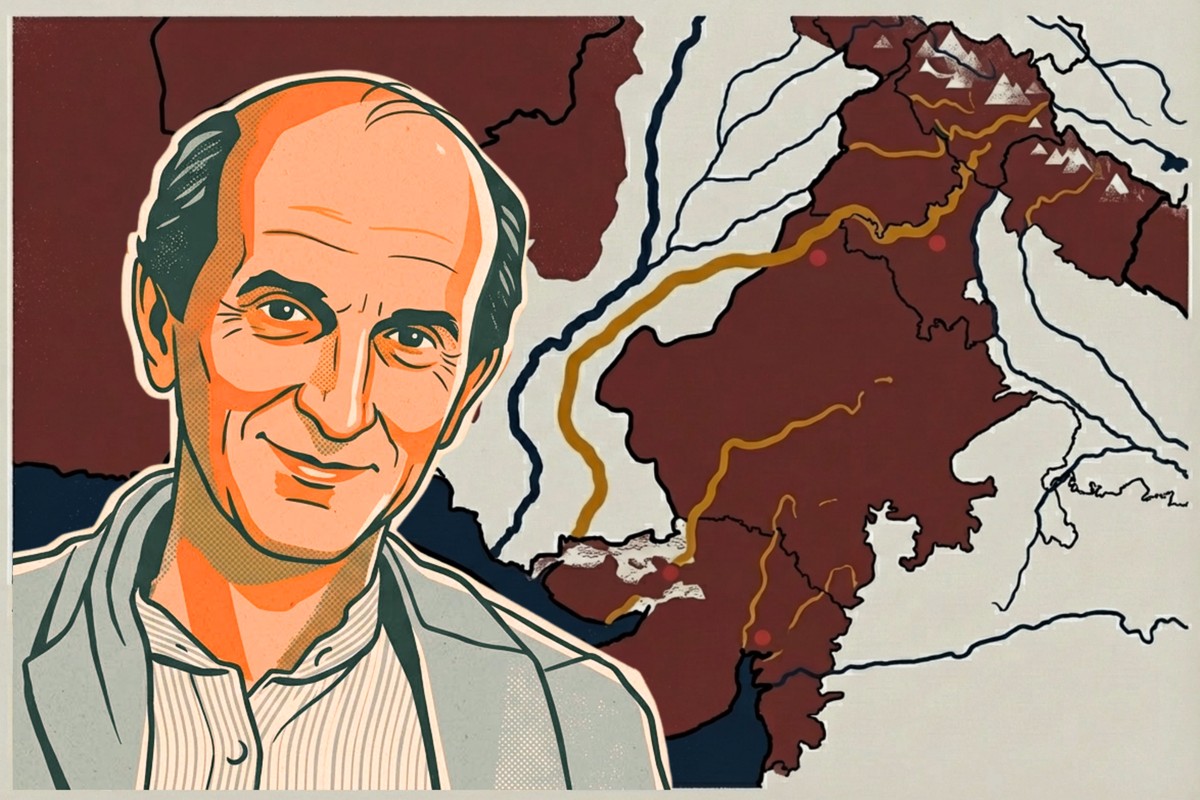
A survey of Michel Danino’s work provides context to the widespread unease surrounding the Supreme Court’s adverse remarks about him. – Swarajya Staff
The Supreme Court on 11 March ordered a blacklisting of three experts involved in drafting a controversial chapter on ‘corruption in the judiciary’ for a Class 8 NCERT textbook.
A bench of Chief Justice Surya Kant and Justices Joymalya Bagchi and Vipul Pancholi described the NCERT director’s response as “disturbing” after it emerged the chapter had been rewritten without disclosing details of the new experts or approval processes.
The court directed the Union government and states not to associate with Professor Michel Danino, Suparna Diwakar and Alok Prasanna Kumar, who were involved in drafting the earlier chapter.
An affidavit by NCERT Director Dinesh Prasad Saklani stated that Michel Danino had supervised the drafting of the chapter, whilst educator Suparna Diwakar and legal researcher Alok Prasanna Kumar were also involved in the process.
The bench directed the Union, all states and all institutions receiving state funds to disassociate them from rendering any service which would mean payment from public funds.
The court observed it had “no reason to doubt that Professor Michel Danino along with Ms Diwakar and Mr Alok Prasanna Kumar either does not have reasonable knowledge about Indian judiciary or they deliberately, knowingly misrepresented the facts in order to project a negative image of the Indian judiciary before students of class 8 who are at an impressionable age. “
However, the three individuals can approach the Supreme Court for modification of this order, the court added.
Who is Michel Danino?
Michel Danino, born in 1956 in Honfleur, France, is a French-born Indian author, scholar, and educationist who has lived in India since 1977 and holds Indian citizenship.
Drawn to Indian civilization from his youth, influenced by Sri Aurobindo and Auroville, he settled in India and became a lifelong student of its ancient heritage. A visiting professor at IIT Gandhinagar, where he supports the Archaeological Sciences Centre, Danino has authored key works including The Lost River: On the Trail of the Sarasvati (2010), exploring the Vedic river, and Indian Culture and India’s Future (2011). He has also co-edited textbooks on Indian knowledge traditions and edited Sri Aurobindo and India’s Rebirth (2018).
The Supreme Court’s comments give his critics fresh ammunition to attack him.
Danino has been a target of suspicion in certain academic and media circles for years. The charge is familiar: he writes sympathetically about ancient India’s civilisational achievements, he has defended the physical existence of the Sarasvati river, he has questioned the Aryan invasion theory. This, the accusation runs, makes him a scholar whose conclusions are predetermined by ideology rather than evidence.
Those who make this accusation have, with remarkable consistency, declined to engage with his works.
What the Evidence Actually Looks Like
The Lost River, Danino’s most comprehensive work, is an investigation into the Sarasvati—the river celebrated in the Rig Veda that later texts describe as “disappearing.” The question of whether this river had a physical existence, and if so where, has become entangled in Indian political controversy. Critics therefore treat any scholarly work that argues for its historical reality as ideologically motivated.
What those critics rarely discuss is how Danino builds his case.
The book draws on geological surveys conducted by the Geological Survey of India; on satellite imagery analysed from NASA’s LANDSAT series, France’s SPOT series, and India’s own IRS satellites; on nuclear isotope dating of groundwater samples carried out by scientists at the Bhabha Atomic Research Centre; on bore-hole data drilled by American hydrologist Robert Raikes near the Harappan site of Kalibangan; on a 1986–1991 hydrogeological survey of the Cholistan Desert conducted by two German scientists, M.A. Geyh and D. Ploethner; and on remote-sensing research published by three scientists of the Indian Space Research Organisation.
This is before one counts the 19th-century British surveyors, the French CNRS mission of the 1980s, the American and Japanese researchers, and the Indian archaeologists whose fieldwork Danino synthesises across more than 400 pages.
The accusation of ideological bias is, in other words, being levelled at a book whose evidentiary base spans four continents, two centuries of scholarship, and at least six scientific disciplines.
Satellite imagery from a NASA programme does not adjust its findings based on Indian political conditions. German isotope hydrology does not take instructions from the RSS. Either the geology is sound or it is not—and critics who wish to challenge Danino’s conclusions are obliged to say which data they dispute and why.
The Quality That Distinguishes a Scholar from an Ideologue
There is a further dimension of Danino’s work that his critics have chosen to overlook: his explicit, consistent acknowledgement of uncertainty and dissent.
In the prologue to The Lost River, he writes that whatever perspective his readers choose to adopt, he will be satisfied if they feel enriched by the inquiry.
In the body of the book, he returns repeatedly to scholars who hold different views, notes where the evidence is genuinely contested, and presents his own synthesis as a reasoned interpretation rather than an unchallengeable verdict. “We will hear diverse viewpoints,” he writes, “learn from every one of them, and I will present my own, while weighing and trying to reconcile inputs from a variety of disciplines.”
This is not a rhetorical formula. It is borne out in practice. Danino does not suppress inconvenient findings. He discusses the minority of scholars who have questioned whether the Vedic Sarasvati was located in India at all, or whether it existed as a physical river.
He engages with their arguments before offering his rebuttal. He flags, more than once, the limits of what the evidence can establish. He distinguishes between what is demonstrated, what is probable, and what remains speculative.
A partisan sophist does not do this. An intellectual demagogue selects evidence, suppresses alternatives, and presents conclusions with a certainty the record does not support. Danino does the opposite—and the contrast with the certainty his critics bring to their dismissals of him is, in itself, telling.
The Argument His Critics Would Rather Not Have
Perhaps the most uncomfortable dimension of Danino’s scholarship—uncomfortable, specifically, for those who accuse him of serving a political agenda—is that his sharpest criticism is directed not at ancient India’s detractors but at the Indian state’s failure to take its own intellectual heritage seriously.
In an article in The Hindu in 2015, Danino notes that no Indian university has a department dedicated to the history of science. He notes that the best online resource for India’s classical mathematicians—a tradition that includes Aryabhata, Brahmagupta, Bhaskaracharya, Mahavira, and Narayana Pandita—is maintained not by an Indian institution but by the University of St Andrews in Scotland.
He notes that significant research contributions to the field in recent decades have come from scholars in the United States, France, Japan, and New Zealand, while their Indian counterparts have worked, in his words, “with little or no institutional support.”
This is not a celebration of ancient India’s greatness. It is a damning audit of post-Independence India’s intellectual priorities. If his agenda were simply to flatter a political constituency, he would not write this. He writes it because it is true, and because a scholar whose subject is being neglected has an obligation to say so regardless of whose discomfort it causes.
The same essay makes an argument that deserves to be read in full by everyone who has dismissed Danino as a partisan. He argues that mainstream Indian historiography’s silence on India’s genuine scientific and mathematical achievements—its failure to give Brahmagupta or Sushruta the space it gives to kings and dynasties—has created the vacuum that fantasists have filled.
The absurd claims about ancient aircraft and Vedic nuclear weapons that embarrass serious scholars arise, at least partly, from a historiography that has told Indian students their civilisation produced nothing worth studying.
Danino’s prescription is not mythologising. It is rigour: document the real achievements, teach them properly, and there will be no room left for the fabrications.
A scholar who builds his case on German groundwater surveys, NASA satellite data, and French archaeological missions is not producing ideology. A scholar who acknowledges competing viewpoints, flags the limits of evidence, and invites his readers to draw their own conclusions is not producing propaganda. A scholar who criticises his own country’s institutions for neglecting the very field he is defending is not writing to please a political master.
In the same way, a scholar who included a section on problems with one of India’s most important institutions in a school textbook is only enabling informed civic understanding among young students. – Swarajya, 16 March 2026
 VOICE OF INDIA