Nehru, Patel and the Babri Masjid: Rajnath Singh exposes Nehruvian double-speak – Utpal Kumar

Nehru & Patel

Rajnath Singh’s remarks on Nehru, Patel, Somnath and Babri Masjid, rather than being fabrications or distortions of history, reflect realities that were suppressed later by the Nehruvian ecosystem. – Utpal Kumar

Truth can often be stranger than fiction. This became obvious when Defence Minister Rajnath Singh’s recent statement about Jawaharlal Nehru, Sardar Vallabhbhai Patel and the Babri Masjid opened a Pandora’s box, pushing the country to revisit the uneasy truths of its early years as an independent entity.

The Congress, quite expectedly and duly supported by its ecosystem, has strongly denied Singh’s assertions, calling them “lies” devoid of archival backing. Yet, when one turns to the memoirs, diaries, and biographies written by contemporaries of Nehru and Patel, a more complex picture emerges—one that suggests history is more often than not written by victors, which in the country’s case were Nehru and his acolytes.

Rajnath Singh’s intervention touches on two sensitive issues: one, whether Nehru had proposed using government funds to build the Babri Masjid; and two, the first prime minister’s alleged reluctance to support a national memorial for Sardar Patel. Contrary to claims that Singh is distorting or inventing history, the fact is that these incidents were explicitly recorded in books and personal documents from the 1950s and 1960s.

The Babri Masjid Question

The most striking material comes from the diary of Maniben Patel, Sardar Patel’s daughter. In one of her entries, she notes that Nehru had raised the question of the Babri Masjid and its reconstruction. According to her account, Sardar Patel immediately made it clear that the government could not spend public money to build or rebuild a mosque. He also reminded Nehru that the case of the Somnath temple had been entirely different. In her entry dated September 20, 1950, Maniben Patel writes,

“Bapu (Sardar) said (the) government cannot give money for building a mosque? He knew it very well so that Junagadh was taken over well in advance, and land [was] obtained from [the] Junagadh government for Somnath, and a trust was created and credited Rs 30 lakh. Panditji wrote a chit to Munshi that [the] government cannot spend money on Somnath, as ours is a secular state. Munshi transferred [it] to him (Bapu). He replied that this is a trust of which Jamshed is chairman and Munshi a member and no government money is going to be used in it. He (PM) was silenced then.”

This diary entry is significant because it directly contradicts the categorical denials made today that Nehru ever entertained any proposal regarding government involvement with the Babri Masjid. It also supports Rajnath Singh’s remark that Patel had explicitly opposed such an idea. The suggestion that Nehru even considered using public funds for the mosque complicates the popular portrayal of him as a secularist who maintained a firm line separating religion and state.

The Somnath Saga

The Nehruvian double standard becomes more acute when one looks at the Somnath temple reconstruction episode. In his book Pilgrimage to Freedom, K.M. Munshi, a key leader in the Somnath project, recounts that when Junagadh acceded to India, Sardar Patel, as deputy prime minister, pledged the government to rebuild the temple. Munshi writes that the Union Cabinet, with Nehru presiding, initially approved the reconstruction at government expense.

It was Mahatma Gandhi, not Nehru, who advised that the temple must be rebuilt not with state funds but with voluntary contributions from Hindus. Sardar Patel accepted Gandhi’s advice and swiftly set in motion the creation of a trust to oversee public fundraising. Munshi himself was appointed chairman of the advisory committee for reconstruction.

What surprised Munshi was Nehru’s conduct after Sardar Patel’s death. He records that Nehru repeatedly criticised him for his involvement, despite the fact that the early Cabinet decision had Nehru’s own assent. Munshi writes that he had to remind the prime minister in a detailed letter that “everything was done … in accordance with the decision of the Cabinet taken under his guidance”.

The Somnath saga thus exposes another, little-known aspect of Nehruvian hostility to things Hindu—that the first prime minister’s opposition to state involvement in temple reconstruction was not a position he held from the start; it emerged only later, especially when he became all-powerful after the death of Sardar Patel. And, more damningly, this secular posturing did not stop him from discussing public support for the Babri Masjid, as Maniben Patel’s diary shows.

The Unfinished Legacy of Sardar Patel

The second part of Rajnath Singh’s critique concerns the systematic neglect of Sardar Patel’s memory and legacy after his death. Here, too, the archival material is extensive.

In his book The Sardar of India, P.N. Chopra describes how a plan to build a national memorial for Patel was approved by the Congress Working Committee. The target was Rs 1 crore. Industrialist G.D. Birla, a close aide of both Mahatma Gandhi and Sardar Patel, raised Rs 50 lakh and handed it to the All-India Congress Committee, while state units began collecting contributions.

Yet the project stalled. According to S.K. Patil, a Congressman, as quoted by Chopra, Nehru “remained passive throughout” and eventually suggested that since Patel had been an “agriculturist” and “friend of villagers”, the collected money should be used instead for digging wells and constructing village roads. S.K. Patil found the suggestion “nonsensical”, as “digging of wells and constructing roads was the normal responsibility of the government. That responsibility could not be shared by the memorial fund”.

Chopra also records that Nehru objected even to raising Patel’s statue at Vijay Chowk. Only after much difficulty was a new site secured on Parliament Street, funded not by the Congress’s official memorial fund but by money raised separately in Bombay, now Mumbai.

More startling is the account related by R.L. Handa in his book Rajendra Prasad: Twelve Years of Triumph and Despair. Handa, who was the press secretary to President Rajendra Prasad, writes that upon Patel’s death in 1950, Nehru issued a direction to ministers and secretaries asking them not to go to Bombay for the funeral. When he requested President Rajendra Prasad to avoid attending as well, Prasad refused. Durga Das, in his book India: From Curzon to Nehru and After, corroborates this, noting that Prasad felt Nehru was attempting to diminish Patel’s stature.

These testimonies strengthen Rajnath Singh’s argument that there was a concerned attempt to diminish Patel’s legacy in the years following Independence—an observation shared not merely by modern political actors but by several of Sardar Patel’s contemporaries.

Rajnath Singh’s remarks, rather than being fabrications or distortions of history, reflect realities that were suppressed later by the Nehruvian ecosystem. They show that the early years of the republic were far from monolithic, carved from Nehruvian stone, as is being projected today, and that the country’s slide towards amoral, soulless secularism detached from ageless Sanatana ethos was neither inevitable nor uncontested. In that sense, the ongoing debate sparked by Rajnath Singh has reopened a window onto a past that continues to challenge our assumptions, proving yet again that truth is indeed stranger than fiction. – News18,

Utpal Kumar is Opinion Editor at Firstpost and News18 and is the author of the book Eminent Distorians: Twists and Truths in Bharat’s History.
Nehru & Patel: Serious differences over China’s invasion of Tibet – Claude Arpi

Sardar Patel

Senior Congress leaders, led by Patel, violently opposed Nehru’s suicidal policy of appeasement with China, which led India to lose a peaceful border. – Claude Arpi

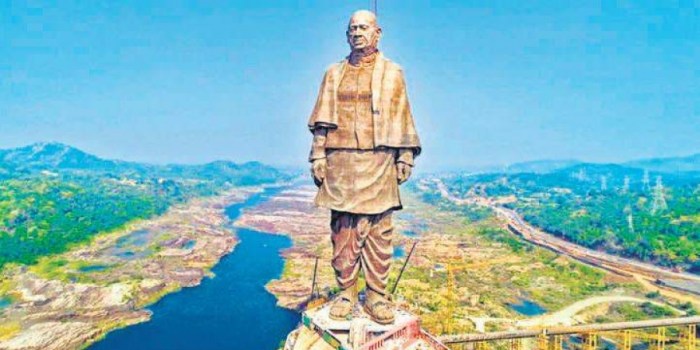
On October 31, the world’s tallest statue, the Statue of Unity dedicated to Sardar Vallabhbhai Patel, was unveiled by Prime Minister Narendra Modi. The work on the 182-metre tall statue has been completed after round the clock work by 3,400 labourers and 250 engineers at Sadhu Bet island on Narmada river in Gujarat. Sadhu Bet, located some 3.5 km away from the Narmada Dam, is linked by a 250-metre-long long bridge.

Unfortunately, for several reasons, scarce scholarly research has been done on the internal history of the Congress; the main cause is probably that a section of the party would prefer to keep history under wraps. Take the acute differences of opinion between Sardar Patel, the deputy prime minister, and “Panditji”, as Nehru was then called by Congressmen. In the last weeks of Patel’s life (he passed away on December 15, 1950), there was a deep split between the two leaders, leading to unilateral decisions for the PM, for which India had to pay the heaviest price.

The most serious cause of discord was the invasion of Tibet by the Chinese “Liberation Army” in October 1950. In the course of recent researches in Indian archives, I discovered several new facts. Not only did several senior Congress leaders, led by Patel, violently oppose Nehru’s suicidal policy, but many senior bureaucrats too did not agree with the Prime Minister’s decisions and objected to his policy of appeasement with China, which led India to lose a peaceful border.

On November 11, 1950, the deputy prime minister of India addressed a meeting organised by the Central Aryan Association to commemorate the 67th death anniversary of Swami Dayanand Saraswati. It was to be his last speech. What did he say? The Sardar spoke of the potential dangers arising from what was happening in Tibet and Nepal, and he exhorted his countrymen: “It was incumbent on the people to rise above party squabbles and unitedly defend their newly won freedom.” He cited the example of Gandhi and Swami Dayanand.

Sardar Patel then criticised the Chinese intervention in Tibet; he asserted that to use the “sword” against the traditionally peace-loving Tibetan people was unjustified: “No other country in the world was as peace-loving as Tibet. India did not believe, therefore, that the Chinese government would actually use force in settling the Tibetan question.” He observed that the Chinese government did not listen to India’s advice to settle the Tibetan issue peacefully: “They marched their armies into Tibet and explained this action by talking of foreign interests intriguing in Tibet against China.” The deputy prime minster added that this fear was unfounded; no outsider was interested in Tibet. The Sardar continued by saying that “nobody could say what the outcome of Chinese action would be. But the use of force ultimately created more fear and tension. It was possible that when a country got drunk with its own military strength and power, it did not think calmly over all issues.” He strongly asserted that the use of arms was wrong: “In the present state of the world, such events might easily touch off a new world war, which would mean disaster for mankind.”

Did he know that it was his last message? “Do not let cowardice cripple you. Do not run away from danger. The three year-old freedom of the country has to be fully protected. India today is surrounded by all sorts of dangers and it is for the people today to remember the teachings of the two great saints and face fearlessly all dangers.”

The deputy prime minister concluded: “In this Kalyug we shall return ahimsa for ahimsa. But if anybody resorted to force against us we shall meet it with force.” He ended his speech citing Swami Dayananda: “People should also remember that Swamiji did not get a foreign education. He was the product of Indian culture. Although it was true that they in India had to borrow whatever was good and useful from other countries, it was right and proper that Indian culture was accorded its due place.” Who is ready to listen to this, even today?

Days earlier, Patel had written a “prophetic” letter to Nehru, detailing the implications for India of Tibet’s invasion. In fact, Patel used a draft done by Sir Girja Shankar Bajpai, the secretary-general of the Ministry of External Affairs and Commonwealth Relations. However, Nehru decided to ignore Patel’s letter.

Witnessing the nefarious influence of K.M. Panikkar, the Indian ambassador to China, who ceaselessly defended China’s interests, Bajpai, the most seasoned Indian diplomat, had lost his cool. On October 31, in an internal note, he detailed the sequence of events which followed Tibet’s invasion and the role of Panikkar, whose attitude was compared to Sir Neville Chamberlain’s towards Hitler.

Bajpai’s anger demonstrates the frustration of many senior officers; the account starts on July 15, when the governor of Assam informed Delhi that, according to the information received by the local intelligence bureau, Chinese troops, “in unknown strength, had been moving towards Tibet from three directions.” Not only was Panikkar unable to get any confirmation, but he virtually justified Beijing’s military action by writing: “In view of frustration in regard to Formosa, the Tibetan move was not unlikely.” During the next three months, the Indian ambassador would systematically take the Chinese side.

After receiving Bajpai’s note, Patel wrote back: “I need hardly say that I have read it with a great deal of interest and profit to myself and it has resulted in a much better understanding of the points at issue and general, though serious, nature of the problem. The Chinese advance into Tibet upsets all our security calculations. … I entirely agree with you that a reconsideration of our military position and a redisposition of our forces are inescapable.”

Some more details of the seriousness of the situation filters through Inside Story of Sardar Patel: The Diary of Maniben Patel, the daughter of the Sardar. In an entry on November 2, 1950, Maniben wrote: “Rajaji and Jawaharlal had a heated altercation about the Tibet policy. Rajaji does not at all appreciate this policy. Rajaji very unhappy—Bapu (Patel) did not speak at all.”

Later in the afternoon, “Munshi complained about Tibet policy. The question concerns the whole nation—said he had written a personal letter to Panditji on Tibet.”

Later, Patel told K.M. Munshi: “Rajaji, you (Munshi), I (Patel), Baldev Singh, (C.D.) Deshmukh, Jagjivan Ram and even Sri Prakash are on one side, while Gopalaswami, Rafi, Maulana (Azad) are on his side.” There was a vertical split in the Cabinet; and it was not only about Tibet. The situation would deteriorate further during the following weeks.

On December 12, Patel was divested on his portfolios. Nehru wrote: “In view of Sardar Vallabhbhai Patel’s ill-health it is absolutely necessary that he should have complete rest and freedom from worry, so as to be able to recuperate as rapidly as possible. … No work should be sent to him and no references made to him in regard to the work of these ministries.”

Gopalaswami Ayyangar, from the “other side”, was allotted the Ministry of States and Nehru kept the Ministry of Home. The Sardar was only informed after the changes were made. He was a dejected man. Three days later he passed away. – Deccan Chronicle, 8 November 2018

» Claude Arpi is a French-born author, journalist, historian and tibetologist. He is the director of the Pavilion of Tibetan Culture at Auroville, Tamil Nadu.

Patel & Nehru