What Mahmud of Ghazni did must not be forgotten – Reshmi Dasgupta

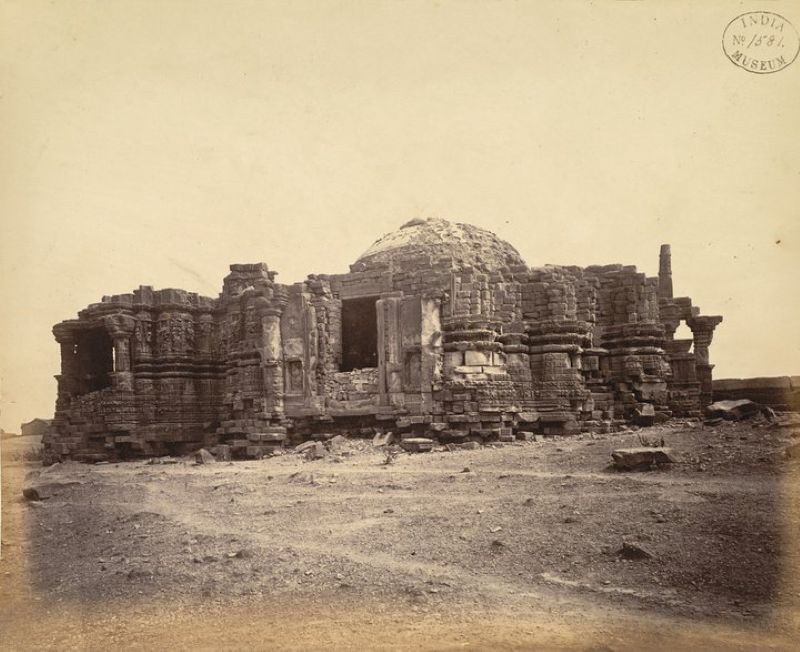
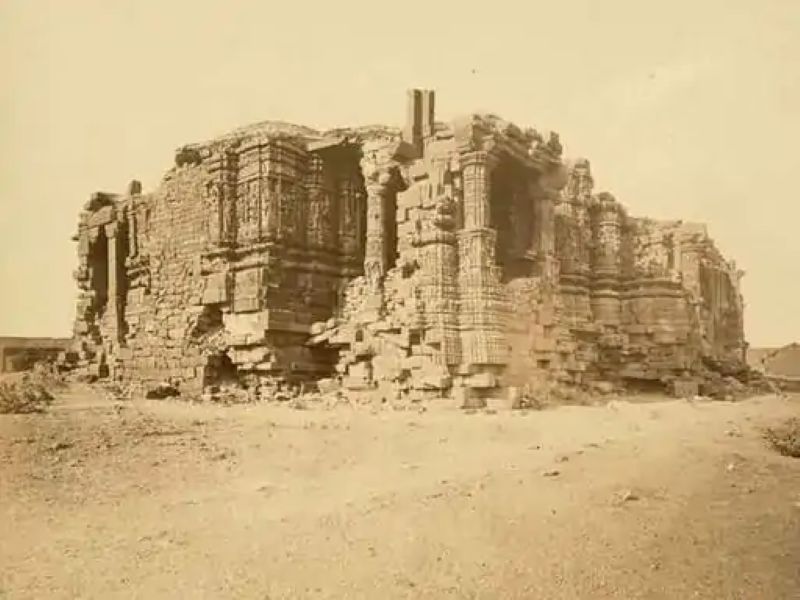
Somnath temple converted to mosque ca 1931.

What happened during this week 1,000 years ago was not a one-off assault by a greedy Central Asian despot who just incidentally happened to be Muslim. Mahmud’s destruction of Somnath set off a millennium-long assault on it by men who definitely had one thing in common apart from Islam: an animus towards the Jyotirlinga. – Reshmi Dasgupta

From January 6 to 9, 1026, the army of Mahmud of Ghazni lay siege to the wondrous temple of Somnath near the port city of Veraval. The defenders of the fortified shrine eventually could not repel the troops of the Central Asian invader and Somnath was captured. It was Mahmud’s 16th raid on India and loot was not the only target. Contemporary sources mention that Hindu merchants offered more money if he spared the idol; he refused and struck the first blow.

For that act, Mahmud earned the title “Butshikan” or idol-breaker, from an admiring Islamic world and his renown for the desecration of Somnath and other major Hindu temples in India persisted for centuries. Sultan Sikandar Shah earned the same Butshikan title in the 14th century for destroying temples in Kashmir in pursuance of the precepts of the Sufi preacher Mir Mohammad Hamadani. Even 600 years later, Aurangzeb appreciated Mahmud’s Islamic fervour.

It is inevitable that Prime Minister Narendra Modi’s commemoration of the 1000th anniversary of the first destruction (as opposed to the misleading word “sacking” commonly used for the violent actions of Mahmud of Ghazni) of the Somnath temple will be countered with supposed “proof” of either “Arab” heroism or Hindu perfidy or both. It is now almost an article of faith among certain sections in India and abroad that Mahmud was more maligned than malevolent.

As has been often pointed out in recent times, the assertions of the high priestess of the secular camp Romila Thapar on the destruction of Somnath lack basis in actual facts even if delivered with withering condescension in impeccable upper class accented English. But there are plenty of willing believers in Thapar’s argument that Mahmud was not communal—merely venal—and that his destruction of the magnificent Shiva lingam at Somnath was incidental.

Indeed, the PM calling the repeated rebuilding of Somnath after each brutal destruction and plunder a symbol of the “unbreakable courage of countless children of Bharat Mata who protected our culture and civilisation” will be met with predictable counters. First, that “Arabs”—mainly traders who had settled in the area and married local women—died protecting Somnath from Mahmud’s marauders. Second, that there were many Hindus in Mahmud’s army.

There were indeed Hindus in Mahmud’s army, including battalion commanders, and he used them with varying effectiveness in campaigns on the subcontinent and even further north in Central Asia. But the phenomenon of mercenaries—soldiers of fortune who fight for the best paymaster—is well known. The presence of Hindus in his army cannot be taken to mean Mahmud was “secular” or that his actions were not intended to attack and diminish India’s majority faith.

There is no dependable account of Arabs dying while defending Somnath, but they could well have been miffed by their co-religionists from Ghazni disturbing their livelihoods. Arabs had all been Islamised by then although earlier traders and sailors may have adhered to pre-Islamic faiths including Christianity. So, it would be a stretch to imagine they would risk irking Allah by actually fighting alongside local Hindus kafirs to save Somnath from his holy warriors.

The Veraval Inscriptions (so named for the ancient port town next to the Somnath, which had a bustling mercantile trading business) dated to about 250 years after Mahmud’s destruction of the great Shiva lingam, highlight the dynamic between the two communities in the last millennium. The bilingual inscriptions from the reign of the Vaghela king Arjundev, records an agreement for the financing of the upkeep of a mosque at Somnath Patan built by a resident of Hormuz.

Curiously, the longer Sanskrit inscription lists the Hindu king and hierarchy but mendaciously describes the lord of the mosque as Vishwanatha and Shunyarupa and even calls Prophet Mohammed a “prabodhak” or preceptor. The Muslim shipowner donor from Hormuz Nuruddin Firoz is called a “dharmabandhav” of Sri Chhada who seems to be the mosque’s chief administrator. But in the shorter Arabic notation, there is no attempt to Indianise Allah or his Prophet.

The twin inscriptions seem to indicate that Hindu rulers bore no lasting animus against all Muslims—especially the Arab and Persian merchants from the Gulf—for the depredations of the Turkic invader from Ghazni 200 years before, and allowed them to set up mosques near the temple. But one sentence of the Arabic inscription points to the thinking of the Muslims even if they attempted to couch their initial outreach to the Hindus with seemingly syncretic gestures.

The Arabic inscription expresses the hope that Somnath will one day become a city of Islam, and that infidels and idols will eventually be banished from it. Why did the officials of the Vaghelas (the last Hindu kingdom of the region) allow that explicit expression of intent to pass unchallenged? Could they not read Arabic? Or were they persuaded, as indeed are some academics reading it 750 years later, that it was a “pro forma” statement and did not constitute a threat?In the event, though Somnath was revered enough for the 11th century Chalukya ruler Bhima I to rebuild it after Ghazni’s desecration, local inhabitants naively seemed to have borne no permanent suspicion of Muslims as the Veraval inscriptions two and a half centuries later seems to confirm. But a mere 35 years after those twin plaques were incised, the army of Delhi’s Sultan Alauddin Khilji under Ulugh Khan pillaged and destroyed Somnath yet again.

And that deed was approvingly chronicled by no less than the much-admired (even today) Persian poet Amir Khusro. In Khazain-ul-Futuh (Treasures of Victory), he gleefully wrote in 1310 (after Khilji’s armies attacked again in 1304 and annexed all of Gujarat):

“So the temple of Somnath was made to bow towards the Holy Mecca; and as the temple lowered its head and jumped into the sea, you may say that the building first said its prayers and then had a bath.”

He also added:

“It seemed as if the tongue of the imperial sword explained the meaning of the text: ‘So he (Abraham) broke them (the idols) into pieces except the chief of them, that haply they may return to it.’ A pagan country, the Mecca of the Infidels, now became the Medina of Islam. The followers of Abraham now acted as guides in place of the Brahman leaders. The robust-hearted true believers rigorously broke all idols and temples wherever they found them.”

Khusro also dispelled doubts about the intent of the Arabic Veraval inscription:

“Owing to the war, ‘takbir,’ and ‘shahadat’ was heard on every side; even the idols by their breaking affirmed the existence of God. In this ancient land of infidelity, the call to prayers rose so high that it was heard in Baghdad and Madain while the Khutba resounded in the dome of Abraham and over the water of Zamzam. The sword of Islam purified the land as the Sun purifies the earth.”

That Khusro described Somnath as the “Mecca of Infidels” underlines its primacy as a Hindu centre of worship, reiterating its pride of place as the first of the 12 Jyotirlingas listed in the Shiva Purana. So it is not surprising that every Muslim ruler thereafter who wanted to assert his religious cred and supremacy attacked Somnath, from Muzaffar Shah to Mahmud Begada to Aurangzeb. But it was restored, rebuilt, reconsecrated faithfully by Hindu rulers each time.

What is glossed over by apologists is that Somnath was not considerately left to resume worship. It was converted into a mosque by several Islamic attackers and then reconstructed repeatedly as a temple by Hindu monarchs. It was turned into a domed mosque by Aurangzeb in 1665. And the final rebuild happened in 1951, thanks to the determined efforts of Sardar Patel, KM Munshi and Dr Rajendra Prasad in the teeth of opposition from Prime Minister Jawaharlal Nehru.

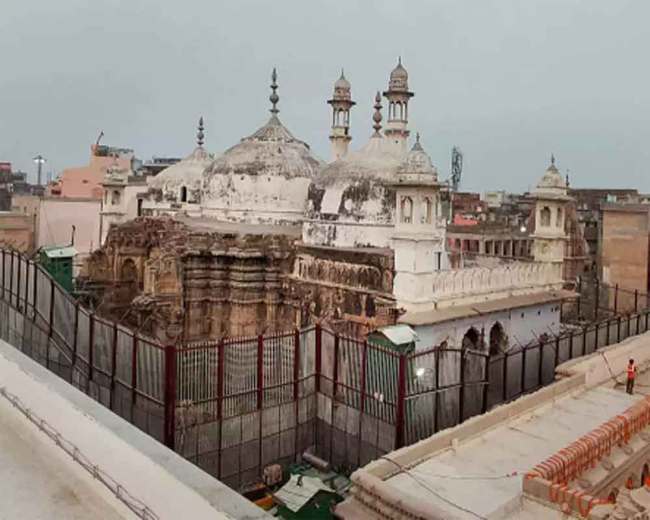
In 1783, the formidable Maratha queen Ahilyabai Holkar had another Shiva temple constructed 200 metres from the original site of Somnath, whose added dome and minaret can be seen in late 19th century photographs now in the British Library. She had done the same three years earlier in Varanasi where the original Kashi Vishwanath temple had been mostly destroyed (only one wall left standing) and rebuilt as “Gyanvapi” mosque, also on Aurangzeb’s orders.

So, what happened during this week 1,000 years ago was not a one-off assault by a greedy Central Asian despot who just incidentally happened to be Muslim. Mahmud’s destruction of Somnath set off a millennium-long assault on it by men who definitely had one thing in common apart from Islam: an animus towards the Jyotirlinga. That it is standing proudly again is indeed a testament to the quiet determination and faith of the children of Bharat Mata, as PM Modi said. – News18, 7 January 2026

›  Reshmi Dasgupta is a freelance writer formerly with the Times of India Group. 
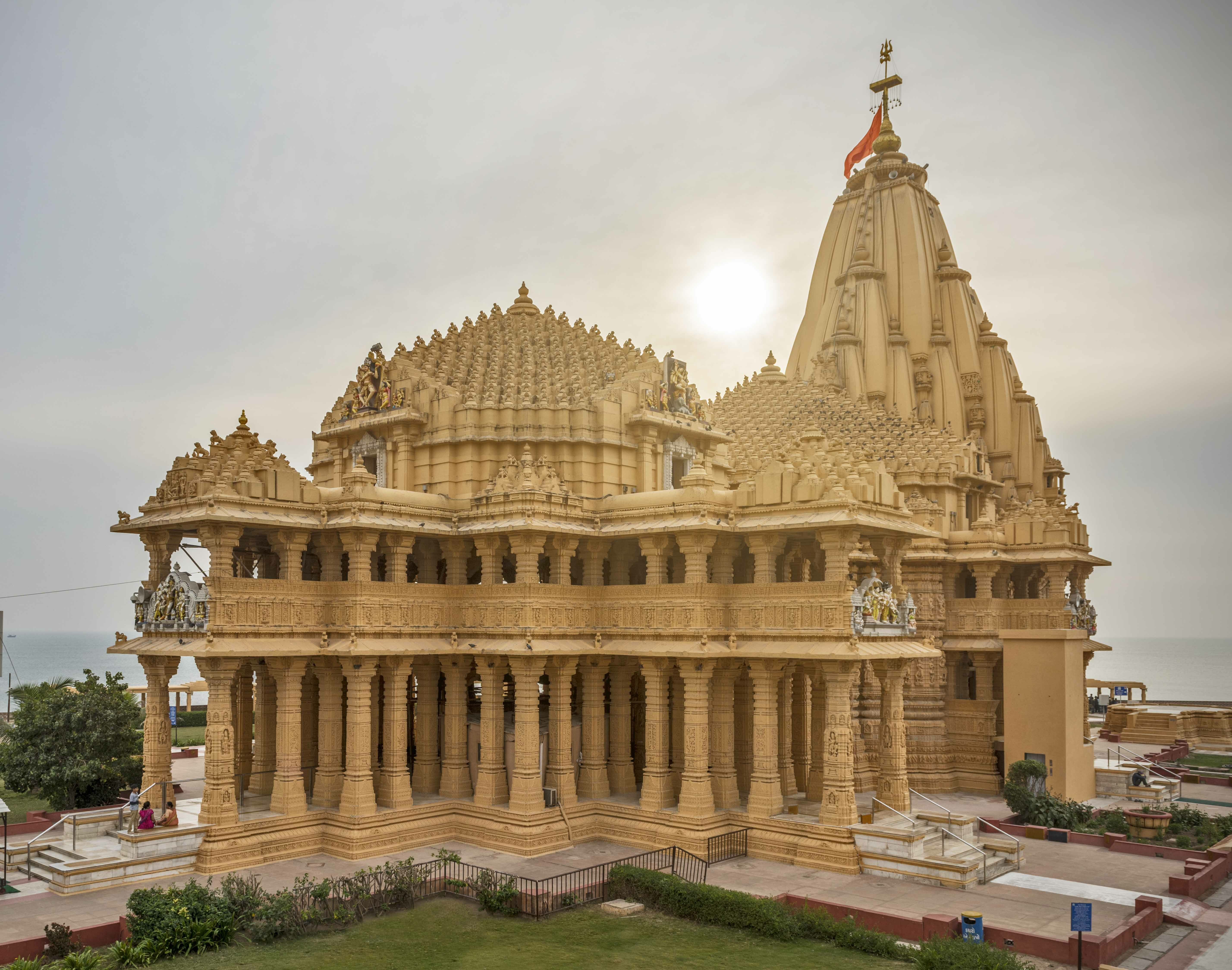
Somnath Temple

Somnath: A thousand years of unbroken faith – Narendra Modi

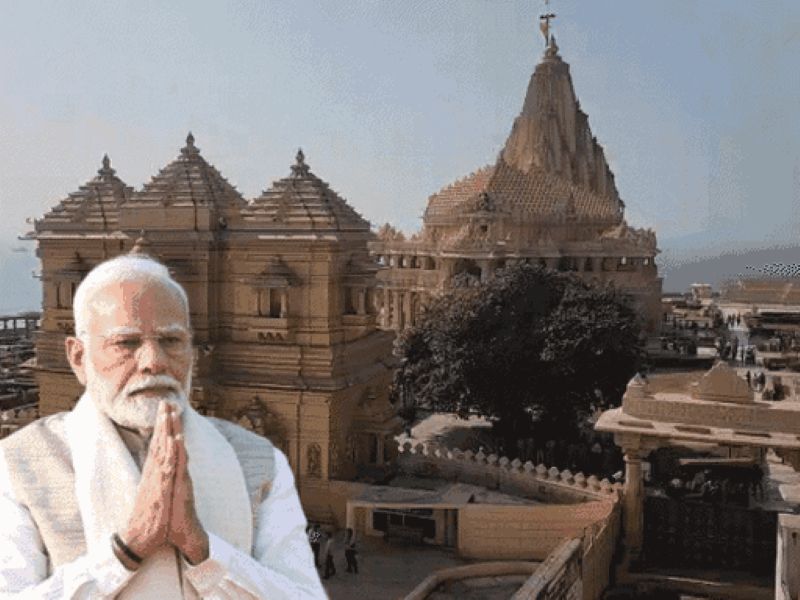
Narendra Modi at the Somnath Temple.

If the Somnath Temple, which was attacked a thousand years ago and faced continuous attacks thereon, could rise again and again, then we can surely restore our great nation to the glory it embodied a thousand years ago before the invasions. – PM Narendra Modi

Somnath … hearing this word instils a sense of pride in our hearts and minds. It is the eternal proclamation of India’s soul. This majestic temple is situated on the western coast of India in Gujarat, at a place called Prabhas Patan. The Dwadasha Jyotirling Stotram mentions the 12 Jyotirlings across India. The stotram begins with “सौराष्ट्रे सोमनाथं च…” symbolising the civilisational and spiritual importance of Somnath as the first Jyotirling.

It is also said:

सोमलिङ्गं नरो दृष्ट्वा सर्वपापैः प्रमुच्यते ।

लभते फलं मनोवाञ्छितं मृतः स्वर्गं समाश्रयेत्॥

It means: Just the sight of Somnath Shivling ensures that a person is freed of sins, achieves their righteous desires and attains heaven after death.

Tragically, this very Somnath, which drew the reverence and prayers of millions, was attacked by foreign invaders, whose agenda was demolition, not devotion.

The year 2026 is significant for the Somnath Temple. It has been 1,000 years since the first attack on this great shrine. It was in January of 1026 that Mahmud of Ghazni attacked this temple, seeking to destroy a great symbol of faith and civilisation, through a violent and barbaric invasion.

Yet, one thousand years later, the temple stands as glorious as ever because of numerous efforts to restore Somnath to its grandeur. One such milestone completes 75 years in 2026. It was during a ceremony on May 11th 1951, in the presence of the then President of India, Dr. Rajendra Prasad, that the restored temple opened its doors to devotees.

The first invasion of Somnath a thousand years ago in 1026, the cruelty that was unleashed upon the people of the town and the devastation that was inflicted upon the shrine have been documented in great detail in various historical accounts. When you read them, the heart trembles. Each line carries the weight of grief, cruelty and a sorrow that refuses to fade with time.

Imagine the impact it had on Bharat and the morale of the people. After all, Somnath had great spiritual significance. It was also on the coast, giving strength to a society with great economic prowess, whose sea traders and seafarers carried tales of its grandeur far and wide.

Yet, I am proud to state unequivocally that the story of Somnath, a thousand years after the first attack, is not defined by destruction. It is defined by the unbreakable courage of crores of children of Bharat Mata.

The medieval barbarism that began a thousand years ago in 1026 went on to ‘inspire’ others to repeatedly attack Somnath. It was the start of an attempt to enslave our people and culture. But, each time the temple was attacked, we also had great men and women who stood up to defend it and even made the ultimate sacrifice. And every single time, generation after generation, the people of our great civilisation picked themselves up, rebuilt and rejuvenated the temple. It is our privilege to have been nurtured by the same soil that has nurtured greats like Ahilyabai Holkar, who made a noble attempt to ensure devotees can pray at Somnath.

In the 1890s, Swami Vivekananda visited Somnath and that experience moved him. He expressed his feelings during a lecture in Chennai in 1897 when he said:

“Some of these old temples of Southern India and those like Somnath of Gujarat will teach you volumes of wisdom, will give you a keener insight into the history of the race than any amount of books.

“Mark how these temples bear the marks of a hundred attacks and a hundred regenerations, continually destroyed and continually springing up out of the ruins, rejuvenated and strong as ever! That is the national mind, that is the national life-current. Follow it and it leads to glory. Give it up and you die; death will be the only result, annihilation, the only effect, the moment you step beyond that life current.”

The sacred duty of rebuilding the Somnath Temple after independence came to the able hands of Sardar Vallabhbhai Patel. A visit during Diwali time in 1947 moved him so much that he announced that the temple will be rebuilt there. Finally, on May 11th 1951, a grand temple in Somnath opened its doors to devotees and Dr. Rajendra Prasad was present there. The great Sardar Sahib was not alive to see this historic day, but the fulfilment of his dream stood tall before the nation.

The then Prime Minister, Pandit Jawaharlal Nehru, was not too enthused with this development. He did not want the Honourable President as well as Ministers to associate with this special event. He said that this event created a bad impression of India. But Dr. Rajendra Prasad stood firm and the rest is history. No mention of Somnath is complete without recalling the efforts of K.M. Munshi, who supported Sardar Patel very effectively. His works on Somnath, including the book, Somanatha: The Shrine Eternal, are extremely informative and educative.

Indeed, as the title of Munshiji’s book conveys, we are a civilisation that carries a sense of conviction about the eternity of spirit and of ideas. We firmly believe that that which is eternal is indestructible, as outlined in the famous Gita verse “नैनं छिन्दन्ति शस्त्राणि….” There can be no better example of our civilisation’s indomitable spirit than Somnath, which stands gloriously, overcoming odds and struggles.

It is this same spirit that is visible in our nation, one of the brightest spots of global growth, having overcome centuries of invasions and colonial loot. It is our value systems and the determination of our people that have made India the centre of global attention today. The world is seeing India with hope and optimism.

They want to invest in our innovative youngsters. Our art, culture, music and several festivals are going global. Yoga and Ayurveda are making a worldwide impact, boosting healthy living. Solutions to some of the most pressing global challenges are coming from India.

Since time immemorial, Somnath has brought together people from different walks of life. Centuries ago, Kalikal Sarvagna Hemchandracharya, a respected Jain monk, came to Somnath. It is said that after praying there, he recited a verse, “भवबीजाङ्करजनना रागाद्या: क्षयमुपगता यस्य।”. It means: “Salutations to That One in whom the seeds of worldly becoming are destroyed, in whom passion and all afflictions have withered away.” Today, Somnath holds the same ability to awaken something profound within the mind and soul.

A thousand years after the first attack in 1026, the sea at Somnath still roars with the same intensity as it did back then. The waves that wash the shores of Somnath tell a story. No matter what, just like the waves, it kept rising again and again.

The aggressors of the past are now dust in the wind, their names synonymous with destruction. They are footnotes in the annals of history, while Somnath stands bright, radiating far beyond the horizon, reminding us of the eternal spirit that remained undiminished by the attack of 1026. Somnath is a song of hope that tells us that while hate and fanaticism may have the power to destroy for a moment, faith and conviction in the power of goodness have the power to create for eternity.

If the Somnath Temple, which was attacked a thousand years ago and faced continuous attacks thereon, could rise again and again, then we can surely restore our great nation to the glory it embodied a thousand years ago before the invasions. With the blessings of Shree Somnath Mahadev, we move forward with a renewed resolve to build a Viksit Bharat, where civilisational wisdom guides us to work for the welfare of the whole world.

Jai Somnath! – The New Indian Express, 5 January 2026

Narendra Modi is the Prime Minister of India and Chairman of the Shri Somnath Temple Trust.

Ruins of Somnath as viewed in 1869

Vande Mataram: How an anti-British song became ‘anti-Muslim’ – Ibn Khaldun Bharati

Bankim Chandra Chatterjee

In the Islamic political praxis, Muslims are nationalist if they are in majority and the rule is theirs. But if they can’t rule the country, they can’t be nationalist either. – Ibn Khaldun Bharati

The Muslim opposition to Vande Mataram is well known. However, the reason behind it is not well understood. Actually, it’s beyond comprehension. Their objection to the national song is formulated in such abstruse theological terms that even an educated Muslim can’t grasp its esoteric nuance. In reality, it’s not so much an opposition to the song as to the idea behind it—the idea of India as a nation. It’s the idea that Hindus and Muslims become an organic whole to form an inseparable political community. The major Muslim ideologues insisted on their separateness, and separate they remain.

To say that saying Vande Mataram (Salutations, Oh Mother) evokes the imagery of idol worship is the kind of convoluted reasoning that defies common sense. Furthermore, to emphasise that the hostility to idol worship is the foundational creed of Islam, and that it’s incumbent on every Muslim to wear this abhorrence on sleeve, isn’t really conducive to diversity, pluralism, peaceful coexistence, and composite nationhood—the ideals in which the Muslims have greater stake than anyone else.

Recently, Maulana Mahmood Madani, the head of the largest organisation of ulema in India, Jamiat Ulema-i-Hind, made a controversial speech, in which he stressed the imperative of jihad in India. He also said, “Murda qaumen mushkilaat mein mubtala nahin hotin. Wo to surrender kar deti hain. Wo kahenge ke Vande Mataram padho to padhna shuru kar denge.” (Dead communities don’t face any difficulty since they surrender readily. When asked to chant Vande Mataram, they willingly do that).

The ferocity with which these Muslims proclaim their revulsion for Vande Mataram, and the grim determination with which they threaten to go to war if its public singing were to be revived, makes one wonder if there is actually something so repugnant in the song that a Muslim can’t countenance it if he were to remain true to his faith.

Is there a problem?

Let’s see if there is anything in Vande Mataram that makes Muslims recoil in horror. Arif Mohammed Khan, the scholarly Governor of Bihar, translated into Urdu the two stanzas that have the status of the national song, and sent the same to one of the most prominent Islamic seminaries, the Nadwa, at Lucknow, for their opinion on it; specifically asking if there was anything in it that was contrary to Islam.

It was presented as an original composition, and not a translation. He had rendered the key words, Vande Mataram, as “Taslimaat, Maa, Taslimaat”. The ulema at Nadwa opined that there was nothing in the song that contravened Islam. One, however, suspects that if they knew it to be the translation of Vande Mataram, they might have had a different opinion. Such is politics and such is the power of narrative!

The reality behind the narrative

The root of the Sanskrit word ‘vande’ is ‘vand’. According to Sanskritist Monier Monier-Williams, depending on the context, ‘vand’ means “to praise, celebrate, laud, extol, to show honour, do homage, salute respectfully; or, venerate, worship, adore”. The primary meaning is not worship; certainly, not the ritual worship. Even if it were, hasn’t Urdu poetry been more extravagant in such expressions. For example, Iqbal, the poet of Islamic revivalism, in one of his earlier poems, said, “Khaak-e watan ka mujhko har zarra devta hai” (Every particle of the country is a god unto me)”. Iqbal’s fans—quite a few of them being fundamentalist fanatics—never saw anything amiss in this.

Can there be a nation without a motherland?

As for mataram, i.e., mother—Mother India—Urdu has a beautiful term, madar-e-watan, the motherland. No Muslim ever found this concept contrary to Islam. In fact, the most literal and yet most exquisite rendition of Vande Mataram has been A.R. Rahman’s song Maa Tujhe Salaam.

There are numerous verses in the Quran (7:12, 23:12, 30:20, etc.) which say that we are made of earth, and it is the source of life and the place of origin. It’s implied that, in a deeper sense, the earth is the mother, and one’s own place is the motherland.

In a display of genius that is peculiar to them, the Muslim leaders espied the idol of a deity in the conception of motherland, and flinched from its adoration. Even in Pakistan—which broke away from us, on difference over the Indian nationhood, and the sacredness of the motherland—Asim Munir, the generalissimo, can be seen referring to his country as motherland.

Nowhere else in the world do Muslims have had any problem with the concepts of nationalism and the sacredness of the respective countries. The literal translation of the word ‘Pakistan’ is holy land, which in Hindi translates as punya bhumi. The Indian Muslims, however, can’t accord this status to their own country.

In the Islamic political praxis, Muslims are nationalist if they are in majority, and the rule is theirs. But if they can’t rule the country, they can’t be nationalist either. In a debate that raged between poet Muhammad Iqbal and Jawaharlal Nehru, the former candidly said, “In majority countries Islam accommodates nationalism; for there Islam and nationalism are practically identical; in minority countries it is justified in seeking self-determination as a cultural unit”. (Modern Review, Calcutta, 1934-35)

There’s a deeper reality. Without recognising the country as the motherland, there can’t be a nation. But can the people who came as invaders, conquered the country, and ruled it for centuries, ever accord the status of mother to the vanquished territory? Could the British ever regard India as mother?

The Muslim ideology has been in the hands of the elite descended from the old ruling class. The Muslim masses follow it uncritically because it’s couched in religious idiom, and religion is not to be questioned.

Is Anandmath anti-Muslim?

Regarding Vande Mataram being a part of the novel Anandmath; well, it’s true that the poem, though independently written, has been interpolated in the book. It’s also true that the theme of the book is the Sannyasi Rebellion of 1770s, which was an uprising against the oppressive Muslim rule, and therefore, some passages have clear anti–Muslim overtones. But isn’t it equally true that those Muslim rulers were oppressors, and their religious hostility toward the Hindu peasants was an added factor in oppression? So, why shouldn’t the rebellion against them be seen as a class war of the oppressed against the oppressors, and the fulmination against them should be seen in perspective, and not misconstrued as invective against ordinary Muslims who belonged to the same class as them? Haven’t we seen this kind of class analysis about the Moplah “Rebellion”?

But, it’s not possible despite the fact that a large number of Marxist historians have been Muslim. That’s because, these historians, when it suits them, treat Muslims as a monolith, ignoring their socioeconomic diversities. Thus, a justified diatribe against the Nawabi system is seen as a tirade against ordinary Muslims. What if Indian Christians were to see in the criticism of the British rule the condemnation of ordinary Christians?

By the way, no Indian ever rejected the popular patriotic song Saare Jahan Se Achha just because it’s from the pen of Iqbal, the separatist ideologue.

The genesis

Vande Mataram, set to tune by Rabindranath Tagore, had been sung in the Congress sessions since 1896. No Muslim leader ever found it antithetical to their religion. Even during the Swadeshi Movement, which was a response to the Partition of Bengal (1905), when this song became the anthem of resistance to the British, one doesn’t hear of any objection to its purported polytheistic imagery. This was despite the fact the division of Bengal was on religious lines, and it supposedly favoured the Muslim majority of East Bengal. Even Maulana Abul Kalam Azad, the great Islamic scholar and thinker, who claims to have joined the underground revolutionary movement of the Bengali youth, doesn’t record any religious objections to it.

Even during the Khilafat Movement (1919-24), when the Congress was working on pan-Islamist agenda, Vande Mataram continued to be sung in its gatherings, in the presence of the leading Khilafatist maulanas, who, then, dominated its proceedings.

How an anti-British song became ‘anti-Muslim’

From 1896 to 1937, Vande Mataram was the staple for the Congress. And then, elections were held under the Government of India Act, 1935; and Congress ministries were formed in provinces. After centuries, the natives of India, the Hindus, were in power. The Muslim ruling class could endure British rule, but seeing their former subjects becoming rulers was beyond their endurance. For centuries, they had been conditioned to look down upon the Hindus, and now the same Hindus were ministers. They freaked out, and began hallucinating about the Hindu oppression. As they upped the ante for a desperate fight, their glance fell upon the “Durga” and “Lakshmi” in Vande Mataram, and the Islam-in-danger bogey became ever more palpable.

This situation has been best summarised by a nationalist Muslim, Rafi Ahmed Kidwai. In a statement that was published in The Pioneer on 19 October 1937, that merits in-extenso reproduction, he said, “Mr. Jinnah characterises Vande Mataram as an anti-Islamic song. Mr Jinnah had been a devoted and enthusiastic member of the Congress and of its chief executive, the All-India Congress Committee, for a number of years. Every year, the session of the Congress opened with the singing of this song, and every year he was seen on the platform listening to the song with the attention of a devotee. Did he ever protest? Mr Jinnah left the Congress, not because he thought the Vande Mataram was an anti-Islamic song, but because he had found the idea of swaraj unacceptable.”

Nehru is both Churchill and Chamberlain

The Muslim League, having suffered a rout in the 1937 elections, and further failing to force its way into the government in the United Provinces—not on the basis of the seats won, but as an entitlement for having once been the rulers—suddenly realised that Vande Mataram was idolatrous, and raised a war cry against it.

In the book Vande Mataram: The Biography of a Song, historian Sabyasachi Bhattacharya details the debates in the Congress, and the correspondence between Nehru, Bose, and Rabindranath Tagore. Nehru’s first reaction was: “The present outcry against Bande Mataram is to a large extent a manufactured one by the communalists.” However, soon, in order to appease the communalists, he said that having read the English translation of Anandmath, he was of the opinion that it was “likely to irritate the Muslims”. And so, he set out “to meet real grievances where they exist(ed).” That is how the Congress Working Committee, on 26 October 1937 (just days after Kidwai’s remonstrance), decided to truncate the song, and adopt only the first two stanzas as they were “unobjectionable”.

Such bending backward before the communalists recalls to mind what Atal Bihari Vajpayee once told Nehru about the streak of appeasement in him: “In you, there are both Churchill and Chamberlain”.

Sabyasachi Bhattacharya narrates how this concession couldn’t satisfy the Muslim League, as they insisted on the deletion of Vande Mataram in toto. Jinnah wrote, “Pandit Jawaharlal Nehru cannot be unaware that Muslims all over have refused to accept the Vande Mataram or any expurgated edition of the anti-Muslim song as a binding National Anthem”.

Prime Minister Narendra Modi is right in his analysis that the mutilation of Vande Mataram whetted the appetite of the Muslim League, and became the prelude to the partition of India. It is in the logic of appeasement that instead of resolving an issue, it exacerbates it.

Even now, the Muslim leadership remains as staunchly against Vande Mataram as it was during Jinnah’s time. So, what is gained by cutting out the better part of the song; and, what’s been gained by acquiescing to the partition?

The way forward

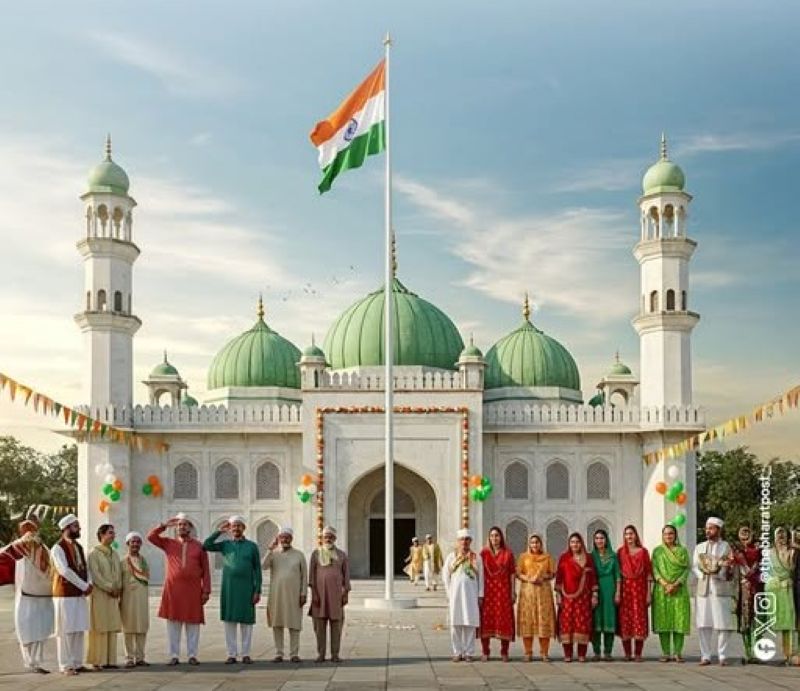
Since 2014, because of the conducive atmosphere provided, the Muslims have been showing an unprecedented fondness for the Constitution, and the sacred symbols of the nation. The Independence and Republic Days are celebrated with gaiety in Muslim institutions, including madrasas; and the national anthem is sung with gusto. Many a time, one can see the national flag waving from the high minaret of a mosque. If a better atmosphere is conduced, the Muslims will sing Vande Mataram with as much fervour as anyone else. – The Print, 12 December 2025

Ibn Khaldun Bharati is a student of Islam, and looks at Islamic history from an Indian perspective. 

Chhattisgarh Waqf Board orders all mosques and madrasas to hoist the Indian flag on Independence Day.

Hinduism & Buddhism: More similar than dissimilar – Ravi S. Kapoor

Mahabodhi Temple

In many parts of Asia—including India, Nepal, and Tibet—there is considerable similarity between Buddhist and Hindu practices, with communities often participating in each other’s festivals and visiting shared sacred sites. – Ravi Shanker Kapoor

With the Supreme Court agreeing to examine a plea for repealing the Bodh Gaya Temple Act, 1949, tensions between Buddhists and Hindus may rise shortly. As it is, there is a long-standing belief that Buddhism and Hinduism are fundamentally different from and antithetical to each other. This perception has led to the construction of oppositional binaries: egalitarian Buddhism versus iniquitous Hinduism, noble Buddhists versus wicked and scheming Brahmins, atheistic versus theistic, spiritual versus ritualistic. However, a closer examination of the philosophies, histories, and lived practices of the two traditions reveals that such binaries are misleading.

At the heart of both Hinduism and Buddhism lie the concepts of dharma and karma. These are not just abstract metaphysical principles but fundamental frameworks through which both traditions interpret human action and its consequences. In Hindu thought, dharma represents righteous duty, aligned with cosmic order. Karma refers to the principle of causation, where one’s actions directly influence future circumstances—either in this life or the next. Buddhism, especially in its early and classical forms, embraces these principles in similar ways.

While it is true that the Buddha rejected the authority of the Vedas and certain ritual practices associated with orthodox Brahmanical practices, he did not reject the ethical foundations of religious life. His teachings were a reformist response to what he saw as unnecessary ritualism and social stratification, not a wholesale rejection of spirituality. The roots of his thought remain embedded in the soil of the Indian subcontinent, and many of his core ideas are echoed in various strands of Hindu philosophy, especially in the Upanishads, Samkhya, and Vedanta schools.

From a theological perspective, there is a remarkable similarity between the philosophies of several Buddhist teachers and the great Hindu exponent of Vedanta, Adi Shankar. According to Encyclopedia Britannica, “His works reveal that he not only was versed in the orthodox Brahmanical traditions but also was well acquainted with Mahayana Buddhism. He is often criticized as a ‘Buddhist in disguise’ by his opponents because of the similarity between his doctrine and Buddhism. Despite this criticism, it should be noted that he made full use of his knowledge of Buddhism to attack Buddhist doctrines severely or to transmute them into his own Vedantic non-dualism.”

Another misconception often propagated is that Buddhism was inherently against Brahminical authority, that it was a movement against Brahmins. Historical evidence contradicts this simplistic narrative. A large number of early and influential Buddhist monks, scholars, and teachers were themselves Brahmins. Asanga and Vasubandhu, the fourth-century Gandhara-based Brahmin brothers, went on to found the Buddhist school of Yogacara (Practice of Yogā). It became a prominent school in China.

Kumarjiva (344-13), a brilliant translator of the Mahayana Buddhist texts like Lotus Sutra, was the son of a Brahmin. The great Buddhist philosopher of the Madhyamaka school, Nagarjuna, and the poet who embraced Buddhism after being its critic, Asvaghosha, also had Brahmin backgrounds.

Idols play a major role in Hinduism and Buddhism, though the followers of both faiths have different attitudes towards idols. In many parts of Asia—including India, Nepal, and Tibet—there is considerable similarity between Buddhist and Hindu practices, with communities often participating in each other’s festivals and visiting shared sacred sites.

The similarity in iconography is also quite evident. Also, images of the Buddha are often found in Hindu homes.

Another dimension where Hinduism and Buddhism have a common history is in the suffering and destruction inflicted by Muslim invasions, particularly during the medieval period. Between the 12th and 16th centuries, numerous Buddhist monasteries and Hindu temples were destroyed, their libraries burned, and monks and priests killed. The great Buddhist universities of Nalanda, Vikramashila, and Odantapuri, which were global centers of learning, were brutally attacked by Turkic and Afghan invaders. Hindu religious centers, too, faced similar devastation.

This shared trauma is a chapter in Indian history that remains insufficiently acknowledged in public discourse. Both traditions were marginalized, not only in terms of physical infrastructure but also in terms of cultural continuity. While Hinduism, with its vast rural roots and decentralised structure, managed to survive and revive over time, Buddhism, with its monastic dependency, suffered a more prolonged decline in India—though it flourished in other parts of Asia.

This is not to suggest that there was never any conflict between the two great traditions, but mostly it was peaceful coexistence. In India, as elsewhere. In The Golden Road: How Ancient India Transformed the World, William Dalrymple writes, “This free mixing of Hinduism and Buddhism is a striking feature of South-east Asian religion for this time onwards [sixth century]. … The Buddha and the Hindu gods accommodated each other and often appear folded in with local religious practices including ancestor worship, fertility ceremonies, and Naga and Yakshi worship as well as other spirit cults.”

To pit Hinduism and Buddhism against each other is to do a disservice to both. – News18, 1 September 2025

› Ravi Shanker Kapoor is an author and freelance journalist.

Muhammad Bakhtiyar Khalji

James Prinsep: The Englishman who mapped the Adi Vishwanath Temple in Kashi – Yudhajit Shankar Das

James Prinsep

James Prinsep first served in Calcutta and then in Benaras for ten years. Prinsep’s stay in Varanasi—from 1820 to 1830—is what is of interest and importance against the backdrop of what is unfolding today. – Yudhajit Shankar Das

At a walking distance from Kolkata’s Eden Gardens is the Prinsep Ghat on the banks of the River Hooghly. One gets a close view of the Vidyasagar Setu and can take a boat ride on the Hooghly from Prinsep Ghat.

The ghat is named after James Prinsep, a British numismatist and archaeologist, who made significant contributions to India’s historiography. He came to India when he was 28 and was the youngest fellow of the British Asiatic Society.

It was Prinsep who deciphered the Brahmi and Kharosthi scripts and helped the world know about Emperor Ashoka’s reign. It was he who established that King Devanampriya Piyadasi, who is mentioned in several inscriptions from Sri Lanka to Afghanistan, was none other than Emperor Ashoka.

The ghat in Kolkata was named after Prinsep as a way to recognise his contributions after he passed away in London in 1840 at the young age of 41.

Benares Illustrated by James Prinsep

James Prinsep and his ‘Benares Illustrated’

James Prinsep first served in Calcutta (now Kolkata) and then in Benaras (now Varanasi) for ten years. Prinsep’s stay in Varanasi (from 1820 to 1830) is what is of interest and importance against the backdrop of what is unfolding now.

Prinsep built Varanasi’s underground sewage system, which is still operational, restored the Alamgir Mosque, built by Mughal Emperor Aurangzeb in 1669, and drew the city’s maps. He also brought out a book, Benares Illustrated, A Series of Drawings, in 1831.

That book and the map will be used as part of evidence by the Hindu side in the legal battle for the Gyanvapi complex, IndiaToday has been told.

In Benares Illustrated, James Prinsep used lithography to engrave every scene on paper and present information with evidence. Chapters and illustrations include Munikurnika Ghat, Bruhma Ghat, Procession of the Tazeeas and Hindoo Nach Girls.

Most importantly, James Prinsep, in Benares Illustrated, discussed the architecture of the old Vishweshwar Temple, and how the original place of worship was converted to the present Gyanvapi Mosque. Vishweshwar or Lord of the Universe is another name for Lord Shiva.

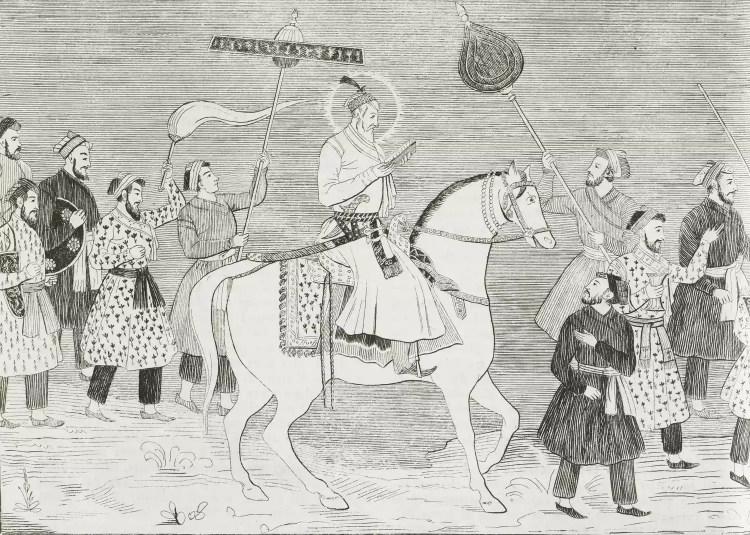
Engraving (1848) of Emperor Aurangzeb with his retenue.

Prinsep on Auranzeb’s bigotry

In Benares Illustrated, Prinsep details how Aurangzeb’s men used the material from the destroyed Kashi Vishweshwar Temple to build the Gyanvapi Mosque.

“The bigotry of Aurungzeb did not allow many vestiges of this more ancient style to remain. In 1660, for some trifling resistance to the imposition of a capitation tax, he took occasion to demolish the principal Shiwalas, and constructed Musjids or mosques with the same materials and upon the same foundations, leaving portions of the ancient walls exposed here and there, as evidence of the indignity to which the Hindoo religion had been subjected,” Princep writes.

The Kashi Vishweshwar Temple is of immense significance in Hinduism as it is one of the 12 Jyotirlingas or temples where Lord Shiva is said to have appeared as a column of light. Lord Shiva is said to have created a water-producing spot there hence the name Gyanvapi (well of knowledge).

The Adi Vishveshwara Temple was destroyed by Qutb ud-Din Aibak, the general of Muhammad Ghori, in 1194 but was rebuilt. It was Aurangzeb who razed the Kashi Vishweshwar Temple again in 1669 and built the Gyanvapi Mosque using the same foundations and materials.

It is very similar to the use of materials from the destroyed 12th-century temple that was used to build the Babri Masjid in Ayodhya. The Babri Masjid was constructed in 1528 by Babur’s commander, Mir Baqi.

Babur was the first Mughal ruler in India, while Aurangzeb was the last of that family to hold sway.

Distroyed Viswanath Temple replaced by Gyanvapi Mosque (James Princep 1834).
Plan of the ancient Kashi Vishwanath Temple. Fine dotted line in the plan image indicates the Gyanvapi Mosque build over the temple's foundation (James Prinsep 1832).

Prinsep’s 200-year-old map of Gyanvapi Temple

Prinsep then went on to reveal the old plan of the Vishweshwar Temple by drawing a map and marking on it how the Aurangzeb-built mosque stood on it.

But how could Prinsep, who came to Varanasi in the 19th century, come up with the map of the old Kashi Vishweshwar Temple, which was destroyed by Aurangzeb in the 17th Century, after a gap of about 160 years?

Prinsep explains in Benares Illustrated how he exactly managed to draw the map of the old Vishweshwar temple.

“Antiquarians will be well pleased that the Moosulmans, in their zeal for the triumph of their own religion, discovered a method of converting the original structure into a capacious Musjid, without destroying above one-half of its walls; so that not only the ground plan but the entire architectural elevation, may still be traced out,” he writes.

In the chapter “Plan of the old Vishveshwur Temple” of Benares Illustrated, Prinsep shares the map that shows that the old Kashi Visheshwar Temple had eight mandaps and the central section which Prinsep calls ‘Mahadeo’.

“The darkly shaded part shews the figure and foundations of the principal dewul: the fainter, those of the outer dewulees. The whole must have formed, when complete, a picturesque groupe of nine spires around a central pyramid. The heights diminishing from the centre towards the corners in the proportions of sixteen, eight, and six, as seen by the ground plan,” he writes.

The book and the map will be part of the evidence put forward in the Gyanvapi case, advocate Vishnu Jain, who represents the Hindu side in courts of law, confirmed to IndiaToday.

Shiva linga found in a well in Gyanvapi Mosque. According Muslims it is a wazukhana fountain (though there is no water connection and the top nozzle is added recently).

Prinsep on the ‘Lingam’ at Gyanvapi Masjid

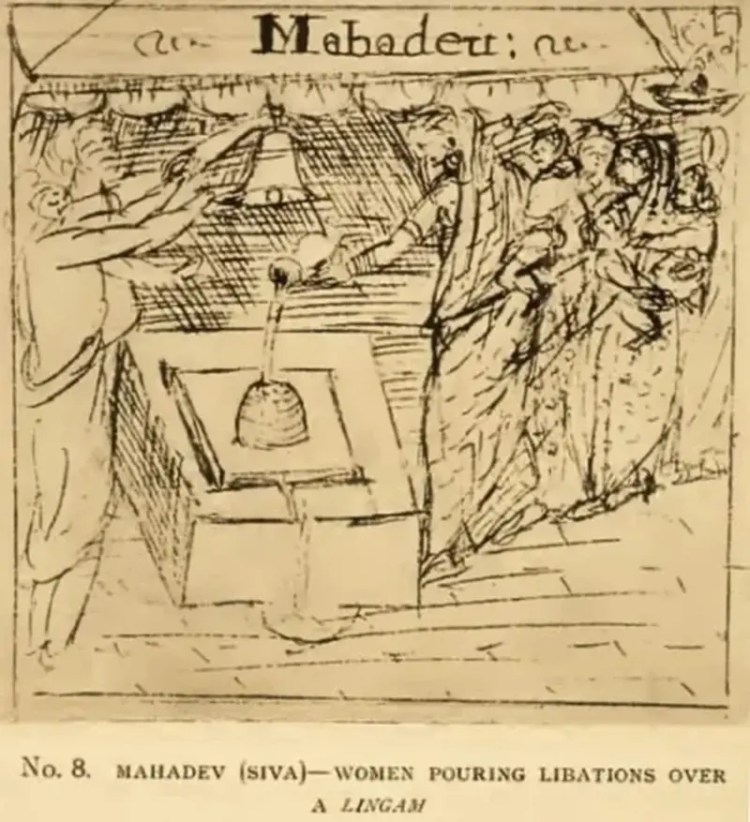
“The principal lingam of Mahadeo stood in an ornamented reservoir in the centre, having a drain below to carry off the Ganges water continually poured over it by day and night,” writes James Prinsep in his Benares Illustrated.

“Prinsep has shown the place of Vishweshwar or Mahadev in the centre of the temple and indicates that the principal lingam was located in a water reservoir and that could be the so-called fountain in the wazukhana, which could have been originally the ornamented reservoir having the lingam,” B.R. Mani, Director General of National Museum, tells IndiaToday.

Mani, who led the Allahabad High Court-ordered excavation at the then-disputed Ram Janmabhoomi-Babri Masjid site in 2003, says that more research is needed to ascertain if it is, in fact, the ‘Lingam’ that James Prinsep mentions.

The wazukhana, or the ablution area, of the Gyanvapi Mosque was sealed in 2022 following a Supreme Court order. According to the Hindu side, the fountain-like structure in the wazukhana is a Shivling or lingam.

This is what Prinsep seems to have suggested in his 1831 book.

“If you draw a graph of human genius, James Prinsep would head the list along with Leonardo da Vinci,” said O.P. Kejariwal, then Director of Nehru Memorial Library, in 2001.

The Gyanvapi site is seeing fast-paced action. A Varanasi court has allowed Hindus to perform puja in one of the cellars, Vyas ji ka Tehkhana, which was ordered sealed by former Uttar Pradesh Chief Minister Mulayam Singh in 1993.

Amid the legal battle surrounding the Gyanvapi site, James Prinsep and his Benares Illustrated, A Series of Drawings of 1831 are interesting to revisit. Both will likely play a key role in the events that follow.

As all the focus is on the Gyanvapi site, about 680 km from Varanasi, stands Prinsep Ghat in Kolkata, in the balmy breeze blowing from the Hooghly River. – IndiaToday, 7 February 2024

Yudhajit Shankar Das is a deputy editor at IndiaToday.

Women doing abhishek to lingam in the Adi Vishwanath Temple (Peter Mindy 1632).

Sita Ram Goel Vindicated: ‘Eminent historians’ no longer deny Islamic iconoclasm – R. Jagannathan

Sita Ram Goel

If the “eminent historians” now can acknowledge the reality of Islamic iconoclasm, surely they can promote Hindu-Muslim amity by getting Muslim groups to accept that damage was done in the past, and some remedy is called for in the present to let bygones become bygones. – R. Jagannathan

Our “eminent historians”, mostly from the Left, are showing signs that they are not beyond all education when hit repeatedly on their heads with facts and evidence. The late Sita Ram Goel, who was among the first to debunk the whitewashed versions of India’s Islamic history, stands vindicated.

Before the Babri was demolished, they repeatedly asserted that there was no temple below the mosque. Once the archaeological survey ordered by the Allahabad High Court established beyond doubt that there indeed was a temple below the Babri, their story-line changed from “no temple below the mosque”, to bland assertions that what was under the Babri was another mosque or even a Buddhist stupa. (Read some of what they said then here.)

When evidence kept surfacing of multiple temple demolitions under Islamic rule, the party line was that this was done not for religious reasons but political reasons. False equivalences were drawn between consistent and bigoted Islamic iconoclasm and the occasional damage done to temples or Buddhist and Jain places of worship. The latter were aberrations rather than the norm.

Now, with a survey seeking to establish the presence of Hindu carvings (and possibly a Shiv Linga) inside the Gyanvapi Mosque, these eminences are slowly abandoning the claim that no temples were destroyed.

In The Times of India today (24 May), there is a clear acceptance that Mughal rulers destroyed temples, though the argument has changed.

Irfan Habib, professor emeritus at the Aligarh Muslim University (AMU), is quoted thus: “Mughal emperor Aurangzeb destroyed temples in Varanasi and Mathura to raise mosques. However, the question today is whether what was done in 1670 should be repeated, despite the existence of the Indian Monuments Act. Should we do the same things as Mughal emperors did in the past?” (Read the details here.)

This is progress. Big progress. If we should not do what Aurangzeb did, it is an indirect admission that the Mughal emperor was a bigot. Facts are no longer denied, or conveniently misinterpreted as mere political acts of rulers in the past, though that is not entirely gone.

Shalin Jani of the Delhi University department of history is quoted as saying: “As far as Mughal India is concerned, we know about the politics of temple desecration during those times. We can’t resolve our contemporary problems by looking at the past.”

Well, maybe the Germans got it wrong when they refused to airbrush history or deny Hitler and the Nazi past. Without acknowledging the past, and making some amends, we cannot move forward.

The unwillingness to see religious bigotry behind temple desecration is not entirely gone, but the facts are no longer disputed.

Nadeem Rezavi, professor of mediaeval history at AMU, is clearer. “No one can justify what Aurangzeb did. However, we can’t behave like him and keep demolishing mosques to restore temples. What difference remains then between the Mughal ruler and rulers of today?”

Clearly, Audrey Truschke, who has tried to whitewash Aurangzeb’s reign in her book Aurangzeb: The Man and The Myth, clearly needs to hear what Habib and Rezavi now have to say. Aurangzeb was a bigot. Full stop. His temple desecrations were real, not just political fallout.

Clearly, the work done by Sita Ram Goel in volume two of his two-volume work on Hindu Temples: What Happened To Them  (Vol. 1 & Vol. 2), which examines both the Hindu and Muslim evidence, should now be required reading in all history departments, including AMU.

Later books by Meenakshi Jain (Rama & AyodhyaThe Battle For RamaFlight of Deities & Rebirth of Temples, Vasudeva Krishna and Mathura, have also completely sealed the evidence in favour of the Hindu version of Islamic destruction of key temples. It is also time to revisit the older historical works of R.C. Majumdar and Sir Jadunath Sarkar and not just junk them as “communal historians”.

The only way forward from here is not to live in the past, but to acknowledge it, and negotiate a deal to hand over the Kashi and Mathura temples back to Hindus fully in return for Hindus allowing the rest of the temple desecrations to remain as acknowledged facts of history with no recompense due.

If the “eminent historians” now can acknowledge the reality of Islamic iconoclasm, surely they can promote Hindu-Muslim amity by getting Muslim groups to accept that damage was done in the past, and some remedy is called for in the present to let bygones become bygones. – Swarajya, 4 May 2022

› R. Jagannathan is a senior journalist and editor and the Editorial Director of Swarajya Magazine.

Gyanvapi Mosque back wall being the front wall of the ancient Vishwanath Temple.