Dating Indian history all over again – Nanditha Krishna

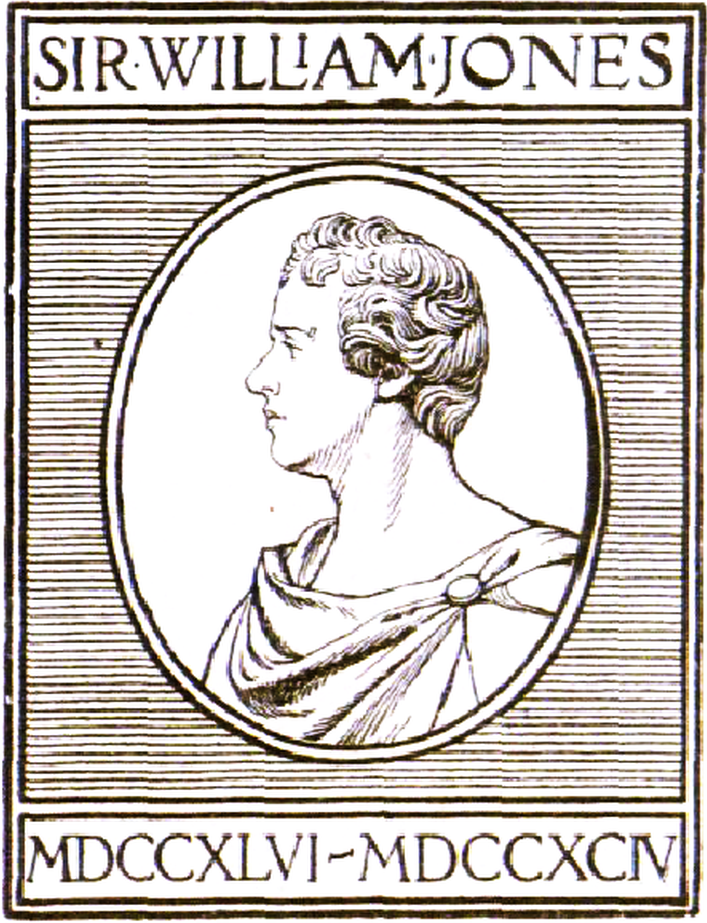
Logo of the Asiatic Society of Bengal depicting Sir William Jones (1905).

Today, science gives us advantages that William Jones lacked. But sadly, some accounts of Indian history are still stuck in outdated methods of dating – Dr. Nanditha Krishna

In 1650, Irish theologian James Ussher claimed that the world was created on Sunday, October 23, 4004 BCE. Ussher based his calculation on a correlation of the Christian holy writ and West Asian and Mediterranean histories.

Tragically, his unscientific dating became a basis for dating Indian history—and, for some, continues even today.

In 1783, William Jones was appointed judge at Fort William in Bengal. He studied Sanskrit, the Vedas and ancient Hindu laws. He was captivated by Indian culture and founded the Asiatic Society in Calcutta. He proposed a relationship between European and Indo-Aryan languages, now known as the Indo-European languages. He suggested that Sanskrit, Greek and Latin had a common root and postulated a proto-Indo-European language uniting Sanskrit, Iranian, Greek, Latin, Germanic and Celtic.

Jones, a follower of Ussher, believed that “the foundation of the Indian empire (sic) was about 3,800 years” before 1790 CE, that is, between Ussher’s date of 4004 BCE and the Great Flood that Jones believed took place in 2350 BCE. He dated the Rig Veda unscientifically to 1500-1000 BCE and proposed an Aryan invasion of India, an idea that lacked any evidence.

For a long time, the West supposed India jumped from the Stone Age to the Buddha, whose date became very important for ancient Indian history. Eastern Buddhist tradition in China, Japan, Vietnam and Korea dated Siddhartha between his birth in 1026 BCE and his death in 949 BCE.

In 1821, John Davy chose the Sinhalese date of Buddha’s Nirvana as 543 BCE, when the Sinhalese system of reckoning time begins. This gave time between Jones’s date for the Vedas (1500 BCE) and the Buddha; hence it was “chosen”. Mahavira was never properly dated and was regarded merely as Buddha’s contemporary.

Alexander’s foray into Punjab in 326 BCE turned up yet another date. Jones decided that Sandrocottus, mentioned by Megasthenes as Seleucus Nicator’s Greek ambassador to Pataliputra, was Chandragupta Maurya. Why not Chandragupta I or II of the Gupta dynasty? They too ruled from Pataliputra. But that did not suit the British dating of the Vedic period, the Buddha and later Ashoka.

Jones decided that Megasthenes had visited Chandragupta Maurya’s empire, founded in 322 BCE. But we know of Chandragupta’s life only from Vishakhadatta’s Mudrarakshasa, where there are no Greeks or Megasthenes, and which was written over a thousand years later.

It is only with Ashoka’s inscriptions that scientific methodology entered Indian archaeology. James Prinsep worked at the Calcutta mint in 1819 and stayed for a while in Benares. He interpreted the three stages of Indian numismatics as punch-marked, die-struck and cast coins. But his greatest contribution was deciphering the Brahmi script.

Edicts from all over India were sent to him. The edicts mentioned a King Devanampiyadasi who filled Indian rocks and pillars with messages of dharma. Prinsep initially assumed him to be Sri Lankan.

The identification of Devanampiyadasi and Ashoka as the same person was established by the Maski and Gujarra inscriptions, which used both the names Devanampiyadasi and Ashokaraja. In his inscriptions, Ashoka also mentions Antiochus, Ptolemy, Antigonus, Magas and Alexanderas as receivers of his message of dharma. But they lived beyond India. The names on this list, though intriguing, were ignored in the dating process.

In the early 20th century, the ruins of Harappa and Mohenjo Daro were discovered by Indian archaeologists Daya Ram Sahni and Rakhal Das Banerji. Overnight, Indian civilisation went back in time from the 6th century to 3300-1300 BCE, and to 2600-1900 BCE in the ‘mature Harappan’ phase. It was spread over an area larger than the contemporary Egyptian and Mesopotamian civilisations.

It extended from Balochistan in the west to western Uttar Pradesh in the east, from Afghanistan in the north to Maharashtra in the south. Later, agriculture was found to have emerged in 7000 BCE in Balochistan. The dating was based on archaeology, and not 4004 BCE.

It was declared as pre-Vedic and Dravidian, but when was Vedic and what was Dravidian? It remains an enigma.

In the 19th century, the river Sarasvati, described in the Rig Veda as a ‘mighty’ one flowing from the hills to the sea, was identified with the Ghaggar-Hakra river system that now ends in the Thar desert. ISRO observed from satellite pictures that most Indus civilisation sites from Haryana and Rajasthan to Gujarat lay along its course. When the monsoons diminished, the river dried up some 4,000 years ago and the Harappan civilisation declined.

Now archaeology was used to delineate Indian history. New discoveries cropped up all over India: Arikamedu and Poompuhar in the south, Dwarka under the sea off the coast of Gujarat and so on. Mahabharata was identified with painted greyware sites dating to 1200 BCE. So the Vedas had to be much older.

Yet, students are still taught dates that are calculated from 4004 BCE. Their textbooks say that the Aryans came to India in 1500 BCE, the date of the Vedas, that the writing of the Mahabharata dates back to 500 BCE, that Chandragupta Maurya met Alexander and so on.

No effort has been made to study the dating system of Indian kings as mentioned in their inscriptions or their chronology lists. This too needs archaeological corroboration. The Buddha died in Kushinagara. His remains could be scientifically tested to find out the exact date of his death.

Today, science gives us advantages that William Jones lacked. But sadly, some accounts of history are still stuck in outdated methods of dating. – The New Indian Express, 29 September 2024

Dr. Nanditha Krishna is an author, historian, and environmentalist based in Chennai

Ashoka's Maski inscription with 'Buddha' word in Brahmi script, 3rd century BCE.

Vedic Saraswati Civilisation, not Harappan Civilisation – David Frawley

Archeological Survey of India has found 60 skeletons in excavations at Rakhigarhi.

The term ‘Harappa’ does not suggest any continuity in India’s history since the ancient period or give the Vedas any place in it. Those who proposed the name were proponents of the Aryan Invasion Theory like Mortimer Wheeler, and such a non-Vedic term was useful in perpetuating that theory. – Dr. David Frawley

It is time to remove the term ‘Harappan’ from designating the ancient civilisation of India, as it is inaccurate and ignores the nature and continuity of India’s civilisation as a whole. Harappan is an artificial and incidental term deriving from the archaeological site of Harappa in Pakistan along with Mohenjo-Daro, which were the major ancient urban sites in greater India discovered in the early twentieth century (1921-22) before the partition of the country. Western archaeologists arbitrarily chose it to designate an entire urban civilisation going back to 3500 BCE, which they viewed more as a lost civilisation than connected to the later history of India.

The term Harappa does not suggest any continuity in India’s history since the ancient period or give the Vedas any place in it. Those who proposed the name were proponents of the Aryan Invasion Theory like Mortimer Wheeler, and such a non-Vedic term was useful in perpetuating that theory. Wheeler also promoted the false theory of the massacre at Mohenjo-Daro by invading Aryans which has been archaeologically disproved.

Importance of Rakhigarhi

Today the site of Rakhigarhi in Haryana, located in the Saraswati River region of Kurukshetra, and traditionally regarded as the home of the Vedas, has been proven to be larger and older than Harappa and Mohenjo-Daro which were on the Indus. As Rakhigarhi is the largest Harappan site, it would be more accurate to associate this ancient Indian civilisation with Rakhigarhi rather than Harappa. It better reveals the geographical connections of these sites to later India and its prime historical regions.

The Harappan civilisation has also been called the Indus Valley Civilisation (IVC) as the Indus River (Sindhu in Indian languages) was the main location of the initial sites discovered. However, further excavations have revealed the majority of the so-called Harappan or Indus sites were located by the Saraswati River, famous in Vedic texts, which dried up around 4000 years ago, showing its antiquity.

An Ancient Maritime Civilisation

In addition, Harappan sites have been found in Gujarat by the ocean in what was then the delta region of the Saraswati River, indicating it was a maritime culture from the Saraswati to the sea. Vedic civilisation was also maritime, with 150 references to the ocean in the oldest Rig Veda alone, including noting the Saraswati River as flowing from the mountains to the sea.

Using nondescript terms like ‘Harappan’ fits in with the terminology of the Aryan Invasion Theory that separates the Vedas from the origins of India’s civilisation, which colonial scholars also maintained. Harappans are often called pre-Vedic or non-Vedic which the Rakhigarhi finds also disprove.

The rivers of Northwest India on which so-called Harappan sites have been found have ancient Vedic names including Sindhu, Saraswati, Vitasta, Parushni (Ravi), Vipas (Beas), Shutudri (Sutlej), Yamuna and Ganga. Vedic texts show a similar culture, artefacts and geography to what has been called Harappan, extending from fire altars to Shiva lingas. We see a continuity of civilisation in India from sites as old as 8000 years ago like Rakhigarhi or Bhirrana, another such ancient site in the Kurukshetra region in Haryana.

Saraswati-Sindhu Vedic Civilisation

In place of ‘Harappan’, the civilisation should be better called ‘Vedic Saraswati Civilisation’, or ‘Saraswati-Sindhu Civilisation’. Using the term ‘Harappan’ is misleading for the study of India’s history as it does not suggest the actual centre of the civilisation on the Saraswati River, along with its Vedic and Bharatiya connections.

Ramifications for India’s Textbook Accounts of History

Indian Marxist scholars like Romila Thapar and Irfan Habib who opposed the idea of the Saraswati civilisation were also, not surprisingly, the main academic opponents of the Ram Temple in Ayodhya. They denied that there ever was any Hindu temple at the Babri Masjid site, even after Prof. B.B Lal, Director General of the Archaeological Survey of India (ASI), showed the evidence. Lal also wrote extensively on the Harappan as a Saraswati and Vedic culture and was involved in the excavation of Harappan sites.

Unfortunately, these same Marxist scholars were given charge over India’s history textbooks by the Congress government, not only relative to the ancient period but medieval and modern periods as well, including India’s independence movement. The youth of India were given their distorted views of India’s history as authoritative, devised to get them to reject their own culture and dharmic civilisation, portraying India as a country of invaders and no such religion as Hinduism but only a series of local cults.

Congress did this trying to gain politically and made the Marxists their intellectual wing in a lack of any thinkers of their own. You can be certain that if the Congress ever came back to power, they would try to restore these academics and their views. Fortunately, Sri Ram has proved too strong for them and the Vedas can no longer be denied their core role in the history of Bharat. – Firstpost, 31 December 2023

› Dr. David Frawley (Pandit Vamadeva Shastri) is the director of the American Institute of Vedic Studies and the author of more than 30 books on yoga and Vedic traditions. 

Saraswati River Map

Rethinking the Indus Valley civilisation – Nanditha Krishna

Mohenjo-daro Dancing Girl (ca. 2300-1750 BCE).

Vasant Shinde, who has excavated several Harappan sites, was fortunate to isolate DNA from the skeleton of a Harappan lady at Rakhigarh. The result was a South Asian gene spread all over India, with no Steppe or Iranian ancestry. But Harappan genomes have been found in Iran and Turkmenistan, giving credence to the Out of India theory. – Nanditha Krishna

A seminar on ‘Art in the Indus Civilization’ was recently held in Chennai. Why art? Because the unverifiable readings of the Indus script are a major impediment, art becomes the most reliable source of information. This Bronze Age civilisation covered a vast area, from Balochistan in the west to Western UP in the east, from Afghanistan in the north to Gujarat in the south, the largest “empire” of the ancient world. Remains of agriculture from 6500 BCE are found in Mehrgarh, Balochistan.

Although Kalibangan (in India) was discovered first, Mohenjo Daro and Harappa were reported first but went to Pakistan during Partition. Subsequent excavations revealed that 75 per cent of the Indus civilisation is situated along the Ghaggar-Hakra, now identified with the river Saraswati. However, it is still known as the Indus Civilisation because the first sites were excavated there. Kalibangan, Dholavira, Lothal and Rakhigarhi are among the important sites subsequently excavated. In 1924, the Indus civilisation was declared a site of remote antiquity by the British, who had earlier maintained that Indian history began in 600 BCE!

The art of the Indus civilisation includes terracottas, ceramics, glyptics, sculpture, jewellery made of carnelian, steatite, gold, silver and, faience and beads. Art “expresses important ideas or feelings” of a people. Early terracottas are primitive, made of pressed clay and pinched, with huge holes for eyes. The mature period produced beautiful images of trees, animals, birds and deities engraved on seals and paintings on pottery. The art residues are distinctive spokespersons for this civilisation. The seals were made of steatite, faience and terracotta and used commercially and ritually. Dogs with collars and elephants with rugs over their back suggest that they had been domesticated. Images of horses, rhinos, monkeys, rams, other animals and birds appear either as toys or on seals. Ornaments, shells, turquoise and lapis lazuli were moved from 500 to 1500 km away.

Why is the naked bronze dancing girl presumed to be dancing? Why is the stone priest-king of Mohenjo Daro presumed to be a priest-king? There are no answers. Several images of yoga poses exist, while two naked male torsos of grey lime are outstanding. One twists a leg, a male dancing figure comparable to the Nataraja pose. The other is in samabhanga, perhaps a Tirthankara (Yajurveda mentions three). 

The earliest worship scene in India is a seal from the Indus Civilisation where a three-horned male figure stands inside a stylised pipal tree. There are several seals of male figures with three pipal leaves protruding from the head, recalling the Ashvatavriskshastotram. The second important seal type is a tree with prickly thorns and small leaves, the khejari or shami, with a female figure seated on a branch and a tiger below, reminiscent of the paalai or desert described by Tolkappiyar, whose goddess is Kotravai or Durga and plant, the prickly kotran. Durga’s vehicle is the tiger. In the Vedas, ashvata and shami were rubbed together to produce fire. Three-headed male figures meditate in yogic moolabandhaasana. All these are Harappan and Vedic iconography. Popular animal stories from the Panchatantra are painted on jars.

Vasant Shinde, who has excavated several Harappan sites, was fortunate to isolate DNA from the skeleton of a Harappan lady at Rakhigarh. The result was a South Asian gene spread all over India, with no Steppe or Iranian ancestry. But Harappan genomes have been found in Iran and Turkmenistan, giving credence to the Out of India theory. According to Dr Shinde, the dominant gene in most south Asians is 25 to 30 per cent Harappan. By craniofacial reconstruction, he found that Harappans resembled contemporary Haryanvis.

Radha and Krishna playing chess.

Some scholars believe that the second urbanisation of 1000 BCE was disconnected from Harappa, with a dark Vedic Age in between. This is false, says Prof Michel Danino, because the same technologies in pottery, water management, metallurgy and crafts are pursued throughout Indian culture. Fire altars and lingassindoor and Mother Goddess figurines, lost wax technique to cast bronze statues, and more have continued since Harappa. Tribal women wear Harappan-style bangles on their arms, and chessmen from Lothal and dice from Harappa are still popular games. Swastika and tree worship still prevailed, while the Harappan weight system continued throughout Indian culture. Check dams to avoid flooding, bathrooms with commodes and drainage lines with manholes for cleaning are Harappan legacies. So, did “untouchability” begin there? Unlike Egypt and Mesopotamia, the Indus people didn’t build pyramids and ziggurats, but made life comfortable for the common person in well-built cities.

When people travel with their musical instruments, they retain their names. The piano and violin retain their names everywhere. Shail Vyas researched Mesopotamian references to Meluha (as the Indus Valley was known there) and found the names of 30 Indian musical instruments and 60 items of trade, including animals, birds and timber species, from Meluha, all in Sanskrit, with similar Mesopotamian equivalents. These had gone with the sea-faring Meluhans of the Indus.

It is time to rethink the Harappan civilisation, a culture with much archaeology but little literature. Vedic culture is all literature, and no material remains—is it possible? The Vedas speak of copper, not iron, making it a Bronze Age civilisation like Harappa. The Vedic civilisation was riverine and agricultural, like the Harappan. The Early Harappan Period lasted from 3300 to 2900 BCE, the Mature period from 2900 to 1900 BCE and the Late Harappan from 1900 to 1500 BCE. By 1000 BCE, the Painted Grey-Ware of the Mahabharata period had appeared, so the Vedas would have to be much earlier. The Vedas do not speak of any homeland outside India. The two civilisations were contemporary, probably the same, for Meluhan Sanskrit in Mesopotamia is compelling evidence. It is time our history books reveal the truth. – The New Indian Express, 12 march 2023

> Nanditha Krishna is an author, historian, educationalist and environmentalist.

Sindhu-Saraswati (Indus Vally) Civilisation Map