
India’s national anthem merely expresses love for the nation through all its variegated landscapes and experiences – plus a veneration for the divine Guru. – Dr Koenraad Elst
India’s anthem, written by Rabindranath Tagore, opens by addressing the Jana Gana Mana Adhinayak or “commander of the people’s minds”, the Bharata Bhagya Vidhata or “dispenser of India’s destiny”. Who is this?
Before focusing on the Indian anthem and wondering to whom it is directed, I want to remind my readers of some fairly well-known facts concerning the anthems of a few other countries, and the unexpected overlaps between them. This will lay out a framework within which we can evaluate India’s anthem.
God Save the Queen
Indians will probably know, if only from historical movies about the colonial age, Britain’s anthem, the oldest anthem in the world. The writer is unknown, but the attribution to John Bull ca. 1618 is common. It is addressed to God, but otherwise, it is all about the monarch:
God save our gracious Queen [c.q. King], God save our noble Queen, God save the Queen. Lead her victorious, happy and glorious, ever to reign over us, God save the Queen.
As you will notice, the focus is not at all on the people but entirely upon the monarch, in whom the ideals of victory, prosperity and good governance are embodied. This is the traditional monarchical scheme: the ruler as the embodiment of the nation.
Heil dir im Siegerkranz
Less well-known is that the same tune once provided the anthem to several countries, including even imperial Russia (1816-33). When devising national symbols, new nation-states just assumed that the tune of the venerable British empire’s anthem naturally and intrinsically was the melody of the national song. Prussia adopted it in 1795, and after its chancellor, Otto von Bismarck, unified the German states (minus Austria and Switzerland) and presided over the founding of the German empire in 1871, it adopted as anthem the Prussian national song. So, this was set to the tune from God Save the Queen, but with the lyrics:
Heil dir im Siegerkranz, Herrscher des Vaterlands, Heil Kaiser dir. “Hail thee in victor’s laurels, ruler of the fatherland, hail to thee, emperor.” It is not about God and only tangentially about the nation, but mostly about the monarch. Patriotism is lauded, but again only subordinate to the monarchy: Liebe des Vaterlands, Liebe des freien Manns, gründen den Herrscherthron, wie Fels im Meer, “Love of the fatherland, love by the free man, found the ruler’s throne like a rock in the sea.”
In 1918, after losing the Great War, the emperor had to abdicate and the anthem lapsed. As we shall see, the succeeding Weimar republic would choose a different one, ultimately more controversial.
Wilhelmus
While God save the Queen played a pioneering role in spreading the notion that a state needs an anthem, it was nevertheless not the oldest song to become anthem. That honour goes to the Wilhelmus, written ca. 1572 by Filips van Marnix van Sint-Aldegonde, mayor of Antwerp (the city where I presently live), in honour of Willem van Oranje-Nassau, the founder of the Netherlands. The tune had only recently been composed, 1568, and had served to animate the Huguenot (Protestant) defenders of Chartres in France against their Catholic besiegers. Ideally, after declaring independence from Spain, the country should have encompassed Belgium (including Antwerp), Luxemburg and a slice of France as well, but those territories were reconquered by Spain.
William of Orange never became king nor wanted to: the Netherlands became a republic and the head of state was a Stadhouder (“city-holder”, maintainer of the public sphere, effectively president-for-life). The Netherlands became the trailblazer of modern liberties, first adopted by England in founding the parliamentary rule, then the budding United States and France. Nevertheless, the monarchical mentality was so engrained that this song might as well have been written for a king. It is not about the nation or patriotism, it is about the person of William of Orange. (After Napoleon, when the Netherlands regained their Independence, the Great Powers gathered at the Vienna Conference insisted that the country become a kingdom, not to encourage liberal ideas elsewhere; so William’s descendants became queen or king of the Netherlands; which didn’t increase their power nor decrease their popularity.)
The song goes, in translation: “Wilhelmus of Nassau, am I of German blood.” (Explanation: the dialects that were to become Dutch and German then still formed a single continuum, the way Tamil and Malayalam did before parting company. They were called Duytsch/Dietsch, “folkish”, as distinct from Latin, used by priests and scholars, and when the names were later distinguished, they came to mean “German” c.q. “Netherlandic”/Dutch. Until ca. 1800, Dutch was regularly called Nederduytsch, “low-German”. Moreover, William’s hereditary fief Nassau did indeed lie in what became Germany. This expression explains why during the German occupation in World War II, this 1st stanza was avoided in favour of the anti-tyrannical 6th.) “True to the fatherland I remain until death. A prince of Orange I remain, free and fearless. The king of Spain I have always honoured.”
The song is written from William’s own viewpoint and reflects his profound dilemma between his loyalty to his suzerain, the king of Spain, and his God-given duty to his people. The central part of the very long song, the rarely performed 8th stanza, likens him to the Biblical king David, showing the Bible-solid Calvinist inspiration of its author. The better-known 6th stanza clearly subordinates him to God: “My shield and trust art Thou, oh God my Lord. On Thee I want to build, don’t ever leave me. May I remain pious, Thy servant at all times, and drive away the tyranny that wounds my heart.”
When the song was written, there was no notion of a national anthem yet. During the 19th century, a different song served as the anthem, and it was only in 1932 that the Wilhelmus was adopted. But meanwhile, its tune had been used to turn a different poem into a song.
In 1814, at the fag end of the Napoleontic occupation, Max von Schenckendorf wrote a poem expressing German patriotism: Wenn alle untreu werden, so bleiben wir doch treu, dass immer noch auf Erden für euch ein Fähnlein sei, “When all become disloyal, even then we remain loyal, so that always your flag will stand somewhere on earth.” It is a nationalist poem, ending in a pledge to the German Reich, which didn’t exist at the time, though its shadowy existence had only been abolished by Napoleon in 1806. The memory was still fresh, and as an ideal, it lived on. It illustrates, as do many of these poems and songs, how Christianity shaded over into nationalism, by likening the worship of “false gods” to the submission to foreign rulers.
The poem was soon put to music using the Wilhelmus tune. Then, more than a century after the poem had been recited and sung, it was adopted by the Nazi elite corps SS. In many contemporary sources, you will find it mentioned as SS-Treuelied, “SS Loyalty Song”. This is a symptom of a common hypersensitivity for anything associated with Nazism, especially in people with a Nazi-centric worldview (such as Leftists who have to hide their own crimes behind a maximized memory of WWII, when even Winston Churchill had to accept Josef Stalin as a good guy only for fighting the Nazis). In reality, the Treuelied owed nothing at all to National Socialism, any more than other much older symbols such as the Swastika or the “Black Sun” (a kind of 12-armed swastika, present on the Wewelsburg castle floor where the SS had chosen to install its headquarters). It will nevertheless still take some time before these symbols, tainted by association, can be completely healed and used again without complications.
The Wilhelmus, though, was never seriously affected. The Dutch have never considered disowning their anthem because of the late and temporary association with the SS. By contrast, another innocent song, or at least part of its lyrics, was demonized.
Gott erhalte unsern Kaiser
For his birthday in 1797, the Austrian emperor Franz was treated to a new song, with lyrics by leading poet Lorenz Leopold Haschka and music by the famous composer Joseph Haydn. When visiting England, Haydn had been enthused by the ready presence of a good song that everybody knew and that expressed their national togetherness. Though he was composer enough to compose his own tune, he too had been inspired by God Save the Queen as the model of an anthem. The lyrics too were somewhat modelled on the British text:
Gott erhalte unsern Kaiser, unsern guten Kaiser Franz, “God save emperor Francis, our good emperor Francis.” And it goes on about: “Long live Francis the Emperor in the brightest splendour of bliss! May laurel branches bloom for him, wherever he goes, as a wreath of honour”, etc. It is his well-being that counts, not the nation, though he is posited modestly below God.
Here too, the defeat of 1918 rendered the song without object, so the lyrics were replaced but the tune, after a decade of disuse, was revived in 1929. The lyrics had now become thoroughly republican, focused on the nation instead of the head of state, but with God still lurking in the background: Sei gesegnet ohne Ende, “be blessed without end”. It lapsed in 1938, when Austria was annexed by Germany.
La Marseillaise
After the French Revolution of 1789, the Revolutionaries who came to power were first of all nationalists. Today’s Leftists, who advocate open borders, demonize military service and laugh at nationalist propaganda, like to forget it, but on the said issues, they were poles apart with their French role models. In 1792, they devised a song, which in 1795 they adopted as anthem, wherein neither king nor God played a role (Ni Dieu ni maître, “neither God nor master”). The focus was fully on the nation, the tone combative: Allons enfants de la patrie, le jour de gloire est arrive, “Let’s go, children of the fatherland, the hour of glory has arrived”. This set the template for a number of secular anthems in new states the world over. It was rich in energy and self-righteousness, but poor in wisdom.
The Star-Spangled Banner
The anthem of the USA was written in 1814, to the tune of an existing popular song from Britain, by Frances Scott Key, a lawyer who had witnessed a scene from the British-American War of 1812 from a rare vantage point: as a prisoner held on a British ship participating in a British naval siege of Baltimore. He had been impressed with the American flag on the tower of a coastal fort, and saw how after a night of fighting, it was still there is the morning. That, then, is the focus of the song: not God, not the ruler, only tangentially the nation (“the land of the free and the home of the brave”), but the national flag, plus the bravery of the American soldiers who defended it. It served as the semi-official anthem for a century, until in 1931 a law was enacted officially declaring it the anthem.
La Brabançonne
The Marseillaise, “(the song) of Marseille”, named after volunteers from Marseille who had intoned the song while entering Paris, served as the model for the Belgian national anthem, La Brabançonne, “(the song) of Brabant”. This is the province where Brussels is located, somewhat like “Kashi” for “Varanasi”. That song has no God either, but peripherally it does venerate the king, as the country (1830) had to make its way in a world where the post-Napoleontic Vienna Conference of 1914-15 had installed a system of monarchical anti-Revolutionary regimes: …le roi, la loi, la liberté, “…law, king and liberty”. As an exceptionally liberal country, with freedom of the press and asylum for foreign dissenters, Belgium has its anthem contain the liberal phrase: het woord getrouw dat g’onbevreesd moogt spreken, “true to the word that you are allowed to speak without fear”. But the focus is on the nation itself and its territory: O dierbaar België, o heilig land der vaad’ren, onze ziel en ons hart zijn u gewijd, “Oh precious Belgium, oh holy land of the ancestors, our souls and our hearts are vowed to thee.”
Das Lied der Deutschen
At the end of 1918, Germany became a republic. A new anthem did not have to be devised. The lyrics had been available in a nationalist poem from 1841 by August Heinrich Hoffmann von Fallersleben, and since then it had been sung to the tune of the well-known Austrian Emperor’s Hymn. It was the time of German unification, and the song called on all Germans to put their loyalties to their own local states between brackets and focus on the then-fragmented Germany as a whole. Hence the song’s title: Das Lied der Deutschen, “The Song of the Germans”, or the Deutschlandlied, “Germany’s Song”. Foreigners usually know it through its opening line, Deutschland über Alles, “Germany above all”. This sentence had nothing to do with condescension towards non-Germans, only with a hierarchy between Germany as a whole and its parts: Germany above Bavaria, Germany above the Rhineland, etc.
It did not address a monarch, but the German nation. The liberal nationalists then in the forefront contrasted their own modern liberal and predominantly secular nationalism with loyalty to the erstwhile Holy Roman Emperor and the contemporaneous Austrian emperor. In the revolution year 1848, it represented a rebellion of the people against the transnational nobility. It is for this reason that in 1922, the Weimar Republic chose Das Lied der Deutschen as its anthem, marking a break with the Imperial Germany of the preceding half century.
Somewhat like Jana Gana Mana, the song situated the country geographically, not by listing its component parts (“Panjaba, Sindhu, Gujarata, Maratha…”), but by listing its borders, roughly: “Von der Maas bis and die Memel, von der Etsch bis an den Belt.” These are the borders, flatteringly but not imperialistically defined, of the German speech area with the French/Dutch, c.q. the Baltic, Italian and Danish speech areas during the mid-19th century. Note that then a unified Germany was still an ideal and its borders were still being debated: it was deemed desirable to include Austria and hence the border would be with Italy. Around 1920 too, the Etsch border with Italy was a realistic proposition, for it was the outspoken desire of the Austrian people to be included in Germany, as is clear from the massive majority that this proposal received in a referendum. (However, France as a victor in the Great War disallowed it.)
The song remained national anthem when the National Socialists under Adolf Hitler came to power in 1933, including when they occupied much of Europe in 1939-45. The latter circumstance gave the song a highly negative connotation. Outsiders reinterpreted the opening line as meaning: “Germany above every other nation in the world.” When Dutch children saw the British bombers fly over their country to drop their load over German cities, they inverted the sentence: Alles, Alles über Deutschland, “(Drop) everything on Germany”.
After 1945, the same anthem continued, or at least its melody. Of the lyrics, only the 3rd stanza has an official status. It carries the liberal bias of Hoffmann von Fallersleben’s unification movement: Einigkeit und Recht und Freiheit für das deutsche Vaterland, danach last uns Alle streben, brüderlich mit Herz und Hand…, “Unity and Justice and Freedom for the German fatherland, for that let us all strive, fraternally with heart and hand”. The 2nd stanza is innocent but not deemed dignified enough to serve as an anthem, and the first is frowned upon as irredentistically seeking the restoration of Germany’s pre-1945 borders: with the loss of East Prussia, the Memel river is now hundreds of miles from the German borders, and with the definitive independence of Austria, Germany has lost all pretence of bordering Italy. Now, the listing of these borders has acquired a decisively imperialistic meaning which originally it did not have.
Many laymen think there is something Nazi about this song (as also about the Treuelied). These are not just tamasic Leftists who fill their empty minds with endless Hitler references in order to assure themselves of a moral high ground, but also the mass of people who are simply ignorant. However, the true story is just the reverse: it is politically liberal, pro-constitution, pro-democracy, and emphasizes the non-aristocratic, people-oriented angle of nationalism. It lays no claim to non-German lands and does not contain even a germ of hatred against other nations or communities such as the Jews. When all is said and done, it is just a song, set to the beautiful music by Haydn.
Jana Gana Mana
This survey of the trail-blazing European anthems, upon which all other anthems were modelled, indicates three possible foci: God, the monarch, and the nation. Traditional monarchies tend to have anthems focusing on the monarch, either putting him in the shadow of God (God Save the Queen, Wilhelmus), or presenting him as the highest authority by himself (Heil dir im Siegerkranz). Modern songs emanating from secular elites tend to avoid God, such as the French and German republican anthems, and they have a conspicuous absence of references to the head of state, who is simply one of us, one of the nation that is already being glorified.
In what category does Jana Gana Mana fall? What did it mean at the time when it was composed? In the rest of this essay, we will find out.
The song was written in 1911 by the Bengali poet Rabindranath Tagore in a high Bengali bordering on Sanskrit. (Among his other poems, one more made it to the status of national anthem: Amar Sonar Bangla, “My Golden Bengal”, written in 1905, was adopted as anthem by Bangladesh in 1971.) In a multilingual country, it has the virtue of being understandable to every citizen with even just a smattering of education. It was first performed at a conference of the Indian National Congress.
The song was first performed with the status of the national anthem by Subhas Chandra Bose’s troops. Before his well-known leadership of the Indian National Army under Japanese tutelage in 1943-45, he had commanded a smaller army, recruited from among the Indian soldiers in the British regiments taken prisoner at Dunkirk, as part of the Nazi-German war effort in 1941-42. It was in Germany that men, for the first time, stood to attention for Jana Gana Mana as India’s national anthem.
The Bharata Bhagya Vidhata is not King George
The song is frankly nationalist to the extent that it glorifies the nation and its territory, of which it enumerates the provinces. However, it also addresses and glorifies the Jana Gana Mana Adhinayak, the “commander of the people’s mind”, who is at the same time the Bharata Bhagya Vidhata, the “dispenser of India’s destiny’. Does this refer to the country’s hereditary or appointed or elected ruler?
We can imagine the vainglorious Jawaharlal Nehru, as Prime Minister in the 1950s, feeling flattered whenever the crowds in front of him were intoning these words. But then, he was not seriously in the picture yet in 1911. At that time, the British king George V was India’s ruler. Moreover, he was to pay a visit to India only weeks after the song was first performed—at a Congress meeting where a proper reception for the king was central on the agenda.
By connecting these dots, the British press at the time, and many of its Indian readers, believed that Tagore composed the song in honour of the king. The claim proved particularly tenacious, and it is occasionally heard even today. Yet, the poet was to deny this, later in life even vehemently. But the first years, this correction did not reach the public.
The confusion in the British and British-Indian press partly came about due to the existence of another song by an Indian that did genuinely glorify the British king-emperor. This was Bâdshâh Hamâra, “Our King”, written in Urdu by Rambhuj Chaudhary, and it was sung on the same occasion but explicitly in praise of the monarch. At that time, Congress was still committed only to dominion status within the British Empire, so with King George as its legitimate ruler.
The mistaken belief that Tagore had wanted to praise the British king and thus further legitimize his rule over India had its bright side. It crucially helped in convincing the Nobel committee to award its 1913 prize for literature for the first time to a non-Westerner. Gitañjali, Tagore’s award-winning collection, is no doubt fine poetry, but to win the Nobel Prize, it was best to satisfy a preliminary condition. Tagore was deemed a loyalist of the colonial dispensation, and therefore a convert to civilization uplifting his own more backward countrymen. Now that was the kind of merit to be rewarded.
If questioned, the Swedes on the committee would probably not have opposed or condemned India’s nationalist movement. But at the same time, Europe in those days was abuzz with stories of murderous rebels and of brave colonials who went there to tame them. So, to actually give open support to a rebellious colonial underling would have been too much even for the well-meaning Swedish bourgeoisie. In these circumstances, the mistaken impression that Tagore had put his literary services at the feet of the British monarch came in handy.
Then who is the Bharata Bhagya Vidhata?
In a letter dated 10 November 1937, Tagore explained the true story:
A certain high official in His Majesty’s service, who was also my friend, had requested that I write a song of felicitation towards the Emperor. The request simply amazed me. It caused a great stir in my heart. In response to that great mental turmoil, I pronounced the victory in Jana Gana Mana of that Bhagya Bidhata [Bengali pronunciation; “dispenser of destiny”] of India who has from age after age held steadfast the reins of India’s chariot through rise and fall, through the straight path and the curved. That Lord of Destiny, that Reader of the Collective Mind of India, that Perennial Guide, could never be George V, George VI, or any other George. Even my official friend understood this about the song. After all, even if his admiration for the crown was excessive, he was not lacking in simple common sense.
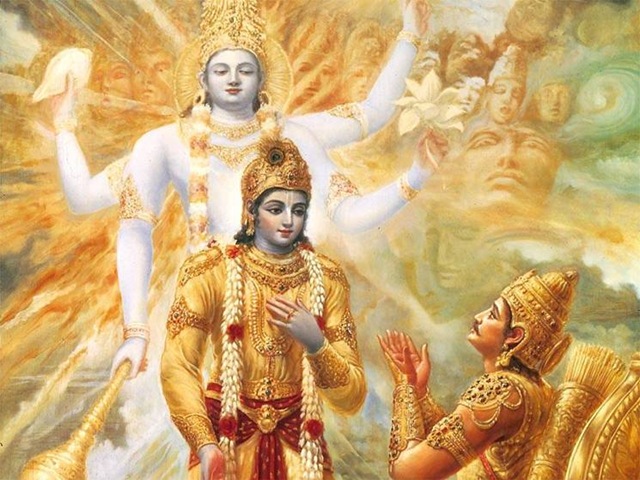
Here Tagore already lets on the real identity of this Dispenser of India’s Destiny. As a scion of the Brahmo Samaj, which frowned upon the variety of god-figures from devotional Hinduism, he avoided mentioning by name any god. Yet, he leaves no one in doubt that he means the Eternal Charioteer leading the pilgrims on their journey through countless ages of the timeless history of mankind. This clearly refers to the Krishna of the Bhagavad Gita, who is there as Arjuna’s charioteer. He is worshipped as an incarnation of Vishnu, who takes birth from age to age, whenever Dharma has weakened and needs to be strengthened.
Usually, only the first stanza is publicly sung. But if you read on or sing on to the third stanza, it all becomes clear enough. The iconography of Vishnu and Krishna (chariot, conch, the expression yuge yuge, “age after age”) is exuberantly sung there, and the singers describe themselves as yatri, “pilgrims”. King George, Prime Minister Nehru or any otherworldly ruler is absent, the entire focus is on Krishna, the guide and charioteer. He is said to “deliver from sorrow and pain”, which would be too much honour for a mere state leader; and to be “the people’s guide on the path”. Hail to the Bharata Bhagya Vidhata!
Is it secular?
For a republic that is always praised as “secular”, we might expect a secular anthem, somewhat like La Marseillaise or Heil dir im Siegerkranz. But whereas these two simply ignore religion altogether, Jana Gana Mana does at most have a passage that could be termed secular in the Gandhian sense, viz. an equally positive recognition of all religions by the state. India only calls itself secular since 1975, when Indira Gandhi’s Emergency dictatorship inserted the words “secular, socialist” into the Constitutional description of India as a “democratic, federal republic”. That makes these two words the only ones in the Constitution that did not go through a proper parliamentary debate. In the days of the Constituent Assembly, by contrast, Dr. B. R. Ambedkar, chairman of the Constitution Drafting Committee, explicitly refused to include “secular”. When, 28 years later, the term did get inserted, it had acquired the meaning “anti-Hindu”, yet most Hindus accept the term because they naïvely assume it still has the meaning “secular”.
That word was not in the air yet when Tagore composed the song, in 1911. But he did support religious pluralism. In fact, like most Hindus, he took it for granted as self-evident, not in need of being articulated as a separate doctrine. It was in his case vaguely the Gandhian idea of “equal respect for all religions”. Consider another unsung stanza, the second. To a superficial reader, this might give the impression of espousing religiously neutrality: “We heed Your gracious call. / The Hindus, Buddhists, Sikhs, Jains, Parsis, / Muslims, and Christians, / The East and the West come together, / To the side of Your throne, / And weave the garland of love. / Oh! You who bring in the unity of the people!”
Indian Muslims and Christians still have a lot of un-Islamic or un-Christian feelings in them, inherited from their Hindu ancestors, adopted from their Hindu environment, or simply stemming from universal human nature. Thus, they generally have a strong attachment to their motherland, overruling their tutored orientation to Mecca, Jerusalem or Rome. In that sense, their attachment to India does bring them together with their Hindu compatriots. Most Hindus are not too serious about doctrines, they overlook the specific points which set Islam and Christianity against all other religions, and hence they tend to welcome all sects into the Indian fold.
But this stance is not reciprocated. The attitude that takes all sects to be one happy family, is emphatically not Muslim and not Christian, for these sects vow only hellfire upon all the others. The spirit of this second stanza is not also-a-bit-Muslim nor also-a-bit-Christian, it is not a bit of everything; it is thoroughly Hindu.
Also ran
When the Freedom Movement and later the Constituent Assembly deliberated upon the choice of an anthem, there were three candidates. Sare jahan se accha Hindustan hamara, “Of the whole world, the best is our Hindustan”, was an Urdu song by Mohammed Iqbal, composed in 1904. Having studied in Germany, he may well have been inspired by Deutschland über Alles, but with the wrong though now common idea that this means: Germany is superior to the rest. At any rate, his opening line said in so many words that India is superior to the rest. Whatever the merits of the lyrics and the melody, any choice for an Iqbal song came to leave a bad taste in the mouth when, shortly before his death in 1938, he became the spiritual father of the fledgling Pakistan movement. Nonetheless, it has never ceased to enjoy a certain recognition within the Indian Army.
Another option was Vande Mataram, “I salute thee, Mother”, meaning Mother India. It was drawn from a novel by Bankim Chandra Chatterji, Anandamath, “Abbey of Bliss” (1882). Covertly, the story appealed to its readers to rise up against the colonizers, at that time the British. But in its explicit narrative, it was set in an earlier age, when the occupiers against whom to revolt were Muslims. As was to be expected, Muslims and Nehruvian secularists objected.
Moreover, and perhaps even more decisively, Muslims proposed a theological objection: this veneration of the Mother Goddess, easily recognizable as the warrior-goddess Durga, was idolatry pure and simple. Only Allah should be worshipped, and to the extent an anthem with all its pomp and ceremony was acceptable at all (the Jehovah’s Witnesses reject it), it should emphatically not deify the nation nor any symbol or deity associated with it. Till today, Muslims regularly boycott public performances of Vande Mataram.
But in fact, Jana Gana Mana’s “dispenser of India’s destiny”, while not its past or present ruler, unambiguously signifies the divine Guide, the eternal Guru, Krishna. If Vande Mataram is “communal”, then so is Jana Gana Mana.
Nehru supported the Muslims in their objections against Vande Mataram, thus, in fact, misdirecting their attention and deflecting further scrutiny of Jana Gana Mana. But to give his own plea against it a less communal colouring, he took an entirely different line and objected that the song is too difficult to sing. Though this objection was disingenuous and had to hide another reason, it had a core of truth. In the functions where I have seen it sung, it was typically performed by a professional singer, while the public kept mum. In comparison, Jana Gana Mana is a pleasant and beautiful hymn that anyone can sing. As far as my opinion counts for anything, I think the Constituent Assembly made the correct choice.
Conclusion
Yet, it may have been a choice based on incomplete information. Clearly, most voting members were unaware of Jana Gana Mana’s third stanza. Alternatively, they may have considered it as not really part of the national anthem anyway. Or, they may not have cared for secularism anyway. At any rate, when including the third stanza, the song is emphatically God-oriented and Hindu.
India’s anthem is not ruler-oriented like Heil dir im Siegerkranz. It is not ruler-and God-oriented, like the Wilhelmus, God Save the Queen, or Gott erhalte unsern Kaiser. It is not secularly nation-and-state-oriented, like the Marseillaise, the Star-Spangled Banner, the Brabançonne or Das Lied der Deutschen. It is emphatically nation-and-God-oriented, God in this case probably being identifiable as Krishna, or more abstractly, the idea of the Divine involving Itself in this world whenever Dharma requires it. The song does not commit itself to a specific political system, such as monarchy, by glorifying the ruler. It merely expresses love for the nation through all its variegated landscapes and experiences—plus a veneration for the divine Guru.
According to Rabindranath Tagore, and according to all Indian citizens who intone or honour his anthem, India is not complete without a heaven-oriented, sacred dimension. – Pragyata, 17 March 2017
» Dr Elst is an historian and indologist with MA degrees in Sinology, Indology and Philosophy. He lives in Antwerp, Belgium.




 VOICE OF INDIA