
In the Islamic political praxis, Muslims are nationalist if they are in majority and the rule is theirs. But if they can’t rule the country, they can’t be nationalist either. – Ibn Khaldun Bharati
The Muslim opposition to Vande Mataram is well known. However, the reason behind it is not well understood. Actually, it’s beyond comprehension. Their objection to the national song is formulated in such abstruse theological terms that even an educated Muslim can’t grasp its esoteric nuance. In reality, it’s not so much an opposition to the song as to the idea behind it—the idea of India as a nation. It’s the idea that Hindus and Muslims become an organic whole to form an inseparable political community. The major Muslim ideologues insisted on their separateness, and separate they remain.
To say that saying Vande Mataram (Salutations, Oh Mother) evokes the imagery of idol worship is the kind of convoluted reasoning that defies common sense. Furthermore, to emphasise that the hostility to idol worship is the foundational creed of Islam, and that it’s incumbent on every Muslim to wear this abhorrence on sleeve, isn’t really conducive to diversity, pluralism, peaceful coexistence, and composite nationhood—the ideals in which the Muslims have greater stake than anyone else.
Recently, Maulana Mahmood Madani, the head of the largest organisation of ulema in India, Jamiat Ulema-i-Hind, made a controversial speech, in which he stressed the imperative of jihad in India. He also said, “Murda qaumen mushkilaat mein mubtala nahin hotin. Wo to surrender kar deti hain. Wo kahenge ke Vande Mataram padho to padhna shuru kar denge.” (Dead communities don’t face any difficulty since they surrender readily. When asked to chant Vande Mataram, they willingly do that).
The ferocity with which these Muslims proclaim their revulsion for Vande Mataram, and the grim determination with which they threaten to go to war if its public singing were to be revived, makes one wonder if there is actually something so repugnant in the song that a Muslim can’t countenance it if he were to remain true to his faith.
Is there a problem?
Let’s see if there is anything in Vande Mataram that makes Muslims recoil in horror. Arif Mohammed Khan, the scholarly Governor of Bihar, translated into Urdu the two stanzas that have the status of the national song, and sent the same to one of the most prominent Islamic seminaries, the Nadwa, at Lucknow, for their opinion on it; specifically asking if there was anything in it that was contrary to Islam.
It was presented as an original composition, and not a translation. He had rendered the key words, Vande Mataram, as “Taslimaat, Maa, Taslimaat”. The ulema at Nadwa opined that there was nothing in the song that contravened Islam. One, however, suspects that if they knew it to be the translation of Vande Mataram, they might have had a different opinion. Such is politics and such is the power of narrative!
The reality behind the narrative
The root of the Sanskrit word ‘vande’ is ‘vand’. According to Sanskritist Monier Monier-Williams, depending on the context, ‘vand’ means “to praise, celebrate, laud, extol, to show honour, do homage, salute respectfully; or, venerate, worship, adore”. The primary meaning is not worship; certainly, not the ritual worship. Even if it were, hasn’t Urdu poetry been more extravagant in such expressions. For example, Iqbal, the poet of Islamic revivalism, in one of his earlier poems, said, “Khaak-e watan ka mujhko har zarra devta hai” (Every particle of the country is a god unto me)”. Iqbal’s fans—quite a few of them being fundamentalist fanatics—never saw anything amiss in this.
Can there be a nation without a motherland?
As for mataram, i.e., mother—Mother India—Urdu has a beautiful term, madar-e-watan, the motherland. No Muslim ever found this concept contrary to Islam. In fact, the most literal and yet most exquisite rendition of Vande Mataram has been A.R. Rahman’s song Maa Tujhe Salaam.
There are numerous verses in the Quran (7:12, 23:12, 30:20, etc.) which say that we are made of earth, and it is the source of life and the place of origin. It’s implied that, in a deeper sense, the earth is the mother, and one’s own place is the motherland.
In a display of genius that is peculiar to them, the Muslim leaders espied the idol of a deity in the conception of motherland, and flinched from its adoration. Even in Pakistan—which broke away from us, on difference over the Indian nationhood, and the sacredness of the motherland—Asim Munir, the generalissimo, can be seen referring to his country as motherland.
Nowhere else in the world do Muslims have had any problem with the concepts of nationalism and the sacredness of the respective countries. The literal translation of the word ‘Pakistan’ is holy land, which in Hindi translates as punya bhumi. The Indian Muslims, however, can’t accord this status to their own country.
In the Islamic political praxis, Muslims are nationalist if they are in majority, and the rule is theirs. But if they can’t rule the country, they can’t be nationalist either. In a debate that raged between poet Muhammad Iqbal and Jawaharlal Nehru, the former candidly said, “In majority countries Islam accommodates nationalism; for there Islam and nationalism are practically identical; in minority countries it is justified in seeking self-determination as a cultural unit”. (Modern Review, Calcutta, 1934-35)
There’s a deeper reality. Without recognising the country as the motherland, there can’t be a nation. But can the people who came as invaders, conquered the country, and ruled it for centuries, ever accord the status of mother to the vanquished territory? Could the British ever regard India as mother?
The Muslim ideology has been in the hands of the elite descended from the old ruling class. The Muslim masses follow it uncritically because it’s couched in religious idiom, and religion is not to be questioned.
Is Anandmath anti-Muslim?
Regarding Vande Mataram being a part of the novel Anandmath; well, it’s true that the poem, though independently written, has been interpolated in the book. It’s also true that the theme of the book is the Sannyasi Rebellion of 1770s, which was an uprising against the oppressive Muslim rule, and therefore, some passages have clear anti–Muslim overtones. But isn’t it equally true that those Muslim rulers were oppressors, and their religious hostility toward the Hindu peasants was an added factor in oppression? So, why shouldn’t the rebellion against them be seen as a class war of the oppressed against the oppressors, and the fulmination against them should be seen in perspective, and not misconstrued as invective against ordinary Muslims who belonged to the same class as them? Haven’t we seen this kind of class analysis about the Moplah “Rebellion”?
But, it’s not possible despite the fact that a large number of Marxist historians have been Muslim. That’s because, these historians, when it suits them, treat Muslims as a monolith, ignoring their socioeconomic diversities. Thus, a justified diatribe against the Nawabi system is seen as a tirade against ordinary Muslims. What if Indian Christians were to see in the criticism of the British rule the condemnation of ordinary Christians?
By the way, no Indian ever rejected the popular patriotic song Saare Jahan Se Achha just because it’s from the pen of Iqbal, the separatist ideologue.
The genesis
Vande Mataram, set to tune by Rabindranath Tagore, had been sung in the Congress sessions since 1896. No Muslim leader ever found it antithetical to their religion. Even during the Swadeshi Movement, which was a response to the Partition of Bengal (1905), when this song became the anthem of resistance to the British, one doesn’t hear of any objection to its purported polytheistic imagery. This was despite the fact the division of Bengal was on religious lines, and it supposedly favoured the Muslim majority of East Bengal. Even Maulana Abul Kalam Azad, the great Islamic scholar and thinker, who claims to have joined the underground revolutionary movement of the Bengali youth, doesn’t record any religious objections to it.
Even during the Khilafat Movement (1919-24), when the Congress was working on pan-Islamist agenda, Vande Mataram continued to be sung in its gatherings, in the presence of the leading Khilafatist maulanas, who, then, dominated its proceedings.
How an anti-British song became ‘anti-Muslim’
From 1896 to 1937, Vande Mataram was the staple for the Congress. And then, elections were held under the Government of India Act, 1935; and Congress ministries were formed in provinces. After centuries, the natives of India, the Hindus, were in power. The Muslim ruling class could endure British rule, but seeing their former subjects becoming rulers was beyond their endurance. For centuries, they had been conditioned to look down upon the Hindus, and now the same Hindus were ministers. They freaked out, and began hallucinating about the Hindu oppression. As they upped the ante for a desperate fight, their glance fell upon the “Durga” and “Lakshmi” in Vande Mataram, and the Islam-in-danger bogey became ever more palpable.
This situation has been best summarised by a nationalist Muslim, Rafi Ahmed Kidwai. In a statement that was published in The Pioneer on 19 October 1937, that merits in-extenso reproduction, he said, “Mr. Jinnah characterises Vande Mataram as an anti-Islamic song. Mr Jinnah had been a devoted and enthusiastic member of the Congress and of its chief executive, the All-India Congress Committee, for a number of years. Every year, the session of the Congress opened with the singing of this song, and every year he was seen on the platform listening to the song with the attention of a devotee. Did he ever protest? Mr Jinnah left the Congress, not because he thought the Vande Mataram was an anti-Islamic song, but because he had found the idea of swaraj unacceptable.”
Nehru is both Churchill and Chamberlain
The Muslim League, having suffered a rout in the 1937 elections, and further failing to force its way into the government in the United Provinces—not on the basis of the seats won, but as an entitlement for having once been the rulers—suddenly realised that Vande Mataram was idolatrous, and raised a war cry against it.
In the book Vande Mataram: The Biography of a Song, historian Sabyasachi Bhattacharya details the debates in the Congress, and the correspondence between Nehru, Bose, and Rabindranath Tagore. Nehru’s first reaction was: “The present outcry against Bande Mataram is to a large extent a manufactured one by the communalists.” However, soon, in order to appease the communalists, he said that having read the English translation of Anandmath, he was of the opinion that it was “likely to irritate the Muslims”. And so, he set out “to meet real grievances where they exist(ed).” That is how the Congress Working Committee, on 26 October 1937 (just days after Kidwai’s remonstrance), decided to truncate the song, and adopt only the first two stanzas as they were “unobjectionable”.
Such bending backward before the communalists recalls to mind what Atal Bihari Vajpayee once told Nehru about the streak of appeasement in him: “In you, there are both Churchill and Chamberlain”.
Sabyasachi Bhattacharya narrates how this concession couldn’t satisfy the Muslim League, as they insisted on the deletion of Vande Mataram in toto. Jinnah wrote, “Pandit Jawaharlal Nehru cannot be unaware that Muslims all over have refused to accept the Vande Mataram or any expurgated edition of the anti-Muslim song as a binding National Anthem”.
Prime Minister Narendra Modi is right in his analysis that the mutilation of Vande Mataram whetted the appetite of the Muslim League, and became the prelude to the partition of India. It is in the logic of appeasement that instead of resolving an issue, it exacerbates it.
Even now, the Muslim leadership remains as staunchly against Vande Mataram as it was during Jinnah’s time. So, what is gained by cutting out the better part of the song; and, what’s been gained by acquiescing to the partition?
The way forward
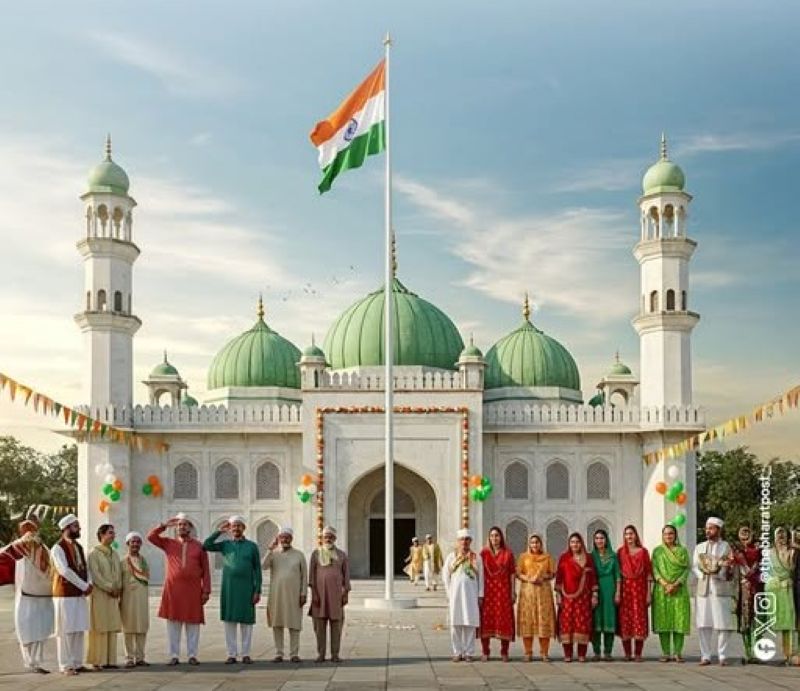
Since 2014, because of the conducive atmosphere provided, the Muslims have been showing an unprecedented fondness for the Constitution, and the sacred symbols of the nation. The Independence and Republic Days are celebrated with gaiety in Muslim institutions, including madrasas; and the national anthem is sung with gusto. Many a time, one can see the national flag waving from the high minaret of a mosque. If a better atmosphere is conduced, the Muslims will sing Vande Mataram with as much fervour as anyone else. – The Print, 12 December 2025
› Ibn Khaldun Bharati is a student of Islam, and looks at Islamic history from an Indian perspective.
 VOICE OF INDIA