Why are Indian historians in denial mode? – David Frawley

Indus Script

It is time for deconstructionist historians to be deconstructed. Such historians, whose view of the world is purely outward, do not have the insight to appreciate India. … Their historical accounts reflect the attempt of a recent ruling elite to rewrite history in its own image—and to deny legitimacy for any other group, even if it requires denying the very existence of India before they assumed power! – Dr. David Frawley

India today is a strange country in that, uniquely among the nations of the world, it seems to be afraid of its own history.

If we study current historical accounts, particularly by India’s academic Left, the most important fact about the history of India is that there is no real history of India. This is because such scholars are unable to see the existence of any cohesive entity called India before 1947.

India as a real country in their view is attributed mainly to Jawaharlal Nehru and his followers after independence on a region that, though previously under the umbrella of British rule, was otherwise lacking in unity, continuity or perhaps even civilisational depth.

Such historians are happy to negate the history of their own country. Their accounts of India’s history are largely denials of any enduring country, civilisation or culture worthy of the name. Their history of India is one of foreign invasions, temporary or vanished empires, internal social divisions and conflicts, and a disparate and confused cultural diversity. They regard India as a melting pot or conglomeration of widely separated peoples and cultures coming together by the accident of geography that hardly constitutes any united country or national identity.

Unfortunately, such Indian historians, particularly with political alliances with Left historians in UK and US, are introducing their anti-India ideas into Western academia, which still does not understand India’s very different civilisational model.

Such studies forget that national identity is cultural, not simply political. India did not become a British state under British rule or an Islamic state under Muslim rule. The older Indian/Bharatiya culture continued.

These anti-India views are easily countered by a number of historical facts.

The first is that outside people and countries have long recognised a civilisation called India.

After Alexander the Great came to India in the fourth century BCE, the Greek historian Megasthenes wrote a book on the region called Indika, in which he noted an existing tradition in the country of 153 kings going back over 6,400 years. The Greeks overall lauded the civilisation of India.

Buddhist pilgrims in the ancient and medieval period, particularly from China, honoured India and its great culture during their travels. India’s cultural influence spread to Indonesia and Indochina in the East and into Central Asia, extending on a religious level to China and Japan.

The ancient Romans lost much of their wealth in a one-sided trade with India and the Europeans long sought the riches of India. Columbus, of course, found America by chance while looking for a more direct sea route to India.

Second, India, like many countries, has more than one name. The Indian Constitution says the “India that is Bharat”. Bharat is the main ancient name for the region going back to King Bharat, an ancient ruler long before Rama, Krishna or Buddha.

The Bharatas were the main people of the ancient Rig Veda, who ruled from the Sarasvati region. They eventually split into several groups, one of which, the Kurus, became dominant in late ancient times, as the main people of the Mahabharata.

Modern historians can more easily deny history to the name India than to Bharat and so ignore the other name of the country.

Third, India has probably the oldest, largest and most continuous literature of any civilisation. The Vedas with their many thousands of pages dwarf anything from the Middle East, Egypt or Greece of the ancient period.

Geography is an important topic in these texts. The Vedas speak of a land of seven rivers, Sapta Sindhu, extending to the ocean, of which the Sarasvati River was the most important. The Persians in their oldest Zend-Avesta remember the area as Hapta Hindu. Sindhu, Hindu and India are related terms.

The Ramayana, Mahabharata and Puranas outline a sacred geography of India/Bharat from Kailas in the north to Lanka in the south, Assam in the east to beyond the Indus in the west. Buddhist and Jain texts do the same, showing a common culture and geography.

Around this sacred geography, Indians built numerous temples and recognised numerous sacred sites, revealing this vast region and its cultural unity.

Along with these sacred sites are numerous festivals and pilgrimages. We see this in modern India, which has the largest tradition of pilgrimage in the world, notably the massive Kumbha Melas that bring in tens of millions of pilgrims. Pilgrims throughout India visit these sites, with South Indians commonly travelling as far as the Himalayan temples of the north. Festivals like Diwali are elaborately celebrated throughout the country.

Ancient Indian literature contains a calendar system still widely followed, the Panchanga. Indian calendars extend from historical time of thousands of years to cosmic time of billions of years.

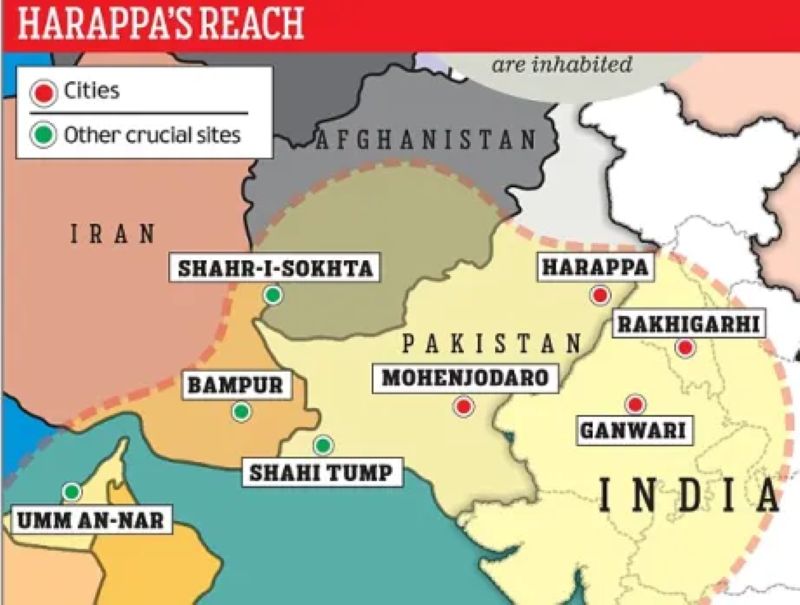
Fourth, extensive new evidence of archaeology upholds the cultural continuity of the region. The Archaeological Survey of India (ASI) claims that in the Haryana/Kurukshetra/Sarasvati river area there is evidence of a continual development of agriculture and civilisation from 8000 BCE, extending through the Harappan urban era. This area hosts Rakhigarhi, the largest Harappan site, more extensive than Mohenjodaro or Harappa.

The Harappan Civilization—also called the Indus Valley or Saraswati Civilisation—is the largest and most uniform urban civilisation of the ancient world in the third millennium BCE. It ended with the drying up of the Sarasvati River around 1900 BCE, which the Geological Survey of India (GSI) has verified. The Vedas refer to the different stages of the Sarasvati river from an ocean-going stream to drying up in the desert, showing they resided on the river long before its termination.

Consistent with their negative line of thought, Leftist historians ignore this information or accuse archaeologists of political bias in their findings.

Lastly, but equally important, the independence movement drew inspiration from the older history of India/Bharat, with such revered figures as Swami Vivekananda, Lokmanya Tilak and Sri Aurobindo seeking to revive the ancient culture. Even Mahatma Gandhi’s mantra was Ram and his idea of India was Ram Rajya.

Not surprisingly, most of these independence leaders have been ignored by the same group of historians, who have made Nehru tower over them, with some afforded diminished roles and others forgotten altogether.

The Congress party, the main support for such historians, has since named every major institution or initiative in India possible after the three members of the Nehru family who became prime ministers. They have little regard for other Congress prime ministers like P.V. Narasimha Rao, whom they have also almost erased from history.

Yet at the same time today, India’s great culture and civilisation through Yoga, Vedanta, Buddhism, Sanskrit, Indian music and dance is once more influencing the entire world—expanding in spite of this historical denigration.

It is time for these deconstructionist historians to be deconstructed. Such historians, whose view of the world is purely outward, do not have the insight to appreciate India, because it is not a mere political formation but a vast spiritual culture.

Their historical accounts reflect the attempt of a recent ruling elite to rewrite history in its own image—and to deny legitimacy for any other group, even if it requires denying the very existence of India before they assumed power! – Vedanet, 30 June 2016

›This article originally appeared in Swarajya Magazine

› Dr David Frawley (Pandit Vamadeva Shastri) is a Vedacharya and includes in his unusual wide scope of studies Ayurveda, Yoga, Vedic astrology, and Indian History.
Mohenjo-daro Graphic


Why a nation and its people must know their true history – Makkhan Lal

India History Cartoon

No country can become a great nation, a world guru and a world leader on borrowed ideas, borrowed cultures and borrowed systems. The greatness and leadership is built upon the solid foundation and the pride of their own past. – Dr. Makkhan Lal

History, history writing and history teaching have, indeed, become newsworthy not only in India but also in most other parts of the world. The reasons may be varied—construction of a national history curriculum in India, England and Wales, the design of national history standards in the US, the content of history textbooks in Japan, China, Korea, Pakistan, Israel, and Germany, the approach to invasion of Latin American countries by the Europeans, the development of new curricula in the successor states of the former USSR, or even the rewriting of history textbooks in Russia after the collapse of the former USSR. Issues of identities, heritage, and citizenship, all rooted in the past, have become the hot stuff of politics.

Similarly, an issue can be raised about the conquest of peaceful people belonging to Inca, Aztec and Maya civilisations by the gun-trotting Europeans. Whether the victory should be viewed as the discovery of a new world and new economic resources for Europe, as is generally viewed by European and North American historians, or it should be seen as the destruction of the independently developed three native civilisations by technologically more advanced nations that have an unending lust for looting others’ treasures and making other people subservient.

A South American historian may well say: “It may be a subject of celebrations for Europeans but for us it is a subject of mourning because just in a few years the Europeans destroyed our civilisation developed over several thousands of years!”

Why study history

Questions have often been raised that when there are so many problems and differences of opinions among historians why should we study history at all.

History is all about the past. In almost every country, city, town and village throughout the world, a large number of existing buildings were built in the past to meet the needs and aspirations of people, now dead. This is most obvious in existing temples, churches, mosques, fireplaces, houses, public buildings, and so on. The systems of governments, political ideas, religious beliefs, art, architecture, cultural practices, educational systems, customs and behaviours are all products of the past, recent or remote.

The past is all-pervasive which, indeed, means that we cannot escape from it. The past signifies what actually happened—events that have taken place, societies that have risen and fallen, ideas and institutions, eating habits, dressing habits, etc. History is precisely the study of this human past. The past is our heritage; we are part of it and the past is part of us in all aspects: Be it culture, behaviour, religious faith and practices, be it rituals, be it the tradition of political, social and economic systems. It is reflected in our day-to-day living.

History is also about roots. It provides societies and individuals with a dimension of longitudinal meaning over time which outlives the human life span. It connects us with our past. History also allows us to peep into the future by providing precedents for contemporary actions and forewarning against the repetition of past mistakes. From its sense of continuity, history offers the apparent form and purpose to the past, the present and the future. In the words of E.H. Carr: “The past is intelligible to us only in the light of the present, and we can fully understand the present only in the light of the past.” He further says that history is needed “to enable man to understand the society of the past and to increase his mastery over the society of the present.” There is a need for history. It has a deeper social value and meaning.

The study of history is not a luxury. It is a necessity. This necessity has been best summed up by Arthur Marwick. He writes: “Individuals, communities, societies could scarcely exist if all knowledge of the past is wiped out. As memory is to the individual, so history is to the community or the society. Without memory, individuals find great difficulty in relating to others, in finding their bearings, in taking intelligent decisions—they lose their sense of identity. A society without history would be in a similar condition. … A society without knowledge of its past would be like an individual without memory. … It is only through a sense of history that communities establish their identity, orientate themselves, understand their relationship to the past and to other communities and societies. Without history (knowledge of the past), we, and our communities, would be utterly adrift on an endless and featureless sea of time.”

We all move ahead through the past of our own cultures, own civilisations, and values and it is this accumulation of ideas and experience, transmitted through education and sheer daily living that gives our thoughts meaning and the patterns and purpose of our actions. It is not that we live in the past but we are defined by it, and so the success of even the most forward-looking developments must inevitably rest on their relation to the ideas and practices of the society they are meant to serve. Science may forget its own history, but a society cannot.

History is neither a simple chronicle of the past nor a list of rulers and kings and the narratives of their rules. The past is not simply a collection of distinct ages or a hotchpotch of facts. History is an extremely complex discipline. Another point that needs to be emphasised is that a historian’s job is not that of a cook who prepares dishes as per the liking of his customers and adds spices accordingly. It is not the job of a historian to write politically correct history. His obligation is to write factually correct history.

It will be helpful if all historians remember what Sir Jadunath Sarkar wrote about the job of a historian: “I would not care whether the truth is pleasant or unpleasant, and in consonance with, or opposed to, current views. I would not mind in the least whether the truth is, or is not, a blow to the glory of my country. If necessary, I shall bear in patience the ridicule and slander of friends and society for the sake of preaching the truth. But still, I shall seek truth, understand truth, and accept the truth. This should be the firm resolve of a historian.”

This brief discussion on the nature of history as an academic discipline should make it abundantly clear that history is neither a static discipline nor can the writings on and of history be put into a set mould. Each generation views and writes about the past in the light of its own experience. Therefore, all interpretations and explanations are and must be as temporary and provisional as the descriptions. But in all these endeavours the sanctity of truth and facts should not be forgotten. Unanimity or one’s efforts to make others surrender is a recognisable characteristic of dictatorships, and not that of a free state. Open and continuing discussions and debates are the essence and strength of history and, for that matter, a great strength of an open society of an intellectually vibrant nation.

And now a word of caution! There is a tendency among historians to act as judges and give moral sermons. Historians must write and rewrite history. They are not supposed to be moral judges. Benedetto Crose has rightly said: “Those, who on the plea of narrating history, bustle about as judges, condemning here and giving absolution there, because they think that this is the office of history … are generally recognised as devoid of historical sense.”

Problems in history writing

Historians recognise that they are all culturally and socially influenced in their endeavour to write history but make all efforts to deny that their work is culturally, or socially, determined or constructed. As has been discussed briefly in the Introduction, EH Carr in chapter two of his book What is History provides a useful summary on this aspect of history writing. He quotes Donne Devotion that society and individuals are inseparable. “No man is an island, entire of itself, every man is a piece of the continent, a part of the main.” Like any other individual, a historian too is a social phenomenon, both the product and the conscious and unconscious spokesperson of the society to which he belongs. It is in this capacity that he approaches the facts of the historical past.

Therefore, we must not forget that we cannot fully understand or appreciate the work of a historian unless we have first grasped the standpoint from which he himself approaches it, and that standpoint is itself rooted in social and historical background. It is, therefore, essential that before we study history, we must study the historian and study his historical and social environment. When some historians claim that they are writing scientific history, or that only their version of history is correct, one must conclude immediately that the historians are not only being untruthful but are also hiding their political agenda under the garb of a “scientific” history. There exists nothing like scientific history. On similar lines, Benedetto Croce also spoke with his characteristic bluntness:

“The historian must have a point of view, … an intimate personal conviction regarding the conception of the facts which he has undertaken to relate. … It suffices to read any book of history to discover at once the point of view of the author if he is a historian worthy of the name and knows his own business. … Absolutely historical historians do not and cannot exist. Can it be said that Thucydidus and Polybius, Livy and Tacitus, Machiavelli and Guicciardini, Giannone and Voltaire were without morals and political views; and in our own time, Guizot or Thiers, Macaulay or Balbo, Renke or Mommson? … If the historian is to escape from this inevitable necessity of taking sides, he must become a political and scientific eunuch; and history is not the business of eunuchs. … Historians who profess to wish to interrogate the facts without adding anything of their own, are not to be believed.”

Karl Marx buried among the crosses of Highgate Cemetery, London.

The problem with Marxist historiography and its relationship with history is much more curious. For Marx and his followers, i.e. Marxist historians, the problem of history is not just understanding “what happened”, “how it happened” and “why it happened”. For them, the problem is “how to change the world” by the use of history. At the core of this view lie two fundamental beliefs. Firstly, the Marxists believe in five universal stages of history.

These five stages are:

  1. Primitive Communism
  2. Slavery
  3. Feudalism
  4. Capitalism
  5. Communism

Secondly, they believe that the society we inhabit is a bad bourgeois society and, fortunately, this society is in a state of crisis. The good society which lies just around the corner can be easily attained if only “we” work systematically to destroy the language, the value, the culture, the ideology of this “bourgeois” society. This necessitates a massive, radical left-wing political programme, and everything the historians write, every criticism they make, is determined by that overriding objective. In this, the post-modernists are exceptions. They are fully convinced of the utterly evil nature of the “bourgeois” society but have lost all hope of change and have fallen back into destructive nihilism. They assert that the only way to achieve Marxism is to destroy society if it cannot be changed.

Marxist historians have failed to understand and appreciate the fact that the society we live in has evolved through a complex historical process, very different from the Marxist formula of the rise of feudalism over slavery and bourgeoisie overthrowing the feudal aristocracy. It is highly complex with respect to the distribution of power, authority, and influence. Just as it was not formed by the simple overthrow of aristocracy by the bourgeoisie, so, in its contemporary form, it does not consist simply of a bourgeois ruling class and a proletariat. The idea that we are now in the final period of the late-capitalist crisis is simply absurd. Marxists have been looking forward to the final capitalistic collapse for over a century—in 1848, 1866, 1918, 1946, 1963 and 1968, to mention just a few dates, but as fate would have it, they are themselves doomed forever.

Statements like “The pursuit of history is, whether practitioners choose to acknowledge it or not, a political occupation,” indeed, is not only exceptional but also far-fetched. At the same time, we have to acknowledge that the experience of colonisation around the world has shown that domination by a more powerful culture—which defines its reality in quite different ways—either totally destroys, or at least drives, the less powerful ones into a subservient role. What was considered culturally “valid” can be rendered “invalid”, and the politically weaker ones are somehow required to modify their reality to fit within the constraints of the new codes.

We, as historians, must learn to recognise: “The past is perceived in different ways by different cultures. Methods of interpreting, recording, managing and protecting the past also differ between cultures. … The way people define their existence, their world view and their creation stories, and how they value, interpret, manage and transmit their past will continue to be handed on from generation to generation.”

Conclusions

Let us remember that no country can become a great nation, a world guru and a world leader on borrowed ideas, borrowed cultures and borrowed systems. The greatness and leaderships are built upon the solid foundations and the pride of the past; deeper the foundations, taller are the superstructures. Even globalisation is built upon this foundation. Many countries are part of globalisation on a much larger scale than India without abandoning their history, culture and heritage. It is on this basis they are able to assert their authority and influence the world order. – Firstpost, 6 January 2022

› Prof. Dr. Makkhan Lal is a historian and the founder director of the Delhi Institute of Heritage Research and Management.