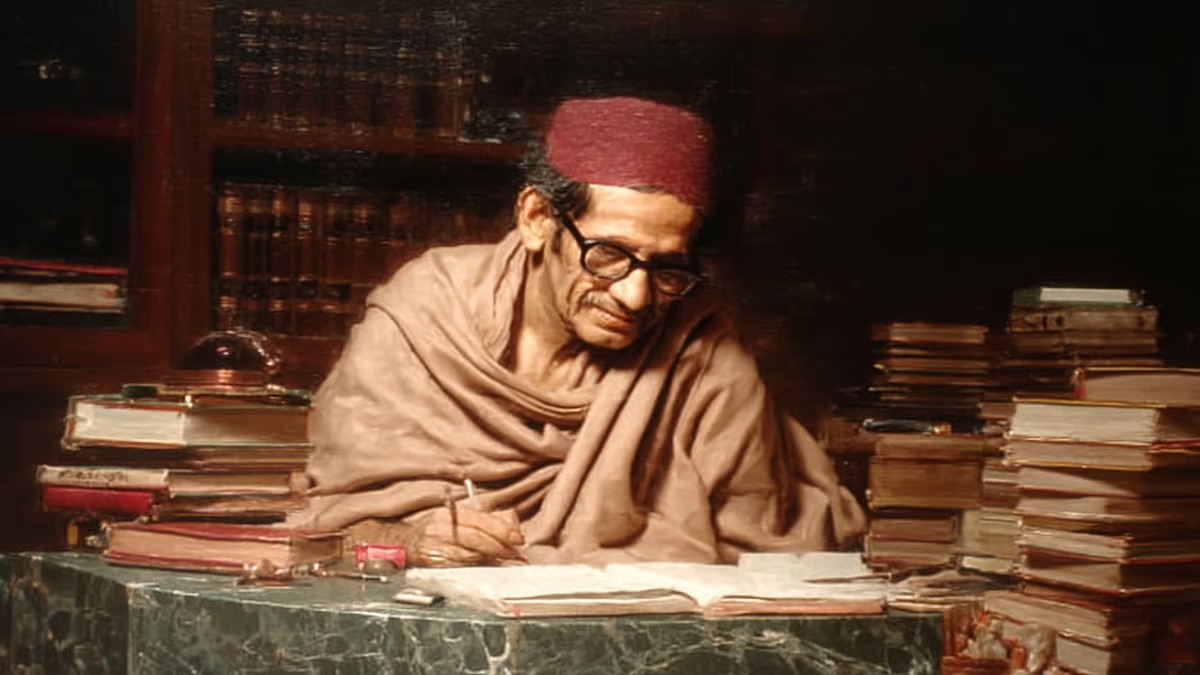
Rushdie’s Duplicity: A victim of Islamist violence makes Hindu nationalism an easy target – Utpal Kumar

Salman Rushdie

To watch Rushdie reprimand “Hindu nationalism” after surviving a near-fatal Islamist attack is therefore to witness a tragic spectacle: a man shaped by fear into criticising the safest opponent available. – Utpal Kumar

Soon after Salman Rushdie was stabbed by an Islamist madman in New York in August 2022, Gopalkrishna Gandhi wrote an article in the Hindustan Times, ‘The scorching truth of Rushdie’s ordeal’. While examining the Rushdie stabbing, Gandhi seemed oblivious to the attacker’s identity—the writer didn’t mention even once why the novelist was attacked, who the attacker was, or why Rushdie was forced to stay under cover for years despite issuing several apologies. Instead, he invoked Mahatma Gandhi’s assassination by a Hindu in 1948. His verdict became intriguingly problematic when he wrote, “The attack on Rushdie comes from the same source?”

Really!

Salman Rushdie’s latest warning about the “rise of Hindu nationalism” in Bharat seems to follow the same Left-‘liberal’ pattern—of, first, denying or at least minimising the scale of Islamist violence; and, second, if the scale of violence is too vast to ignore, creating an equivalence in Hinduism. It reads less like a principled stand and more like a man barking up the only tree that never bit him while fastidiously avoiding the forest of blades that left him with one eye less and a badly damaged liver.

The documented record of violence against Rushdie is neither vague nor debatable. It is exhaustively chronicled by many scholars, including Daniel Pipes, who, in his book The Rushdie Affair (1990), coined the term “Rushdie Rules” to describe how “editors, newspapers, publishers, and academic teachers abide by a new set of rules—new to modern Westerners at least—which limit the freedom to discuss Islam with the same methods, terminology and frank inquisitiveness that are considered normal in discussing Christianity or Hinduism”. Rushdie had himself written extensively about this in his 2012 memoir, Joseph Anton.

It was Ayatollah Khomeini’s fatwa that sent Rushdie into hiding. Then, there was the selective killing of no less than 45 people worldwide associated in one way or the other with The Satanic Versesthis included the murder of its Japanese translator, Hitoshi Igarashi, in 1991. Many were stabbed, including an Italian translator of the book in Milan; a Norwegian publisher was shot in Oslo. And, finally, it was an Islamist radical, Hadi Matar, who in 2022 stormed a stage in New York and plunged a knife repeatedly into Rushdie’s neck and abdomen, leaving him almost dead. All this is a living testament to the fact that Khomeini’s decree, as Daniel Pipes emphasises, “was never simply a religious opinion, but a death sentence with no expiry date”.

In contrast, Rushdie’s affair with Hindu nationalism is not only bloodless, it is anti-climactic in many ways. When he mocked Bal Thackeray and caricatured Hindu figures in The Moor’s Last Sigh (1995), the much-anticipated Hindutva havoc never materialised. Thackeray, far from issuing anything resembling a fatwa, responded with a shrug and the suggestion that his secretary could read the book for him.

This civilisational lopsidedness was noted by Koenraad Elst in his preface to The Rushdie Affair, where he contrasted the Ayatollahs’ unforgiving wrath despite Rushdie’s repeated apology with the quick closure of the Shivaji Maharaj controversy when Khushwant Singh apologised for calling the Maratha hero “a bastard”. In the Hindu case, an apology ended the matter. In the Islamist case, apology merely confirmed guilt. The difference is civilisational, not rhetorical.

Given this stark historical-civilisational difference, Rushdie’s latest denunciation of “Hindu nationalism” appears less like conviction and more like reflex—the reflex of a man who has learnt, through his own bloody experience, which ideologies kill and which merely complain. It is psychologically understandable, even if morally disappointing and intellectually dishonest.

A traumatised man avoids the bully but lectures the weak and gentle. Writers like Ayaan Hirsi Ali have described this phenomenon as the “fear-shaped silence” that hangs over critiques of Islamism. Rushdie may not be totally silent, but he is certainly cautious, careful to look for the safer target while framing his criticisms of Islamism within layers of diplomatic phrasing. He is well aware, better than anyone else, of the one ideology that puts a global contract on life that never gets revoked.

To watch Rushdie reprimand “Hindu nationalism” after surviving a near-fatal Islamist attack is therefore to witness a tragic spectacle: a man shaped by fear into criticising the safest opponent available. It is not courage; it is self-preservation masquerading as principle. And it underscores a deeper truth about our intellectual climate—the willingness of cultural elites to condemn, even cut, the tree that never struck them while tiptoeing around the jungle that nearly swallowed one of their own.

Rushdie’s warning about Hindu nationalism may win him applause in Left-‘liberal’ salons, but it is a misdirection that obscures the true, documented, bloodstained threat that has shadowed him for the past 36 years. If he is barking, he is barking up the wrong tree—and perhaps the only one that never bared its teeth.

Hindu nationalism, after all, did not force Rushdie into hiding. Hindu nationalism did not murder his colleagues. Hindu nationalism did not stab him on an American stage. Hindu nationalism did not declare that repentance is insufficient and that the sentence is eternal. Islamism did all of this, openly and repeatedly—an ideology that celebrates the likes of Hadi Matar.

Perhaps Rushdie the rebel, which he was once in the 1980s, is no more, as he himself had suggested in Joseph Anton. Recalling the moment in 1989 when a fatwa was issued against him by the Ayatollah of Iran, he remembered receiving a call from a woman BBC reporter who asked, “How does it feel to know that you have just been sentenced to death by the Ayatollah Khomeini?” It was a sunny Tuesday in London, but Rushdie had never felt the world so dark. “It doesn’t feel good,” he replied, though inwardly he thought, “I’m a dead man.”

Rushdie, the rebel writer, is long dead. Long live Rushdie! – Firstpost, 9 December 2025

› Utpal Kumar is Opinion Editor at Firstpost and News18 and is the author of the book “Eminent Distorians: Twists and Truths in Bharat’s History”.

Hindutva and other peoples’ nationalism – Koenraad Elst

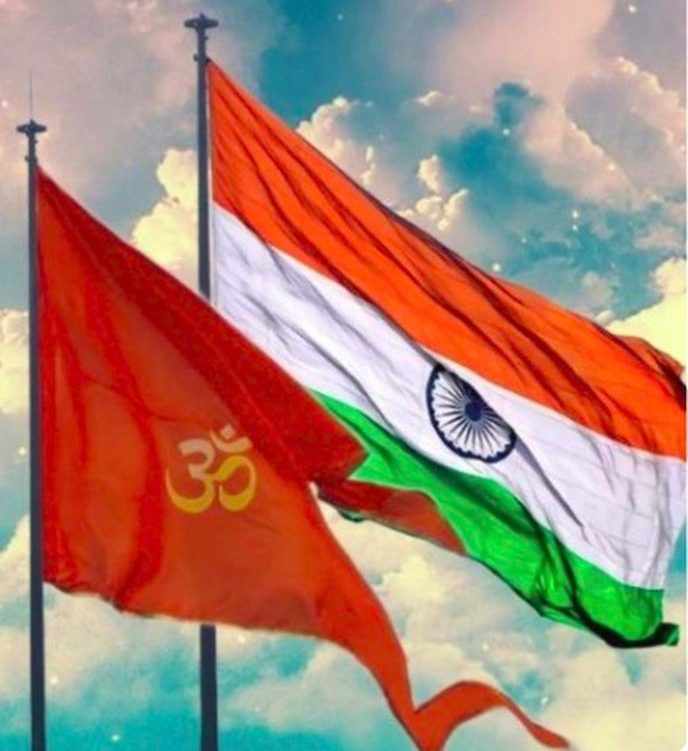
Hindu & India Flags

Along with falling from cultural Hindu nationalism to empty secular-territorial nationalism, the BJP has also fallen from solidarity with other oppressed and colonised nations to a short-sighted ethnocentrism. – Dr. Koenraad Elst

The BJP’s subordination of any and every ideological or religious conflict to questions of “national unity and integrity”, this most mindless form of territorial nationalism, is also a worrying retreat from the historical Hindu conception of Indian nationhood and its implications for the evaluation of foreign problems of national unity. Along with Mahatma Gandhi and other Freedom Fighters, the BJS used to be convinced that India was a self-conscious civilisational unit since several thousands of years, strengthened in its realisation of unity by the Sanskrit language, the Brahmin caste, the pilgrimage cycles which brought pilgrims from every part of India all around the country (“country” rather than the “Subcontinent” or “South Asia”, terms which intrinsically question this unity), and other socio-cultural factors of national integration. The notions that India was an artificial creation of the British and a “nation in the making”, were floated by the British themselves and by Jawaharlal Nehru, respectively, and both are obvious cases of unfounded self-flattery. Gandhi’s and the BJS’s viewpoint that India is an ancient nation conscious of its own unity is historically more accurate.

In foreign policy, one can expect two opposite attitudes to follow from these two conceptions of India, the Gandhian one which derives India’s political unity from a pre-existent cultural unity, and the Nehruvian one which denies this cultural unity and sees political unity as a baseless coincidence, an artificial creation of external historical forces. In its own self-interest, an artificially created state devoid of underlying legitimacy tends to support any and every other state, regardless of whether that state is the political embodiment of a popular will or a cultural coherence. The reason is that any successful separatism at the expense of a fellow artificial state is a threat to the state’s own legitimacy. That is, for instance, why the founding member states of the Organisation of African Unity decided from the outset that the ethnically absurd colonial borders were not to be altered. It is also why countries like Great Britain and France, whose own legitimacy within their present borders is questioned by their Irish, Corsican and other minorities, were reluctant to give diplomatic recognition to Lithuania when it broke away from the Soviet Union.

By contrast, those who believe that states are merely political instruments in the service of existing ethnic or cultural units, accept that state structures and borders are not sacrosanct in themselves and that they may consequently be altered. That is why Aleksandr Solzhenitsyn proposed to allow the non-Slavic republics to leave the Soviet Union, and why as a sterling Russian patriot he pleaded in favour of Chechen independence from the Russian Federation: it is no use trying to keep Turks and Slavs, or Chechens and Russians, under one roof against their will. If Russia is meant to be the political expression of the collective will of the Russian people, it is only harmful to include other nations by force, as the Chechens and Turkic peoples once were.

To be sure, even partisans of this concept of “meaningful” (as opposed to arbitrary) states will concede that there may be limitations to this project of adjusting state structures and state borders to existing ethnic and cultural realities, especially where coherent communities have been ripped apart and relocated, as has happened in Russia. Also, cultural and ethnic identities are not static givens (e.g. the “Muslim” character of India’s principal minority), so we should not oversimplify the question to an idyllic picture of a permanent division of the world in states allotted to God-given national entities. But at least the general principle can be accepted: states should as much as possible be the embodiment of coherent cultural units. That, at any rate, is the Hindu-nationalist understanding of the Indian state: as the political embodiment of Hindu civilisation.

Now, what is the position of the BJS/BJP regarding the right of a state to self-preservation as against the aspirations of ethnic-cultural communities or nations? The BJS originally had no problem supporting separatism in certain specific cases, esp. the liberation of East Turkestan (Sinkiang/Xinjiang), Inner Mongolia and Tibet from Chinese rule. At the time, the BJS still adhered to the Gandhian position: India should be one independent state because it is one culturally, and so should Tibet for the same reason. Meanwhile, however, this plank in its platform has been quietly withdrawn.

As A.B. Vajpayee told the Chinese when he was Janata Party Foreign Minister, and as Brijesh Mishra, head of the BJP’s Foreign Policy Cell, reconfirmed to me (February 1996): India, including the BJP, considers Tibet and other ethnic territories in the People’s Republic as inalienable parts of China.[1] The BJP has decisively shifted towards the Nehruvian position: every state, by virtue of its very existence, must be defended against separatist tendencies, no matter how well-founded the latter may be in cultural, ethnic or historical respects. That is, for example, why the BJP is not supporting Kurdish sovereignty against Iraqi and Turkish imperialism.[2] Along with falling from cultural Hindu nationalism to empty secular-territorial nationalism, the BJP has also fallen from solidarity with other oppressed and colonised nations to a short-sighted ethnocentrism.

When you ask why the BJP has abandoned its support for the Tibetan freedom movement, the standard reply is that this would justify other separatisms, including those in Kashmir and Punjab. Exactly the same position is taken by non-BJP politicians and diplomats. But from a Hindu and from an Indian nationalist viewpoint, this position does injustice to India’s claim on Kashmir and Punjab, which should not be put on a par with all other anti-separatism positions in the world. Firstly, while Tibet was never a part of China, and while Chechnya was only recently (19th century) forcibly annexed to Russia, Kashmir and Punjab have been part of the heartland of Hindu culture since at least 5,000 years. Secondly, in contrast with the annexations of Chechnya and Tibet, the accession of Punjab (including the nominally independent princedoms in it) and the whole of the former princedom of Jammu & Kashmir to the Republic of India were entirely legal, following procedures duly agreed upon by the parties concerned.

Therefore, Indian nationalists are harming their own case by equating Kashmiri separatism with independentism in Tibet, which did not accede to China of its own free will and following due procedure, and which was not historically a part of China. To equate Kashmir with Tibet or Chechnya is to deny the profound historical and cultural Indianness of Kashmir, and to undermine India’s case against Kashmiri separatism. Here again, we see the harmful effect of the BJP’s intellectual sloppiness.

To be fair, we should mention that the party considers its own compromising position on Tibet as very clever and statesmanlike: now that it is preparing itself for Government, it is now already removing any obstacles in the way of its acceptance by China and the USA (who would both be irritated with the “destabilising” impact of a Government in Delhi which is serious about challenging Beijing’s annexation of Tibet). In reality, a clever statesman would reason the other way around: possibly there is no realistic scope for support to Tibetan independence, but then that can be conceded at the negotiation table, in exchange for real Chinese concessions, quid pro quo.[3] If you swallow your own hard positions beforehand, you will have nothing left to bargain with when you want to extract concessions on the other party’s hard positions, i.e., China’s territorial claims on Ladakh, Sikkim and Arunachal Pradesh, and its support to Burmese claims on the Andaman and Nicobar islands. International diplomacy should teach the BJP what it refuses to learn from its Indian experiences, viz. that being eager to please your enemies doesn’t pay. – Pragyata, 13 May 2020 (excerpt taken from BJP vis-a-vis Hindu Resurgence by  Koenraad Elst and published by Aditya Prakashan, New Delhi).

› Belgian scholar Dr Koenraad Elst is an author, linguist, and historian who visits India often to study and lecture. 

References

  1. If earlier BJP manifestos still mentioned Sino-Indian cooperation “with due safeguards for Tibet”, meaningless enough, the 1996 manifesto does not even mention Tibet. Nor does it unambiguously reclaim the China-occupied Indian territories; it vaguely settles for “resolv[ing] the border question in a fair and equitable manner”.(p.32)
  2. In October 1996, a handful of BJP men bravely demonstrated before the American Embassy against the American retaliation to the Iraqi troops’ entry in the Kurdish zone from which it was barred by the UNO. There was every reason to demonstrate: while punishing Iraq, the Americans allow Turkish aggression against Iraqi Kurdistan, the so-called “protected” zone, and fail to support Kurdish independence in deference to Turkey’s objections. But that was not the target of the BJP protest, which merely opposed any and every threat against the “unity and integrity” of Iraq, a totally artificial state with artificial and unjustifiable borders (as Saddam Hussain himself argued during the Gulf War, pointing to the artificial British-imposed border between the Mesopotamian population centre and the Kuwaiti oil fields).
  3. This is not to suggest that demanding freedom for Tibet should only be done to have a bargaining chip, merely to illustrate the principle that concessions, even if unavoidable under the circumstances, should still be made known as such, i.e. in exchange for concessions from the other party, and not made beforehand in exchange for nothing. But Beijing politics may develop in such a way that Tibetan sovereignty becomes a realistic proposition again.

Tibetan Independence

The RSS Century – Makarand R. Paranjape

Mohan Bhagwat and Narendra Modi with Hedgewar memorial at RSS headquarters in Nagpur.

The RSS set its sights on nation-building through cultural and political mobilisation. Its ideology emphasises a unified Hindu identity as the bedrock of Indian nationhood, a stance that has both inspired millions and provoked fierce opposition. – Prof. Makarand R. Paranjape

In the brouhaha over the ‘impossible’ retirement of Prime Minister Narendra Modi and the somewhat more probable demission of Rashtriya Swayamsevak Sangh (RSS) head Mohan Bhagwat, might we be forgetting an even more important milestone?

True that both Modi and Bhagwat will turn 75 in a few weeks, September 17 and September 11, respectively. Seventy-five, we needn’t remind ourselves, is the age at which leaders of the Sangh Parivar are expected to retreat gracefully both from public office and active duty, giving way to younger, even if not more capable, talent.

The prospects of Modi hanging up his boots, so to speak, seem not just unlikely, but remote. Despite his much-vaunted ‘almost sannyasi’ image as India’s most powerful renouncer. From all reports, not only does the Bharatiya Janata Party (BJP) need him, but he, too, has sent several signals to the effect that his work is far from done.

What about Bhagwat? Less implausible than Modi, but who can tell? RSS sarsanghchalaks lead by example. They are not politicians, though, almost as an occupational hazard, so embroiled in politics. Instead, a sarsanghchalak is supposed to embody the highest values, not only of the Sangh but of Sanatana Dharma itself.

My own contact with Mohan Bhagwat has convinced me that both his company and his conversation are spiritually elevating. At a crucial moment in my career, he suggested, quite simply and softly, that sticking to one’s own highest intention and integrity were far more valuable, in the long run, than ”playing the game”. A true intellectual, he remarked in passing, should never seek position or preferment: “Vat rahat nahi,” he said in Marathi. Which means, you lose respect.

Yes, we, in India, tend to revere individuals more than organisations. The personality cult comes naturally to us. But built into the Sangh’s DNA is the idea that the organisation is more important than the individual, society more important than the organisation, and the nation the most important of all.

As one pracharak or full-time worker, shifted out of what most would consider a very high-profile post to one of relative ano­nymity told me, “We are good to go wherever we are sent at very short notice.” He smiled when he said this and did not look at all unhappy or disappointed: “Apna jhola tham liya aur bus chal diye.” Get hold of one’s rucksack and just move on.

Such an attitude of egoless idealism and absence of attachment may not be universal among the cadres, but in the core group of those who actually make the Sangh what it is, it is less rare than common.

No wonder, rather than focusing on any individual, however great, the more significant jubilee that I am alluding to, of course, is the 100th anniversary of RSS.

Let us not forget that RSS has produced not only prime ministers like Narendra Modi and Atal Bihari Vajpayee but dozens of cabinet ministers, chief ministers, and governors. At least two vice presidents, Bhairon Singh Shekhawat and M. Venkaiah Naidu, and one president of India, Ram Nath Kovind, have come from its ranks. Not to mention luminaries in every branch of society.

With an estimated membership running into millions and over 75,000 active branches (shakhas) that are supposed to congregate daily, RSS is the world’s largest and most important voluntary socio-cultural organisation.

One would have to be blind or utterly prejudiced to disregard its unique and prodigious achievements. The RSS journey over the last 100 years has been nothing short of phenomenal. Its contributions to nation-building have, in my estimation, no parallel anywhere in the world.

On Vijayadashami 2025, the tenth victory day marking the culmination of In­dia’s autumn Navaratri festival, RSS completes 100 years of its existence. Celebrated all over the subcontinent and elsewhere as the triumph of good over evil, it coincides this year, quite ironically for critics, with the birthday of Mahatma Gandhi on October 2.

Unlike our political leaders, RSS shuns self-praise, avoids blowing its own trumpet. Of its six sarsanghchalaks, only its found­er, Dr. Keshav Baliram Hedgewar or Doctorji and, his anointed successor, Madhav Sadashiv Golwalkar or Guruji, have a specially consecrated joint memorial in Nagpur. No one else. There is no active personality cult around these two either.

I would not be surprised if, at least from the RSS side, its centenary celebrations might end up being relatively quiet. Closer to the date, however, the world, especially the Indian media, is bound to take notice.

Let us just say that I am starting a bit early.

Does the RSS centennial signify a spectacular and momentous accomplishment?

The answer is an unambiguous yes. Because, in the minds of many, RSS has done more in the service of Hindu society and the Indian nation than any other organisation or association.

Founded in Nagpur in 1925 by Hedgewar, RSS emerged at a time when India was grappling with colonial subjugation and internal divi­sions. Hedgewar, an ardent nationalist and physician trained at the Calcutta Medical College and Hospital, envi­sioned an organisation that would unify Hindus and foster a sense of cultural and national pride. RSS was not merely a response to British colonialism but also to the fragmentation of Hindu society, weakened by centuries of invasions, social stagnation, and religious disunity.

In addition to the threat of Muslim separatism, which was casting its long and sinister shadow over the motherland.

Hedgewar adopted a grassroots approach, establishing shakhas, daily gatherings where volunteers engaged in physical exercises, ideological discussions, and community service. This disciplined, decentralised model allowed RSS to penetrate deep into Indian society, from urban centres to remote villages. From its modest beginnings, RSS, as I have already shown, has become a mighty and, I dare to invoke a Gandhian phrase, a “beautiful tree”.

The RSS journey is marked by its unapologetic, at times aggressive, commitment to Hindu nationalism, or Hindutva, a term popularised by Vinayak Damodar Savarkar. Unlike other reform movements like the Arya Samaj or the Ramakrishna Mission, which focused primarily on religious or social reform, RSS set its sights on nation-build­ing through cultural and political mobilisation. Its ideology emphasises a unified Hindu identity as the bedrock of Indian nationhood, a stance that has both inspired millions and provoked fierce opposition.

Why is RSS is so feared, to the extent of being deliberately slandered and demonised? Because it alone, of all of India’s great Hindu reform movements, has dared to dedicate itself to nation formation. Also because its enemies want Hindus to remain divided and India to remain weak?

When Hindu society was at a parlous and precarious juncture, as during the bloody Partition of India in 1947, RSS played a critical role in saving the lives of hundreds of thousands of men, women, and children. RSS, since Independence, has also selflessly served the nation, whether during flood, famine, or, worse—the dreaded Emergency of 1975-77, often at great cost to itself and immense sacrifice of its members.

What is more, all this service has been rendered silently, with hardly any publicity or fanfare. Even if its fully dedicated cadre of workers, numbering not over an estimated 3,500, are called pracharaks or publicists—a better English rendering, were it not for the negative connotations, would actually be “super spreaders”.

This goal has embroiled it in the rough and tumble of politics. RSS not only inspired, seeded, and nurtured the Bharatiya Jana Sangh in 1951, but its successor, the Bharatiya Janata Party in 1980. The latter has been India’s ruling party at the Centre for over 11 years and is in power in 14 out of India’s 28 states.

Besides BJP and the Jana Sangh, RSS has also spawned over 100 important organisations from student to trade unions, schools, colleges, and ashrams, to cultural, social, and religious organisations.

It was RSS that founded the Akhil Bharatiya Vidyarthi Parishad (ABVP) in 1949 and the Vishva Hindu Parishad (VHP) in 1964. As also the Bajrang Dal in 1984.

The Bharatiya Mazdoor Sangh, the Bharatiya Kisan Dal, and Seva Bharati have been inspired and founded by RSS too. Its work is not confined, unlike a popular misconception, solely to men. Major women’s organisations such as the Rash­tra Sevika Samiti, Durga Vahini, and Matru Shakti have also been birthed by the Sangh. As dozens devoted to tribal and minority welfare have also been. These and a variety of other institutions have endeavoured to strengthen Hindu society and the Indian nation.

RSS is feared, reviled, and hated precisely because it has not shied away from seeking and wielding power, through its progenies and affiliates, in the interests of Hindus and India. This is the one simple reason why several groups, forces, and bodies from the extreme left to the farther right, not to mention India’s former ruling party Congress, all sought to ban, suppress, malign, denigrate, and delegitimise RSS.

But while its antagonists have failed and weakened over the decades, RSS has succeeded dramatically, even incredibly. That is why the last 100 years can justly be termed the RSS century.

And millions more may join its summons to national service in consonance with its beautifully moving and inspiring anthem. Inspired by Doctorji and composed by Narhari Narayan Bhide, let me invoke its opening line: Namaste Sada Vatsale Matrubhume (To Thee, ever-affectionate Motherland, my obeisance). – Open Magazine, 1 August 2025

Prof. Makarand R. Paranjape is an author, columnist, former teacher at JNU and former director of the Indian Institute of Advanced Study.

RSS flag march in Tamil Nadu.

Sita Ram Goel: A wronged man redeemed by history – Makarand R. Paranjape

Sita Ram Goel

Goel defined the three main threats to Sanatana Dharma—political Islamism, proselytising Christianity, and anti-national Marxist-Leninism. It has taken over 40 years, without adequate credit, for his ideas to be mainstreamed. – Makarand R. Paranjape

1 – The wronged man who turned right

On October 16, 2024 India ought to be marking the 103rd birth anniversary of one of our greatest, but still least recognised, post-independence intellectuals. The one who almost single-handedly created an enormous and powerful body of work against the “history men” and “eminent historians.” But he was not even recognised as a historian. Indeed, he was never a part of the academy. He carried out his lonely crusade from outside the safety and comforts of well-funded and influential institutions. The establishment tried to erase him by what has famously come to be called “strangling by silence”.

Who was he? His name is Sita Ram Goel. It may ring a bell in the minds of some, but his huge and impressive body of work remains mostly unknown among the thinking and reading public. Today, this name is bandied about freely in right-wing circles. There are even courses being taught on him. Suddenly, we notice many champions and followers of his line of thinking. But none of them, as far as I know, has engaged with his work in depth. Most of the secondary material is informative and ideological, characterised by borrowed plumes and virtue signalling. The only volume I know on his work that makes a worthwhile contribution has not even been edited by an Indian. It is the work of the redoubtable and indefatigable Koenraad Elst. Who has also been strangulated by silence.

Indeed, “right-wing” India, despite being in power for over 15 years at the Centre and much longer in several states, is yet to produce scholars who, far from matching Goel’s competence or persistence, have even bothered to engage seriously with his oeuvre. Despite massive government, institutional, and private funding. In the meanwhile, we must be content with fiery, even incendiary, expositions such as appear frequently on web platforms like the Dharma Dispatch.

Goel was born in a Vaishnava Bania Agarwal community in the Chhara village of present-day Haryana. His own family tradition was based on the Granth Sahib of Sant Garibdas (1717-1778). But by the time he was 22, he says, “I had become a Marxist and a militant atheist. I had come to believe that Hindu scriptures should be burnt in a bonfire if India was to be saved.” He also became an Arya Samaji and, then, Gandhian before turning seriously to Marxism. Living in Calcutta, where his father worked in the jute business, such an attraction and affinity was natural.

Elst’s eponymous opening chapter, “India’s Only Communalist,” eloquently spells out the extraordinarily uncompromising and exceedingly courageous challenge that Goel posed to what was akin to India’s prevailing state religion—Nehruvian secularism. Goel called it a “perversion of India’s political parlance”, in fact, nothing short of rashtradroha, or treason. In that sense, he was India’s only true communalist. For everyone else, RSS and VHP included, were tying themselves into knots to prove how truly secular they were—and still are.

It was Goel who spelled out clearly that what went by the name of secularism was actually what Elst has termed negationism. The denial of the life-and-death civilisational, religious, spiritual—and, yes, secular— conflict between a conquering Islam and a resistant Hindu society. Nehruvian secularism, to Goel, was not only an attempt to whitewash this horrifying history of Islamic conquest, vandalism, plunder, conversion, and genocide, but it was also the continuous appeasement of a Muslim minority in India till it held the Indian state and the Hindu majority to ransom.

Despite his early commitment, Goel’s disillusionment with the Communist Party of India (CPI) was triggered by their support of the Muslim League in its demand for a Muslim state of Pakistan. Goel himself, along with his family, narrowly missed the murderous Muslim mob fury of Direct Action Day during the great Calcutta killings of August 16, 1946. Independence came exactly a year later, with Goel on the verge of joining CPI. But the Communists took a belligerent stance against the Indian government, calling for an armed revolution. Consequently, Nehru banned the CPI in 1948. In the meanwhile, Goel’s intellectual mentor and the major influence on his life, Ram Swarup, himself a rising intellectual, weaned him forever from Communism.

Goel soon turned 180 degrees into one of India’s prominent anti-Communists, actively working for the Society for the Defence of Freedom in Asia. Several of his early works warned of the dangers of Communism, both the Soviet kind and, closer home, of Red China under Mao Zedong. Ram Swarup fired the first salvos, publishing the pamphlet Let Us Fight the Communist Menace in 1948, following it up Russian Imperialism: How to Stop It (1950). Then it was Sita Ram Goel’s turn. His amazingly prolific output in the 1950s include: World Conquest in Instalments (1952); The China Debate: Whom Shall We Believe? (1953); Mind Murder in Mao-land (1953); China is Red with Peasants’ Blood (1953); Red Brother or Yellow Slave? (1953); Communist Party of China: a Study in Treason (1953); Conquest of China by Mao Tse-tung (1954); Netaji and the CPI (1955); and CPI Conspire for Civil War (1955).

The Communist threat, looming large after the occupation of Tibet, materialised in China’s invasion of India in 1962.

The war lasted barely a month. Chinese troops of the People’s Liberation Army (PLA) crossed the McMahon Line on October 20. After capturing an area the size of Switzerland, some 43,000 square kilometres in Aksai Chin, they declared a ceasefire on November 21. Nehru was a broken man. He died less than two years later, on May 27, 1964, his dreams of a united Asian front against global capitalism shattered. The border standoff still continues with over 20,000 Indian and 80,000 Chinese troops massed on either side, with periodic skirmishes and casualties.

Goel was proven right; Nehru was wrong. Yet, during the Chinese aggression against India, quite ironically, established Leftists and highly placed bureaucrats, including P.N. Haksar, Nurul Hasan, I.K. Gujral, called for Goel’s arrest. During the 1950s, Goel wrote over 35 books, of which 18 were in Hindi. He also translated six books. He stood for elections from the Khajuraho constituency as an independent candidate in the 1957 Lok Sabha elections—but lost. He then embarked upon a publishing programme upon the suggestion of Eknath Ranade of RSS. However, according to Elst, RSS refused to sell or promote his books after the initial encouragement.

In 1957, Goel moved to Delhi, taking up employment with the Indian Cooperative Union (ICU) started by Kamaladevi Chattopadhyay. But Goel’s attack on Communists, both of the Chinese and Soviet Union varieties, had made him many enemies.

Goel, instead, trained his guns on Nehru, whose deep Communist sympathies and miscalculations had cost India so dear. He had been criticising Nehru in a series in the RSS mouthpiece, Organiser, under the pseudonym Ekaki (Alone). In 1963, he published these with the provocative title, In Defence of Comrade Krishna Menon. Why? Because V.K. Krishna Menon, as defence minister, had not only presided over India’s debacle but had also been an avowed Communist and Nehru favourite. In supposedly defending him, Goel traced the malaise back to Nehru himself, as a confirmed Fabian Socialist and consistent supporter of Leftist regimes across the world. As a result of this open attack, Goel lost his job in the state-funded ICU.

Jobless and free to pursue his own interests full-time, Goel went into publishing himself. In 1963, he started Biblia Impex, a book publication, distribution and import-export business. Apart from his own and Ram Swarup’s books, he also published Dharampal’s Indian Science and Technology in the Eighteenth Century and The Beautiful Tree. Later, in 1981, Goel also founded Voice of India (VOI), a non-profit publishing house, dedicated to the defence of Hindu society. VOI still continues with his grandson, Aditya Goel, at its helm. It has published over hundred titles in the ideological defence of Hindu society. – Open Magazine, 11 October 2024
Dhwaja

2 – The unsung scholar extraordinaire

The threat of Communism’s taking over India receded after the hugely unpopular Chinese invasion. The Communist Party of India itself split into two, one section affiliated with the Soviet Union, and the other with Maoist China. Sita Ram Goel now turned his attention to the Hindu-Muslim fault line that had divided India for centuries. It was an unhealing wound that needed the nation’s urgent attention. Instead, we were in constant denial, eager to erase the fact that Hindu society had endured an existential threat under two waves of colonialism, Islamist and Western.

Hindu secularists and Leftists tried almost obsessively to blur the theological and civilisational line between the invading and colonising Islamic empires and Hindu society. They come up with all kinds of artifices and subterfuges, including mile-jule sanskriti, Ganga-Jamuni tahzeeb, aman ki asha, and so on. Commenting on Sita Ram Goel’s work, Koenraad Elst explains this almost suicidal folly: “Contrary to the fog-blowing of the secularists and their loudspeakers in Western academe, who always try to blur the lines between Hinduism and Islam, a line laid out ever so clearly by Islamic doctrine, Goel firmly stuck to the facts: Islam had waged a declared war against infidelism in India since its first naval invasion in AD 636 and continuing to the present.”

This line so openly and clearly drawn between Muslims and non-Muslims by both the precepts and practice of Islam through the ages confronts us in every conflict situation. It turned into a bloody conflagration during and after the Partition. It still simmers as an incarnadine boundary between India and its Muslim neighbours. The latter born, as we are never tired of repeating, of the same stock as the Hindus. It was Goel who first enunciated with the greatest clarity that India had been subjected to two waves of colonialism, Western, and prior to that, Islamic. His classic exposition of the latter, The Story of Islamic Imperialism in India (Voice of India, 1994), should be compulsory reading in every course on post-colonialism. Instead, it is erased altogether.

That is why Goel focused his energies on the breaking-India efforts of the two Abrahamic and adversarial faiths which, to him, were the greatest threats to Hindu society, Islam and Christianity. Not as religions per se but as religious and political ideologies. Christianity worked against the native populace through the well-organised and funded enterprise of conversion. The difficulty with Islam was much deeper and historical. The unresolved conflict between a conquering Islam and a resistant Hindu society led not only to India’s Partition on religious lines, but also to continuing violence, riots, appeasement, and separatism within the country.

The decisive shift in Goel’s intellectual career occurred in 1981 when he retired from his mainline book business and created the non-profit Voice of India publishing platform. His aim, as stated in an early book from that period, Hindu Society Under Siege (1981), was to define the three main threats to Sanatana Dharma—political Islamism, proselytising Christianity, and anti-national Marxist-Leninism. As Elst puts it, “The avowed objective of each of these three world-conquering movements, with their massive resources, is diagnosed as the replacement of Hinduism by their own ideology, or in effect: the destruction of Hinduism” (ibid). It has taken over 40 years, without adequate credit, for his ideas to be mainstreamed. But today they have become commonplace, on the minds and tongues of most right-wing or Hindutva intellectuals and activists. Only a few of them say them or think them through as well as he did. Worse, very few of them acknowledge—or even read—Goel’s works.

What is, however, noteworthy is how different Goel was from these latter-day crusaders in one important aspect. Though he believed that Mahatma Gandhi had misunderstood and underestimated the threat of political Islamism, Goel never denounced him as a British stooge, charlatan, father of Pakistan, let alone a paedophile. Nor, in fact, did he advocate a Savarkarite Hindutva. Goel’s position remained firmly liberal, rational, democratic, and spiritual. He never preached hatred toward or between communities, nor did he wish to demonise any group of citizens because of their religion or ethnicity. Instead, he was interested in truth-seeking and truth-telling, holding the state and the political class accountable to the first principles of the republic, not playing havoc with the future of the nation with appeasement, favouritism, or identity politics.

Readers, especially those who are quick to typecast the right-wing, would be surprised to know that he had quite a few run-ins with the Rashtriya Swayamsevak Sangh (RSS) and its affiliates, though he was sympathetic, overall, to their role in Hindu character-building and nationalism. Though he wrote often for Organiser and Panchajanya, he often found the RSS outlook narrow-minded, not to speak of muddled. He accused them of confusion and double-speak, using the same tired and dishonest cliches about secularism and national integration which falsified both history and ground reality. Unlike them, Goel had the guts to call a spade a spade.

His astonishing output during this phase, which lasted right till the end of his days, borders on the incredible; he was an intellectual giant and his was a giant’s labour. It is not possible to engage seriously with his enormous output in these two pages, let alone do justice to it. Suffice it to say that there is enough published material by him to support several PhDs. Here is a list, drawn up by Elst, of his major writings. It does not include essays or chapters published in books edited by others or, indeed, the first Hindi translation of Taslima Nasreen’s Lajja, published in instalments in Panchajanya. I have already mentioned some of his works earlier, but a more detailed listing is salutary: Hindu Society Under Siege (1981, revised 1992); Story of Islamic Imperialism in India (1982); How I Became a Hindu (1982, enlarged 1993); Defence of Hindu Society (1983, revised 1987); The Emerging National Vision (1983); History of Heroic Hindu Resistance to Early Muslim Invaders (1984); Perversion of India’s Political Parlance (1984); Saikyularizm, Rashtradroha ka Dusra Nam (1985); Papacy, Its Doctrine and History (1986); Preface to The Calcutta Quran Petition by Chandmal Chopra (a collection of texts alleging a causal connection between communal violence and the contents of the Quran; 1986, enlarged 1987, and again 1999); Muslim Separatism, Causes and Consequences (1987); Foreword to Catholic Ashrams, Adapting and Adopting Hindu Dharma (a collection of polemical writings on Christian inculturation; 1988, enlarged 1994 with new subtitle: “Sannyasins or Swindlers?”); History of Hindu-Christian Encounters (1989, enlarged 1996); Hindu Temples, What Happened to Them (1990 vol 1; 1991 vol 2, enlarged 1993); Genesis and Growth of Nehruism (1993); Jesus Christ: An Artifice for Aggression (1994); Time for Stock-Taking (1997), a collection of articles critical of RSS and BJP; Preface to the reprint of Mathilda Joslyn Gage: Woman, Church and State (1997, ca. 1880), an early feminist critique of Christianity; Preface to Vindicated by Time: The Niyogi Committee Report (1998), a reprint of the official report on the missionaries’ methods of subversion and conversion (1955).

Though polemical, even provocative and pugilistic, each of these books is thoroughly researched and comprehensively argued. Very unlike today’s TV debaters and other credit-hogging activists who pretend that they have come up with “original” ideas and arguments which are already found in plenty of Goel’s writings. Without reading Goel or citing him, they repeat these ideas and arguments in a much worse and less persuasive manner. Indeed, the idea of the intellectual Kshatriya itself originates in Goel, though others now appropriate it as if they pioneered it. Thus, they end up doing injustice to Goel and a disservice to the cause that they profess to champion—performing the same U-turn manoeuvre that they condemn in others.

Mainstream academics and media, of course, continue completely to ignore Goel’s work. But Hindu organisations too, far from engaging with his massive output, also neglect to give him adequate credit. One might wonder why. In my view, the answer is simple. No one has Goel’s intellectual calibre, stamina, or capacity. In the prevailing anti-intellectual climate, politics, slogan-shouting, and ideological posturing become much easier to friend and foe alike. The skills required for reading, writing, research, exposition, analysis, and argument are sorely lacking in Indian society. Goel is a victim of this glaring deficit.

Moreover, during the heyday of his intellectual activism, there was no internet, Wikipedia, or Google Baba. Indians were so brainwashed by sarva dharma samabhava—regarding all religions equally—that they understood neither the basic texts or the intent of the two imperialistic Abrahamic faiths, Christianity and Islam. Goel acquainted a large body of naïve and mistaken members of the public with the historically verifiable theology and teleology of these proselytising faiths. Which was to exterminate Sanatana Dharma, as they had other Pagan traditions that they had encountered. Also, the naked admission of global conquest and dominance.

A posthumous Padma Award for Sita Ram Ji? That is the least we can do to honour the memory and legacy of this scholar extraordinaire. – Open Magazine, 25 October 2024

Makarand R. Paranjape is an author, poet, a former director at the Indian Institute of Advanced Study, Shimla, and former professor of English at the Jawaharlal Nehru University in New Delhi.

Voice of India Banner

Arun Shourie: Intellectual warrior or an intellectual hit-man? – Aravindan Neelakandan

Arun Shourie

Arun Shourie, once seen as an intellectual warrior, has descended into the realm of an intellectual hit-man. Or perhaps he has always been a hit-man, merely posturing as a warrior. – Aravindan Neelakandan

Arun Shourie, the acclaimed writer and intellectual, is poised to release a new book on Veer Savarkar called The New Icon: Sarvarkar and the Facts. Judging by the pre-publication publicity, it seems clear this work intends to tarnish Savarkar’s image, portraying him in a decidedly negative light.

Shourie, with his characteristic meticulousness, will undoubtedly marshal a convincing array of ‘facts’ to support his argument. But is this a genuine attempt to re-evaluate a complex historical figure, or a calculated exercise in denigration disguised as objective analysis?

But wait, the discerning reader might interject. Wasn’t Arun Shourie a steadfast supporter of the Hindu movement for an extended period?

During the Ayodhya movement, weren’t his lectures a resounding wave across the nation? Did he not author books that critically examined the predatory conversion tactics of missionaries?

Did he not unveil the treacherous roles played by Communists during the freedom movement? Did he not expose the systemic stranglehold Marxist academics exerted over the social sciences, particularly history?

Did he not produce a comprehensive and penetrating book on the realm of fatwas? Did he not contribute to the seminal compilation by Sita Ram Goel, Hindu Temples: What Happened to Them  (2002)?

Following the demolition on December 6, 1992, did he not pen a remarkable article for the volume The Ayodhya Reference (1995), published by Sita Ram Goel’s Voice of India?

Was it not his book Harvesting Our Souls (2006), replete with empirical data on conversions, that emerged when the Vajpayee government faced intense scrutiny over alleged attacks on Christians and the Staines murder?

Yes, he did all that. He started aligning with the Hindu movement slowly and tentatively with his articles in The Illustrated Weekly of India when the BJP held merely two seats in the Lok Sabha and any semblance of it being in substantial numbers in the Parliament was lightyears away.

Progressively, he embraced the Hindu cause more and more boldly, remaining steadfast for decades. His contributions are irrefutable, marking a lifelong commitment.

However, it is important to acknowledge that his journey has witnessed a recent estrangement from the movement. While his past allegiance and contributions remain significant, the present situation reflects a shift in his stance.

Arun Shourie’s trajectory exposes a fundamental challenge within the Hindu political landscape: the engagement with intellectual supporters of the cause.

Foremost, there should be a distinction between an intellectual yodha and an intellectual hit-man. These are not rigid classifications, for a yodha may transition into a hit-man, and conversely, a hit-man may ascend to the status of a yodha.

Yodha or a hit-man?

Sita Ram Goel stands as an exemplar of the dharmic yodha, a warrior of the intellect who dedicated his life to the pursuit and defence of Dharma.

With unwavering resolve, he embarked on a mission to rectify historical narratives and illuminate the depths of civilizational history, forever transforming how generations of Hindus perceive their heritage.

Goel’s journey was marked by both triumphs and tribulations. Despite experiencing profound disappointments with institutions, he once held in high regard, he remained steadfast in his commitment to core Dharma. His intellectual odyssey, a transition from the confines of Communism to the expansive embrace of Hindu Dharma, serves as a testament to his intellectual integrity and unwavering pursuit of truth.

Arun Shourie is far more academically qualified, far more accomplished in worldly realm of power and popularity than Sita Ram Goel. But he is not an intellectual yodha. He is an intellectual hit-man. If his demands are not met he would simply move to the other side with bitterness and destructive zeal.

So to understand the intellectual hit-man phenomenon called Arun Shourie, the book one has to start with is a book most Hindutvaites may not want to remember. It was one of his earliest books: Hinduism: Essence and Consequence (1979).

The book is a sophisticated critique of Hinduism, blaming it for many of India’s problems. The criticism, largely from a Marxist perspective, suggests that Hindu spiritual traditions were designed to exploit people. It argues that the philosophical discourse of Hinduism was a cunning creation to extract wealth from the masses for the priestly class and rulers.

Here is a quote from the book:

We are often told that the Hindu tradition exalts man, that it raises him to the level of the Absolute Itself. But … what is exalted is a disembodied, non-corporal Atman. An abstraction is what is being equated with another abstraction. The empirical man is reviled, ridiculed. His body is abused. His desires are abused. His senses are said to be snares. His mind, his thinking faculties are said to be unruly monkeys among trees, aimless dogs wandering in empty villages. … Just as the twin aspects of the goal—its transcendental and its exclusive character—breed inertia in the oppressed as far as changing the empirical, man-made world is concerned, it rationalizes callousness in the oppressor. The call to detachment, … becomes a cover for sheer disregard for the sufferings of others, vulgar notions of karma are a handy balm for the well-off. … The entire doctrine reflects the deep schism between producers and parasites that seems to have developed as early in our society and that had millennia in which to congeal and harden. Is it at all surprising then that the operational implications of the doctrine were precisely the ones that would suit the rulers? – Hinduism: Essence and Consequence (1979)

It is important to note that Shourie emerges as an intellectual precursor to the more vehemently anti-Hindu ideologue, Kancha Illaiah. Illaiah extrapolates Shourie’s implicit assertions of producers and parasites, mapping them onto Bahujans and Brahmins respectively in a manner reminiscent of how Der Stürmer characterised Jews.

Shourie’s writings do not deter such extrapolations; rather, his depiction of Hindu spirituality as a cunningly crafted device for exploitation lends support to Illaiah’s views.

But Shourie changed.

Was it genuine or was his antennae so powerful that he understood how the political winds of India had started blowing with the nascent Ayodhya movement starting? Or was it some personal situation and power frustration with his erstwhile Leftist PUCL friends? Or sincere change of heart?

It is hard to say.

For such a momentous transformation, there appears to be no article in which Shourie has articulated a cerebral journey or the internal alchemy through which this change happened.

Considering the deep-seated animosity he displayed towards Hinduism in his book, documentation of his journey in detail, akin to the reflective accounts penned by Sita Ram Goel, would have immensely benefitted his readers.

But he never did that.

However, it’s important to differentiate Shourie from Subramanian Swamy, who also aligned with the Hindu movement during Modi’s rise but opposed the Ayodhya movement when it happened. Swamy even suggested using the military to take over the Sri Ram Janmabhumi site and hand it over to the Muslims.

In contrast, Shourie remained a steadfast supporter of the Ayodhya movement throughout its duration, standing resolutely with the cause.

Perhaps this transformation can be attributed to a singular influence: Sita Ram Goel.

Drawing from Goel’s source materials, Shourie authored The Only Fatherland (1992) a scathing critique of the Communists’ role during the freedom struggle. Goel’s influence is also evident in Shourie’s book on missionaries, which Kushwant Singh famously compared to Romans throwing Christians to lions. Shourie openly acknowledged that his book on fatwas had significant inputs from Arif Muhammad Khan.

In 1997 Shourie published another book that was totally out of sync with the general spirit of the Hindu movement but in the post-Mandal era of caste-polarisation it played to the gallery of ‘upper-castes’.

The book was on Dr. Ambedkar. Provocatively titled Worshiping False Gods (1997) the book attacks Dr. Ambedkar mostly as pro-British and a self-serving person. The book should have been actually a warning to the Hindu side. It showed the tendency of Arun Shourie to mutilate facts and disregard the contexts with the sole object of vilifying a person.

Here is an instance of Shourie’s “technology, line and fraud”. The year was 1941. The Second World War was happening. Lord Linlithgow was the Viceroy. The Secretary of State for India was Leopold Stennett Amery. Shourie writes that Ambedkar very much wanted to be part of the Viceroy’s Council. But the British knew there was a section within Congress which wanted to side with the British against Hitler. They did not want to offend that group by inducting Dr. Ambedkar. Shourie writes:

At the last minute, therefore, the Viceroy had called Ambedkar and the other aspirant, M.S. Aney, and told them that he would have to put off the expansion of his Council for the time being. Not only that, in view of what he might have to do to win cooperation of the Congress, the Viceroy had had to tell Ambedkar that he could not bind himself or his successor about the future.  – Worshiping False Gods (1997)

Shourie recounts how the British viewed Ambedkar favourably and how Ambedkar was not entirely supportive of an independent India, claiming Ambedkar’s hardships were exaggerated. He laments that these facts have been erased, culminating in Ambedkar receiving the Bharat Ratna.

In reality, caste Hindus did little to convince Ambedkar of their genuine change of heart. Congress faced resistance passing resolutions against untouchability, and temple entries were contentious. Ambedkar’s fears about orthodox elements in Congress were understandable. His biographer, Dhananjay Keer, presented a well-researched and contextual biography. Shourie, however, recycled known facts with rhetorical flourish.

Shourie’s main argument is that Dr. Ambedkar was after power and position. He claims that Ambedkar became frustrated when the Secretary of State for India and the Viceroy delayed his appointment.  He writes:

A few months later when Ambedkar again did not make it to the Council, the frustration burst through. He urged his case to the Secretary of State—the dejection that was manifest flies in the face of the usual claims that Ambedkar was never keen on posts, just as the grounds on which he pleaded for the post were typical—he wanted the post not for himself but so that the Depressed Classes may be represented! – Worshiping False Gods (1997)

This perspective suggests that Dr. Ambedkar used the cause of Scheduled Communities to gain power, driven by a desire for authority and frustration when it wasn’t achieved.

But what is the truth? A fierce patriot, Ambedkar’s biographer Dhananjay Keer says the following regarding the same sequence of events:

In the last week of July 1941, the Viceroy expanded his Executive Council by including eight representative Indians and established a Defence Advisory Committee. Ambedkar was appointed, on the Defence Advisory Committee along with Jamnadas Mehta, Ramrao Deshmukh, M.C. Rajah and other well-known Indians and Indian princes. The Sikhs and the Depressed Classes resented their non-inclusion in the Executive Council. Ambedkar protested against the injustice done to the claims of the Depressed Classes. He sent a cablegram to Amery, the Secretary of State for India, informing him that the non-inclusion of their representative was regarded by them as an outrage and a breach of trust. Savarkar upheld Ambedkar’s demand and wired to the Viceroy to include Ambedkar in the Executive Council. – Dr. Ambedkar: Life and Mission (1948)

Contrary to Shourie’s implication that Ambedkar sought power, Ambedkar was already a member of the prestigious Defence Advisory Committee. He advocated for the representation of the Depressed Classes, and Veer Savarkar proposed his name. The contrast between these factual presentations and Shourie’s rhetorical distortions is stark.

When Shourie aims to malign someone, he disregards truth and context, sensationalizing and magnifying his narrative with rhetorical flair. This trait should have been a warning to Hindutvaites, yet they chose to overlook it and promote Shourie.

As Shourie rose in prominence within Hindutva circles, he became a member of the Rajya Sabha of Parliament in 1998, representing the BJP.

Shourie’s book, Eminent Historians: Their Technology, Their Line, Their Fraud (2004) cemented his status as a cult figure among Hindutvaites. This work masterfully combined facts and rhetoric, recharacterizing Hindu traditions he once deemed exploitative as an “inclusive religion” and “the pluralist spiritual search of our people and land”.

He now viewed the portrayal of Hinduism as “intolerant, narrow-minded, and obscurantist” as a “diabolic inversion”. To this day, the book remains a valuable resource for understanding the actions of the Marxist cabal when in power.

If Shourie’s infiltration into the Hindutva political ecosystem was largely facilitated by Atal Bihari Vajpayee, his initial stamp of approval was because of his anchoring in the work of Sita Ram Goel. That is despite Sita Ram Goel’s visceral hatred for Vajpayee, whom he unjustly and in bad taste called a “Nehruvian windbag”.

Between Vajpayee and Advani, it was the latter who was closer to Goel’s stance. However, once inside the ecosystem, Shourie clearly made himself closer to Vajpayee. It is unclear if Shourie ever used his proximity to both Vajpayee and Goel to clear any misunderstandings between them. However, it is well documented that in the aftermath of the 2002 riots, Shourie suggested to Vajpayee that he ask Advani to make Narendra Modi resign.

It was not long after the BJP’s 2004 election loss, that Arun Shourie turned his attacks on his own party, reserving his harshest criticism for Rajnath Singh. By 2009, he publicly distanced himself from the BJP and his pro-Hindu stance, claiming his loyalty was only to Vajpayee. He then lavished praise on Sonia Gandhi:

In Indian public life there is only one person that I know of who does something conspicuously on the special day for persons with handicaps, that’s Mrs Sonia Gandhi, on Rajiv Gandhi’s birthday, you will always find some photograph of her giving wheelchairs and so on. Why don’t more of us do this? This is a simple thing.

No Hindu temples, no civilizational discourse—it was Vajpayee that kept him in the BJP. Now, he finds Sonia Gandhi the most humane of Indian politicians. He labeled the BJP a “kati patang” (runaway kite), borrowing from a Bollywood movie title, and metaphorically quoted Mao Zedong about bombarding the BJP headquarters. Yet, in 2013, he returned to campaign for Modi within the elite intellectual circles he knew well and thought he was doing a great service to Modi and the BJP.

When in power, Modi did not grant him the powerful cabinet portfolio that Shourie sought, leaving him angry and frustrated. Ironically, he exhibited the same traits he accused Dr. Ambedkar of. He then targeted two revered saints of modern Hinduism, Sri Ramakrishna and Ramana Maharishi attributing their divine experiences to neuropathology, perhaps hoping to provoke Hindutvaites. But most Hindutva responses were in the form of reviews which systematically dissected the book and showed it to be an neither original nor a thorough holistic study, like the Swarajya review here.

This attempt failed. Despite his absence from social media, he claimed BJP supporters abused his disabled son online. While social media abuse is common, no respectful Hindutva handles targeted his son. Many still respect Shourie, believing Modi might have wronged him.

With his latest book aimed solely at maligning Veer Savarkar, the illusions of intellectual grandeur, integrity, and honesty that many Hindutvaites hold for Arun Shourie will hopefully be shattered.

Arun Shourie, once seen as an intellectual yodha, has descended into the realm of an intellectual hit-man. Or perhaps he has always been a hit-man, merely posturing as a yodha. Yet, Shourie serves as a caution and prayer for every intellectual—whatever his or her ideological persuasion: “Do not lead me to the Shourie fall.” – Swarajya, 18 Decemeber 2024

Aravindan Neelakandan is an author, historian, and consulting editor at Swarajya magazine. He has degrees in psychology and economics. Most of his work appears in the Tamil language.

Sita Ram Goel & Atal Bihari Vajpayee

William Dalrymple: Admiring Indian civilisation, undermining the Hindu spirit behind it – Utpal Kumar

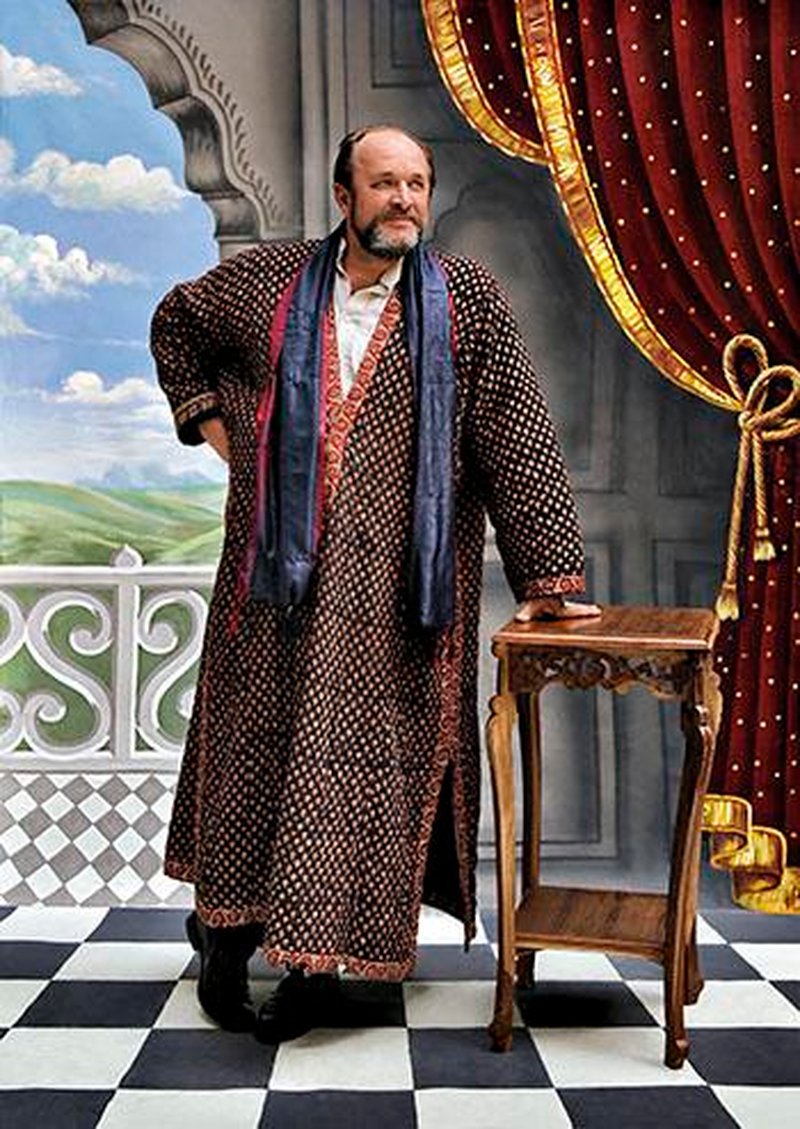
William Dalrymple

Scottish author William Dalrymple wants to safeguard the physical infrastructure of Indian civilsation but is working hard to tamper with its Hindu soul. – Utpal Kumar

William Dalrymple is suddenly the darling of a section of the Right. One prominent Right-wing think tank has even invited him for a talk on his new book, The Golden Road. The book highlights “how ancient India transformed the world”—a subject close to those whose heart is in the ‘Right’ place.

There’s absolutely nothing wrong in engaging in a dialogue over a book—in fact, this culture of dialogue with contrarian views should be encouraged. The problem, however, could be when this intellectual exercise leads to legitimisation of the other viewpoint without due deliberation and critical enquiry. What one fears is that The Golden Road, which has already become a bestseller soon after hitting the bookstores, might become a cover to push blatant historical lies.

At the very outset, it must be clarified that this is a good book, pushing forward India’s narrative. Dalrymple cannot claim—and he doesn’t either—that what is written in the book hasn’t been told in the past. Where the author scores is the style of his writing: A history book is better written when the author thinks like a historian but writes like a novelist. History, after all, is about stories and the lessons one can learn from them.

Dalrymple is undoubtedly a “gifted historian” who writes engaging prose. His research work for his books is almost impeccable. And one finds affinity and warmth in him for his karmabhoomi, which is India.

But, then, Dalrymple is a double-edged sword, often cutting both ways. This 59-year-old British author, born in Scotland, is an unapologetic admirer of Delhi, but his love gets confined to the era of “Djinns”; the other, non-Islamic characteristics of the city rarely get his attention. The same partisanship is evident in his writings on the Mughals, especially the late Mughals. The decadence of the late Mughals, about which Sir Jadunath Sarkar bemoans in his extensive studies and regards as among the dominant causes of the Mughal decline, is what excites Dalrymple the most.

In The Last Mughal, for instance, Dalrymple writes: “… while Zauq led a quiet and simple life, composing verse from dusk until dawn, rarely straying from the tiny courtyard where he worked, Ghalib was very proud of his reputation as a rake. Only five years before the wedding, Ghalib had been imprisoned for gambling and subsequently wore the affair—deeply embarrassing at the time—as a badge of honour. When someone once praised the poetry of the pious Sheikh Sahbai in his presence, Ghalib shot back, ‘How can Sahbai be a poet? He has never tasted wine, nor has he ever gambled; he has not been beaten with slippers by lovers, nor has he once seen the inside of a jail.’ Elsewhere in his letters he makes great play of his reputation as a ladies’ man.”

Similarly, in The Anarchy, Dalrymple writes about the unabashed loot and plunder by the East India Company. He begins this book by saying how “one of the first Indian words to enter the English language was the Hindustani slang for plunder: loot”. He then takes the readers to Powis Castle, “a craggy fort” built during the 13th century in the Welsh Marches. According to him, Powis “is simply awash with loot from India, room after room of imperial plunder, extracted by the East India Company (EIC) in the 18th century”.

Yet, the same Dalrymple had made a public appeal last year asking Britain not to return the loot to India! According to him, Mughal treasures looted by the British might never be displayed if they are returned to India, which is currently run by “a Hindu nationalist government that does not display Mughal items”. (Dalrymple’s prejudiced mind stopped him from seeing what was obvious: That the wealth stolen was not Mughal’s but India’s.) He said, “You can go to Delhi and not see a display, at the moment, of Mughal art at all. But it’s there, beautifully displayed, in the British Library, the British Museum, the Victoria and Albert Museum.”

Dalrymple’s propensity to run with the hare and hunt with the hounds is evident in the narration of his 2009 book, Nine Lives, too. In one of the stories, he recounts with empathy the story of “The Dancer of Kannur”, in which Hari Das, a Dalit from Kerala, is a “part-time prison warden for 10 months of the year”, but during the Theyyam dancing season between January and March, he is “transformed into an omnipotent deity” to be worshipped even by the high-caste Brahmins. However, in the same book, his reverence for the sacred goes missing as he invokes Romila Thapar’s idea of “syndicated Hinduism” to intellectually discredit Hindu resurgence in India. Dalrymple, quite mischievously, calls it “Rama-fication of Hinduism”.

Coming to The Golden Road, Dalrymple’s new-found love for ancient India may remind one of American Sanskrit scholar Sheldon Pollock, who not very long ago was zeroed upon by a group of wealthy non-resident Indians (NRIs) in New York, along with the top administrative leaders of Sringeri Peetham in India and representatives of Sringeri Peetham in the US, to head a newly found American university chair in the name of Adi Shankara. They had, by 2014, collected $4 million for the chair, which was to be set up at the prestigious Columbia University. There was a lot of enthusiasm and support for Pollock, as he was seen to be an ardent advocate for the revival of Sanskrit. What these people didn’t realise was that Pollock’s idea of revival was, as Rajiv Malhotra writes in The Battle for Sanskrit, “the reinvigorated study of Sanskrit as if it were the embalmed, mummified remnant of a dead culture”.

Pollock sought to revive Sanskrit studies, but wanted no association with Sanskrit language and culture. He loved Sanskrit but without its sacred cultural (Hindu) identity. In the same way, Dalrymple acknowledges India’s contribution but doesn’t seem to be quite enthusiastic about the Hindu roots of the same. He would talk with gusto about Central Asia’s Buddhist connections, but the same enthusiasm is lacking vis-à-vis Hinduism. Dalrymple’s love for India is obvious, but without its cultural/civilisational moorings. He wants to safeguard the physical infrastructure but is working hard to tamper with its soul.

Dalrymple tells the story of the great Buddhist scholar Kumarajiva (344-413 CE). Born to a Kashmiri father, probably a minister in the Takshashila royal court, and a Kuchean mother, Kumarajiva learnt Buddhism in Kashmir, but to study Vedas, he chose to go to Kashgar in the Xinjiang region. It’s pertinent to note that the land where Kumarajiva went to study Vedas was the hub of Buddhism, disputing the predominant Hindu-Buddhist conflict narrative put forward by colonial-Leftist historiography. What further manifests the Hindu-Buddhist cultural continuum in the region is that “not very far” from a monastery in Miran, as Dalrymple himself writes in The Golden Road, “some of the very earliest surviving fragments of the text of the Mahabharata have recently been dug up”.

A couple of quotes from The Golden Road should expose the real intent of the author. Dalrymple writes in the last chapter of the book, “The fate of Nalanda is much disputed: it had been in decline for centuries and archaeology shows that it was burned several times, with some of these conflagrations clearly dating to before the arrival of the Turks. Either way, the Tibetan monk Dharmaswami, who visited Nalanda in 1235, describes the Turushka soldiers prowling the ruins while he and his guru lay hidden in a deserted monastery. There is some evidence that Nalanda continued to function in a much-reduced form until the early fourteenth century, when the last Tibetan monks are described as coming to study philosophy in its ruins.”

Nalanda was “burnt several times” before the fury of Bakhtiyar Khilji in 1193 AD! The ancient Indian university survived the Muslim assault to “function in a much-reduced form until the 14th century”! One, thus, gets two assessments from the above lines: That while Muslims burnt Nalanda once, Hindus had done it “several times” in the past; and also that the Muslim assault wasn’t bad enough as the university could survive for the next two centuries! How is Dalrymple’s assessment different from, say, Romila Thapar and D.N. Jha?

In the same chapter, Dalrymple provides another gem of assessment, exposing his state of mind. He writes, “During the days of Nehruvian rule in the 1950s and early 1960s, Indian school textbooks and most academic histories were written by left-leaning, Congress-supporting figures. These historians tended to underplay the violence and iconoclasm that came with the Turkish invasions, partially in the interests of what they saw as ‘nation building’ following the terrible inter-religious violence that had taken place during partition. Today, under the current right-wing BJP government, the reverse is true, and the destruction of Hindu temples is almost all that many in India seem to know of the complex but fascinating medieval period of Indo-Islamic history.”

Given this line of thinking being promoted in the book, where the Indian physical superstructure is admired but the innate Hindu spirit is denied and damned, it’s astounding to see a section of the Right getting excited with The Golden Road. Maybe the excitement is the result of intellectual haziness and laziness: No one has bothered to read between the lines and instead got excited with the book’s tagline: “How ancient India transformed the world”. Maybe the colonial hangover is still going strong in India. A British historian highlighting the “greatness” of ancient India can still be a heady moment for some of us. Maybe the more things change in Indian history, the more they remain the same.- Firstpost, 23 November 2024

Utpal Kumar is the Opinion Editer for Firstpost and News18.

Wm. Dalrymple at St. Mary Magdalen Church, Oxford.

See also

Nightmare of Nehruism – Sita Ram Goel

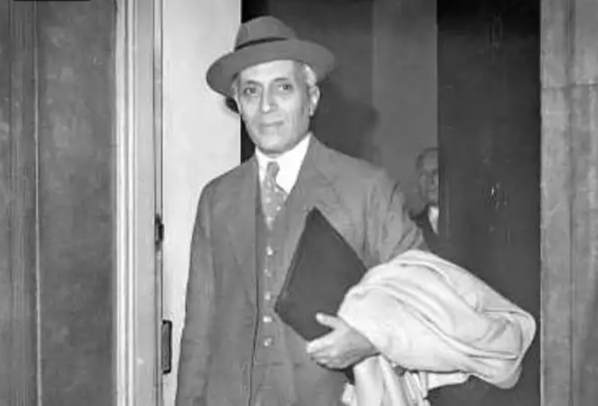
Jawaharlal Nehru (London 1946)

The late Sita Ram Goel, a prominent historian, author, and publisher, had Left leanings during the 1940s, but later became an outspoken anti-Communist. He also wrote extensively on the damage to Bharatiya culture and heritage wrought by Nehruism. The article below is an extract from Goel’s book, How I Became a Hindu, first published by Voice of India in 1982.

Today, I view Pandit Jawaharlal Nehru as a bloated brown sahib, and Nehruism as the combined embodiment of all the imperialist ideologies—Islam, Christianity, White Man’s Burden, and Communism—that have flooded this country in the wake of foreign invasions. And I do not have the least doubt in my mind that if India is to live, Nehruism must die. Of course, it is already dying under the weight of its sins against the Indian people, their country, their society, their economy, their environment, and their culture. What I plead is that a conscious rejection of Nehruism in all its forms will hasten its demise, and save us from the mischief which it is bound to create further if it is allowed to linger.

I have reached this conclusion after a study of Pandit Nehru’s writings, speeches and policies ever since he started looming large on the Indian political scene. But lest my judgement sounds arbitrary, I am making clear the premises from which I proceed. These premises themselves have been worked out by me through prolonged reflection on the society and culture to which I belong.

I have already described how I returned to an abiding faith in Sanatana Dharma under the guidance of Ram Swarup. The next proposition which became increasingly clear to me in discussions with him, was that Hindu society which has been the vehicle of Sanatana Dharma is a great society and deserves all honour and devotion from its sons and daughters. Finally, Bharatavarsha became a holy land for me because it has been and remains the homeland of Hindu society.

There are Hindus who start the other way round, that is, with Bharatavarsha being a holy land (punyabhumi) simply because it happens to be their fatherland (pitribhumi) as well as the field of their activity (karmabhumi). They honour Hindu society because their forefathers belonged to it, and fought the foreign invaders as Hindus. Small wonder that their notion of nationalism is purely territorial, and their notion of Hindu society no more than tribal. For me, however, the starting point is Sanatana Dharma. Without Sanatana Dharma, Bharatavarsha for me is just another piece of land, and Hindu society just another assembly of human beings. So my commitment is to Sanatana Dharma, Hindu society, and Bharatavarsha—in that order.

In this perspective, my first premise is that Sanatana Dharma, which is known as Hinduism at present, is not only a religion but also a whole civilisation which has flourished in this country for ages untold, and which is struggling to come into its own again after a prolonged encounter with several sorts of predatory imperialism. On the other hand, I do not regard Islam and Christianity as religions at all. They are, for me, ideologies of imperialism. I see no place for them in India, now that India has defeated and dispersed Islamic and Christian regimes.

I have no use for a secularism which treats Hinduism as just another religion, and puts it on par with Islam and Christianity. For me, this concept of secularism is a gross perversion of the concept which arose in the modern West as a revolt against Christianity and which should mean, in the Indian context, a revolt against Islam as well. The other concept of secularism, namely, sarva dharma samabhava, was formulated by Mahatma Gandhi in order to cure Islam and Christianity of their aggressive self-righteousness, and stop them from effecting conversions from the Hindu fold. This second concept was abandoned when the Constitution of India conceded to Islam and Christianity the right to convert as a fundamental right. Those who invoke this concept in order to browbeat the Hindus are either ignorant of the Mahatma’s intention, or are deliberately distorting his message.

My second premise is that Hindus in their ancestral homeland are not a mere community. For me, the Hindus constitute the nation, and are the only people who are interested in the unity, integrity, peace and prosperity of this country. On the other hand, I do not regard the Muslims and the Christians as separate communities. For me, they are our own people who have been alienated by Islamic and Christian imperialism from their ancestral society and culture, and who are being used by imperialist forces abroad as their colonies for creating mischief and strife in the Hindu homeland. I therefore, do not subscribe to the thesis that Indian nationalism is something apart from and above Hindu nationalism.

For me, Hindu nationalism is the same as Indian nationalism. I have no use for the slogans of “composite culture”, “composite nationalism” and “composite state”. And I have not the slightest doubt in my mind that all those who mouth these slogans as well as the slogan of “Hindu communalism”, are wittingly or unwittingly being traitors to the cause of Indian nationalism, no matter what ideological attires they put on and what positions they occupy in the present set-up.

My third premise is that Bharatavarsha has been and remains the Hindu homeland par excellence. I repudiate the description of Bharatavarsha as the Indian or Indo-Pak subcontinent. I refuse to concede that Afghanistan, Pakistan, and Bangladesh have ceased to be integral parts of the Hindu homeland simply because they have passed under the heel of Islamic imperialism. Hindus have never laid claim to any land outside the natural and well-defined borders of their ancient homeland, either by right of conquest or by invoking a promise made in some scripture. I, therefore, see no reason why Hindus should surrender their claim to what they have legitimately inherited from their forefathers but what has been taken away from them by means of armed force. Moreover, unless the Hindus liberate those parts of their homeland from the stranglehold of Islam, they will continue to face the threat of aggression against the part that remains in their possession at present. These so-called Islamic countries have been used in the past, and are being used at present as launching pads for the conquest of India that has survived.

My fourth premise is that the history of Bharatavarsha is the history of Hindu society and culture. It is the history of how the Hindus created a civilisation which remained the dominant civilisation of the world for several millennia, how they became complacent due to excess of power and prosperity and neglected the defences of their homeland, how they threw back or absorbed in the vast complex of their society and culture a series of early invaders, and how they fought the onslaughts of Islamic, Christian, and British imperialism for several centuries and survived.

I do not recognise the Muslim rule in medieval India as an indigenous dispensation. For me, it was as much of a foreign rule as the latter-day British rule. The history of foreign invaders forms no part of the history of India, and remains a part of the history of those countries from which the invaders came, or of those cults to which they subscribed. And I do not accept the theory of an Aryan invasion of India in the second millennium BC. This theory was originally proposed by scholars as a tentative hypothesis for explaining the fact that the language spoken by the Indians, the Iranians and the Europeans belong to the same family. And a tentative hypothesis it has remained till today so far as the world of scholarship is concerned. It is only the anti-national and separatist forces in India which are presenting this hypothesis as a proven fact in order to browbeat the Hindus, and fortify their divisive designs. I have studied the subject in some depth, and find that the linguistic fact can be explained far more satisfactorily if the direction of Aryan migration is reversed.

These are my principal premises for passing judgement on Pandit Nehru and Nehruism. Many minor premises can be deduced from them for a detailed evaluation of India’s spiritual traditions, society, culture, history, and contemporary politics. It may be remembered that Pandit Nehru was by no means a unique character. Nor is Nehruism a unique phenomenon for that matter. Such weak-minded persons and such subservient thought processes have been seen in all societies that have suffered the misfortune of being conquered and subjected to alien rule for some time. There are always people in all societies who confuse superiority of armed might with superiority of culture, who start despising themselves as belonging to an inferior breed and end by taking to the ways of the conqueror in order to regain self-confidence, who begin finding faults with everything they have inherited from their forefathers, and who finally join hands with every force and factor which is out to subvert their ancestral society. Viewed in this perspective, Pandit Nehru was no more than a self-alienated Hindu, and Nehruism is not much more than Hindu-baiting born out of and sustained by a deep-seated sense of inferiority vis-a-vis Islam, Christianity, and the modern West.

Muslim rule in medieval India had produced a whole class of such self-alienated Hindus. They had interpreted the superiority of Muslim arms as symbolic of the superiority of Muslim culture. Over a period of time, they had come to think and behave like the conquerors and to look down upon their own people. They were most happy when employed in some Muslim establishment so that they might pass as members of the ruling elite. The only thing that could be said in their favour was that, for one reason or the other, they did not convert to Islam and merge themselves completely in Muslim society. But for the same reason, they had become Trojan horses of Islamic imperialism, and worked for pulling down the cultural defences of their own people. The same class walked over to the British side when British arms became triumphant. They retained most of those anti-Hindu prejudices which they had borrowed from their Muslim masters, and cultivated some more which were contributed by the British establishment and the Christian missions. That is how British rule became a divine dispensation for them. The most typical product of this double process was Raja Ram Mohun Roy.

Fortunately for Hindu society, however, the self-alienated Hindu had not become a dominant factor during the Muslim rule. His class was confined to the urban centres where alone Muslim influence was present in a significant measure. Second, the capacity of Islam for manipulating human minds by means of ideological warfare was less than poor. It worked mostly by means of brute force, and aroused strong resistance. Finally, throughout the period of Muslim rule, the education of Hindu children had remained in Hindu hands by and large. So the self-alienated Hindu existed and functioned only on the margins of Hindu society, and seldom in the mainstream.

All this changed with the coming of the British conquerors and the Christian missionaries. Their influence was not confined to the urban centres because their outposts had spread to the countryside as well. Second, they were equipped with a stock of ideas and the means for communicating them which were far more competent as compared to the corresponding equipment of Islam. And what made the big difference in the long run was that the education of Hindu children was taken over by the imperialist and the missionary establishments. As a cumulative result, the crop of self-alienated Hindus multiplied fast and several fold.

Add to that the blitzkrieg against authentic Hindus and in favour of the self-alienated Hindus mounted by the Communist apparatus built up by Soviet imperialism. It is no less than a wonder in human history that Hindu society and culture not only survived the storm, but also produced a counter-attack under Maharshi Dayananda, Swami Vivekanand, Sri Aurobindo and Mahatma Gandhi such as earned for them the esteem of the world at large. Even so, the self-alienated Hindus continued to multiply and flourish in a cultural milieu mostly dominated by the modern West.

And they came to the top in the post-Independence period when no stalwart of the Hindu resurgence remained on the scene. The power and prestige which Pandit Nehru acquired within a few years after the death of Sardar Vallabhbhai Patel had nothing to do with his own merits, either as a person, or as a political leader, or as a thinker. They were the outcome of a long historical process which had brought to the fore a whole class of self-alienated Hindus. Pandit Nehru would have never come to the top if this class had not been there. And this class would not have become dominant or remained so, had it not been sustained by establishments in the West, particularly that in the Soviet Union.

It is not an accident that the Nehruvian regime has behaved like the British Raj in most respects. The Nehruvians have looked at India not as a Hindu country but as a multi-racial, multi-religious and multi-cultural cockpit. They have tried their best, like the British, to suppress the mainstream society and culture with the help of “minorities”, that is, the colonies crystallised by imperialism. They have also tried to fragment Hindu society, and create more “minorities” in the process. In fact, it has been their whole-time occupation to eliminate every expression of Hindu culture, to subvert every symbol of Hindu pride, and persecute every Hindu organisation, in the name of protecting the “minorities”, Hindus have been presented as monsters who will commit cultural genocide if allowed to come to power.

The partition of the country was brought about by Islamic imperialism. But the Nehruvians blamed it shamelessly on what they stigmatised as Hindu communalism. A war on the newly born republic of India was waged by the Communists in the interests of Soviet imperialism. But the Nehruvians were busy apologising for these traitors, and running hammer and tongs after the RSS. There are many more parallels between the British Raj on the one hand and the Nehruvian regime on the other. I am not going into details because I am sure that the parallels will become obvious to anyone who applies his mind to the subject. The Nehruvian formula is that Hindus should stand accused in every situation, no matter who is the real culprit. – How I became a Hindu, 1982

Sita Ram Goel Quote

Ram Swarup: The greatest Hindu thinker since Sri Aurobindo – Aravindan Neelakandan

Ram Swarup

Whether it is Dharmic darshanas, global Pagan revival, study of Western philosophies and theologies from Hindu perspective, study of language from Hindu framework or, resistance to monopolistic ideologies—Ram Swarup has gifted every aspiring Hindu with vision, values and tools for his or her search . – Aravindan Neelakandan

The globalised environment today has created both challenges and opportunities for local, natural cultures. Among such natural cultures and spiritual traditions, Hindu Dharma represents the largest and the longest-continuing traditions. In fact, Hindus are the last standing nation of such a natural culture and spirituality.

With predatory and monopolistic forces threatening such a theo-diversity-laden ecosystem as Hindu Dharma and society, how should Hindus respond?

How do Hindus interact with other cultures and be a blessing to humanity while being rooted in their traditions, and without insulating themselves?

The answer may well lie with the works of Ram Swarup, who should be considered and can be considered as the greatest Hindu thinker and seer after Sri Aurobindo.

In many ways, he carried forward the thinking and vision of both Sri Aurobindo and Swami Vivekananda into the future, meeting head-on the challenges of the present and showing the thinking Hindu the opportunities embedded in every challenge.

For many millennial Hindutvaites, Ram Swarup would be known as the mentor of Sita Ram Goel.

The duo was like Sri Krishna and Arjuna in the dharma kshetra of life and rashtra.

Just as Sri Krishna is far more than the charioteer of Arjuna and Gitacharya, though that is a core dimension of the avatar, Ram Swarup was the mentor and guide of Sita Ram Goel and the sattvic energy behind Voice of India, but he was also much more than that.

And it will benefit the Hindu society to go through these other dimensions of Sri Ram Swarup as his centennial celebrations commence this year. And with the Ram Swarup foundation, we will also understand and utilise the work of Sita Ram Goel better.

In 1981, through Voice of India, he published The Word as Revelation: Names of Gods.

By any reckoning, this work should be considered a milestone in both study of religions and the study of languages.

Here, Ram Swarup takes linguistics to a different plane entirely. The magnificent view that Ram Swarup shows here is not partisan to any sectarian group of humanity.

Though he has limited his study to what he calls the “Indo-European” languages, he points out that “if speech and meaning are deeply human phenomena and if they follow deeply-laid patterns of the mind and heart, then they must share certain common characteristics, however differently clothed, and certain truths must hold good for them all”.

Going through this book, one is immersed into the beauty of words and their meaning—where the perspective is deeply Hindu, and the phenomenon studied is universal.

The book has two parts. In Part I, he explores how words are formed and what creates the relation between a word and its meaning.

He states:

“The process of naming is complicated and deeply psychological. It operates at subconscious level. Different elements that go into making of a name—the referent, the sound, the meaning—all tend to coalesce in the mind so much so that it is difficult to separate them from one another. … The process of naming may also be too much forced or fanciful; it may not be keeping with the deeper wisdom of the mind.”

What Ram Swarup talks about is an important aspect which educationists who are working to provide science and technical education in mother languages should pay attention to.

For example, in Tamil Nadu, the Dravidianists have only one purpose in their attempt to create Tamil terms for science and technology; it is not taking the concepts to the child but to remove Sanskrit from the words they coin. But still, they must use the term “kanakku” for mathematics which in turn is derived from Sanskrit gana and ganitham.

Similarly, “botany” is “thavaraviyal”, which in turn is derived from the Sanskrit sthavara.

Our tradition, from poet Kalidasa to sage Kumaragurupara, has handed over the relation between the word and the meaning as Shakti and Shiva and pure consciousness as the substratum from which the word and the meaning arise.

Sri Ramana Maharishi takes this further and hints at a roadmap for preserving linguistic diversity through this common spiritual matrix. In his famous Aksharamanamalaihe speaks of the non-dual union as the union of azhaku and sundaram—both being Tamil and Sanskrit terms for the same aspect: beauty.

In Part II of the book, Ram Swarup studies the names of gods. Here, he shows how humanity reaches its greatest linguistic possibilities in arriving at the names of the divine. Language, through the names of the divine, becomes a tool to elevate human consciousness to reach more “profound heights”.

The way Ram Swarup harmonises the spiritual elements in various traditions of the world is very important for every Hindu. He has provided a solid foundation for engaging in a proper dialogue with mutual respect for non-Hindu religions.

In discussing the names of the Vedic gods, he points out that all gods have multiple names and the knowledge of these multiple names is an important and holy knowledge.

Then he says:

“In all spiritual traditions, there is something analogous to it. The God of the Jews has many names. … But according to Jewish mysticism, God has also a secret name which should not even be uttered. Therefore, the Jews simply called it ‘the Great Name’ or ‘the Great Precious Name’ or just ‘the Name’. … Islam too admits of God’s Names though it denies His Forms. But the admission receives a certain narrowing at the hands of the more orthodox and faithful. … Socrates presents this idea in the language of understanding. He proclaims the awe, mystery and unknowability of Gods and their names but also tells us how these are ultimately names of man’s own intentions and meanings. … According to Hindu thought too, the names of Gods are not names of external beings. These are names of the truths of man’s highest Self.”

One can see how softly but sharply Ram Swarup creates a Hindu framework for the study of monopolistic religions—preserving whatever spiritual components they have and pointing out where the sublime truth is lost to rigidity inevitable to monopolistic theology.

His critique of the emergence of monopolistic rigidity traces to Paul who represented “a passionate attachment to a fixed idea which is closed to wider viewpoints and larger truths of life”.

To him, this was more an ideology than a spiritual idea. From the very early days to the present, this had worked in aid of imperialism. If rigidity and closing minds to larger truths of existence plague monotheism “polytheism too is subject to the despiritualizing influence of externalizing mind”.

As against these two, he points out that the Vedic approach “gives unity without sacrificing diversity … a deeper unity and deeper diversity beyond the power of ordinary monotheism and polytheism”.

Ram Swarup writes:

“God transcends every one of His Names; He also lives fully and indivisibly in each one of them. In one Name we should be able to see all the Names; in one God, we must be able to see all the Gods; otherwise, our knowledge of a God and His Names is not sufficient. We must also be able to see that a God exceeds all his Forms and Names, individually and collectively. The heart of a God is an enigma.”

Here is an interesting self-experiment for the inquisitive reader.

After reading the chapters on the names of gods in The Word as Revelation, one should read the science fiction short story The Nine Billion Names of God (1953) by Arthur C Clarke.

It will be rewarding to see how Ram Swarup’s framework transforms the way the short story gets internalised.

Another must read is On Hinduism: Reviews and Reflections (2000). Published posthumously, the book has eight long essays and contains his very early writing on Hinduism.

Here is an example of the alertness and conceptual clarity of Ram Swarup. One of the essays is “Buddhism vis-a-vis Hinduism“, originally published in July 1958.

Impressed by this essay, Rajaji wrote the following in Swarajya (21 May 1966):

“I read with great interest Sri Ram Swarup’s scholarly paper on the intimate connection, amounting almost to identity, between the Buddhistic philosophy and the Vedanta of the Upanishads. Hindu conformism sensed the danger lurking in a close identity with a school of thought which may well be misunderstood to be denial of God and soul. … Sri Ram Swarup’s paper explains how Hinduism saved itself from the dangers of its own philosophical dialectics through the cult of Bhakti and surrender. …”

Ram Swarup responded to this much later in a detailed footnote when he was updating the essay for a new reprint.

He wrote:

“[Rajaji] was a sage and a great spokesman of Hinduism. His views command our greatest respect. But I beg to make one clarification. Sri Rajagopalacharya agrees that there was a great affinity between the Vedanta and the Buddhist philosophy, but according to him Hinduism saw in it a danger at being misunderstood and identified with a school which denied God and soul; and it met the danger by developing the school of Bhakti and surrender. I believe Hinduism sensed no such danger and it did not panic into Bhakti and surrender because of any such danger. The fact is Bhakti and surrender even as a ‘school’ are older than Buddhism. … At no point there was any intention of keeping Buddhism ‘out of pale’. … [Hindus] protected Buddhism and defended it when it was threatened; they gave refugee to Buddhists when they were persecuted in Persia, Khurasan, Iraq, Mosul by king Gushtap and his descendants—in the same manner they are doing it at present to Buddhist Chakmas fleeing from persecution in Bangladesh.”

The importance of this response cannot be overstated. The idea that Bhakti movement was a reactionary movement against Buddhism and Jainism is one of the cornerstones of colonial and Marxist indology. It had been internalised by almost all scholars of Hinduism of that time. This continues to this day.

Well-meaning Hindu scholars too fell into this trap and spoke of Bhakti as a response to either Buddhist-Jain movements or Islamist invasion and persecution.

While Bhakti did allow a strong resistance movement against Islamist invasion, that was not its origin or motive. Nor did Bhakti movement in Tamil Nadu or elsewhere emerge as a strategy or response to counter Buddhism.

Ram Swarup stands for eternity as the pioneering Hindu scholar, whose deeply penetrating Hindu insight identified this fallacy and cautioned students of Hindu Dharma against this.

Every aspiring young Hindu intellectual should also read his essay “Development in Huxley’s Thought: Hindu-Buddhist influences“, which is also in this collection.

This essay, running to almost 40 pages, is an excellent guide for anyone who wants to study Hindu influence on the Western philosophical traditions, particularly in modern times.

Here is Ram Swarup’s analysis of Aldous Huxley’s critique of Christian art.

“Despite non-representative Christian mystics like Eckhart, Tauler and Ruysbroeck, the profound inner mystic landscape and its elements could not find their expression in Christian art. Huxley observes that there is nowhere ‘equivalents of those Far Eastern Buddhas and Bodhisattvas who incarnate, in stone and print, the experience of ultimate reality.’”

Ram Swarup, pointing out that Huxley stops here and does not get into the deeper cause, analyses further:

“Christian artists were talented and innovative; they performed all the tasks set for them by their religion and fulfilled all its needs for what they were worth. … Similarly, they discovered important techniques like perspective and foreshortening by which they could portray the third dimension and render horizons and depth in space. … The fact is that Christian art failed at a deeper level. It failed not in execution but in conception and vision and this failure was at bottom failure of Christian theology in which mysticism is rudimentary and peripheral. … A deeper iconography needed the support of a deeper theology and vision. This explains why Christian art has no equivalents of Far Eastern Buddhas and Bodhisattvas as Huxley notices.”

Another important work of his which too was published posthumously is Meditations Yogas, Gods, Religions.

In the essay, “Gods, God, Unity, Unit” which deals with the origin of Hindutva, some striking parallels between what Ram Swarup puts forth and the way some pioneering neuro-psychological studies look at the evolution of religions, have been shown.

Ram Swarup proves to possess a perspective which, in hindsight, was more scientific and holistic than that of the Western psychologists.

Whether it is Dharmic darshanas, global Pagan revival, study of Western philosophies and theologies from Hindu perspective, study of language from Hindu framework, literary criticism, resistance to monopolistic ideologies, Dharmic ecology—Ram Swarup has gifted every aspiring Hindu with vision, values and tools for his or her search.

It is amazing that a person could do all these in one life.

There was no Internet then. He neither sought nor had any cult following as many have and seek now. He worked in solitude, his writing was his sadhana, his tapas, his yajna—the fruits of which shall always be there for generations of seekers.

Thus, among us lived a rishi. And he was born a hundred years ago. – Swarajya, 14 October 2020

Aravindan Neelakandan is an author, psychology and economics major, and contributing editor at Swarajya.

Ram Swarup's Books


The Modi government as an exponent of BJP secularism – Koenraad Elst

Narendra Modi

Like the previous BJP Government, the present one fails to live up to the oft-heard predictions of strident pro-Hindu and anti-minority policies. This is due to a phenomenon insufficiently realized by most India-watchers: a desire to live up to the norms upheld by the secularists and an interiorization of the disinterest in “outdated” Hindu concerns, not just among the numerous opportunists who have flocked to the new party in power, but even in the loyal core of the BJP’s personnel. Based on insider sources, this paper enumerates the data establishing the reality of “BJP secularism” and analyses the reasons for this emerging phenomenon. – Dr Koenraad Elst

A.B. VajpayeeA. B. Vajpayee’s NDA Government (1998-2004) heavily disappointed the experts who had predicted “all Moslims into the Indian Ocean” or similar doomsday scenarios—or rather, it put them squarely in the wrong. Hindu “fascism” as a threat to democracy? When Vajpayee narrowly lost a confidence vote, he meekly stepped down. War against Pakistan? Though Pakistan unilaterally invaded India (Kargil 1999), Vajpayee forbade the Army to strike at the invaders’ base across the border, and later opened a peace process, making symbolic concessions which Congress had always refused. Isolationism? He threw the Indian media market open to foreign media ownership, a move opposed by India’s entire political spectrum. The only “Hindutva” thing the NDA ever did was HRD Minister M. M. Joshi‘s clumsy overhaul of the recommended history schoolbooks, changing nothing dramatic and easily reversed. When the Government created a Chair for Indic Studies in Oxford (“saffronization!”), it selected an outspoken opponent for the job, in the vain hope of receiving a pat on the back from its declared enemies.

With the hindsight knowledge of historical reality, it would be embarrassing to reproduce the predictions by Indian and foreign experts. Today, anti-BJP discourse is less shrill, but still confidently classifies the BJP among the “Hindu Right”. This implies a prediction that once in power, the BJP would pursue distinctly pro-Hindu policies. However, in the light of our experience with the Vajpayee Government, it is no surprise that the present Government led by Narendra Modi fails to live up to this learned prediction, at least for now. (Of course, this paper will be updated by November as new developments take place.)

In spite of having a more homogeneous majority, it is reluctant to do anything pro-Hindu or perceivable as anti-minority. On the contrary, one of its first acts was to decree a new subsidy to Islamic schools. The stray Hindutva statements by loose cannon (Sakshi Maharaj, Niranjan Jyoti) were followed by retractions, condemnations by Government spokesmen, and indignant innuendos by Modi-friendly journalists (Tavleen Singh, Swapan Dasgupta). Public reconversions by the allied VHP, heavily publicized and demonized by the media, were promptly discouraged by the Government. Having learned from Vajpayee’s 2004 defeat, though, Modi does “keep the pot boiling”, does regularly throw crumbs of inconsequential Hindu symbolism to his support base, all while not formally changing anything.

However, if many BJP workers are disappointed with this Government, is not for what it does but mainly for what it persistently fails to do. Thus, it inducted no figures with a strongly ideological profile (Arun Shourie, Subramanian Swamy). Likewise, some public figures who had crossed the floor (e.g. Madhu Kishwar) were conspicuously not rewarded—a fact not considered here for disgruntled ego reasons but for illustrating the BJP’s lack of strategy: it doesn’t put people who have actually sacrificed for the BJP to any use, while awarding positions of influence to unreliable newcomers motivated by sheer opportunism. While some things on the Hindu agenda are either useless to Hinduism (e.g. declaring a “Hindu Rashtra”) and others would arouse violent protests for which the media are sure to blame Modi (e.g. a Common Civil Code, though “secular” par excellence), others are perfectly feasible and, moreover, turn out to be the most consequential for the flourishing of Hinduism.

In particular, the amending of Constitutional Articles 28 and 30, which (de facto c.q. formally) discriminate against Hinduism in education, does not take away any rights from the minorities, yet lifts an enormous burden from Hindu organizations investing in education and eliminates a major reason for Hindu sects (Arya Samaj, RK Mission, Lingayats, Jains) to have themselves judicially declared non-Hindu minorities. Similarly, eliminating the legal basis of the discrimination against Hinduism in temple management, with rich temples (but not mosques or churches) nationalized and their income pocketed by politicians or diverted to non-Hindu purposes, would give an enormous boost to Hindu religious and cultural life, without impinging upon the rights of the minorities. It has to be noted, however, and it buttresses my case for “BJP secularism”, that temple management is partly a competence of the States, and that BJP State Governments have not made the difference. At any rate, there are meaningful things a BJP Government could do specifically for Hinduism without endangering its non-religious agenda (development, cleaning India etc.) or its international standing, yet it chooses not to do them.

As for the Hindutva fits and starts of some BJP members, now considered extremists but in fact only representative of what the erstwhile Jan Sangh (1952-77, predecessor of the BJP) stood for, it should be easy to bring them in line around a more reasonable but still credibly pro-Hindu programme. It is here that the BJP is most conspicuously failing — conspicuous at least to insiders, for 99% of the outside literature about the BJP never mentions this phenomenon. Contrary to a consensus among academic and journalistic India-watchers, the supposed “Hindu extremist” party has no Hindu agenda. It relies on pro-Hindu workers to do the campaigning legwork, but once in power it cold-shoulders them, it publicizes and pursues an agenda of economic development only, and it tries to curry favour with the secularists.

The main reason is the long-standing deliberate lack of investment (pioneered by M. S. Golwalkar) in an intellectual and strategic vision of its own, the spurning of any analysis of the forces in the field and of the potential and limitations of the situation. It therefore also lacks competent personnel for the ideological struggle, e.g. for a textbook overhaul or, now, for nominating politically friendly new Vice-Chancellors. Consequently, most BJP leaders have an enormous inferiority complex vis-à-vis the secularists and, even when in office, try to live up to the norms laid down by their opponents.

This is hardly the impression created by most experts; but the primary data, the only source to which this paper pledges loyalty, tell a clear story: the present BJP is only termed a Hindu party in deference to the distant memory of its initial orientation. – Koenraad Elst Blog, 15 November 2016

» Dr Koenraad Elst is an indologist and historian from Belgium who publishes with Voice of India.

Remembering Karmayogi Sita Ram Goel – Virendra Parekh

Sita Ram Goel

This is the original article which appeared in a commemorative volume on Sita Ram Goel many years ago. It is well worth reading as author Virendra Parekh has faithfully recorded in detail Sita Ramji’s views on Islam, Christianity, Communism, Secularism, Hinduism, his own work and Voice of India. – Editor 

“How old are you?” Sita Ramji asked me. “Forty.” “You are younger than my younger son”, he said affectionately. Thus began my first and only meeting with Sita Ramji in November 1993. I was on my way to Manali along with my family and had happily foregone sightseeing in Delhi in order to be able to meet him. As a bonus, Sita Ramji had offered to take me to Ram Swarupji.

For years, his writings had just mesmerized me. Even a few paragraphs were enough to bring out his originality of approach (more about it later), incisive analysis, fiery style and a stubborn refusal to be tamed by considerations of political correctness imposed by the Mullah-Marxist-Missionary-Macaulayite combine. If style is the man, then the picture that Sita Ramjis writings threw up was that of a sterling patriot who happened to be a great scholar and a fearless fighter. Brahmakshatriya is the only word that comes to the mind to describe him.

However, what put him in a class apart from angry pamphleteers was his reverence for truth, a breadth of vision combined with an eye for detail and accuracy, and a willingness to go wherever his search for truth led him. If he had only contempt for Indian secularists, he had no burning desire to be counted among the officially recognized champions of Bharatiyata. He was a seeker of truth, not a camp follower. He would not spare Hindu kings for their myopia, disunity and strategic failures. He would praise Gandhiji for arousing Hindu society by stirring its heart like the Savarkars and Hedgewars never could, because his commitment was to the ideal of truth, goodness and beauty, not to any individual or group.

Our conversation was brief and informal, but Sita Ramji did make a few perceptive remarks. “Where Brahmins are blind, Kshatriyas are lame”, he said. “Intellectuals (Brahmins) are the eyes of the society, and the ruling class its arm. Hindu society, which is not lacking in numbers, valour or devotion to its culture, is kicked around in its own land, because Hindu intellectuals lack vision”, he explained. He referred to the fateful decision of the Vijayanagar King Ramaraya to have two battalions of Muslim archers who could shoot from the horseback. In the critical battle of Rakshasi-Tangadi, widely though erroneously known as the battle of Talikota (1565), these battalions deserted their employer and joined the invaders. Ramaraya lost the battle and his life. The great Hindu kingdom of Vijayanagar which had kept the saffron flag aflutter in the South for over two centuries, suffered a terrible blow from which it could never recover. “Look at the irony, Parekh. In this land of Lord Ram and Arjun, the idea of having our own archers did not occur to the king”, commented Sita Ramji.

He went on to say that there should be a Catalogue of National Mistakes which must be taught to all children in the schools with a view to avoiding their repetition. History which does not provide an insight into our weaknesses and mistakes, which is merely a source of false pride through glorification of a mythical past, is no history at all. Secularists would readily accept this, but their definition of India and Indianness would be suspect.

In the afternoon, Sita Ramji drove me from his residence in Shakti Nagar to Maharani Bagh where Ram Swarupji was staying. It was one more act of kind affection from a great person who had over the years replied to each of my letters, enlightened me by answering every question I asked, communicated his candid views on several issues, and sent me for free all the publications of Voice of India, some of them beyond my means.

My meeting with Ram Swarupji was brief, lasting about an hour. I told him that measured against the depth and vastness of his knowledge, he had written very little. He smiled and said that it may be true in some sense, but he did not like to be repetitive. Around 9 p.m., Sita Ramji dropped me at the hotel where my family and friends were waiting for me. I could not have asked for more. My purpose of coming to Delhi was fulfilled.

His mission

During our conversation, Ram Swarupji made an important point about the work of Voice of India. It deserves greater attention. For long, Hinduism has been defined for Hindus by its enemies. They denigrated whatever hindered their designs on us. They told us that Brahmins were a class of deceitful exploiters and oppressors, that Sanskrit was a dead language, that Hinduism was a mumbo-jumbo of silly superstitions, puerile priest craft and meaningless mysticism, and that the caste system was the root of all evils afflicting Indian society. They even taught us that the Vedic Aryans had come to India from outside (so why cavil at Muslim or Christian invaders?), that the history of India was actually a series of India’s conquests by one invader after another.

Their praise was motivated, too. The missionaries and mullahs always praise Hindu society for its tolerance and generosity (something that they have never shown to it or other rival creeds) and expect the Hindus to look the other way when they themselves malign Hinduism and convert its weaker sections through force, fraud and allurements. The missionaries always praise Hindus for their religiosity, but never for their religion. The pope praises Hinduism for its secondaries, while hiding his contempt for its primaries.

The enemies of Hinduism floated false notions about their own creeds, too. We were told that Islam is a religion of peace and brotherhood; that Christianity has nothing but love and mercy for non-believers, that Marxism has the master-key to the “ascent of mankind from the kingdom of necessity to the kingdom of freedom.”

The greater tragedy is that the Hindus have gone along with this con game, slavishly or foolishly. What the enemies of Hinduism found wrong with us, we found wrong with ourselves. Even today, few Hindus can see through these mischievous canards. Hindus feel flattered by the motivated praise of their tolerance by the missionaries, little realizing that it is a ploy for their moral disarmament against a ruthless, systematic onslaught on their culture and tradition; that it is akin to a sermon on detachment and renunciation by a pickpocket while he is relieving you of your wallet.

Centuries of cultural and political enslavement have led Hindus to look at themselves and others through the tinted spectacles forged by the inveterate enemies of their religion and culture. Voice of India, said Sita Ramji, wanted Hindus to use their own eyes for looking at themselves and at others. All its efforts were directed at equipping them for doing so. The means of achieving this end was a detailed and objective first-hand study of the rival ideologies (Islam, Christianity and Marxism) from their primary sources. It meant a study of their scriptures, their sources of inspiration, their worldview, their objectives and methods and their historical record. It also meant studying Indian history from primary sources and interpreting it, on the basis of undisputable and recorded facts, from the perspective of Indians rather than that of invaders and conquerors.

Perhaps for the first time in its long and chequered history did Hindu society take up this Herculean task. Ordinary Hindus had long regarded Islam as barbarism masquerading as religion, at least for non-Muslims. They had not regarded Christian missionaries as anything more than wily, cunning, arrogant fanatics who were hand in gloves with India’s foreign masters. And for all their skills in sophisticated slander and manipulation of the mind, the Communists have not been able to expand their influence (or whatever is left of it) beyond the two corners (Bengal/Tripura and Kerala) of India. However, Hindu scholars had by and large neglected to examine critically the tall claims made by these ideologies. This was at par with the failure of the Hindu rulers to keep abreast of developments in the neighbouring lands, even those developments that had a direct bearing on national security.

The consequences of both these failures have been heavy. The myopic refusal of the Hindu rulers to look beyond their nose led to the political enslavement of the country whereas the failure of the Hindu scholars to examine critically the doctrines of Islam and Christianity, not to speak of Communism, left the ideological field open to the enemies of Hinduism. Whatever they said about their own creeds went uncontested.

Sita Ramji and Ram Swarupji moved in to fill this vital gap. In the nineteenth century, Swami Dayanand Sarawati, founder of the Arya Samaj, had subjected the Quran and the Bible to the test of traditional Hindu polemics. Before him, Brahmins from Tamil Nadu had asked a few pertinent questions to Christian missionaries. But the task before the duo was truly daunting. As Sita Ramji wrote to me in a personal letter: “My heart sinks when I think of the organizational, financial and political resources at the command of our adversaries. Voice of India is not even a drop in the ocean.”

Sita Ramji went about his lifework in the spirit of a true Karmayogi. Calculations of personal cost and benefit never mattered to him. His detachment (anasakti) afforded him tenacity, fearlessness and independence of judgment. He sat at the feet of great masters like Vyasa, Valmiki, the Buddha, Vivekananda and Aurobindo and recaptured a vision of India that was dazzling in its brilliance. This vision defined for him the mission of Voice of India.

National vision

As Sita Ramji himself pointed out, his vision of India is nothing new. It is only a restatement in modern language, in a modern setting, of the ancient Vedic vision as enshrined in the Vedas, in the Upanishads, in the Jainagama, in the Tripitaka, in the Ramayana and the Mahabharata, in the Puranas, in the Dharmashastras and in the latter-day poetry of saints and siddhas. We have had countless spokesmen of that vision throughout our history.

The first dimension of that vision is that India is the land of Sanatana Dharma. India’s national identity is coterminous with Sanatana Dharma. As Sri Aurobindo said in his Uttarpara Speech, India would rise with the rise of Sanatana Dharma, India would sink if Sanatana Dharma sank and India would die if it were at all possible for Sanatana Dharma to die. The second dimension of that vision is that of a vast and variegated culture. According to adhara and adhikara, various sections of our population, various segments of our society, various regions of our country, developed their own culture, their own art, their own literature. It is a vast fabric, this art and literature. But its spirit is the spirit of Sanatana Dharma. It is informed by Sanatana Dharma in all its details.

The third dimension of that vision was that this great society, the society which we describe as Hindu Society today, was reared on the basis of spirituality and a great culture created by Sanatana Dharma. The Hindu social system, epitomized in the phrase varnashrama dharma, has degenerated under the onslaught of foreign invasions and is the subject of severe criticism today. It was originally, and it has been for centuries, a harmony model which enabled people of various abilities and inclinations to live together as an organic whole. As Dr. S. Radhakrishnan pointed out, the varna vyavastha was founded on two ideals: firstly, society should be based on cooperation and accommodation, not competition and exclusion; secondly, the highest place in society should go to the men of learning and character, not to the men of wealth and power. As for ashrama dharma, the division of life into four stages of brahmacharya (period of celibacy and learning), garhasthya (period of householding), vanaprastha (period of retirement) and sannyasa (period of renunciation), indicates that this life is a pilgrimage to the eternal life through different stages. For all its weaknesses and distortions, varnashrama dharma has saved Hindu society from the destruction which overtook so many societies outside India at the hands of Christianity, Islam and Communism.

The fourth dimension of that national vision is that the history of India is the history of the Hindu society, of Hindu culture, of Hindu spirituality. In short, it is the history of the Hindu nation and not the history of foreign invaders as we are being taught today.

The last dimension which India’s great men have stressed, which they have affirmed again and again, is that this land of Bharatvarsha is one indivisible whole; that it is the cradle of Hindu society, of Hindu culture, of Hindu spirituality; that it is the homeland of the Hindu nation. Other communities are welcome to live in this land provided they come to terms with Hindu society and Hindu culture. Today, Bharatavarsha stands divided into several countries such as India, Pakistan, Bangladesh and Afghanistan, which are not only politically but also culturally hostile to each other; and we seem to have become reconciled to that division. But the vision that was given to us by our great men was that of Bharatvarsha as an indivisible whole, not only geographically but also culturally.

It was from this perspective that Sita Ramji judged ideologies like Islam, Christianity, Communism and their united front, which in India is called secularism, as well as Indian history and contemporary developments. Thus, about the demolition of the Babri Masjid, he wrote to me in a personal letter: “My only grievance is that the Hindus had to do it surreptitiously. I never thought that the Hindus would assert themselves or that the Communist empire would disintegrate. I have fought for both. I am fulfilled.”

One has only to look around to realize how far we have moved away from this pristine vision of India shining in its natural glory. We are taught that even today’s truncated India is a multi-religious, multi-racial, multi-lingual, multi-cultural and multi-many-other-things entity struggling to evolve some principle of unity that can hold together its disparate components; that it is a nation in the making, to use a phrase dear to the secularist elite. Indian history has been massively perverted. Stalinist activists masquerading as historians have thoroughly and systematically distorted and falsified every period of Indian history with the malicious intention of cleansing it of all Hindu influences, to negate every dimension of the national vision outlined above. The very idea of India is adulterated to suit the designs of invading ideologies.

Sita Ramji made it his lifework to defend this national vision of India as it has existed through millennia. He has set out the problem and its solution in the books Hindu Society Under Siege and Defence of Hindu Society. His books relating to Indian history (Story of Islamic Imperialism in India; Heroic Hindu Resistance to Muslim Invaders; and Muslim Separatism, Causes and Consequences) convincingly nail the secularist propaganda. In Perversion of India’s Political Parlance, he traced and exposed the secularist sleight of hand whereby Muslim communalism became respectable as “secularism” while Indian nationalism was reviled as “communalism”. When he handled the works of others, Sita Ramji brought out the depth, perspective and relevance of the original work in bold relief. His publication of The Calcutta Quran Petition, the Niyogi Committee Report on the Activities of Christian Missionaries, and, to some extent, Catholic Ashrams: Sannyasins or Swindlers? provides examples of this. His two major contributions, Hindu Temples: What Happened to Them (Vol. I & Vol. II) and History of Hindu-Christian Encounters are classics of original research and will stand the test of time.

Sita Ramji’s works (and VOI publications in general) are characterized by a depth and an intellectual honesty that are rare in secularist writings on Hindutva. The views and arguments of the other side are rendered faithfully and then answered cogently by setting out an alternative perspective backed by facts and reasoning. Ancient India had this tradition of scholarly debate. It is said of Shankara, the great philosopher, that he formulated the arguments of his opponents better than they themselves could. Indeed, these are elementary features of public debate in a civilized society, but Indian debate on issues like (what passes for) secularism, the cultural content of Indian nationalism, the nature of Indian society, the interpretation of Indian history and the role and direction of the Indian State leaves much to be desired on this count.

Much of Hindutva writing is characterized by whining and self-pity, dwelling on the atrocities and injustices heaped on Hindus by others. Sita Ramji carried the battle to the enemy camp, taking on the adversaries in a frontal attack. Instead of calling himself secular and others pseudo-secular, as the BJP is doing, he discussed secularism—of the Indian variety—threadbare and showed that it was far from being a noble idea. Instead of presenting Hinduism as a monotheistic religion, he showed that monotheism as extolled in the Abrahamic religions was a monstrous idea responsible for a great deal of strife and bloodshed in the name of God.

Critique of India’s secularism

Sita Ramji’s critique of what passes for secularism in India is epitomized in the title of his book India’s Secularism: New Name for National Subversion. Jawaharlal Nehru, who had not used the term in his pre-Independence writings or speeches, picked up a prestigious word from Western political parlance and made it mean the opposite of what it meant in the West. In the West, secularism stood for rationalism, universalism and humanism. In India, it is a united front of all anti-Hindu ideologies: Islam, Christianity and Communism. Each of these is an intolerant, aggressive and violent ideology. Each of them aims at conquest of the world by rooting out other religions. Each of them has a history soaked in the blood of the innocent. All over the world, they are enemies of one another; but in India, they are always found on the same side against their common enemy: Hinduism.

In the West, secularism was directed against Christianity, which spurned reason, suspected science, punished doubt and claimed absolute monopoly of truth in all matters, secular and spiritual. In India, secularism is ranged against Hinduism which respects reason and experience, which imposes no belief system but enjoins everyone to realize the spiritual truths in the cave of his heart through his own effort in his own way.

It is the ultimate irony of Indian politics that those who masterminded this subversion of the national psyche have positioned themselves as guardians of democracy and secularism in the country, and that votaries of authoritarian ideologies lecture the Hindus on the virtues of pluralism. And the Hindu society, which is the national society, which has borne the brunt of all foreign invasions and fought all freedom struggles, is driven into a corner and made to shout that it is secular, that it regards Islam and Christianity as noble religions, that it regards Islamic heroes as its own.

In pre-Independence days, the Muslim minority had a veto on what was national. Only that leader, that party, that programme was national which was approved by the Muslim leaders. The rest were, by definition, communal. In the post-Independence period, the same game is played in the name of secularism: only that leader, party, organization, or programme is secular which is approved by Muslim leaders. Whatever they disapprove of is, for that very reason, communal. Sita Ramji showed that this deliberate and malicious perversion of thought has thoroughly distorted the national perspective. Love for one’s country and its world-renowned ancient culture has been turned into a cardinal sin. Foreign invaders and tyrants have become lawful rulers while national heroes are downgraded as petty rebels fighting for personal gain. The catchword “secularism” provides a smokescreen behind which several types of imperialism (Islamic, Christian, Communist and Consumerist) are stealing a march over Hinduism.

Sitaramji urged Hindu intellectuals to see through this con game perpetrated on them by the residues of imperialist ideologies with the help of a self-alienated denationalized elite, and to counter it by conducting the public debate in the proper language. Such a language, he said, would substitute “Indian nationalism” for “Hindu communalism”; and “national subversion” for “secularism”; and “Islam” for “Muslim communalism” or “Islamic fundamentalism”.

Two traditions of worship

A major contribution of Sita Ramji and other VOI scholars, especially Ram Swarup and David Frawley, is a clear enunciation of two types of religious traditions. One may be called the Biblical or Abrahamic tradition and the other, Vedic or Indic tradition. The Bible-derived creeds are founded on a central figure—Jehovah, Allah, God or History—who commands the exclusive and overriding allegiance of the believers. He is jealous, cruel, and brooks no rival. He deals with his people through an intermediary, messenger, prophet, or the sole saviour. His teachings are contained in the Book. The Book is the sole repository of Ultimate Truth.

Thus in these creeds, there is only one Truth; there is only one way to it; the God has given it to us, the Chosen People, and us alone; it is contained in our Book and in our Book alone. Since the Book is authored by God himself, every word in it is true, excellent, immutable and binding. The Book, al-Kitab, is beyond the comprehension of most of even the believers, and certainly the non-believers. We must therefore heed the Church, the Priest.

The faith in the Book is the overriding duty, as is the duty of making others to see the light. Since this is the absolute Truth, since it alone can lead to Heaven or permanent bliss, mankind must be awakened to it for its own good at any cost in whatever way. No sacrifice is too great for holding on to it; no means are impermissible for converting others to it. The very idea of an absolute monopoly of ultimate truth contains within it the seeds of intolerance, aggression, strife and authoritarianism. It is a charter for killing, destruction and subversion with a clean conscience. There will always be more than one claimant to this monopoly while there are bound to be others who refuse to acknowledge the authority of the Church or the Party.

The Vedic tradition, on the other hand, is founded on very different premises. The starting point of this tradition is human consciousness, which can be explored, which can be purified progressively and which can be transcended till it attains the highest heights of knowledge and creativity. At this summit, the Self becomes one with the Universe and sees all things, animate and inanimate, as its own symbols and sequences. In this vast vision, sanctity attaches not only to human life but to the whole of creation. This is the summum bonum of spiritual humanism, which has always been India’s message to mankind.

The Vedic tradition teaches us that spiritual truths are not of the nature of a revelation received by a historical prophet from an extra-cosmic God or some other supernatural source. Nor are those truths contained in or confined to a Book. On the contrary, these truths lie secretly in every human heart and have always been accessible to those who seek for them. These truths are never in need of a crusade for their spread and propagation. On the contrary, these truths are self-propagating due to their own inner strength. The only defence they need is the dedication they inspire spontaneously in all those who invoke them.

Sita Ramji pointed out that the Vedic tradition advises people to be busy with themselves, that is, their own moral and spiritual improvement. Several disciplines have been evolved for this purpose: tapas (austerity), yoga (meditation), jnana (reflection), bhakti (devotion), etc. A seeker can take to whichever discipline (adhara) suits his adhikara (stage of moral-spiritual preparation). There is no uniform prescription for everybody, no coercion or allurement into a belief system, and no claim of merit for aggression against others.

The Biblical tradition, on the other hand, teaches people to be busy with others. One is supposed to have become a superior human being as soon as one confesses the “only true faith”. Thenceforward one stands qualified to “save” others. The only training one needs thereafter is how to man a mission or military expedition, how to convert others by all available means including force and fraud, and how to kill or ruin or blacken those who refuse to come around.

The Vedic tradition has given to the world schools of Sanatana Dharma, which have practised peace among their own followers as well as towards the followers of other paths. On the other hand, the Biblical tradition has spawned criminal cults such as Christianity, Islam, Communism and Nazism, which have always produced violent conflicts as much within their own camps as with one another and the rest of mankind. As Sita Ramji pointed out, the syrupy slogan of sarvadharma-samabhava glosses over the basic difference between these two traditions. This has caused an enormous amount of confusion.

Critique of Islam

The magnitude of crimes credited to Muslim monarchs by the medieval Muslim historians was beyond measure. In his book The Story of Islamic Imperialism in India, Sita Ramji has devoted two long chapters to the magnitude of the Muslim atrocities. He showed with the help of detailed documentation that with a few exceptions, Muslim kings and commanders were monsters who stopped at no crime when it came to their Hindu subjects. He showed that there was a broad pattern to those crimes. The pattern is that of a jihad in which the ghazis of Islam 1) invade infidel lands; 2) massacre as many infidel men, women, and children, particularly Brahmins, as they like after winning a victory; 3) capture the survivors to be sold as slaves; 4) plunder every place and person; 5) demolish idolatrous places of worship and build mosques in their places; and 6) defile idols which are flung into public squares or made into steps leading to mosques.

Hindus were long familiar with this “behaviour pattern patented by Islam”. Sita Ramji’s distinct contribution was to trace this behaviour pattern to the tenets of Islam. Apologists of Islam, from Mahatma Gandhi to Mohammad Habib, regarded the atrocities committed by Muslim rulers on Hindus as aberrations and deviations from true Islam; they attributed it to greed, political compulsions, inherent barbarism of certain tribes etc. Sita Ramji showed that far from being aberrations or deviations from the true faith of Islam, these atrocities were the logical outcome of the teachings of Islam. Far from being a slur on the fair name of Islam, the behaviour of Muslim rulers towards the Hindus was the true face of Islam, it is what Islam had in store for non-believers. He showed that this is exactly the pattern 1) revealed by Allah in the Quran; 2) practised, perfected and prescribed by the Prophet in his own life-time; 3) followed by the pious khalifas of Islam in the first 35 years of Islamic imperialism; 4) elaborated in the hadiths and hundreds of commentaries with meticulous attention to detail; 5) certified by the ulama and the sufis of Islam in all ages including our own; and 6) followed by all Muslim monarchs and chieftains who aspired for name and fame in this life, and houris and beardless boys hereafter. It is, therefore, poor apologetics to blame the Islamized Turks alone of being barbarous. Islamic barbarism was shared in equal measure by all races and communities who were forced or lured into the fold of Islam—the Arabs, the Turks, the Persians, the Pathans, the Hindu converts. The conclusion is inescapable that Islam brutalizes all those who embrace it. And that is where the blame should be laid in all reason and justice.

“Islam in India is still suffering from the high fever of self-righteousness, though lately it has shifted its claim from the ‘only true religion’ to the ‘only human brotherhood’. Powered by petro-dollars, it is again dreaming of an empire in India. Hindus, on the other hand, have learnt no lesson from history as is evident from their slogan of sarva-dharma-samabhava vis-à-vis Islam, which is only a totalitarian and terrorist ideology of imperialism. And now the Hindu secularists are bent upon perverting the historical record in order to prove that Islam never intended any harm to Hindus or Hinduism!” (Story of Islamic Imperialism, p. 87) And he added a warning: “Will Hindu society have to pay the price again? It is highly doubtful if Hindu society will survive another determined assault from Islam, such is the mental, moral and spiritual health of this society. A society which has no self-confidence, which suffers from self-pity, which indulges in breast-beating at the behest of every Hindu-baiter, and which stands in daily need of certificates of good conduct from its sworn enemies, has not the ghost of a chance in a world which is becoming deadlier with the passing of every day. Can such a society make any creative contribution to the greater good of mankind? Let every Hindu search his heart, and seek the answer.” (ibid.)

Critique of Christianity

Sita Ramji’s views on Christianity are equally clear and instructive. “Hindus, from early-seventeenth-century Pandits of Tamil Nadu to Arun Shourie in the closing years of the twentieth, have spent no end of ink and breath to demolish the dogma of Christianity and denounce missionary methods. But it has hardly made any difference to the arrogance of Christian theologians and aggressiveness of Christian missionaries. That is because the dogma was never meant for discussion. It is an axiom of logic that that which has not been proved cannot and need not be disproved. And who has ever proved that the nondescript Jew who is supposed to have been crucified by a Roman governor of Judaea in AD 33 atoned for the sins of all humans for all time to come? Who has ever proved that those who accept that man as the Only Saviour, will ascend to a heaven of everlasting bliss, and those who do not, will burn forever in the blazing fire of hell? Nor can the proclamation or the promise or the threat be disproved.

“High-sounding theological blah blah notwithstanding, the fact remains that the dogma is no more than a subterfuge for forging and wielding an organizational weapon for mounting unprovoked aggression against other people. It is high time for Hindus to dismiss the dogma of Christianity with the contempt it deserves, and pay attention to the Christian missionary apparatus planted in their midst.

“The sole aim of this apparatus is to ruin Hindu society and culture, and take over the Hindu homeland. It goes on devising strategies for every situation, favourable and unfavourable. It trains and employs a large number of intellectual criminals ready to prostitute their talents in the service of their paymasters, and adept at dressing up dark designs in high-sounding language. The fact that every design is advertised as a theology in the Indian context and every criminal euphemized as an Indian theologian, should not hoodwink Hindus about the real intentions of this gangster game.” (Pseudo-Secularism, Christian Missions and Hindu Resistance, pp. 1-2)

Sita Ramji said time and again that Hindu society was committing a blunder in regarding Christianity and Islam as religions at par with Sanatana Dharma. These are ideologies of power, masquerading as religions. They proceed from very different premises and have very different objectives: “Hindus are committing a grave mistake in regarding the encounter between Hinduism and Christianity as a dialogue between two religions. Christianity has never been a religion; its long history tells us that it has always been a predatory imperialism par excellence. The encounter, therefore, should be viewed as a battle between two totally opposed and mutually exclusive ways of thought and behaviour. In the language of the Gita (ch. 16), it is war between daivi (divine) and asuri (demonic) sampads (propensities). In the mundane context of history, it can also be described as war between the Vedic and the Biblical traditions.” (op. cit., p. 2)

Focus on ideas, not people

Notice that the focus is on the ideas, not on people; it is on Islam, not Muslims; on Christianity, not Christians. In his prolific writings, Sita Ramji always took care to distinguish between Islam and Muslims, between Christianity and Christians. At the end of his discussion of the two traditions of worship, he clarified that this analysis cannot be applied mechanically to all persons born and brought up in these two opposite traditions. The head and heart of a person can be smaller or larger than any thought pattern. Therefore, ordinary men born and brought up in both these patterns are found to be of good as well as bad behaviour.

This distinction between ideas and people marks out VOI from many other pro-Hindu organizations. Many Hindus sincerely believe that Islam is good, but Muslims are wicked; Christianity is good, but Christians are crooked. As a result, they are baffled by the behaviour pattern of Muslim leaders or missionaries and harbour prejudices against them. The VOI approach removes prejudices against people, while providing a proper basis for understanding their behaviour: “It has long been a Hindu habit to resent the behaviour pattern of Muslims and Christians, while praising Islam and Christianity as revealed religions. We are asking Hindus to reverse this process, to study Christianity and Islam to see for themselves that Christian and Muslim behaviour patterns follow from the belief system of Christianity and Islam.” (History of Hindu-Christian Encounters, pp. 453-454)

The whole approach to the communal problem is redefined. “Muslims are not to be hated”, Sita Ramji said to me, “they are our own people alienated from their ancestral society and culture by a divisive doctrine masquerading as religion”. So, target the ideas, not the people.

It also imparts a wider dimension to the noble endeavour of VOI. By speaking up for Hinduism as an ancient, pagan religion that has survived the onslaughts of monotheistic creeds, VOI is speaking up for pagan America and Africa, and also for the pagan past of Egypt, Iraq, Persia, Arabia, Greece, Rome and Europe in general. As Ram Swarup put it in the preface to his Hindu View of Christianity and Islam, “Today, there is an awakening in many parts of the world. Many people are coming to know what they have gone through and what they have lost. They have also begun to realize that their present religions are impositions on them, that they once belonged to a different spiritual culture which had a different orientation and was built on a deeper and wider base. As this realization becomes more acute, many of them are trying to break form their present confines and recover their lost identity. They are also seeking a more satisfying spirituality. Probably Hinduism can help them. It has survived many physical and ideological onslaughts and it still retains in its bosom layers of spiritual traditions, intuitions and knowledge which other nations have lost; it can therefore help these nations recover their lost religious roots and identity.”

Conclusion

Sita Ramji was a karmayogi whose personality was a lively synthesis of jnana (knowledge), karma (action) and bhakti (devotion). This brave son of Hindu society took up cudgels in its defence on a frontier that was left largely unmanned for ages. He showed the difference that an individual can make with dedicated efforts. In any history of the Hindu renaissance, the contribution of Sita Ram Goel and Voice of India will be acknowledged in golden letters.

» Virendra Parekh is a senior journalist based in Mumbai. He writes in English and Gujarati on issues and developments related to Indian nationalism, economy and politics.

Sita Ram Goel - THIE - 17-10-16 - Chennai