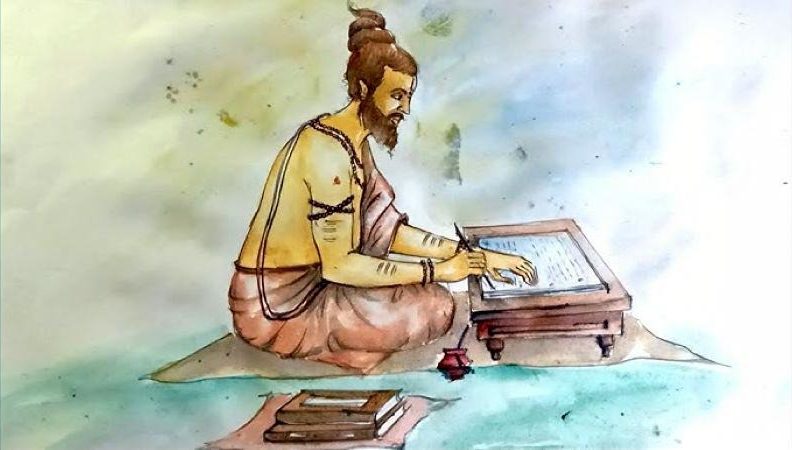
It is high time we examine an important question: why is the Manusmriti, a text so old and largely obsolete in everyday life, cast as the villain responsible for all our societal miseries today? Is this merely a matter of ignorance, or is there something more deliberate behind such attacks? Is it being used as a tool to portray an entire philosophical and religious tradition as primitive? – Prajesh Panikkar
There is an old joke about a philosophy professor who sets out to prove, with impeccable logic, that he is the best professor in the world. He leads a student step by step through a chain of unquestioned loyalties.
“Which is the best country in the world?” he asks. The student answers, of course, that it is their country. “And the best state in it?” The student replies that it is their state. “And the best town in that state?” It is their town. “The best college in that town?” It is their college. “And which is the best subject taught in that college?” the professor asks. “Philosophy”, the very subject the professor teaches, the student answers.
The final question is who teaches philosophy best in the college, and the answer is hardly a mystery: it is the same professor who has been asking the questions all along. The proof is now complete. By carefully choosing the premises and designing the questions, the professor arrives at the conclusion that he is the best professor in the world.
A similar mode of reasoning appears in the opening chapter of the Manusmriti, where Manu sets out to establish the pre-eminence of Brahmins who are Vedic savants. The text constructs a hierarchical sequence that moves from living beings to humans, from humans to Brahmins, and from Brahmins to the learned, the resolute, the active, and finally to those learned in the Vedas.
The logic mirrors that of the anecdote: once the hierarchy is accepted, the conclusion follows seamlessly. By defining value through a series of nested distinctions, the text arrives at its intended endpoint—the supremacy of the Vedic Brahmin—not as an assertion, but as the apparent outcome of an orderly classificatory process.
The text says: “Among creatures, living beings are the best; among living beings, those who subsist by intelligence; among those who subsist by intelligence, human beings; and among human beings, Brahmins—so the tradition declares. Among Brahmins, the learned are the best; among the learned, those who have made the resolve; among those who have made the resolve, the doers; and among doers, the Vedic savants.”
As mentioned in the previous part of this essay, the world as envisaged by the Manusmriti is Brahmin-centric, in which whatever exists on earth belongs to the Brahmin, and it is only by the kindness of the Brahmin that others are able to eat. From the very beginning of the text, from the first chapter itself, it is amply clear who the target audience is. The text is written for Brahmins.
In the same chapter, the Smriti further says: “[This text] should be studied diligently and taught to his pupils properly by a learned Brahmin, and by no one else. When a Brahmin who keeps to his vows studies this treatise, he is never sullied by faults arising from mental, oral, or physical activities; he purifies those alongside whom he eats, as also seven generations of his lineage before him and seven after him. […]” Echoing the Purusha Sukta of the Rig Veda, the Manusmriti also says that the Brahmin was produced from the mouth of the Purusha, and the Shudra from the feet.
There is absolutely nothing surprising in the fact that, in a text written two thousand years ago and aimed at a specific group of people, that group is described as pre-eminent among human beings. In Deuteronomy, the Lord tells the Jews that “God has chosen you to be a people for his treasured possession, out of all the peoples who are on the face of the earth,” and Jews, to this day, consider themselves the chosen people. Similar claims of “pre-eminence” can be found in the Quran with regard to Muslims as well.
A critique might say that Manusmriti is different. What makes Manusmriti, or the varna system as mentioned in the Smritis or the Rig Veda, different, he would argue, is the fact that these distinctions were more or less rigid. The varnas are assigned by birth, and one cannot choose one’s varna or convert from one to another. But this is, more or less, true of Abrahamic religions as well. Though one can convert to Judaism, converts were often socially (and at times communally) treated as distinct from born Jews in premodern Jewish societies, and frequently faced questions about whether they were “born Jews,” despite their formal religious status. Yet, there is a certain fluidity: a convert would be seen as fully Jewish after a couple of generations, the opponent might say. That is quite true of the varnas in Manu’s time as well. Though uncommon, complex, and practically onerous, the Smritis, including the Manusmriti, do prescribe such fluidity between varnas, a fact that those who care to study the text know well.
At considerable length, the text prescribes the life of a Brahmin and how it ought to be lived from the time of his birth. It specifies the childhood rites to be performed, the conduct required during his student life, the proper modes of respecting teachers, the manner of marriage, his duties as a husband, the prescribed forms of prayer, the propitiation of ancestors, the management of household affairs, and the conduct expected in old age. After a life lived in strict accordance with the Smṛtis, a Brahmin is expected to become a forest hermit once his hair has turned grey and he has seen his grandchildren. The text also tries to regulate the governance of the state, setting out the duties and daily routine of the king, the judicial system, and the various forms of punishment prescribed for the four varnas.
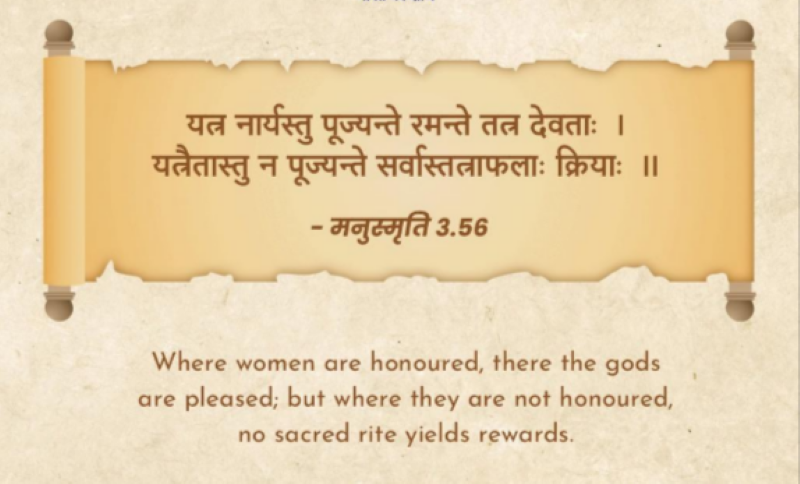
There are many well-known aspects of the Manusmriti that one may have heard about: particularly its treatment of castes lower than Brahmins with contempt, and its infamous assertion that women do not deserve independence. There are also passages that many may not have encountered: sections that are known only to those who take the trouble to read the text itself. These passages, too, are interesting, though for different reasons. Consider, for example, the rules concerning eating.
According to the Manusmṛti, a Brahmin is not supposed to eat anything that has been offered to the deities. He is also not supposed to consume anything that has turned sour, except curd. When it comes to vegetarianism, the text explicitly states that there is nothing inherently wrong with consuming meat. “Prajapati created this whole world as food for lifebreath; all beings, the mobile and the immobile, are nourishment for lifebreath. … The eater is not defiled by eating living beings suitable for eating, even if he eats them day after day; for the creator himself fashioned both the eaters and the living beings suitable for eating,” says the Manusmriti. In a similar manner, the text also states that there is no fault in drinking liquor or in engaging in sexual activity. It is worth noting, once again, that this is a text whose intended audience is Brahmins, and one that is regarded as the most authoritative within its tradition.
None of these prescriptions are followed by Brahmins today, and there is little evidence to suggest that they were strictly followed even in the time of Manu. Vegetarianism was not prescribed by Manu. It did not become a dominant Brahmanical ideal in the Manusmriti itself, but only afterward, when debates over meat-eating versus non-violence intensified in later texts. Scholars such as Ludwig Alsdorf, who studied the growth of vegetarianism in India, maintain that Brahmin vegetarianism is a post-Vedic development that emerged after the Manusmriti.
In South India, a staple food in most Brahmin households is idli, which is made from a fermented and sour batter. K.T. Achaya, the renowned food historian, notes that idli is mentioned in a thousand-year-old Kannada text, where it is prescribed as one of the dishes to be offered to a Brahmachari. This also suggests that, although the Manusmriti were revered and respected, everyday life among Brahmins was not rigidly dictated by its norms. Life was always lived pragmatically, and there is no indication that anyone lived strictly in accordance with the prescriptions of the Smritis. Even if people had sought to do so, it would often have been impractical, and wherever practical considerations prevailed, the Smritis yielded.
The Smritis conceived of a world in which Brahmins were universally respected and in which everything under the heavens belonged to them. The real world, however, was the opposite of this ideal. By the time the Manusmriti was composed, society consisted of multiple religious groups, some of them more powerful than the Brahmins. The authority and prestige that Brahmins had once enjoyed were in decline. It therefore became important to codify and imagine a world in which Brahmins were supreme.
The real world diverged significantly from this idealized vision. Sometimes these divergences were excused; at other times, they were attributed to regional customs, which were often said to be contrary to the Smritis. Moreover, different Smritis expressed differing opinions on the same matters. There was no single text that dictated customs, rituals, or ways of life that was accepted by everyone—or even by all Brahmins. The absence of universally accepted norms in these areas was a well-known reality. One of the oft-quoted shlokas from the Mahabharata expresses this clearly. The shloka says: arguments are inconclusive, the Vedas have divergent emphases, and different rishis hold different views; the essence of dharma is hidden, and therefore one must follow the path of great men.
That is the point: there is no universally acceptable way, no universally authoritative text, and no universally accepted teacher. Indians, from the time of the Manusmriti, were acutely aware of this reality. At times, divergences from the Smritis could be so pronounced that practices perceived as violating the moral norms of the society of the time were explained as consequences of the Kaliyuga. Tantric traditions sometimes adopt this approach. Some Tantric texts claim that the Vedas are no longer effective in the Kaliyuga, or that a new value system independent of Vedic authority is required in this age—a role that Tantra itself is said to fulfil.
A text written two thousand years ago, reflecting values that are even older, is bound to raise concerns when compared with contemporary values. That much is obvious. Surprisingly, however, Manusmriti also contains several elements that align well with modern values. Just last week, in support of a judgment in an inheritance case, the Supreme Court of India cited the Manusmriti to convey the idea that no one in the immediate family, including the mother, father, wife, or son, should be abandoned, thereby reinforcing the principle of familial support.
A text that is notorious for its views on castes lower than Brahmins, however, does not explicitly deny access to Vedic knowledge for non-Brahmins. In fact, the text intriguingly states that in times of adversity, a man may study the Veda under a teacher who is not a Brahmin, thereby acknowledging that Vedic knowledge was familiar among non-Brahmins as well. The text does not explicitly permit inter-caste marriage, but it again, curiously, notes that one may marry a splendid woman even if she comes from a “bad” family. For all its normative severity, these are some of the rare instances where the text sheds light on social realities that appear to have existed at the time of its composition.
Considering all this, it is high time we examine an important question: why is a text so old and largely obsolete in everyday life cast as the villain responsible for all our societal miseries today? Is this merely a matter of ignorance, or is there something more deliberate behind such attacks? Is it being used as a tool to portray an entire philosophical and religious tradition as primitive?
For instance, Audrey Truschke, in her recent book on Indian history, examines what she describes as Manu’s “dismal view of women,” before quoting the well-known verse in the Manusmriti that denies independence to women. Similarly, in examining a punishment dictated for an “unfaithful wife” in the Yajnavalkya Smriti, Truschke notes that the penalty may appear even darker to modern eyes once one realises that Yajnavalkya does not specify whether the woman’s unfaithfulness was by choice or by force. Judged by contemporary standards, these positions may indeed appear dismal. The question, however, is why such ancient texts should be evaluated by contemporary standards at all. Where is the historical empathy or contextualism that a historian is expected to maintain?
No one adopts a similarly judgmental tone when writing about Greek or Assyrian history. One might respond that, unlike in India, the religions of ancient Greece or Assyria are long extinct, and that no surviving texts from those traditions continue to exert normative influence. Yet this objection does not hold entirely. There exist legal and religious texts—indeed, law codes—that remain relevant within the Abrahamic traditions. Historians do not approach these texts by measuring them against modern human-rights standards or by dwelling on their moral dismalness. Nor do they routinely frame them as evidence of the inherent primitiveness of an entire religious worldview.
In the end, the Manusmriti appears less as a sinister blueprint for social oppression than as a historically situated attempt to imagine order, authority, and moral hierarchy in a world that was already far more plural, fluid, and unruly than the text itself would admit. Its prescriptions reflect aspiration as much as reality, ideology as much as practice, and anxiety as much as power. To read it as a timeless moral code, whether to defend it uncritically or to condemn it as the source of all social ills, is to misunderstand both the nature of the text and the culture that produced it.
A historically responsible reading requires neither reverence nor outrage, but contextual understanding—an awareness that traditions are internally diverse, contested, and constantly renegotiated. When ancient texts are singled out for moral prosecution while comparable materials elsewhere are treated with interpretive caution, the problem lies not in the past but in the present lenses through which that past is viewed. Such selective moralism transforms historical inquiry into a form of contemporary adjudication, where texts are judged less for what they meant in their own time than for how effectively they can be mobilised to support present-day narratives. In doing so, history ceases to be an effort to understand difference and becomes instead a search for culprits, with ancient texts made to bear burdens they were never meant to carry.
The Manusmriti, like any other ancient legal or ethical text, tells us far more about the anxieties, negotiations, and self-fashioning of its times than about immutable truths or enduring social mandates; to treat it otherwise is to replace history with polemic. – News18, 22 january 2026
› Prajesh Panikkar is a commentator with a research degree in philosophy from the University of Sheffield, focusing on the intersections of culture, history, and politics.


 A crucial factor here was the choice of language. Ram Swarup himself was quite at home with British culture and thought, being most influenced by British liberalism: Bertrand Russell, George Bernard Shaw, Aldous Huxley, George Orwell. In his case, this didn’t stop him from fighting for freedom from British rule, with active participation in the Quit India Movement. But for less independent minds, gulping down English influence would only end up estranging them from their Hindu roots, as it had done in the case of Jawaharlal Nehru. The vote in the Constituent Assembly’s Language Committee should have been crucial: 50% voted for Sanskrit, 50% for Hindi (which was given victory by the deciding vote of the chairman), and 0% for English. For the generation that had achieved independence, it was completely obvious that decolonisation implied abolishing the coloniser’s language. Yet by 1965, when this abolition was due to become effective, the English-speaking elite had gathered enough power to overrule this solemn commitment. Ever since, the influence of English and of the thought systems conveyed by it has only gone on increasing, and at some levels, India is becoming a part of the Anglosphere—hardly what the freedom fighter envisioned. Today, most Anglophone secularists are nearly as knowledgeable about Hindu culture as first-time foreign tourists who have crammed up the


 VOICE OF INDIA