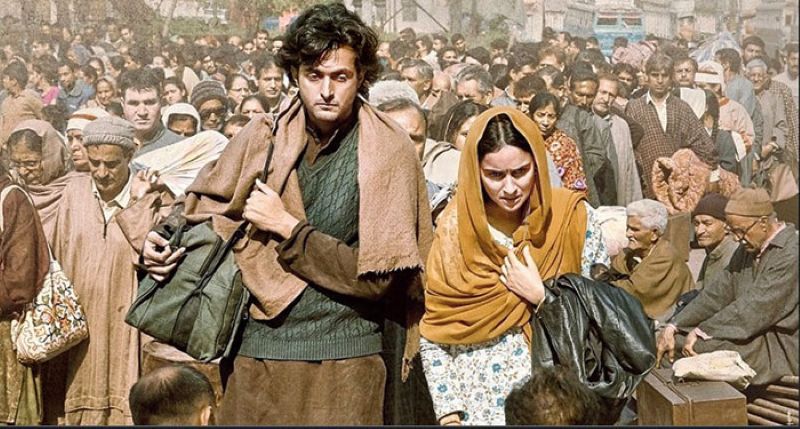
The ethnic cleansing of Pandits from Kashmir is the greatest moral lapse of independent India, unmatched in its magnitude, specificity, or completeness when compared to other such similar social upheavals—over a quarter million Indian citizens wronged. – Vivek Gumaste
The passage of time has the uncanny ability to blur our memory, numb our conscience, and mellow the intensity of our reactions, so much so that even the most horrendous of crimes become gradually cemented into history, fade into the background, and come to be accepted as a part of normalcy; accountability is evaded and life moves on. One such horrific event is the ethnic cleansing and genocide of Kashmiri Hindu Pandits from the Valley of Kashmir that began in the late 1980s (more than 35 years ago) and continues to this day. During this genocide, over a quarter million Hindu Indian citizens were driven from their homes to become refugees in their own land, over 1000 were killed, and close to 16000 of their homes were burnt to cinder. More than 500 Hindu temples were desecrated or destroyed. This is unequivocally the greatest moral lapse of independent India, unmatched in its magnitude, specificity, or completeness when compared to other such similar social upheavals—over a quarter million Indian citizens wronged.
The purpose of recalling the horrific, blood-curdling events of those dark days is to reawaken the indifferent conscience of a country that has basically decided to callously brush aside the pain and agony of over a quarter million of its citizens and move on with its life. It is also possible that this indifference stems from ignorance. Today, over 40 per cent of Indians are below 30 years of age, and this pertains to events that happened before they were born. Therefore, it becomes vitally important to make them aware of this gruesome episode of their country’s recent past.
For a democratic, secular nation to be viable, it must demonstrate its ability to uphold the lofty principles it espouses. There is still time to rectify this wrong and salvage the credibility of a nation and prove (not to others) but to ourselves that we truly believe in the ideals of secularism. Hence this reminder.
Definition
The events that transpired in Kashmir were so comprehensive in their cruelty—killings, burning of homes, expulsion, and destruction of sacred sites—that we did not have a single term to describe this phenomenon of evil, then. Only in the mid-nineties, when journalists began to use the word “ethnic cleansing” to describe the forced migration of Bosnian Muslims from Serb territories of the former Yugoslavia, did we realise what had happened in Kashmir and were able to give it a name.
A United Nations Commission, with reference to the happenings in the former Yugoslavia, defined ethnic cleansing as “… rendering an area ethnically homogeneous by using force or intimidation to remove persons of given groups from the area.”
As per the United Nations, genocide is defined as “acts committed with intent to destroy, in whole or in part, a national, ethnical, racial or religious group”.
The exodus of Kashmiri Pandits fits the bill of both ethnic cleansing and genocide. This was also endorsed by the NHRC, headed by the former Chief Justice of India, M.N. Venkatachaliah, which concluded in 1995 that the ethnic cleansing of Kashmiri Pandits was “akin to genocide”.
Ethnic cleansing and genocide, with reference to Kashmir, are not flippant terms concocted by Hindu fanatics but officially vetted descriptions. By appropriately labelling a crime, we not only define its scope for public and international understanding but also induct a sense of urgency to seek its redress.
Kashmir History
What makes this ethnic cleansing even more egregious is that the Kashmiri Pandits are the original inhabitants of Kashmir and the carriers of a culture and tradition that goes back 5000 years, making them and the land an inalienable part of our Vedic civilisation. The oft-repeated phrase—Kashmir is an integral part of India—is not merely a political slogan to counter Pakistan’s claims but a historical reality.
As per the Nilmata Purana, one of our ancient scriptures, the word “Kashmir” is widely believed to be derived from the Vedic sage Kashyap, who is credited with making Kashmir habitable. Kashmir also finds mention in Panini’s Ashtadhyayi, written around the 5th century BC. Other Hindu scriptures like the Puranas (Vishnu, Vayu, Matsya), which modern methodology dates to around 3 to 10th century CE (in their written form—oral versions existed much before), also refer to Kashmir.
Over the centuries, Kashmir established itself as a great centre of Hindu and Buddhist learning. Sharada Peeth, a temple university now in ruins and located 10 kms from the LOC in Pakistan, flourished between 6-12th century CE. Learned and scholarly, Kashmiri Pandits have produced a galaxy of intellectuals like Abhinavagupta, the noted philosopher and poet, and Utpaladeva (10th CE) and others who expounded the theology of Kashmir Saivism. The holy shrines of Vaishno Devi and Amarnath, located in Kashmir, which thousands of Hindus from all over India visit every year despite terrorist threats and the vagaries of the weather, is another example of the importance of Kashmir to our civilisation.
Historically and spiritually, Kashmir is inextricably intertwined with the rest of India and our civilisation; it is the northernmost outpost as exemplified in the 8th century by the extent of Shankaracharya’s religious outreach. Today, Shankaracharya Hill, a majestic mound overlooking the capital Srinagar, marks the site of Shankaracharya’s stay in Kashmir, testifying to this reality.
The purpose of reiterating these historical facts is to demonstrate that Kashmir is ancient Hindu land from which Hindu Kashmiri Pandits are being driven out, today.
Islam is a late entrant to Kashmir. Kashmir remained predominantly Hindu and Buddhist till the 14th Century, ably defended by Hindu rulers. In 1339, Shah Mir established the first Islamic dynasty of Kashmir and started the process of conversion using both fear and inducement. Sikander Shah (1389-1412), labelled “Butshikan” (iconoclast), the sixth ruler of the dynasty, was notorious for his anti-Hindu atrocities, destroying temples by the thousands and forcing people to convert. By the time he died in 1413, a mere 70 years after Shah Mir established his dynasty, nearly 60 per cent of the population had been converted to Islam, mostly by force. Over the next 600 years till present times, different Muslim kings tried to rid the Valley of its Hindu inhabitants or forcibly converted them to Islam. Times changed, people became more educated, but the intention never changed—Project Kafir, whose aim is to rid the Valley of infidels, remained on track.
After 1819, Kashmir became a part of Maharaja Ranjit Singh’s Sikh empire and eventually passed into the hands of the Dogra dynasty. While these periods provided some respite to the Hindus, the tolerant nature of both Sikh and Hindu rulers failed to reverse the new culture of intolerance that had been forced on the majority of Kashmiris who now accepted it as their destiny.
Since the reign of Sikander Shah, Kashmiri Pandits have been forced to flee the Valley because of religious harassment at least seven times, under different Muslim rulers. The current ethnic cleansing is the latest in this gory saga of ugly religious persecution.
Grievances
The political aura given to the “Kashmir Problem” in recent times is a sham. Machinations of New Delhi, the rigging of the 1987 elections, and the Pakistani Hand have all been invoked as explanations for the targeting of Pandits. But none of these explanations are logically sound or morally tenable. Secular grievances against a third party cannot justify the killings and expulsion of a helpless minority that is an intrinsic part of one’s community. If that were the benchmark, we would see a hundred reverse-Kashmirs in the rest of India. Even at the height of the Gujarat riots, we did not see the scale of migration that Kashmir has witnessed.
There is and remains only one explanation for this depravity: the Hindu identity of the Kashmiri Pandits. The reasons put forth are mere excuses to camouflage the ultimate hidden agenda—the Islamisation of Kashmir.
Even before matters came to a head in the late 80s and early nineties, what we see in Kashmir from the beginning of the 20th century is a sustained anti-Hindu animosity. Nearly every modern political leader of Kashmir has adopted this game plan.
Sheikh Abdullah (1905-1982), the grandfather of Omar Abdullah, was one of the tallest leaders of modern Kashmir, supposedly known for his broad secular outlook. But under the façade of secularism, he practised a rank communalism that discriminated against Hindus and Kashmiri Pandits. In 1931, he was at the forefront of a popular rising against Dogra rule. On July 13 (observed as Martyr’s Day by Muslim Kashmiris on either side of LOC), the Maharaja’s forces fired on an unruly mob, killing 22 Muslims. The Muslims in turn directed their ire on the Kashmir Pandits, killing several of them, looting their shops, desecrating temples, and raping their women. These riots, called the Maharajganj riots, were the beginning of the latest campaign to evict the Kashmiri Pandits from the Valley.
Following independence, when Dogra rule ended and governance fell into the hands of the National Conference, persecution of Kashmiri Pandits became even more blatant. Land reforms were introduced that effectively stole the livelihood of Kashmiri Pandits, many of whom actually belonged to the low-income group. To justify these reforms, Kashmiri Pandits were cast as rich feudal landlords, a myth that the left-liberal lobby and their lapdogs in Western academia latched on to. The reality was quite different—lucrative sericulture, horticulture, and floriculture land meant for farming of fruits, flowers, and silk was under control of the Muslim majority. Even compensation for the land acquired was delayed, and Pandits were discriminated against in jobs, forcing many Kashmiri Pandits to move away from the Valley.
Ghulam Mohammed Shah, who was the CM from 1984 to 1986, openly followed a policy of communalism. In 1986, he authorised the construction of a mosque in Jammu Secretariat where an old Hindu temple stood. And later that year, when Rajiv Gandhi opened the doors of the Ram Mandir-Babri Masjid to Hindus for prayer, he incited Muslims to riot by declaring, “Islam khatre mein hai ” (Islam is in danger). Kashmiri Pandits again bore the brunt of Muslim anger. A mini-pogrom engulfed Kashmir in which Anantnag was the epicentre—hence called the Anantnag riots. An investigation revealed that it was the so-called secular parties that engineered the violence. In Kashmir, there is a thin line between secular and non-secular parties with regard to their core ideology—persecution of Hindus.
In 1986, Ghulam Shah was dismissed and President’s rule was imposed. The 1987 elections that were allegedly rigged, reinstalled Farooq Abdullah as the chief minister. Law and order collapsed during this period, allowing Muslim separatists and Pakistan a free run. Added to this, a weak V.P. Singh government that was both clueless and directionless took power at the centre.
Time was ripe for the final phase of ethnic cleansing of Kashmiri Pandits and the Islamisation of the Valley that started 600 years ago, to be executed. – News18, 24 January 2026
› Vivek Gumaste is an academic and political commentator based in the US. This is the first part of a two part article.

 VOICE OF INDIA