The sacred fire at Baku – Sandeep Balakrishna

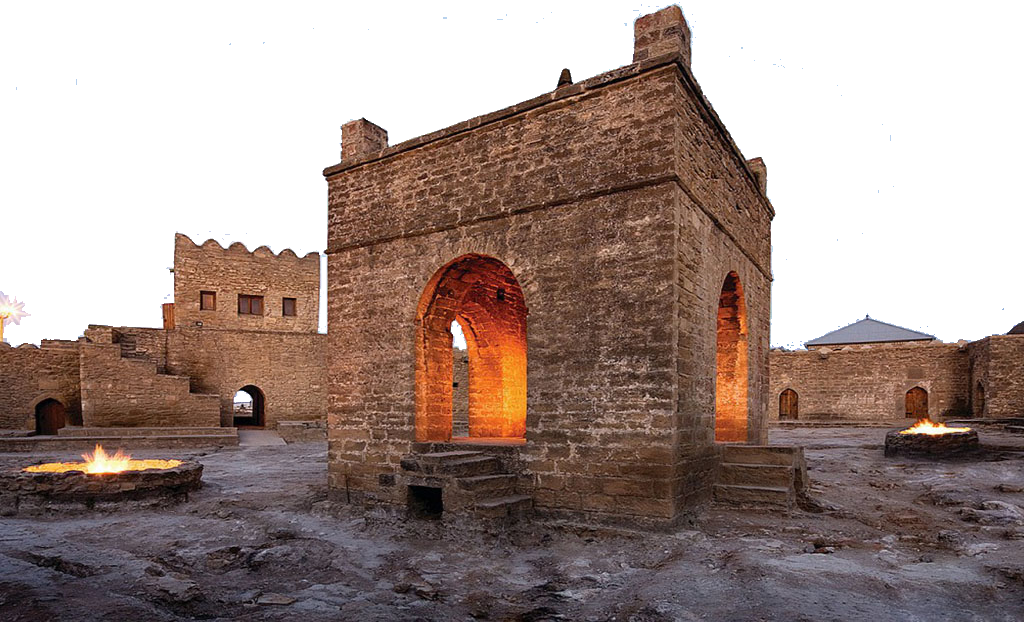
 Jvalaji Temple Baku

The Jvalaji Temple was built in 1745 near Baku. It quickly became a vener­ated site of pilgrimage. Hindus and Sikhs from India undertook tirtha yatra to Azerbaijan at great cost and risk. – Sandeep Balakrishna

When Will Durant wrote “most of us spend too much time on the last twenty-four hours and too little on the last six thousand years,” he was restating a truth about the importance of keeping history afresh in memory.

This 6,000-year time travel takes us back to an India which had evolved a flourishing maritime culture and had left its im­print overseas. David Frawley in his Gods, Sages and Kings, and Michel Danino in his The Lost River: On the Trail of the Sarasvati show that the ancient Vedic civilisation was a maritime civilisa­tion. Likewise, pioneering historian S. Srikanta Sastri (1904-74) marshalled a wealth of evidence that testified to the seafaring element in the Vedic zeitgeist.

This maritime contact of India with the rest of the world was a continuous and positive force for transnational economic and cultural exchange. It remained unabated till the waves of Islamic invasions disrupted it. It is also, sadly, an understudied area of Indian history, which had been spearheaded in the late 19th century and continued till about 1950. No­table works in the field include Radha Kumud Mukherjee’s Indian Shipping: A History of Seaborne Trade and Maritime Activity of the Indians from the Earliest Times, R.C. Majumdar’s Classical Accounts of India, Ancient Indian Colonies in the Far East, India and South-East Asia and Moti Chandra’s Trade and Trade Routes in An­cient India. These apart, V. Raghavan and Vasudeva Sharan Agarwala’s scholarly anthologies explore the influence of India’s artistic, musical and theatrical traditions in foreign lands.

Three random examples can illus­trate this.

Pliny the Elder (24 CE-79 CE) was mortified at how copiously the Mala­bar black pepper was draining the Roman exchequer; he branded India as the “sink of precious metals” that Rome supplied as ex­change to buy pepper.

In the second century CE, a Greek artist had engraved an image of Bharat Mata on a silver dish discovered at Lampsacus (now Lapseki in Turkey) during an archaeological dig in 1847.

The Balinese dramatic art form known as Wayang Beber, performed by the artist known as Dalang, is a song narrative in which he unfolds sheets cloth embossed with miniatures of scenes from the Ramayana and the Mahabharata and narrates each story depicted therein.

Among all foreign lands, Brihad Bharata—known as Southeast Asia—shows the densest imprint of Hindu culture and traditions. In R.C. Majumdar’s words: “The Indian colonies in the Far East must ever remain as the high-water mark of maritime and colonial en­terprise of the ancient Indians. … Political conquest … was rapidly followed by a complete cultural conquest. The local people readily assimilated the new civilisation and adopted the religion, art, social manners and customs, literature, laws … of the conquerors. … A new India was established in that far-off region. … We find new towns and countries called Ayodhya, Kaushambi, Srikshetra, Dvaravati, Mathura. … So long as the Hindu dynasties were in power the civilisa­tion flourished. … The descendants of men who founded that empire abandoned sea-voyage as something unholy and thus an impass­able barrier was created between the Hindus and their brethren of the Far East.”

Moti Chandra’s Trade and Trade Routes in Ancient India is perhaps the most thorough treatise on the prow­ess of Hindu maritime and cultural proselytisation that carried the best of Hindu culture to Southeast Asia, Rus­sia, Turkey, Greece and Rome. In his foreword to this work, V.S. Agarwala opens an evocative world before us: “In the travellers besides the merchant community were included monks, pil­grims, pedlars, horse traders, acrobats and actors, students and tourists. … In­dian travellers by land and sea routes, were also the carriers of Indian story lit­erature. Seamen often related miracu­lous stories of Yakshas, Nagas, demons and spirits and aquatic animals connected with the seas. These stories diverted the people during their travels; such stories were adopted by literature as motifs as well.…”

Indeed, every great Hindu empire in the classical and post-classical period was also a formidable naval power—from the Maurya to the Gupta and the Rashtrakuta, the Chola and the Vijayanagara empires.

With the establishment of Muslim power in India, this spread of Hindu culture abroad received an almost irrecoverable blow. However, the entrepreneurial spirit of Hindus refused to remain caged. While sultans wielded despotic and bigoted political power, they depended on Hindu business classes to keep their finances well-oiled. In turn, these classes found creative ways to preserve their Dharma and traditions both in India and abroad.

In the 16th century, groups of Sindhi Bhatiyas migrated to the Persian Gulf and settled in Muscat; they were later followed by Kutchi Banias. For the next two centuries, they acquired unchal­lengeable financial clout and became confidants of the successive sultans of Oman. They even had a decisive say in deposing one sultan and installing another. They built temples, celebrated all major Hindu festivals and sent prasad to the sultan himself. It was not a coincidence that Narendra Modi visited the  in Muscat in 2018. It had been built by a Sindhi Bhatia sometime in the 19th century.
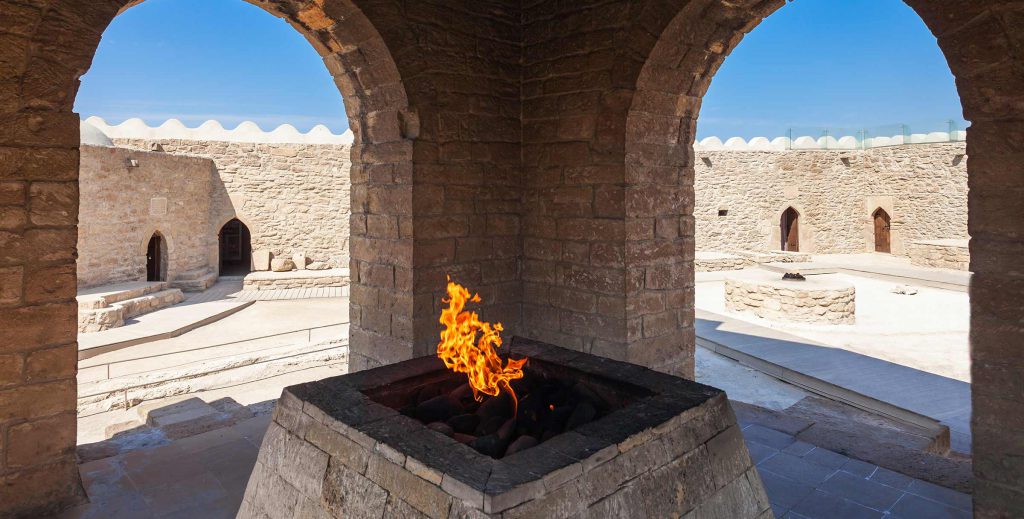
Javalaji (Agni) Temple near Baku.

A similar but lesser-known cultural stamp left by migrant Hindu businessmen is found in Baku, Azerbaijan. This is the Jvalaji Temple built in 1745. Today, it is simply known as the Ateshgah of Baku.

Brisk trade had existed between India and the region for at least three centuries prior to the Russo-Persian war of 1722. A sizeable community of Hindu and Sikh businessmen—mer­chants, traders and bankers—had settled in Bokhara, Samarkand and Azerbaijan. However, the Russian invasion didn’t hamper commerce in a significant way.

After the Jvalaji Temple was built, it quickly became a vener­ated site of pilgrimage. Hindus and Sikhs from various parts of India undertook tirtha yatra at great risk. European travellers of the era testify as to how “… These poor devotees … come on a pil­grimage from their own country. … They mark their foreheads with saffron, and have a great veneration for a red cow. … [I] met two Hindoo Fakirs who announced themselves as on a pilgrimage to this Baku Jawala Ji. … Where a Hindoo is found so deeply tinc­tured with the enthusiasm of religion, that though his nerves be constitutionally of a tender texture and his frame relaxed by age, he will journey through hostile regions from the Ganges to the Volga, to offer up prayer at the shrine of his God.…”

As its name clarifies, the Jvalaji Temple is a shrine dedicated to Agni. Seven sacred fires used to burn from seven holes within the enclosure of the temple. This was the original garbhagriha. In the Vedic pantheon, Agni is conceived as having seven “tongues” (sapta jihva) or flames.
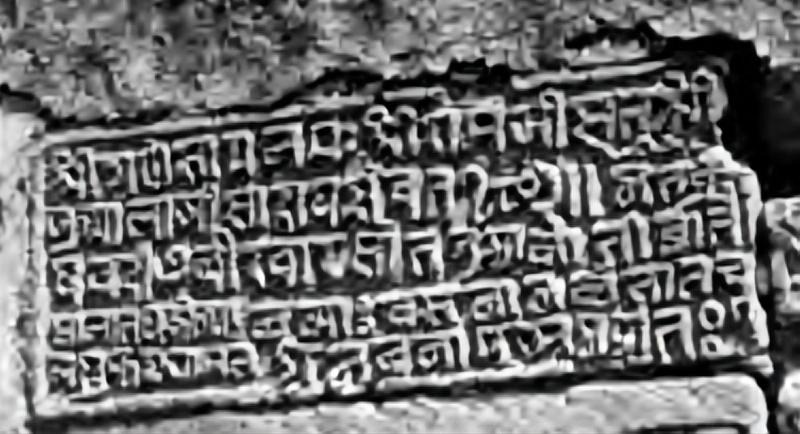
Sanskrit Engraving Javalaji Temple, Baku. First line invokes Lord Ganesha.

The temple complex houses 17 inscriptions of which 14 are in Sanskrit (both Nagari and Devanagari), two in Gurumukhi and one in Farsi. The very first inscription contains an invocation of Ganesha, beginning with “Sri Ganesaya Namah.” Then it de­scribes the glory of the Jvalaji deity, narrating its miraculous pow­ers. Another inscription is an elaborate stuti, or praise of Shiva.
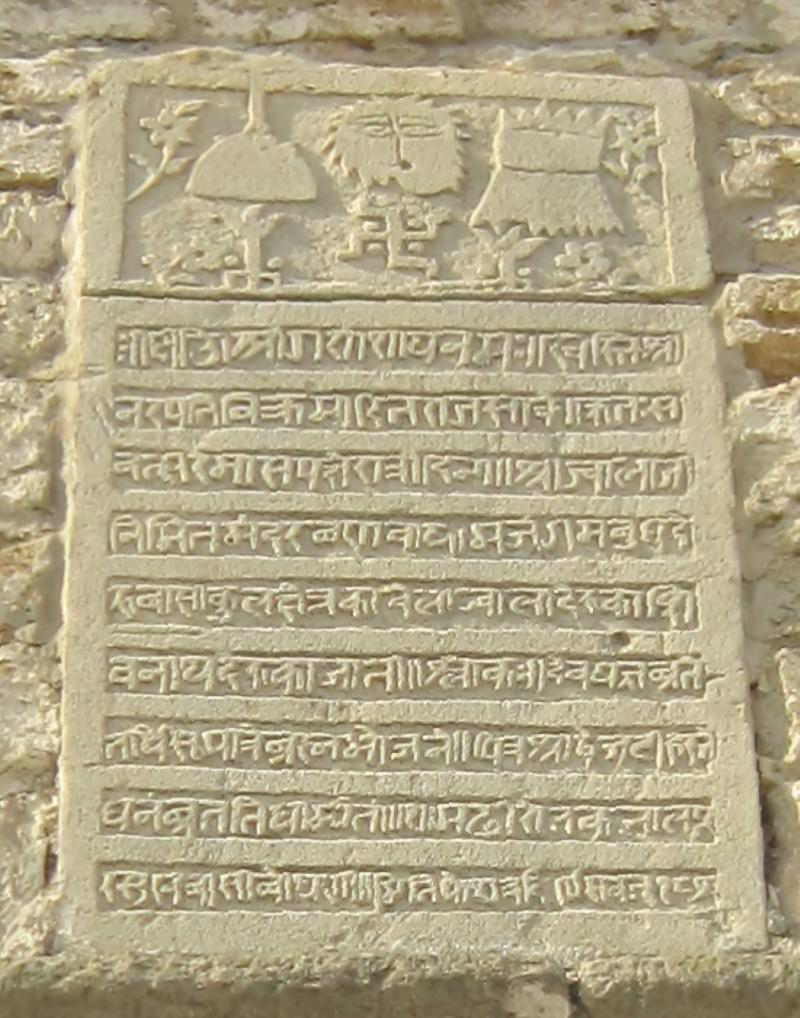
Sanscrit inscription invoking Lord Shiva in the Jvalaji Temple, Baku.

In his History of Dharmasastra, P.V. Kane cites a sloka found in another inscription and gives an informed exposition on the Hindu rituals performed there. This is the gist of the sloka: “In yajnas, vows, pilgrimages, the feeding of Brahmanas at sacred places, giving sacred offerings to ancestors, in the hands of a men­dicant, wealth finds its righteousness.”

Such verses are abundantly found in thousands of inscriptions within India. But the fact that they were also discovered in Baku reaffirms the truth that Hindus create a new India wherever they go.

These verses also give us a hint as to why Hindus from India journeyed all the way to visit the Jvalaji Temple. It was believed to have a deep connection with the Jwal­amukhi Temple in Kangra, a shakti peetha in Himachal Pradesh. Devotees regarded the Kangra deity as the chhota (smaller) Jva­laji and the one in Baku, as the bada (greater) Jvalaji. In A Second Journey through Persia, the British secretary to the embassy in Persia, James Morier, records his 1818 encounter with a sadhu in Karadagh, in East Azerbaijan: “… We met an Indian entirely alone, on foot, with no other weapon than a stick, who was on his road to Benares returning from his pilgrimage to Baku. He was walking with surprising alacrity, and saluted us with great good-humour, like one satisfied with himself for having done a good action. I believe that these religious feats are quite peculiar to the Indian character; or there is a great difference between the mind of one who undertakes a voyage to Mecca with a caravan, in the company of others, and of him who undismayed by solitude and distance, and unencouraged by example, perseveres in his object to the last.”

By the end of the 19th century, Arabia and Central Asia had become bloody theatres of war. As a result, most of the Hindu population in Baku fled. Its place was taken by Zoroastrians who mistook the Jvalaji Temple as a shrine of their venerated fire god and renamed it as Ateshgah. The term is a Persian compound word, a corruption of the Sanskrit words, atharvan (atesh: fire) and gruha (gah: house).

In 1925, the Zoroastrian priest Jivanji Jamshedji Modi travelled extensively in Iran, Azerbaijan and Russia and recorded his expe­riences in My Travels Outside Bombay: Iran, Azerbaijan, Baku. This is what he writes about the Jvalaji Temple: “… Any Parsee … after examining this [temple] with its inscriptions, architecture, etc., would conclude that this is not a Parsee Atash Kadeh but is a Hindu temple whose Brahmins … used to worship fire.”

When Jamshedji Modi visited Baku, it had long ceased to be a living temple or a Zoroastrian shrine. In 2007, the Azerbaijani president by decree designated the temple complex as a pro­tected reserve named as the Ateshgah Temple State Historical Architectural Reserve. – Open Magazine, 23 October 2025

› Sandeep Balakrishna is an author, editor, columnist, public intellectual and an independent researcher. He is the founder and chief editor of The Dharma Dispatch.
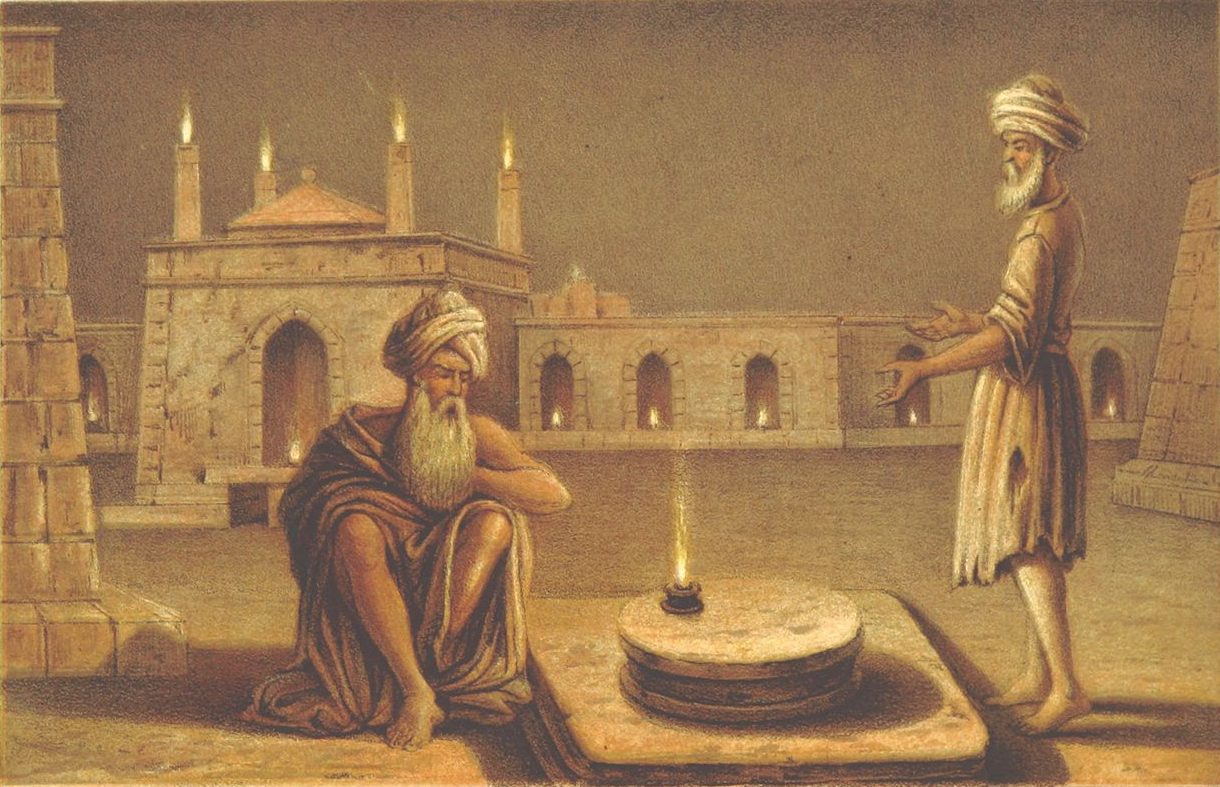
Pilgrims at the Jvalaji Temple (ca. 1860).

The non-dual reality of Lord Shiva – David Frawley

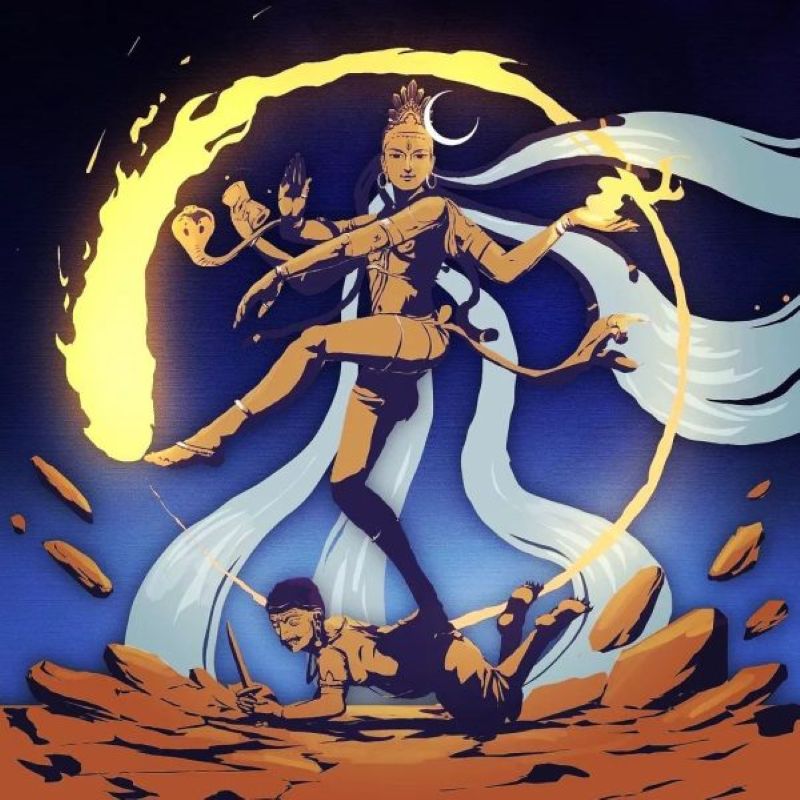
Nataraja

Shiva is not what we think God is supposed to be, conforming to our opinions or hopes; Shiva is what the Supreme Divine truly is beyond the limitations of our minds and the fixed tenets of any particular faith or belief. … There is no box we can place Shiva into, no formula or structure that the mind can arrive at that can comprehend him. – Dr David Frawley

Shiva is ultimately a deity that represents the non-dualistic Absolute beyond all the contraries and oppositions of this dualistic world of time, space, and karma. He is the force of transcendent unity that is more than the combination of opposites and holds simultaneously the power of both sides of all dualities. Shiva is a deity who transcends duality in his very nature, appearance and manifestation—which also requires that he embraces all dualities and resolves them back into himself. This makes Shiva difficult to understand for the dualistic mind caught in outer differences and distinctions.

Shiva reflects the supreme truth that dwells beyond both relative truth and relative falsehood. He is the Supreme Being beyond both relative being and non-being. He is the supreme good beyond both relative good and evil. He embraces our world on both sides, above, below, and in the center and yet stands infinitely beyond it. He is One, yet he is all. He is everything and nothing, both within all things, outside of all things, and not limited by anything.

As a non-dual deity, Shiva seems contrary to our prevailing views of what is logical, right or appropriate. Shiva is portrayed as a dispassionate yogi yet he has the most powerful passions and the most beautiful and powerful wife. He both destroys Kamadeva, the ordinary God of love but then becomes the Supreme God of Love himself, Kameshvara. He takes us beyond suffering, but to do this he can cause us excruciating pain.

Shiva awakens a higher awareness in us, but for this to occur he must first take us beyond all our preconceptions, making us see the darkness of ignorance behind our lives. Shiva represents our higher Self that is the goal of our aspirations, but to reach it we must allow our ego, its attachments and opinions to be dissolved, giving up our ordinary sense of self altogether.

The challenge of our encounter with Shiva

Shiva in his diverse names, forms, and actions is meant to be challenging for us to grasp. Lord Shiva is not meant to be easy to understand, nor can we present his reality in a simple manner that resolves all doubts as to what he actually represents. To contact the reality of Shiva we must face all doubts and difficulties within ourselves and learn how to move beyond them with steadiness and grace. We must recognize the limitations of the mind and its particularized knowledge. The portrayal of Shiva is not meant to present us with only a pleasing appearance, any more than life is always kind. Our encounter with Shiva is meant to shake us up, to stir our inner transformative energies—to get us to question ourselves and all that we may hold to be truth or reality.

Any real encounter with Lord Shiva is not likely to conform to our existing beliefs, hopes, or expectations. It may not leave us feeling more confident about who we are, or more certain that our lives are moving in the right direction. An encounter with Shiva may not initially make us feel happier or give us more prosperity or what we may regard as a better life.

Shiva is not what we think God is supposed to be, conforming to our opinions or hopes; Shiva is what the Supreme Divine truly is beyond the limitations of our minds and the fixed tenets of any particular faith or belief. Shiva is the supreme reality, not we ourselves, our ideas, opinions, books, or institutions. Shiva is the cosmic reality not our individual or collective imaginations and fantasies. There is no box we can place Shiva into, no formula or structure that the mind can arrive at that can comprehend him.

To arrive at the state of supreme awareness that is Shiva, we must allow ourselves to be stripped bare of our personal conditioning down to the subconscious level, beyond the memories of the present birth and the perceptions of the outer world. We must learn to see ourselves in all beings past, present, and future. We must be humbled back to the core of our being where no self-image prevails, and where there is no other that we have to conform to, please, or fear.

The human mind as it is today is not a conscious intelligence that we can rely upon to determine what is real. It is a conditioned response mechanism for biological survival and social development. Information technology has augmented its powers but not taken us beyond its dualistic limitations. But in the silence of the heart, where all is forgotten, one can know the truth. You are Shiva in your deepest Self and core being. Shiva is the non-dual reality in which you personally are not there, yet in which through your inmost essence of feeling and awareness you are everything.

We can approach Lord Shiva many ways through ritual, yoga, mantra, pranayama and meditation, but these are only expedient measures to draw us beyond body and mind to the mysterious core of our being that knows all intuitively without being trapped in any concepts.

Om Namah Shivaya!

› Dr. David Frawley (Pandit Vamadeva Shastri) is a Voice of India author and teacher in the Vedic tradition. Article from Vedanet.

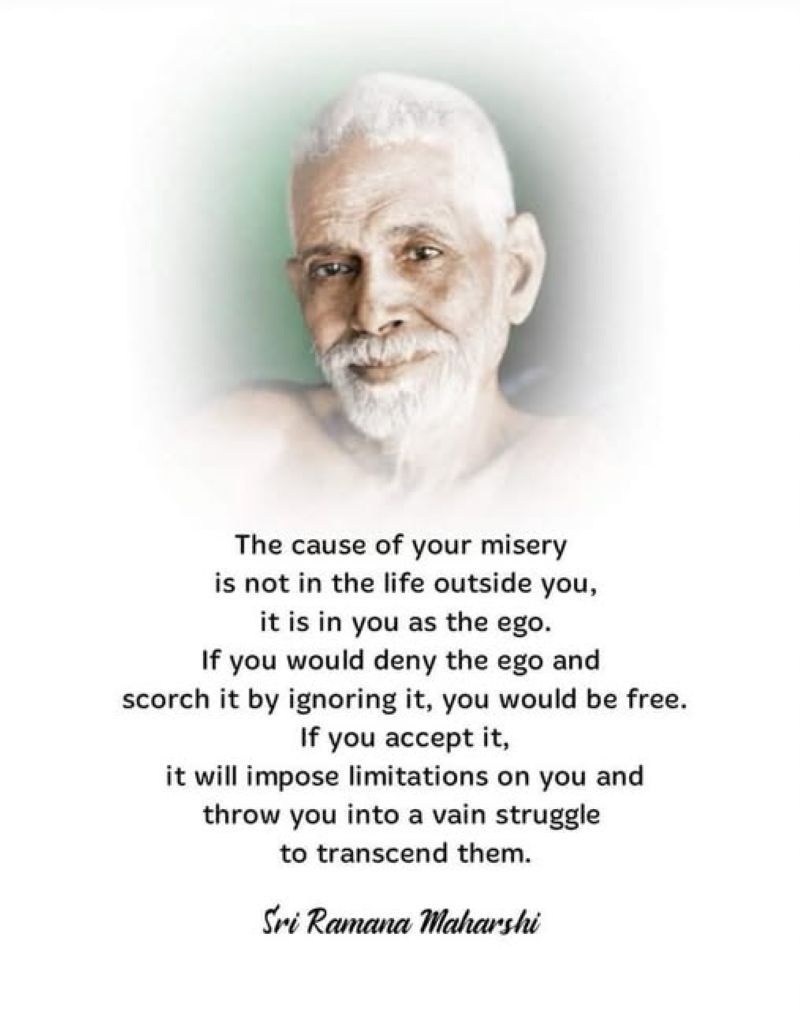
Ramana Maharishi Quote

The secret power of Hanuman – David Frawley

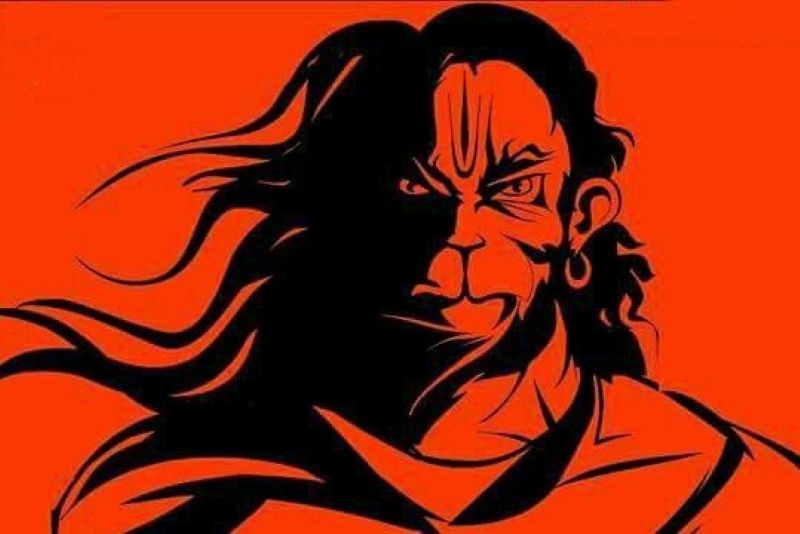
Hanuman

Hanuman endows us with the Atma-shakti or Self-power through which we can realise our higher potential and accomplish what is magical. He grants us fearlessness, self-confidence, daring and boldness to attempt the impossible and succeed. – Dr. David Frawley

Hanuman endows us with Self-power

Hanuman is the great hero of the Ramayana, the wonderful story’s most fascinating character. Though having the form of a monkey, he is said to be the greatest sage, yogi and devotee. What is the inner meaning of this magical figure?

Hanuman is portrayed as the son of Vayu, the wind God. This explains his speed of movement, his power to become as small or large as he likes, and his incredible strength. But there are many other yogic secrets hidden behind his symbolism.

Hanuman and cosmic energy

Today our world prides itself in a new information technology, with a rapid speed of data, calculation and communication. Modern science has learned to tap the latent powers of nature to transform our outer lives. At a cosmic level, there is a deeper energy that runs everything in the universe.

This is called “Vayu”, which is not just a force of the wind or air element, but the kriya shakti or power of action that governs all inanimate and animate forces in the universe. It is the source of all cosmic powers, not just wind as a force in the atmosphere.

Vayu manifests as lightning or propulsive force (vidyut). This is not just the lightning that arises from clouds but the kinetic energy that permeates all space and time. Vayu is the energy operative from a subatomic level to the very Big Bang behind the universe as a whole. Tapping into that supreme cosmic power is what the methodology of Yoga is all about.

Vayu at an individual level becomes prana, which is not just the breath but the life force that holds all our motivations and sustains our inner strength and will power. It is not just our physical prana but the prana of mind and ultimately of consciousness itself.

Hanuman represents the cosmic Vayu manifesting through our individual prana. This occurs when we dedicate our lives to the Divine Self or Rama within us, letting go of our attachment to the external world of appearances.

Hanuman endows us with the Atma-shakti or Self-power through which we can realise our higher potential and accomplish what is magical. He grants us fearlessness, self-confidence, daring and boldness to attempt the impossible and succeed.

The cosmic Vayu is inherently a force of intelligence, linking us to the cosmic mind that aligns all minds together in an interconnected network of thought. That is why Hanuman is the most wise and observant, holding the power of buddhi, the discriminating inner intelligence that reveals the highest truth.

Hanuman and the power of Yoga

This cosmic Vayu is the true power of Yoga. It gives flexibility of body, boundless vitality, indomitable will power, and concentration of mind. Our highest prana is to reach out and merge into the immortal Prana, which is to dedicate ourselves as Hanuman to Rama.

Hanuman grants all yoga siddhis extending to the highest self-realisation, allowing us to master all cosmic energies.

Hanuman is the conduit of the power of Rama as the universal Self. Rama represents the Self who guides all nature—through which the wind blows, out of which the Sun and Moon move, which holds the Earth in place through gravity.

The yogi works through that cosmic Vayu and universal Prana, in attunement and harmony with the whole of life.

The true bhakta or devotee surrenders to the Divine will which is the motivating force of Vayu.

Vayu’s vibration is Om or Pranava, the primal sound behind all creation and the source of all mantras.

The Upanishads teach us that Vayu is the directly perceivable form of Brahman, the Cosmic Reality.

Becoming Hanuman

To become Hanuman we must awaken to our inner nature as a portion of cosmic consciousness. Each one of us has the power of the entire universe within us.

But we can only recognise this when we become aware of our inner Self, what the Upanishads call the antaryami or inner controller. Hanuman is the force of Rama working within us, the strength of our innermost Self that is the ruler of all.

It is Hanuman alone who can discover Sita Devi. Sita represents the deeper Self-knowledge or Atma Vidya, through which Rama or the Self can be fully realised.

Sita is also the feminine principle of space and receptivity that the cosmic Vayu depends upon. Without Hanuman, we cannot find Sita, and Rama cannot fulfill his destiny of the highest dharma.

Let us not forget our own deeper cosmic energy in our fascination with the latest information technology that is but its shadow. Hanuman reveals to us the way of transcendence.

Jai Sri Ram! Jai Jai Hanuman! – Vedanet, 30 March 20

› Dr. David Frawley (Pandit Vamadeva Shastri) is a Voice of India author and teacher in the Vedic tradition.


Atma Shakti