James Prinsep: The Englishman who mapped the Adi Vishwanath Temple in Kashi – Yudhajit Shankar Das

James Prinsep

James Prinsep first served in Calcutta and then in Benaras for ten years. Prinsep’s stay in Varanasi—from 1820 to 1830—is what is of interest and importance against the backdrop of what is unfolding today. – Yudhajit Shankar Das

At a walking distance from Kolkata’s Eden Gardens is the Prinsep Ghat on the banks of the River Hooghly. One gets a close view of the Vidyasagar Setu and can take a boat ride on the Hooghly from Prinsep Ghat.

The ghat is named after James Prinsep, a British numismatist and archaeologist, who made significant contributions to India’s historiography. He came to India when he was 28 and was the youngest fellow of the British Asiatic Society.

It was Prinsep who deciphered the Brahmi and Kharosthi scripts and helped the world know about Emperor Ashoka’s reign. It was he who established that King Devanampriya Piyadasi, who is mentioned in several inscriptions from Sri Lanka to Afghanistan, was none other than Emperor Ashoka.

The ghat in Kolkata was named after Prinsep as a way to recognise his contributions after he passed away in London in 1840 at the young age of 41.

Benares Illustrated by James Prinsep

James Prinsep and his ‘Benares Illustrated’

James Prinsep first served in Calcutta (now Kolkata) and then in Benaras (now Varanasi) for ten years. Prinsep’s stay in Varanasi (from 1820 to 1830) is what is of interest and importance against the backdrop of what is unfolding now.

Prinsep built Varanasi’s underground sewage system, which is still operational, restored the Alamgir Mosque, built by Mughal Emperor Aurangzeb in 1669, and drew the city’s maps. He also brought out a book, Benares Illustrated, A Series of Drawings, in 1831.

That book and the map will be used as part of evidence by the Hindu side in the legal battle for the Gyanvapi complex, IndiaToday has been told.

In Benares Illustrated, James Prinsep used lithography to engrave every scene on paper and present information with evidence. Chapters and illustrations include Munikurnika Ghat, Bruhma Ghat, Procession of the Tazeeas and Hindoo Nach Girls.

Most importantly, James Prinsep, in Benares Illustrated, discussed the architecture of the old Vishweshwar Temple, and how the original place of worship was converted to the present Gyanvapi Mosque. Vishweshwar or Lord of the Universe is another name for Lord Shiva.
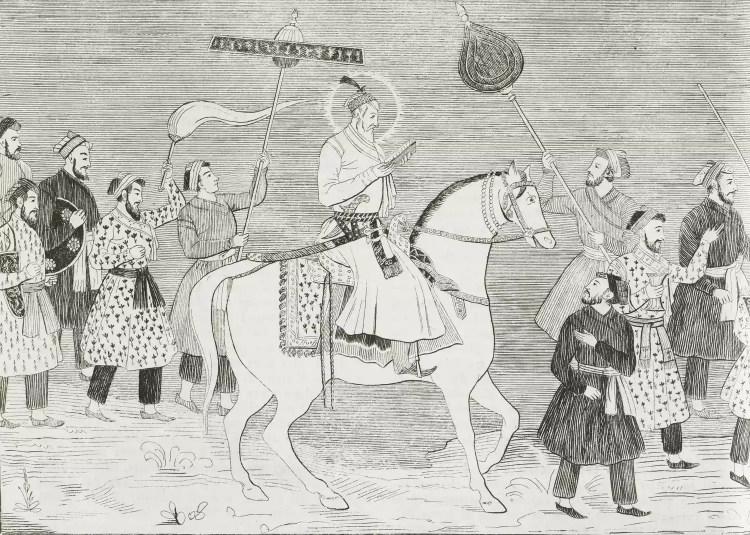
Engraving (1848) of Emperor Aurangzeb with his retenue.

Prinsep on Auranzeb’s bigotry

In Benares Illustrated, Prinsep details how Aurangzeb’s men used the material from the destroyed Kashi Vishweshwar Temple to build the Gyanvapi Mosque.

“The bigotry of Aurungzeb did not allow many vestiges of this more ancient style to remain. In 1660, for some trifling resistance to the imposition of a capitation tax, he took occasion to demolish the principal Shiwalas, and constructed Musjids or mosques with the same materials and upon the same foundations, leaving portions of the ancient walls exposed here and there, as evidence of the indignity to which the Hindoo religion had been subjected,” Princep writes.

The Kashi Vishweshwar Temple is of immense significance in Hinduism as it is one of the 12 Jyotirlingas or temples where Lord Shiva is said to have appeared as a column of light. Lord Shiva is said to have created a water-producing spot there hence the name Gyanvapi (well of knowledge).

The Adi Vishveshwara Temple was destroyed by Qutb ud-Din Aibak, the general of Muhammad Ghori, in 1194 but was rebuilt. It was Aurangzeb who razed the Kashi Vishweshwar Temple again in 1669 and built the Gyanvapi Mosque using the same foundations and materials.

It is very similar to the use of materials from the destroyed 12th-century temple that was used to build the Babri Masjid in Ayodhya. The Babri Masjid was constructed in 1528 by Babur’s commander, Mir Baqi.

Babur was the first Mughal ruler in India, while Aurangzeb was the last of that family to hold sway.

Distroyed Viswanath Temple replaced by Gyanvapi Mosque (James Princep 1834).
Plan of the ancient Kashi Vishwanath Temple. Fine dotted line in the plan image indicates the Gyanvapi Mosque build over the temple's foundation (James Prinsep 1832).

Prinsep’s 200-year-old map of Gyanvapi Temple

Prinsep then went on to reveal the old plan of the Vishweshwar Temple by drawing a map and marking on it how the Aurangzeb-built mosque stood on it.

But how could Prinsep, who came to Varanasi in the 19th century, come up with the map of the old Kashi Vishweshwar Temple, which was destroyed by Aurangzeb in the 17th Century, after a gap of about 160 years?

Prinsep explains in Benares Illustrated how he exactly managed to draw the map of the old Vishweshwar temple.

“Antiquarians will be well pleased that the Moosulmans, in their zeal for the triumph of their own religion, discovered a method of converting the original structure into a capacious Musjid, without destroying above one-half of its walls; so that not only the ground plan but the entire architectural elevation, may still be traced out,” he writes.

In the chapter “Plan of the old Vishveshwur Temple” of Benares Illustrated, Prinsep shares the map that shows that the old Kashi Visheshwar Temple had eight mandaps and the central section which Prinsep calls ‘Mahadeo’.

“The darkly shaded part shews the figure and foundations of the principal dewul: the fainter, those of the outer dewulees. The whole must have formed, when complete, a picturesque groupe of nine spires around a central pyramid. The heights diminishing from the centre towards the corners in the proportions of sixteen, eight, and six, as seen by the ground plan,” he writes.

The book and the map will be part of the evidence put forward in the Gyanvapi case, advocate Vishnu Jain, who represents the Hindu side in courts of law, confirmed to IndiaToday.
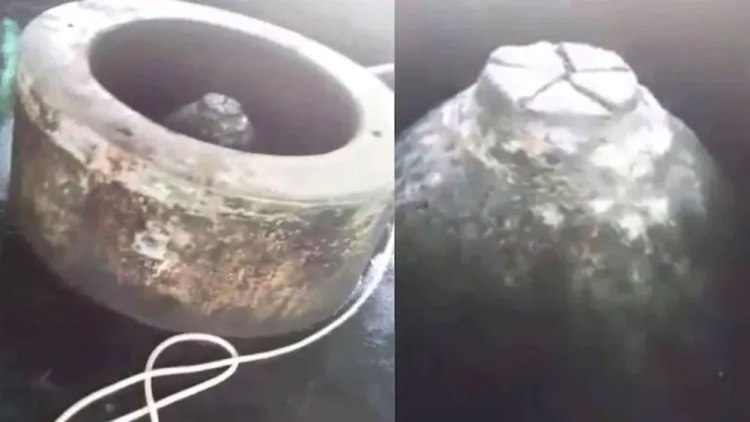
Shiva linga found in a well in Gyanvapi Mosque. According Muslims it is a wazukhana fountain (though there is no water connection and the top nozzle is added recently).

Prinsep on the ‘Lingam’ at Gyanvapi Masjid

“The principal lingam of Mahadeo stood in an ornamented reservoir in the centre, having a drain below to carry off the Ganges water continually poured over it by day and night,” writes James Prinsep in his Benares Illustrated.

“Prinsep has shown the place of Vishweshwar or Mahadev in the centre of the temple and indicates that the principal lingam was located in a water reservoir and that could be the so-called fountain in the wazukhana, which could have been originally the ornamented reservoir having the lingam,” B.R. Mani, Director General of National Museum, tells IndiaToday.

Mani, who led the Allahabad High Court-ordered excavation at the then-disputed Ram Janmabhoomi-Babri Masjid site in 2003, says that more research is needed to ascertain if it is, in fact, the ‘Lingam’ that James Prinsep mentions.

The wazukhana, or the ablution area, of the Gyanvapi Mosque was sealed in 2022 following a Supreme Court order. According to the Hindu side, the fountain-like structure in the wazukhana is a Shivling or lingam.

This is what Prinsep seems to have suggested in his 1831 book.

“If you draw a graph of human genius, James Prinsep would head the list along with Leonardo da Vinci,” said O.P. Kejariwal, then Director of Nehru Memorial Library, in 2001.

The Gyanvapi site is seeing fast-paced action. A Varanasi court has allowed Hindus to perform puja in one of the cellars, Vyas ji ka Tehkhana, which was ordered sealed by former Uttar Pradesh Chief Minister Mulayam Singh in 1993.

Amid the legal battle surrounding the Gyanvapi site, James Prinsep and his Benares Illustrated, A Series of Drawings of 1831 are interesting to revisit. Both will likely play a key role in the events that follow.

As all the focus is on the Gyanvapi site, about 680 km from Varanasi, stands Prinsep Ghat in Kolkata, in the balmy breeze blowing from the Hooghly River. – IndiaToday, 7 February 2024

Yudhajit Shankar Das is a deputy editor at IndiaToday.
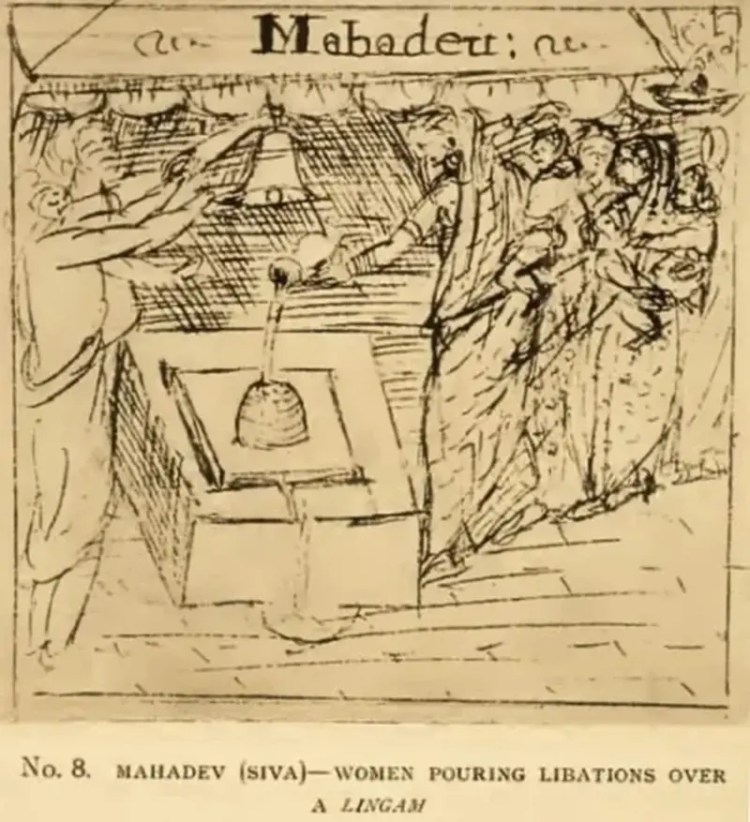
Women doing abhishek to lingam in the Adi Vishwanath Temple (Peter Mindy 1632).

The word ‘spolia’ hides too many humiliations – Reshmi Dasgupta

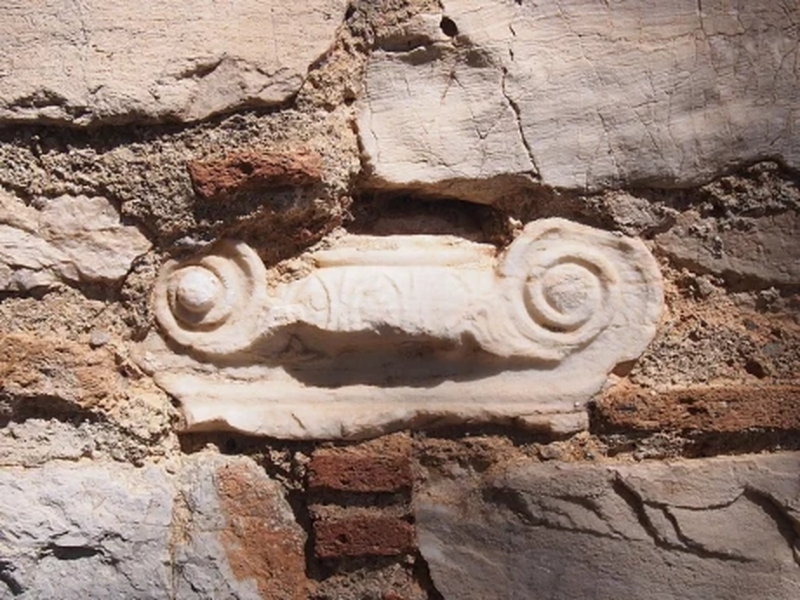
Ionic pillar capital embedded in wall of St.Peter's Church, Kalyvia Thorikou, Greece.

For medieval European builders who used temple rubble in their churches, the older Pagan faith was totally snuffed out in the former Roman Empire, so no one was left to protest against the deliberate insult to the ancient Gods. But in India there are many left to seethe about temple ‘spolia’ in mosques. – Reshmi Dasgupta

‘Spolia’ is an interesting word. Taken from Latin, it means “spoils” (of war) but archaeologists and academics use it to describe stones and architectural elements retrieved from older structures and re-used in new constructions, as masonry or decoration, either in the same place or elsewhere. Many of those who use the word prefer it because ‘spolia‘ sounds passive, because most people do not know the real meaning, with its vivid allusions to violence and destruction.

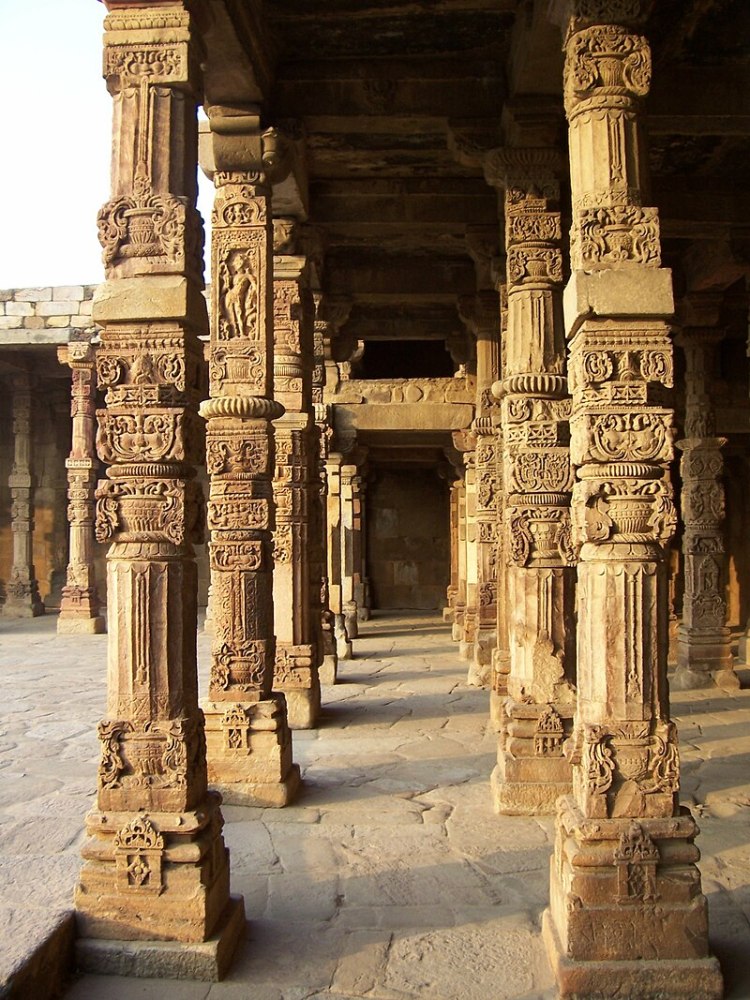
Debris and rubble are the better known words that imply destruction and hence are less used as they give rise to uncomfortable questions. More so when certain sections of them are reused intact, so that their original purpose juxtaposed with their new ‘repurposed’ existence remains clear to those looking at it. Hindu and Jain temple ‘spolia’—pillars—used in the cloisters of the 12th century Quwwat-ul-Islam Mosque in New Delhi’s Mehrauli is one such example in India.

Quwwat-ul-Islam Mosque
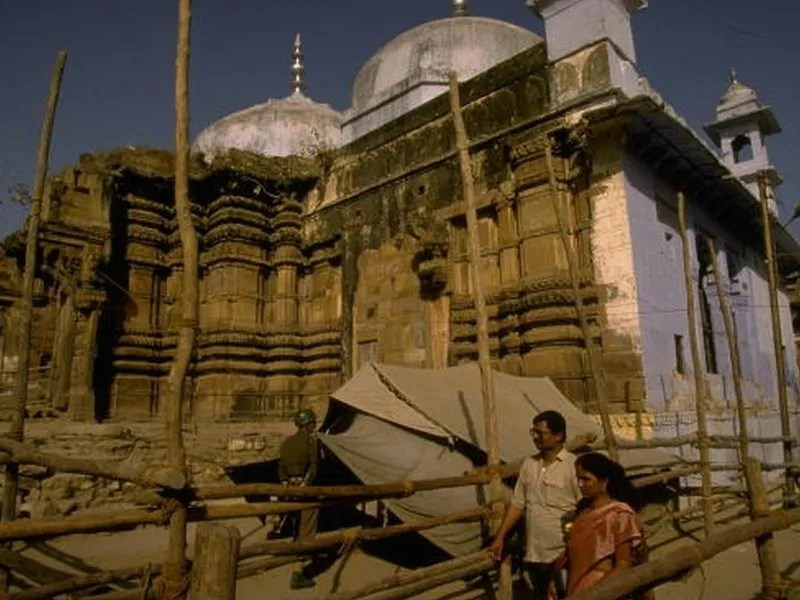
Western wall of Gyanvapi Mosque is that of earlier hindu temple.

Of course, an entire wall of an older structure retained intact in a subsequent construction—one example of which is currently in the news here—cannot be called ‘spolia’ in the classical sense as technically, it is not in bits and pieces. But its impact on those who see it is far sharper than, say, statues of Pagan or forbidden gods embedded in walls or on stairs, of which there are many examples in the areas of the erstwhile Roman, Byzantine and Ottoman empires.

In this connection, it may be remembered that remains of old statues and columns which were used in later constructions in the Acropolis in Athens have been widely interpreted as a deliberate device to forever remind Athenians about the destruction wrought by Persian emperor Xerxes I in 480 BCE after the battle of Thermopylae. Only certain spolia were used, so as to ensure Athenians resolve to never let it happen again. This is called ‘purposeful memorialisation’.

The ‘spoliate colonnades’ of Rome, however, are even more apt in the context of Mehrauli as intact pre-Christian Roman pillars were deliberately re-used in churches. In Spolia Churches of Rome: Recycling Antiquity in the Middle Ages, Maria Fabricius Hansen writes how from the 4th century CE to the 13th century CE, Christians “re-used” columns, pediments and other spolia of ancient (Pagan) Rome prominently in churches. It even became an architectural style.

The assertion of Christianity over the earlier faith prevalent there was implicit in this exercise since the new churches not only used old material but were also eventually built on the very sites of Roman temples. Fortunately for those medieval church builders, the older faith was totally snuffed out in the former Roman Empire, so no one was left to protest against the deliberate insult to their ancient gods. But in India there are many left to seethe about ‘spolia’.

The term ‘purposeful memorialisation’ can be used to describe the use of ‘spolia’ in India too, but the intention was rather different. Although contemporary left-leaning historians have tried hard to find a continuity in terms of violence and destruction in India before and after the advent of Islamic rulers, there is little proof of wilful debasing. There is no evidence of Buddhist ‘spolia’, for example, being deliberately used in Hindu temples to humiliate and disparage.

On the contrary, the great Buddhist university or mahavihara at Nalanda (then in Magadha and now Bihar) was built by the Hindu emperor Kumaragupta in the 5th century and flourished under successive Hindu rulers and non-royal Hindu donors. It was destroyed in the 12th century by ‘Turks’ (almost certainly Bakhtiyar Khilji’s army) corroborated by contemporary accounts of monks. The site of another mahavihara Odantapur that Khilji razed became Bihar Sharif.

Many reused ‘older’ building materials in India without any idea of what the original structures were, of course. Bricks and pillars of the 2nd century BCE Amaravati mahachaitya buried for more than a millennia were reused by a local zamindar Raja Vesireddy Nayudu to build his new capital in the late 18th century. Bricks from the then-undiscovered Harappa were also used by the British as track ballast for the Lahore-Multan railway in the late 19th century.

The Indus-Saraswati civilisation was still unknown when the railway was being built and Amaravati was just a grassy mound of bricks. They both could just as well have belonged to abandoned settlements of relatively recent provenance, that too not of known importance. So, whether knowing the origin of the bricks and ‘spolia’ would have really made a difference in these two cases remains moot. But all use of ‘spolia’ in India has not been that unwitting.

Which explains why there has been a concerted effort to project that destruction of places of worship and use of ‘spolia’ in India predated the Islamic period. One example cited is of the Pallava king Narasimhavarman I’s Brahmin general Paranjothi who took away a Ganesha idol from the Chalukyan capital Vatapi (now Badami in Karnataka) after the defeat of Pulakeshin II in 642 AD and installed it in his village Tiruchenkattankudi in Tiruvarur district of Tamil Nadu. But those who cite it omit the fact that the razing of Vatapi exempted temples.

Not only did Paranjothi install the Ganesha idol with great devotion and respect in his village but there is an inscription by Narasimhavarman I in the Mallikarjuna Temple at Vatapi, proving that destruction of Chalukyan temples—much less raising another structure on the site to rub it in—was not on the agenda. Carrying away idols did not indicate contempt as they were not melted down, unlike those taken from southern temples by Alauddin Khilji’s general Malik Kafur.

Another example given is of Rajadhiraja Chola who defeated the Chalukyas and plundered their capital Kalyani, taking away a large black stone dwarapala. But the inscription on that dwarapala, now installed at the Darasuram Temple in Kumbakonam, attributing its presence there to Rajadhiraja, proves it was not demeaned or destroyed but respectfully given place in another temple. If this could be called ‘spolia’ at all, it had been given a dignified new home.

The actions of warring southern Hindu rulers were a marked contrast to the attitude of the invading Islamic armies from the north, especially the expeditions of Alauddin Khilji’s favourite general Malik Kafur. The many stories of idols hidden to prevent destruction and mutilated stone carvings of figures in the great temples of south India bear witness to the fury and intentions of these invaders, going beyond just plundering their gold, gems, horses and elephants.

This is conveyed in almost fawning detail by the admired 14th century bard Amir Khusrau (who was witness to many of those pillaging wars) in Tarikh-i-Alai. One description goes: “The holy places of the Hindus, which the Malik Kafur dug up from its foundations with the greatest care. … The stone idols called ling, which had existed for a long time and until now, the kick of the horse of Islam hadn’t attempted to break … the Mussalmans destroyed all the idols”.

In most cases though, the ‘spolia’ used by idol-breaking armies are not as evident as, say, at the Quwwat-ul-Islam mosque and certainly Gyanvapi. But the question is when (if at all) will India’s historians and intelligentsia take a cue from their counterparts (who have noted the same phenomenon around the Mediterranean) face up to the truth? They need to not only call a spade a spade but also disseminate the real meaning and purpose of ‘spolia’ in history. – FirstPost, 14 August 2023

Reshmi Dasgupta is an editor at the Times of India, New Delhi.

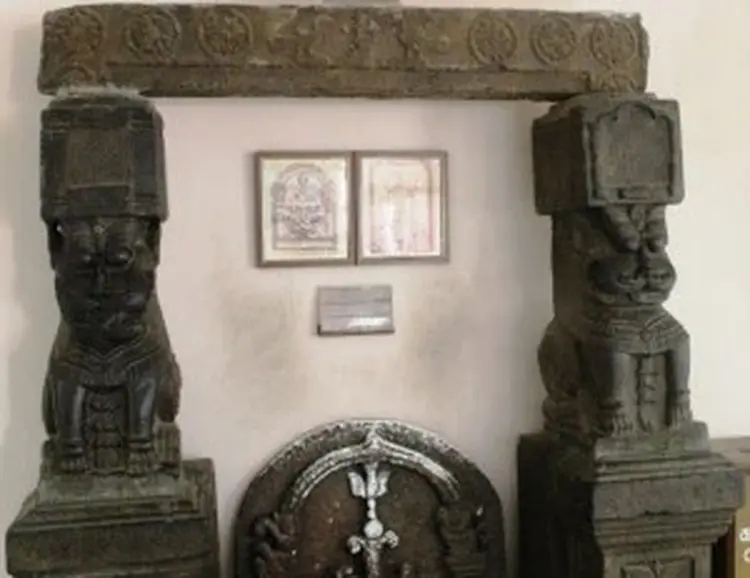
Temple pillars in Santhome Church museum, Mylapore.

Nandi’s Witness: The moral question and obvious evidence at Gyanvapi Mosque – Venu Gopal Narayanan

It is a moral question: if, by custom, tradition, belief, and history, Nandi has always been posted to watch over Shiva, why have legalistic delays and an otiose intransigence prevented him from resuming his duties for so long? – Venu Gopal Narayanan

The issue of whether the Gyanvapi mosque in Varanasi was built on a Shiva temple, or not, is entering its denouement phase in various courts.

A number of questions are being asked: many are legal; more are legalistic; others are technical; and some, as always, are wretchedly political ones pregnant with instigative intent.

Original Kashi Vishwanath Temple with Gyanwapi Mosque standing atop it.

At one level, the entire legal ruckus seems slightly mindless and wholly needless, since the three domes of the mosque rest on the intricately sculpted remnant western wall of what is clearly a Hindu temple.

But then, defending the indefensible using word play has long been the preferred modus operandi for some schools of politics.

Alleged Shiva linga found in a well in the Gyanvapi Mosque.

As a result, the questions are flying thick and fast: Is that linga-shaped object in the mosque’s forecourt a linga or a pillar? Is it old or new? Is it made of concrete or stone?

Will an archaeological survey bring out the truth? Why should a survey be allowed? Is the petition for a survey legally tenable? Why do ‘they’ want a survey? Won’t ‘they’ ever let us live in peace? Ad infinitum.

Separately, the media domain is filled with questions about the questioners.

Heady legal verbiage is distilled with reductionist severity, by self-styled experts blessed with only a passing knowledge of the law, to such an extent, that it makes the concept of ‘dumbing down’ seem intelligent.

It is entirely beside the point that most such efforts either miss the point, get it wrong, or merely muddy the pool further.

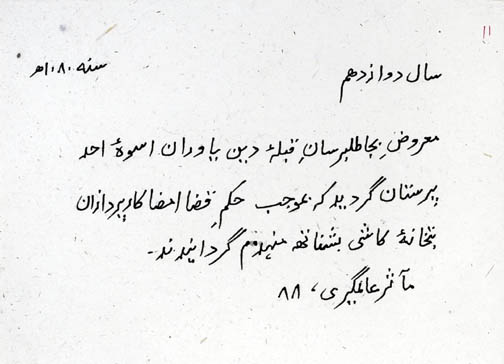
Auranzeb's firman ordering the destruction of the Kashi Vishwanath Temple (Sept. 1669).

Is that judge kosher? Why didn’t this lawyer make that point? What about the imperial firmans ordering the destruction of a temple at that very site? Can’t they be adduced as irrefutable evidence? Or, is it all a sinister majoritarian ploy? Again, ad infinitum.

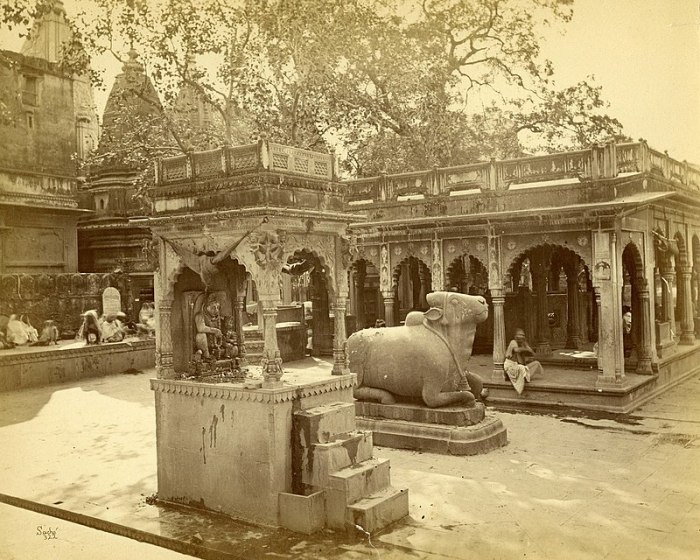
And then, there is a statue of a seated bull at the northern perimeter of the Vishwanath temple at Kashi, which has been quietly asking a different query ever since the ruckus began some centuries ago. He is Nandi, Shiva’s mount.

According to the legends which made this sacred land, Nandi is the keeper of Shiva’s abode, be it atop Mount Kailash, at Kashi, or any one of the innumerable grihas where a dreadlocked trident-bearer is the resident deity.

Nandi is endowed with great strength, and his job is to keep the peace while his Lord attends to various matters; so strong, in fact, that even Ravana, the invincible Lankan king, had to suffer a humiliating chastisement at Nandi’s hooves, when the royal visitor once threw a petulant fit after being forced to wait for an audience with Shiva at Kailash.

It is a task demanding eternal devotion and great fortitude, for which reason, Nandi is always found seated facing the abode of his master.

Photo by Britisher Samuel Bourne taken in the 1860s with the caption "Gyanvati is not a mosque, but a temple".

But this Nandi of Kashi has not seen peace, and oddly not his Lord, in a long age, for he sits facing away from the jyotirlinga of Vishwanath, gazing at a mosque through tall barricades erected by thoughts alien to this land. That is why his query is different from any other.

It is a moral question: if, by custom, tradition, belief, and history, he has always been posted to watch over Shiva, why have legalistic delays and an otiose intransigence prevented Nandi from resuming his duties for so long? It is a question for the ages.

Our modern questioners would rush to answer, excitedly and volubly, that the delay is on account of a small, but extremely influential section of the Muslim aristocracy, along with the secularist parties, who have turned the issue into a cause celebre for political control of a vote bank, and vital electoral profit.

Perhaps they are right, from a legal or a technical standpoint, but theirs is not a moral answer.

The reason is that an article of faith goes far beyond a judge, a court, a law, or an archaeological survey. It is an issue of morality: is it right to hinder Nandi thus? And the issue will be resolved peaceably, the day that point is answered honestly.

Consequently, it is not a matter of which court will answer Nandi’s query, or about how justly it will be answered, but when, because some questions cannot be avoided.

That is the way of dharma. In the end, the natural order of things is always restored by the truth.

Just as the Yaksha Prashna to Yudhishthira was the question of the Dvapara Yuga, Nandi’s query is the question for this Yuga, and the time for an answer has arrived. – Swarajya, 25 July 2023

Venu Gopal Narayanan is an independent petroleum consultant who focuses on energy, geopolitics, current affairs and electoral arithmetic.

Vishwanath Temple Complex and Gyanvapi Mosque.