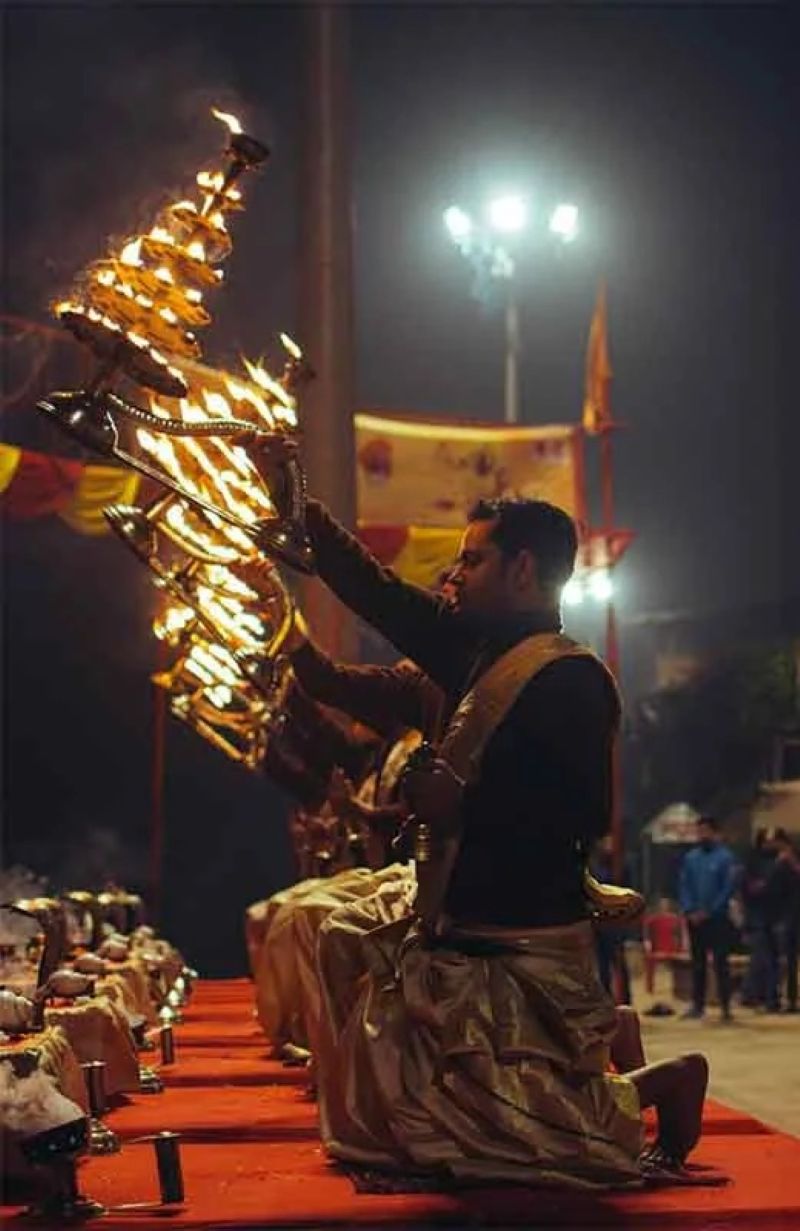
With the worship of the holy Ganga finally restarting with arati on the riverbank in Kolkata and ceremonial dips at Tribeni, is it not time to discard the latter-day secularised name of the Ganga—Hugli/Hooghly—coined and imposed by foreigners? – Reshmi Dasgupta
In 2023, rather belatedly, Ganga Arati on the riverbank unmistakeably similar to the hugely popular one at Varanasi began to be conducted every evening in Kolkata. Today, it’s a must-attend for tourists. Around the same time a Kumbh Mela also restarted up-river, held at the same time as the more famous one at Prayagraj. The natural question that comes to mind is, “Why on earth is the Ganga called Hooghly or Hugli then as it flows past the capital of West Bengal?”
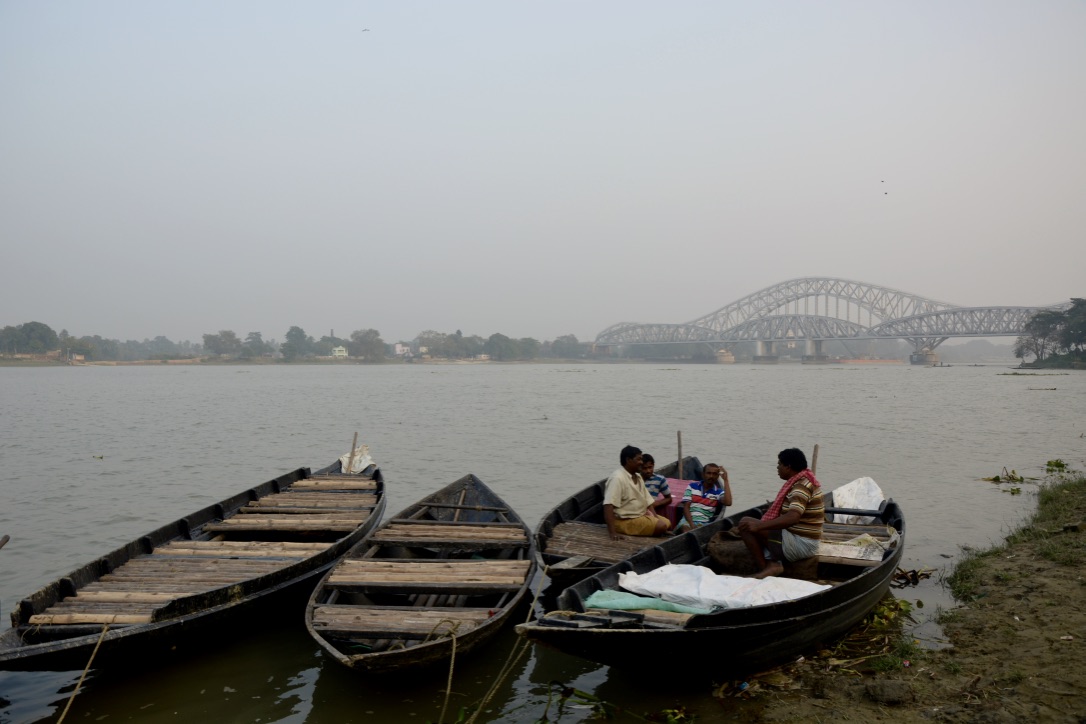
More so as this undoubtedly ugly name was not given by locals. The Ganga bifurcates as it enters West Bengal from Bihar, with one distributary veering off into Bangladesh as the Padma. The one that remains in India is called the Bhagirathi. But once Bhagirathi/Ganga reaches the 16th century Portuguese trading post of Fort Ugolim (Bandel), its name changes to Hooghly, a corruption of that Portuguese word. And this name was readily adopted by the British.
Hundreds of years of Islamic rule, European traders flocking to establish trading posts on the river and, finally, Calcutta becoming the headquarters of British Raj all contributed to the inexorable de-consecration—secularisation—of India’s holiest river in the final stages of its journey to the sea. Retaining the name Bhagirathi would hark back the river’s sacred status, clearly did not suit either the Muslim conquerors or their white successors whose focus was commerce.
Obviously the ‘firinghees’ preferred Hooghly: most foreigners cannot pronounce Bhagirathi even today and back then they would not have even tried. But why has it not been changed back? It has been 78 years since foreigners finally ceased ruling India, and yet we persist with many exonyms—non-native names for places, peoples, geographical features or languages. Just indigenising Kolkata, Mumbai, Chennai, all essentially British-established cities, does not cut it.
The reason for the Ganga becoming and remaining the Hooghly for so long (too long?) is complicated. It can probably be traced back to the place in West Bengal called Tribeni, which echoes that similar sounding but far better-known place in Uttar Pradesh, Triveni. Both places mark the unified Ganga, Yamuna and Saraswati. Only, in UP it is known as Yuktaveni, where those three rivers converge, while in Bengal it is Muktaveni, where the waterways diverge.
Yuktaveni and Muktaveni were equally revered and till the Islamic conquest of Bengal in the 13th century. Back then the Kumbh Mela was said to have been held annually at Tribeni too. That ended when Zafar Khan Ghazi not only conquered that part of Bengal in the late 13th century but also built the earliest mosque-madarsa complex of eastern India—where he and his family were buried—at the exact spot of the holy Muktaveni. That surely cannot be a mere coincidence.
There is clear evidence visible there even today that parts of demolished Hindu temples were used to build those Islamic edifices, why which Zafar Khan justified his honorific Ghazi. Once the temples were destroyed, there was an inevitable loss of inheritance and memory. This, though remnants of Hindu iconography and Sanskrit inscriptions remain on the walls of the complex—as seen in Somnath and Gyanvapi—pointing to the conversion of yet another sacred Hindu site.
Ironically this Islamic complex at Tribeni is now touted as syncretic, a saintly dargah—of a Ghazi!—that supposedly even attracts Hindu devotees. It is more likely that the Hindus actually began by going to secretly pay their respects to the desecrated idols interred on the walls and mihrab of that tomb and mosque—as happens at Gyanvapi even today—though after 800 years that initial reason may not have percolated down to the current “secular” generation in Bengal.
Turning the final 160 km of India’s holiest river into merely a waterway for trade and commerce by the East India Company by the 18th century sealed the secularisation—desacralisation—of the Ganga-Bhagirathi. Though temples dot the entire length of this section, from the Ananta Basudev temple at Bansberia to the Brindaban Chandra quartet at Guptipara and more, attesting to the quiet faith that the river is indeed the Ganga, the focus on the secular trading centres.
Ever since major European colonial powers—the Portuguese, Dutch, Danes, French and British—established their trading posts along the Bhagirathi via permissions from the Mughal rulers and then local Muslim overlords and sultans, the original name of the northern-most firinghee settlement, Ugolim, became the convenient name for all of them to use and disseminate. And the sentiments of the Hindu population about the holy river were naturally drowned out.
The sad state and fate of the ‘Adi’ or Original Ganga’ also called Tolly’s Nullah—said to be the pre-17th century main channel of the Ganga-Bhagirathi-Hooghly near Kolkata—is further proof of the successful campaign to desacralize India’s most revered river. In 1777 the eponymous British engineer aimed to revive the old channel to facilitate an easier journey upstream for British ships, which found it difficult to negotiate the twists and turns of the mainstream ‘Hugli’ flow.
His plan failed to help the merchant ships so the British had no compunction in eventually turning the canalised ancient riverbed into a ‘nullah’ (drain) for the city’s effluents and sewage instead. This even though Kolkata’s most important temple, Kalighat, lies on its banks, testifying to its sacred antecedents. Amazingly parts of the putrid waterway are still revered as sacred by locals although the final blow came in the form of 300 pillars of the Metro rail being installed in it.
Not that dumping waste into the holy Ganga was confined to the part that flowed through Calcutta; that was perpetrated at many points along its course during the Raj. The most horrific example of that was the Sisamau Nullah in Kanpur (Asia’s largest) which pumped 140 million litres of untreated sewage into the Ganga daily from 1892 until it was finally fully diverted into a treatment plant in 2019.
That the Bhagirathi remained the Ganga in the collective Hindu consciousness, however, is clear from the name of the spot where it joins the sea: Gangasagar, an amalgam of the name of the river, Ganga, and an island, Sagar, named after the sea now called the Bay of Bengal. Millions of Hindus take a dip at on Makar Sankranti just as they do at other points along the holy Ganga such as Prayagraj and Haridwar. Note, it is not called Hooghlysagar—and never has been.
Interestingly, where the Padma-Jamuna-Meghna confluence—for now the bigger amalgam of Ganga distributaries—meets the sea in Bangladesh is not called Gangasagar although the name of the island that it flows past into the Bay of Bengal is evocative too: Bhola. But the Bhagirathi-Hooghly in West Bengal is obviously the true receptacle of the holy Ganga in the minds of the faithful.
With the worship of the holy Ganga finally restarting in West Bengal with arati on the riverbank in Kolkata and ceremonial dips at Tribeni, is it not time to discard the latter-day secularised name of the Ganga—Hugli/Hooghly—coined and imposed by foreigners? – News18, 14 February 2026
› Reshmi Dasgupta is a freelance writer.


 VOICE OF INDIA