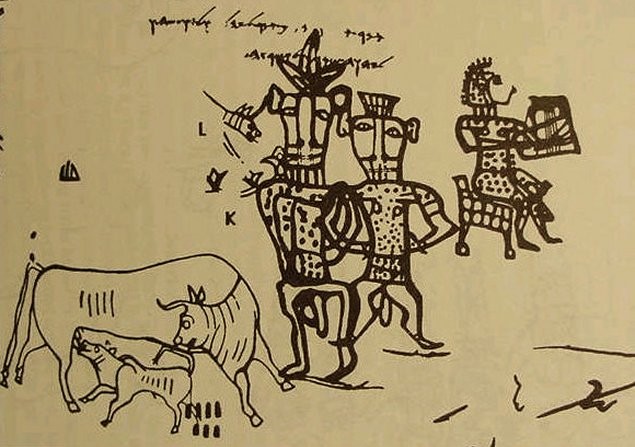
The Hindu-Buddhist influence on Christianity – Koenraad Elst

Jesus & Buddha

Christianity is not as original as it flatters itself to be. Just as it is now widely accepted that the Old Testament has profusely borrowed from older Mesopotamian and Egyptian sources, the New Testament has likewise borrowed some of its core imagery and defining beliefs from the ambient Hellenistic cosmopolitan culture and from the Indic teachings which had gained a certain popularity in the Eastern Mediterranean region. This implies that rather than being a direct gift from God, Christianity is simply a human construct, just as it already believes all other religions to be. Those who are inspired by Jesus’ example and teachings might do well to study their Saviour’s own sources of inspiration. – Dr. Koenraad Elst

Christianity was born in a region and age full of cross-pollination between different religions and philosophies. In particular, Indic traditions had been influencing the intellectual climate in the Eastern Mediterranean and among them, Buddhism made its mark most strongly on the scriptures and doctrines of the nascent religion named after Jesus Christ. Some of these borrowings are anecdotal and peripheral, others go to the heart of Christianity’s distinctive beliefs, e.g. the doctrine of Incarnation. The Christian doctrine of Salvation (in a non-worldly sense, as distinct from the Jewish belief in a political “salvation” amounting to the restoration of David’s kingdom by the Messiah) is borrowed in its essential features from Upanishadic-Buddhist notions of Liberation transformed in a devotional-theistic sense. It sets Christianity apart from the other members of the “Abrahamic” tradition. Indeed, a closer study of the Indic elements in Christianity reveals a dimension which cuts through the neat dichotomy between Abrahamic and Pagan religions.

1. Jesus in India?

In the 19th century, the Hindu reform movement Brahmo Samaj (1820) tried to protect the essence of Hinduism against the perceived threat from missionary Christianity by incorporating the latter’s most attractive elements and “recognizing” them as somehow part of Hinduism’s own tradition. In particular, monotheism, the notion of “the fatherhood of God and the brotherhood of man” and the rejection of idol-worship were borrowed from Protestant Christianity. The Brahmoists didn’t simply replace Hindu notions with Christian ones but rather reinterpreted Hinduism, e.g. they explained Hindu polytheism as a masked monotheism (“polymorphous theism”), taking support from the Vedic verse: “Indra, Agni, Varuna, the wise ones call the One True Being by many names”.

Another reform movement, the Arya Samaj (1875), followed suit: though it took a more polemical stand against the Christian missionaries than the Brahmos ever did, it professed monotheism and actively campaigned against idol worship. Next, the mixed Indian-European membership of the syncretistic Theosophical Society added more colourful ideas of Hindu-Buddhist-Christian interaction and mystical common denominators, e.g. by explaining the Christian notion of “the Kingdom of God” as referring to a blissful yogic state of consciousness. The Brahmo Samaj and the Theosophical Society, though numerically small, were very influential among the anglicized bourgeoisie, while the Arya Samaj exercised a strong influence on India’s national liberation movement and on Hindu nationalism. Though the strictures against idol-worship and participation in popular Hindu festivals gradually gave way to an accommodation with the Hindu mainstream, some doctrinal innovations persisted and started influencing the mainstream in turn. It should not come as a surprise, then, that numerous Hindus have interiorized certain Christian notions, most prominently a highly favourable prejudice regarding the person of Jesus Christ.

With hindsight, we can say that this partial incorporation of Christian elements was the most effective defence of Hinduism against the lure of Christian conversion campaigns under circumstances of Christian colonial dominance. Rather than confronting Christianity, this approach neutralized its appeal by understanding Jesus in Hindu terms, as a spiritual teacher, venerable yet only one among many, not as a unique saviour. By giving Jesus a place, it made the acceptance of the full doctrinal package of Christianity seem superfluous. Instead, modern Hindus including Mahatma Gandhi started evaluating all religions as roughly equivalent “paths” leading to the same goal. Most of them don’t realize that this idea is not welcomed but rather abhorred by orthodox Christians.

The incorporation of Jesus in Indian spiritual tradition was given a more concrete shape in the belief that Jesus learned his trade in India before going on an eventful preaching tour in Palestine whence he returned to stay and breathe his last in Kashmir at the ripe age of 115 (e.g. Kersten 1986). This claim of Jesus’s sojourn among Indian yogis is frequently heard among Hindus, Theosophists, some South Asian Muslims and even—since Indian spirituality is internationally often identified with its Buddhist variant—among Buddhists from Japan to California. In 1983, I attended a lecture by the Japanese Zen teacher Hogen-san, in which he held up a photograph of an ancient painting purportedly showing a meeting of the Buddha and Christ!

This story apparently originates with the Ahmadiyyas [following Notovitch], a Muslim sect founded in the later 19th century by Mirza Ghulam Ahmad . He claimed to be a prophet in defiance of the Islamic dogma that Mohammed was the final prophet. The belief that Jesus, a high-ranking prophet in Islam, had lived in India, was meant to buttress Ahmad’s claim that India, though far away from the West-Asian homeland of the Abrahamic religions, could nonetheless be the locus of a legitimate prophet’s mission. It is sometimes given additional support with the late-medieval theory that the Pathans, who live just to the west of Kashmir, are descendants of the lost tribes of Israel, which would explain how Jesus’ Jewish parents could send their son to distant relatives in north-western India for his education. Or how one eccentric theory can carry an even more eccentric one in its bosom.

Meanwhile, there have also been Christian overtures towards Hinduism, particularly in the “Christian ashram” movement. The idea was launched by a Bengali convert, Brahmabandhab Upadhyay (d. 1907), who was enough of a nationalist to insist on giving a Hindu colouring to his adopted Christian religion. He clashed with his superiors when he held a devotional ritual to goddess Saraswati and gave praise to Krishna and the Vedas. After independence, his inculturation experiments were revived by Catholic missionaries like Jules Monchanin (d. 1957), Henri Le Saux (d. 1973) en Bede Griffiths (d. 1999), who justified this move as a necessary strategy to speed up the disappointingly slow process of converting India.

In their “ashrams”, designed with temple-like architecture and ornamentation, they served vegetarian meals, wore homespun saffron robes and incorporated into their liturgy Vedic phrases such as: “Lead me from death to immortality”. Le Saux renamed himself Abhishiktananda, “bliss of the Anointed One [i.e. the Messiah]”, while Monchanin called his hermitage the Sacchidananda Ashram, “hermitage of Being-Consciousness-Bliss”: fortunately for them, Hindu religious vocabulary contained not only explicitly polytheistic and un-Christian god-names but also many abstract spiritual concepts which a Christian may use without overtly lapsing into heresy.

Om on Cross image used by Fr. Bede Griffiths

All the same, Indian Christians and especially recent converts rejected this “paganization of Christianity”. So do the guardians of orthodoxy, e.g. in his book Crossing the Threshold of Hope (1994), Pope John-Paul II denounced the trend among Christian monks and laymen to explore Eastern forms of meditation, and in 2000, his statement Dominus Jesus reaffirmed that salvation can only come through Jesus, not through other “paths”. Genuine Hindus aren’t too enthusiastic either. Thus, one of the favourite symbols of the Christian ashram movement was the Aum sign on a cross. The combination is absurd, at least if the cross is taken in its Christian sense as the symbol of suffering. Though Hinduism has a place for the notions of suffering and sin, the Aum sign by contrast represents the cosmic vibration and eternal bliss.

In this paper, we have no intention of arguing for this relatively recent tradition of Hindu-Christian syncretism or for the thesis of Jesus’ sojourn in India. Instead, we will explore the unsensational possibility of India-related influences on Christianity which can be explained through cultural tendencies present in the Eastern Mediterranean, in Jesus’ surroundings. We will survey indications that some elements in Judaism, in Jesus’s preachings and in mature Church doctrine can indeed be traced to the broader Indo-Iranian tradition through three of its layers and offshoots: (1) the basic Indo-European culture of which certain motifs were still palpable in the ambient Hellenistic culture; (2) Zarathustra’s Mazdeism, a (partly rebellious) offshoot of the Indo-Iranian religion, which influenced Judaism in the 6th-4th century BCE, and whose Romano-Hellenistic offshoot Mithraism influenced the nascent Christian doctrine; (3) ideas from missionary Buddhism and other Indian schools of thought which were in the air in the eastern Roman empire and influenced the Gospels, sometimes through the mediation of other Hellenistic philosophy schools. For our present purposes, a brief overview of these common or borrowed elements will suffice before we focus on their meaning and implications for the science of comparative religion.
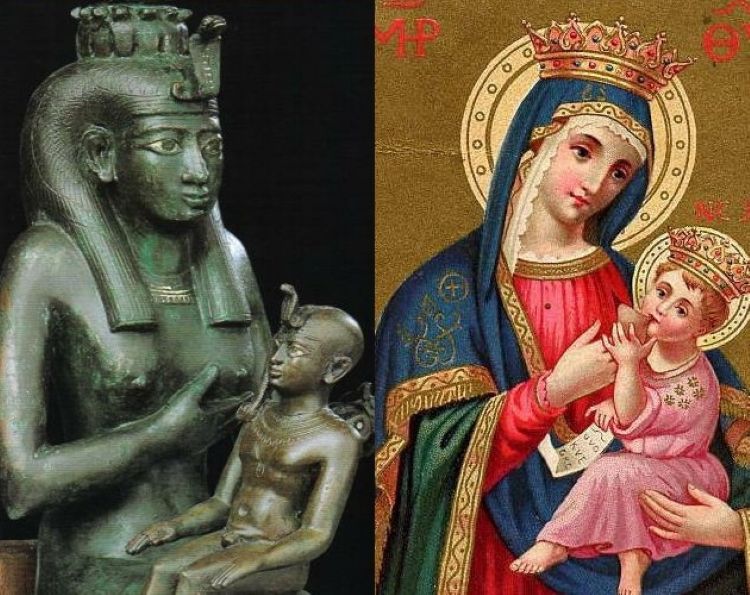
Isis & Horus - Mary & Jesus

2. More than inculturation

It is well-known that in its campaigns of conversion, Christianity followed a policy of inculturation. This means that it adopted Pagan elements in christianised form in order to ease the transition from Paganism to Christianity. To be sure, the reinterpretation of religious items long predates Christianity: Judaism turned an ancient spring festival into a day of remembrance of the exodus from Egypt (replacing universal nature with national history as its religious point of reference), Hindus turned an ancient harvest celebration into a commemoration of victorious Rama’s coronation (Diwali), and Buddhists turned May Day into a celebration of the Buddha’s birth or enlightenment (Wesak). But Christianity was the first to use this type of reinterpretation systematically as a strategy for conversion.

Pagan gods became Christian saints, e.g. Isis with the babe Horus became the Madonna with Child. The bearded and horse-borne Germanic god Wodan became Saint Nicolas, later americanized as Santa Claus. Even the Buddha found a place on the saints’ calendar under the name Saint Josaphat. The autumnal celebration of the dead became All Saints’ Day and All Souls’ Day, which is nowadays regaining its purely Pagan colours in the form of Hallowe’en. The date of Easter (from the Germanic dawn goddess Eostra/Ostarra) combines the Pagan symbolism of spring equinox and full moon with the Christian innovation of Sunday as the day of the Lord—an innovation which itself was borrowed from the solar cult of Mithraism, a late-Roman type of Masonic Lodge inspired by both Iranian Mazdaism and astrology. Winter solstice as its feast of the Invincible Sun became Christmas.

In fact, the whole cult of the year cycle in Mithraism (not unrelated to that of the Vedic year-cycle god Prajapati) deeply influenced the Christian liturgical calendar, so that Protestant fundamentalists would later protest quite accurately that most Church festivals including even Christmas are Pagan borrowings devoid of scriptural foundation. The ritual of the Eucharist, in which Christians are deemed to be drinking Christ’s blood (sacrilege to Jews), may also be of Mithraic origin.

A separate priesthood was created along with a standard liturgy, on the model of religious professionalism in the established Pagan religions or in the popular mystery cults. Concepts and terms from Greek philosophy were incorporated in Christian theology. Among the typically Christian innovations vis-à-vis Judaism, the notion of the Divine Trinity (rejected by Jews and Muslims as crypto-polytheistic) clearly bears the imprint of the Indo-European tripolar cosmology known as trifunctionality, well-attested in the ancient Roman religion. Churches arose where temples or sacred trees had stood, so that worshippers could keep on coming to their old places of worship and gradually get used to the Christian liturgy there.

In this process of inculturation, the Christian Church remained in control: it adapted old forms to its new message, but made sure that through the Pagan veneer the Christian doctrine was impressed upon the converts. However, the incorporation of Indic and particularly Buddhist elements which we will now discuss, has had a far deeper impact. It preceded the genesis of a discernible Christian religion and Church and determined some of their most central doctrines.

The Gospels contain a number of almost literal repetitions of phrases, parables and scenes from the Buddhist canon, particularly from the Mahaparinirvana Sutra: the master walking on water (and saying to the baffled disciples: “It’s me”), the simile of the blind leading the blind, the multiplication of the loaves of bread, the master asking and accepting water from a woman belonging to a despised community, the call not to pass judgment on others, the call to respond to hostility with love, and other overly well-known motifs. (Gruber & Kersten 1995, Derrett 2001) Both doctrinal elements and biographical anecdotes have been borrowed. The Buddha’s mother saw in a dream how a white elephant placed the promising boy in her womb while a heavenly being revealed the great news to the father, roughly like the annunciation to Mary and Joseph. The loose but devout woman Mary Magdalene is a neat copy of the Buddha-revering courtesan Amrapali. (Lindtner 2000) The iconography of Jesus resembles that of the expected future Buddha Maitreya, a name derived from maitri, “fellow-feeling, friendship”, close enough to the Christian notion of agape/charity. The Maitreya is depicted with lotus flowers in the places where Jesus has stigmata of the crucifixion.

This is becoming too much for coincidence, and the similarity is moreover strengthened by very specific details. Thus, Jesus relates how a widow offers two pennies from her humble possessions and thereby earns more merit than a wealthy man who gives a larger gift from his abundant riches. In Buddhist texts we find the same message in several variants, among them that of a widow offering two pennies; a holy monk disregards the larger gift of a wealthy man and praises the widow’s piety.

Not to make all this too idyllic, we can point out a less fashionable item which Christianity may have borrowed from Buddhism: the depreciation of woman as focus of lust and continuator of life in this vale of tears. We do not mean the belief in the inequality of man and woman, which is near-universal, even in fertility-promoting religions like Judaism, Vedic Brahmanism or Confucianism. While these cultures celebrate intercourse with woman and the harvest of her womb as a grand sacrament of life, Christianity and Buddhism tend to condemn life as tainted by sin and suffering, hence procreation and sexuality as sources of misery, and woman as an inauspicious temptress. Celibacy as the Buddhist monks’ way of life was foreign to both Greeks and Jews but was adopted and held up as ideal by Saint Paul and the Christian monks. Buddhism and Christianity allow sex and procreation to the outer circle of half-hearted followers (“better to marry than to burn”), but prefer total asceticism for the inner circle of true seekers.
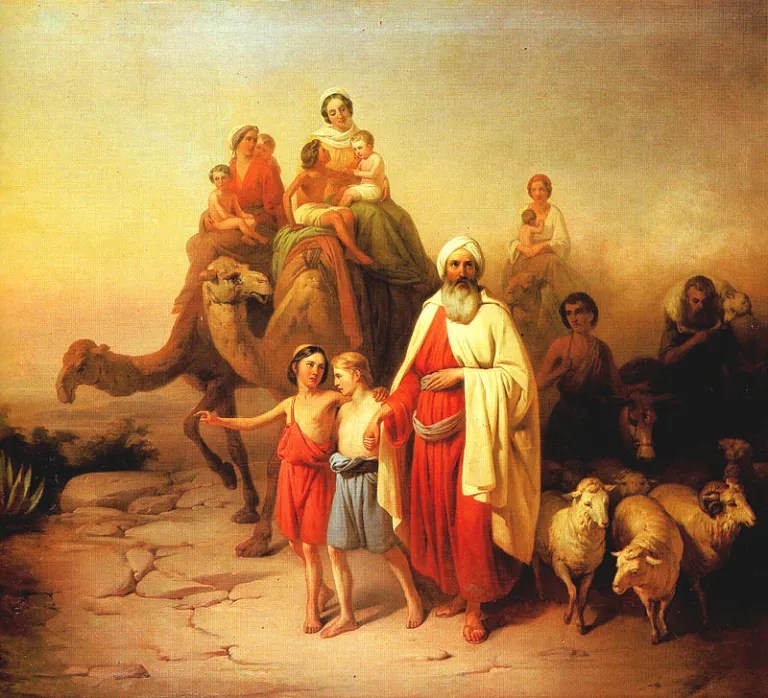
Abraham with sons Isaac and Ishmael.

3. Abrahamic versus Pagan

The gap between the Hindu-Buddhist tradition and Christianity is at first sight much deeper than that between Christianity and Judaism or Islam. Unlike the latter two, Indic religions have no common “Abrahamic” roots with Christianity. Hinduism in particular may count as par excellence the representative of the ancient hate object and scapegoat of the Abrahamic religions including Christianity: Paganism. Hostility towards Paganism is historically the first and defining commitment of the Abrahamic tradition. “Thou shalt have no other Gods”, or: “There is no God except Allah”, concretely meant to its original audiences: “Fight Paganism and its false Gods.”

As mentioned above, many modern Hindus have interiorized the Abrahamic strictures against polytheism and against the use of icons in worship. It is only in recent decades that the late Ram Swarup (1980, 1992) has taken up the defence of both polytheism and “idolatry”. He dismisses the numerical quarrel over one or many as silly and irrelevant to Hinduism, which acknowledges both the unity and the multiplicity of the Divine. Concerning idolatry, he points out that depictions of the Godhead are only visual aides to mental concentration on the Divine Person behind the image (as the Roman Catholic and Orthodox segments of the Abrahamic family have also argued). As even ordinary Hindus are heard arguing: does keeping a photograph of a loved one diminish or harm your love for him or her? Does destroying the photograph make the love more authentic? Ram Swarup also adds a spiritual critique: Christian (and mutatis mutandis, Islamic) exclusivism, which limits salvation to those who believe in Christ’s divinity and resurrection, betrays a lack of confidence in God’s omnipresence.

In contemporary forums for Jewish-Christian or Muslim-Christian dialogue, the “common Abrahamic roots” are eagerly highlighted. The religions concerned are said to have plenty in common, starting with their belief in One Creator and in His Self-Revelation through prophets. The dialogue delegates, and even the less dialogue-minded orthodox theologians, agree that certain basic doctrines set the Abrahamic religions collectively apart from all the other religions, collectively known as Paganism. While inter-religious dialogue is a recent fad, Christians have always made the distinction between the Abrahamic (viz. Muslim or Jewish) and the Pagan non-Christians, acknowledging in the former a far greater religious kinship with themselves than in the latter.

Along with Ram Swarup, many contemporary Hindus have interiorized this dichotomy between Abrahamic and Pagan religions, but this time to line up against the Abrahamic alternative, deemed narrow-minded and spiritually immature. While the disagreement about which doctrine is good and which is bad remains, there is now an agreement between these Hindu ideologues and their Abrahamic opponents about at least this fundamental division of the religious landscape in two opposing poles: the Pagan religions professed and practised by mankind since the Palaeolithic, and Abrahamic religions springing from God’s Self-revelation to selected human beings in West Asia in the last few millennia. And yet, this dichotomy may not be all that neat.

Yahweh / Jehovah

Firstly, it has often been pointed out that the crucial belief in monotheism may well have as one of its tributaries an evolute of the Indo-Iranian religion, hence a sister of the Vedic religion, viz. Iranian Mazdeism. In at least some layers of Mazdeic scripture, we find the rejection of the Indo-Iranian gods (daevas), who are turned into devils, in favour of the double-god Mitra-Varuna, extolled under the appellative name Ahura Mazda, “Lord Wisdom”. This seems to prefigure Mohammed’s rejection of most Arab gods in favour of a single one among them, Allah, and also to resemble Moses’s rejection of Semitic gods like Ba’al in favour of Yahweh alone. Given that the genesis of true monotheism in ancient Israel was a slow and complicated process, and given the occupation of West Asia by the Mazdeic Iranians in the 6th century BCE (where they explicitly helped to re-establish the Yahwist cult in the rebuilt temple of Jerusalem), it is not far-fetched to propose a Mazdeic influence on Israelite monotheism, though its outline remains vague.

However, if there was such a Mazdeic influence, it cannot be construed as an indirect influence from the Vedic upon the Israelite religion, for it concerns precisely that part of Mazdeism which originated in the break-away from and reaction against the Indo-Iranian polytheist mainstream as preserved in the Vedas. Likewise, others elements attributed to Mazdeic influence, such as the eschatology of physical resurrection, arrival of a redeemer and final judgment, definitely originate in later internal developments in Mazdeism unrelated (whether by conserving or rejecting) to the old Indo-Iranian core beliefs.

The second element interfering with the neat dichotomy between Pagan and Abrahamic looks more promising for our present study. We will be able to show that there are doctrinal similarities between the Christian and the Hindu-Buddhist traditions which set the former apart from the other Abrahamic religions, and the latter from the other Pagan religions. These similarities are certainly the fruit of historical contacts, though apart from the presence of a Buddhist community outside Alexandria (the Therapeutae), the details of the whereabouts of Buddhists in West Asia are as yet eluding us. We will consider the two most important common points of doctrine: Incarnation and Salvation.

4. Salvation

In the Upanishads, the youngest layer of Vedic literature, attention shifts from the ritual fire sacrifice to the interior of man’s consciousness. If we empty it of the sensory and mental contents which usually occupy it, we see in it our true nature, the Self. However, experiencing the mental silence in which the realization of the Self dawns is easier said than done. So, determined seekers made it their full-time occupation to pierce the veil of mental dross, to seek liberation from the web of ignorance, false identification and attachment. It is among this class of seekers that the Buddha emerged as the discoverer and teacher of the most successful and well-rounded method.

The goal of the Upanishadic and Buddhist yogis was “liberation” (mukti, moksha), or, in the Buddha’s more negative-sounding terminology, “blowing out” (nirvana). This is a double-negative concept: first a problem intrinsically affecting all people is defined (suffering, ignorance, attachment), then a method of eliminating the problem is devised and put into practice, ideally resulting in liberation. Exactly the same doctrinal structure forms the core of Christianity: all human beings are afflicted with original sin incurred by Adam and Eve, and now they stand in need of salvation, which the religion provides. This notion of a radical wrongness in the human condition and of a concomitant radical jump out of it and into the state of salvation does not exist in Judaism and Islam. Neither does it exist in most Pagan religions, such as the ancient Greek religion, Confucianism or Shinto, nor even, apparently, in the oldest Vedic layer of Hinduism.

How is liberation or salvation achieved? The original Hindu-Buddhist answer is: through right effort, viz. through a meditative practice which stills all mental distractions. However, this path of self-liberation is demanding and fails to deliver the immediate consolation ordinary people hope for. So, soon enough a devotional practice developed which attributed to the Buddha, or to Shiva or Krishna, the power to somehow “grant” liberation to his devotees. Hindu philosophers have distinguished between two approaches to liberation: the “way of the baby monkey”, which clings to its mother through its own effort, and the “way of the kitten”, which is picked up by its mother between her teeth. In practice, the way of the kitten is the most popular by far: people make the effort of putting themselves into a religious mood but expect the real breakthrough to salvation from a caring and interventionist divine person. Though most Hindus and Buddhists vaguely know of the fruits of meditation, few of them actually practise it, while most settle for devotional practices such as chanting and waving incense sticks before an idol of a divine or liberated Person.

It is at this devotional stage, which purists would evaluate as a degenerative stage, that Christianity has picked up the Hindu-Buddhist notion of salvation. Just like the Oriental devotee expects Shiva or the Amitabha Buddha or Guan Yin (Chinese Buddhist goddess) to save him, the Christian reveres Jesus Christ as the agent of his salvation. Though Christian mystics have tried to come closer to God through meditative techniques, Christianity as such has no technology of Salvation, unlike orthodox Buddhism. Official Christian doctrine confines the possibilities of salvation to the salvific intervention of God through his only-begotten son, Jesus Christ.
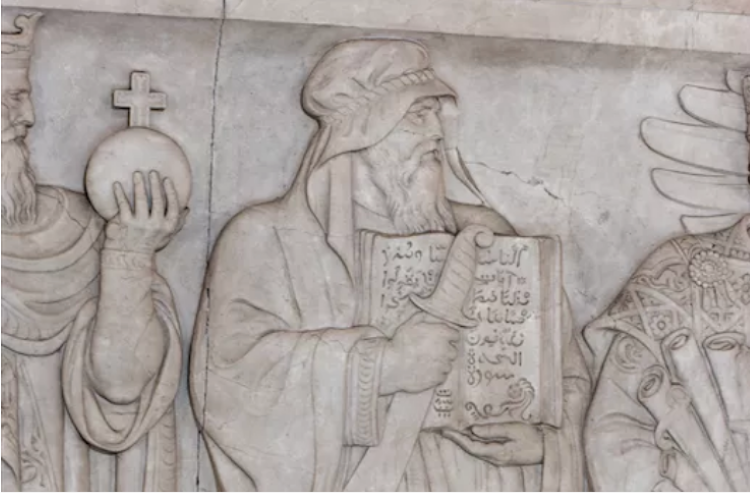
Prophet Muhammad as represented on the US Supreme Court.

5. Incarnation

Jews and Muslims have always denounced Christianity as an incomplete or downright false pretender to monotheism. They see the doctrine of the Trinity (Father, Son and Holy Spirit) as detracting from God’s unity and unicity. Leaving aside for now the Holy Spirit, it is mainly the Divine Person of the Son, God incarnate, which strict monotheists find theologically incorrect.

In Hellenistic society, people had a very fuzzy notion of “god” and didn’t mind describing remarkably spiritual people or purported miracle workers as “divine”. Ancient heroes such as Hercules were deified after their deaths in a process known as apotheosis, “transformation into a god”, and placed among the stars in the night sky. The Hindus posthumously deified their heroes Rama and Krishna by reinterpreting their lives as incarnations of Lord Vishnu. In Buddhism, the historical Buddha is gradually given the status of a divine incarnation, one in a series of enlightened beings descended on earth in order to bring liberation to all the suffering beings. Pagan Semitic cultures, e.g. in Ugarit, likewise gave a posthumous divine status to their revered kings by associating them with one of the gods, such as El or Ba’al. This process of association was called shirk, a term generalized by Mohammed to every “association” of lesser beings with the one God, Allah (“the god”). Muslims refer to all polytheists as mushrikin, “associators”, viz. of lesser beings with Allah.

In the opinion of the Muslims, the Jews and the Arian heretics of Christianity, the allotment of a divine status to Jesus Christ is not truly different from the procedure by which the Pagans gave divine status to their kings and saints, to stars and mountains, even to animal species (Egyptian cats, Hindu cows) and sculpted statues and trees, briefly to creatures instead of the Creator. They think, quite sensibly, that Christian belief detracts from monotheism by adopting as its most central dogma the highly Pagan notion that a creature, the son of a woman, could be God. On this point, Christianity is undeniably less akin to Judaism and Islam than to those sects of Hinduism and Buddhism which deify historic figures like Krishna and the Buddha.

6. Charity

Christianity’s number one selling point is its emphasis on the virtue of love (not to be misinterpreted as erotic love) or charity. Missionaries love to contrast universal Christian charity with Jewish ethnocentrism, Muslim or Marxist conflict-prone fanaticism, Hindu callous indifference to the suffering of anyone belonging to another caste, or Buddhism’s ethereal disinterest in any useful worldly work per se. However, this notion of universal fellow-feeling and its implementation in works of charity definitely predates Christianity.

Four centuries before Christ, the Chinese school of Mozi already preached jian’ai, “universal love”, and put it into practice in self-supporting communities (comparable to those established by the Epicureans in the Hellenistic world). These Mohists argued that one’s love should be distributed evenly over all fellow men, while their Confucian contemporaries contended that love should be differentiated in intensity: more love for close relatives, less for distant acquaintances, less still for unknown people. Yet, even the Confucians taught that some fellow feeling or “fellow humanity” (ren) should be extended to all mankind. Meanwhile in India, the Vedas and later the Buddha extolled fellow-feeling or compassion (daya c.q. karuna), not just towards one’s fellow men but towards all sentient beings.

It may be admitted that Christianity gave its own twist to charity. The activist streak of going out and opening orphanages or hospitals is less in evidence in Hinduism or Buddhism than in Christian settlements. Unlike Buddhist and Hindu monks, who are only expected to do their devotional or yogic duties, Christian monks of most orders are required to work. It may be conceded that Buddhist monks sometimes did take upon themselves certain charitable activities, notably in medicine, which is after all an application of the basic Buddhist vocation to relieve suffering. Among the duties of kings, Hindu scriptures include the care for the needy and the handicapped. Even so, there is just no denying that among religious personnel, Christian monks were and are encouraged far more systematically than any others to give a materially constructive expression to their sense of charity.

The reason for this difference, according to Hindus and Buddhists convinced of the superiority of their own tradition, is that Christian missionaries had to “sell” their doctrinal “product” by giving the extra bonus of material help, just like salesmen of inferior products try to make people buy them with the lure of extras. In this view, a convert to Buddhism opts for the Buddhist Way, while a convert to Christianity may take Christian beliefs in his stride while primarily seeking access to the Christian network of charity. A less polemical explanation would be that the wider family units in India could better provide for the needs of their own sick and needy members, hence requiring less help from “public” charities than the uprooted masses of the late Roman empire or the industrial-age West (note that Mother Teresa made her name in Kolkata among uprooted immigrants into the modern city, not in a traditional Hindu social setting). The reason may also be that Christianity simply happened to acquire its mature form in a pre-existing activist culture: first the Romans with their no-nonsense dynamism and their feats of engineering, later the Germanic peoples in their cold climate requiring daily labour and inventiveness for sheer survival, as contrasting with the Buddha’s Gangetic setting where the relative opulence of nature and the immense heat discourage physical exertion.

But the most fundamental reason why traditions originating in India lay less emphasis on material compassion and activist forms of charity, is simply that they pay more attention to what they perceive as a deeper human need. Clothing the naked and feeding the hungry is very fine, but as the Buddha knew from his own young days of luxury, even the well-fed and well-clad are subject to unhappiness and suffering. The highest compassion is therefore not the sharing of material things or emotional attention, but the imparting of the ethical and meditative methods leading to Nirvana.

In any case, the whole idea that man should care about his brother, that he should take responsibility for the welfare of society as a whole or for needy human beings in particular, clearly precedes Christianity. Like the Christian, though since centuries earlier, the Hindu or the Buddhist is his brother’s keeper, and is taught from childhood not to indulge in self-centred inanities and mindless self-indulgence, of course not to be confused with disciplined self-introspection. Caring for others may legitimately be called a Christian virtue, but it is not exclusively Christian and finds older models in at least Mohism, Confucianism, Hinduism and Buddhism, and no doubt in other pre-Christian teachings as well.
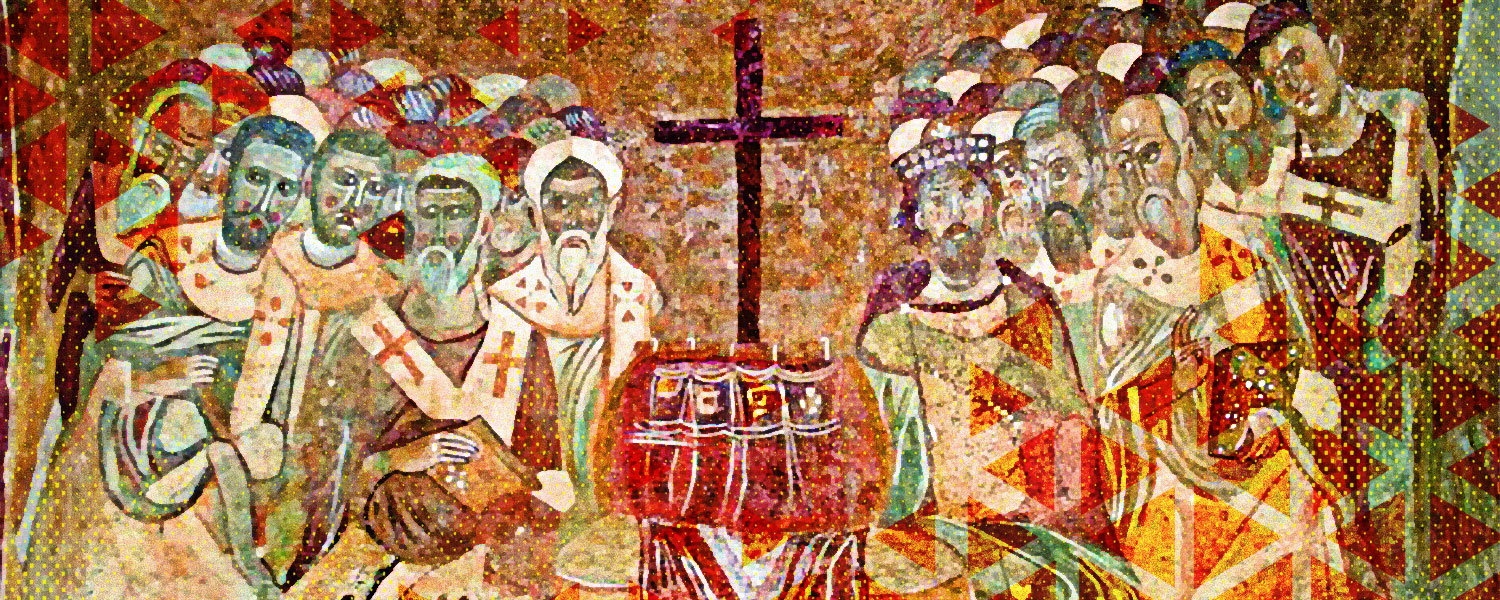
Council of Nicea

7. Conclusion

Christianity is not as original as it flatters itself to be. Just as it is now widely accepted that the Old Testament has profusely borrowed from older Mesopotamian and Egyptian sources, the New Testament has likewise borrowed some of its core imagery and defining beliefs from the ambient Hellenistic cosmopolitan culture and from the Indic teachings which had gained a certain popularity in the Eastern Mediterranean region. This implies that rather than being a direct gift from God, Christianity is simply a human construct, just as it already believes all other religions to be. Those who are inspired by Jesus’ example and teachings might do well to study their Saviour’s own sources of inspiration. – Acta Indica, 2019

Bibliography

  1. Abhishiktananda, Swami (Le Saux, Henri): Hindu-Christian Meeting-Point, Delhi 1976.
  2. Brockington, John: Hinduism and Christianity, MacMillan, London 1992.
  3. Dayananda Swaraswati, Swami (of Coimbatore), and Girndt, Helmut: A Vedantin’s View of Christian Concepts, Arsha Vidya Gurukulam, Saylorsburg PA 1998.
  4. Derrett, J. Duncan M.: The Bible and the Buddhists, Sardini, Bornato (Italy) 2001.
  5. Goel, Sita Ram: Papacy, Its Doctrine and History, Voice of India, Delhi 1986.
    – Catholic Ashrams, Sannyasins or Swindlers?, 2nd ed., Voice of India, Delhi 1994.
    – Jesus Christ, an Artifice for Aggression, Voice of India, Delhi 1994.
    – History of Hindu-Christian Encounters (AD 304 to 1996), 2nd ed., Voice of India, Delhi 1996.
  6. Griffiths, Bede: Christ in India, Bangalore 1986.
  7. Gruber, Elmar, en Kersten, Holger: The Original Jesus: The Buddhist Sources of Christianity. Element Books, Shaftesbury 1995 (München 1995).
  8. Kattackal, Jacob: Comparative Religion, St. Thomas Apostolic Seminary, Kottayam 1990.
  9. Kersten, Holger: Jesus Lived in India. His Unknown Life Before and After the Crucifixion, Element Books, Shaftesbury 1986 (Munich 1983).
  10. Kung, Hans, en Von Stietencron, Heinrich: Christendom en Wereldgodsdiensten, 2: Hindoeïsme, Gooi en Sticht, Hilversum 1987.
  11. Leeming, Joseph: Yoga en de Bijbel, Lulof, Almelo 1963.
  12. Lindtner, Christian: Amrapali in the Gospels, Adyar Library Bulletin 46, 2000.
  13. Majumdar, R.C.: The History and Culture of the Indian People, Bharatiya Vidya Bhavan, Bombay 1963 ff.
  14. Oddie, Geoffrey: Hindu and Christian in South-East Asia, SOAS, London 1991.
  15. Parrinder, Geoffrey: Avatar and Incarnation. A Comparison of Indian and Christian Beliefs, OUP, New York 1982.
  16. Prabhavananda, Swami: De Bergrede in het Licht van de Vedanta-Leer, De Driehoek, Amsterdam n.d.
  17. Rajaram, N.S.: Christianity’s Scramble for India and the Failure of the ‘Secularist’ Elite, Hindu Writers’ Forum, Delhi 1999.
  18. Secretariatus Pro Non-Christianis: Pour un Dialogue avec l’Hindouisme, Ancora, Milano n.d.
  19. Swarup, Ram: The Word as Revelation: Names of Gods, Impex India, Delhi 1980.
    – Hinduism vis-à-vis Christianity and Islam, 3rd ed., Voice of India, Delhi 1992.
    – Pope John Paul II on Eastern Religions and Yoga: A Hindu-Buddhist Rejoinder, Voice of India, Delhi 1995.

Dr. Koenraad Elst is an Orientalist (Indology & Sinology), linguist, historian and author.

Buddha and Jesus Cartoon

The historical roots of our ecological crisis – Lynn White

Lynn Townsend White Jr

Prof Lynn Townsend White was a historian of medieval Christianity who conjectured that Christian influence in the Middle Ages was the root cause of the ecological crisis in the 20th century. He gave a lecture on December 26, 1966, called “The Historical Roots of Our Ecological Crisis” at the Washington meeting of the American Association for the Advancement of Science, that was later published in the journal Science. White’s article was based on the premise that “all forms of life modify their context,” that is, we all create change in our environment. His ideas were considered by some to be a direct attack on Christianity and set off an extended debate about the role of religion in creating and sustaining the West’s destructive attitude towards—and exploitation of—the natural world. — Editor

The Historical Roots of Our Ecological Crisis

A conversation with Aldous Huxley not infrequently put one at the receiving end of an unforgettable monologue. About a year before his lamented death he was discoursing on a favorite topic: Man’s unnatural treatment of nature and its sad results. To illustrate his point he told how, during the previous summer, he had returned to a little valley in England where he had spent many happy months as a child. Once it had been composed of delightful grassy glades; now it was becoming overgrown with unsightly brush because the rabbits that formerly kept such growth under control had largely succumbed to a disease, myxomatosis, that was deliberately introduced by the local farmers to reduce the rabbits’ destruction of crops. Being something of a Philistine, I could be silent no longer, even in the interests of great rhetoric. I interrupted to point out that the rabbit itself had been brought as a domestic animal to England in 1176, presumably to improve the protein diet of the peasantry.

All forms of life modify their contexts. The most spectacular and benign instance is doubtless the coral polyp. By serving its own ends, it has created a vast undersea world favorable to thousands of other kinds of animals and plants. Ever since man became a numerous species he has affected his environment notably. The hypothesis that his fire-drive method of hunting created the world’s great grasslands and helped to exterminate the monster mammals of the Pleistocene from much of the globe is plausible, if not proved. For 6 millennia at least, the banks of the lower Nile have been a human artifact rather than the swampy African jungle which nature, apart from man, would have made it. The Aswan Dam, flooding 5000 square miles, is only the latest stage in a long process. In many regions terracing or irrigation, overgrazing, the cutting of forests by Romans to build ships to fight Carthaginians or by Crusaders to solve the logistics problems of their expeditions, have profoundly changed some ecologies. Observation that the French landscape falls into two basic types, the open fields of the north and the bocage of the south and west, inspired Marc Bloch to undertake his classic study of medieval agricultural methods. Quite unintentionally, changes in human ways often affect nonhuman nature. It has been noted, for example, that the advent of the automobile eliminated huge flocks of sparrows that once fed on the horse manure littering every street.

The history of ecologic change is still so rudimentary that we know little about what really happened, or what the results were. The extinction of the European aurochs as late as 1627 would seem to have been a simple case of overenthusiastic hunting. On more intricate matters it often is impossible to find solid information. For a thousand years or more the Frisians and Hollanders have been pushing back the North Sea, and the process is culminating in our own time in the reclamation of the Zuider Zee. What, if any, species of animals, birds, fish, shore life, or plants have died out in the process? In their epic combat with Neptune have the Netherlanders overlooked ecological values in such a way that the quality of human life in the Netherlands has suffered? I cannot discover that the questions have ever been asked, much less answered.

People, then, have often been a dynamic element in their own environment, but in the present state of historical scholarship we usually do not know exactly when, where, or with what effects man-induced changes came. As we enter the last third of the 20th century, however, concern for the problem of ecologic backlash is mounting feverishly. Natural science, conceived as the effort to understand the nature of things, had flourished in several eras and among several peoples. Similarly there had been an age-old accumulation of technological skills, sometimes growing rapidly, sometimes slowly. But it was not until about four generations ago that Western Europe and North America arranged a marriage between science and technology, a union of the theoretical and the empirical approaches to our natural environment. The emergence in widespread practice of the Baconian creed that scientific knowledge means technological power over nature can scarcely be dated before about 1850, save in the chemical industries, where it is anticipated in the 18th century. Its acceptance as a normal pattern of action may mark the greatest event in human history since the invention of agriculture, and perhaps in nonhuman terrestrial history as well.

Almost at once the new situation forced the crystallization of the novel concept of ecology; indeed, the word ecology first appeared in the English language in 1873. Today, less than a century later, the impact of our race upon the environment has so increased in force that it has changed in essence. When the first cannons were fired, in the early 14th century, they affected ecology by sending workers scrambling to the forests and mountains for more potash, sulphur, iron ore, and charcoal, with some resulting erosion and deforestation. Hydrogen bombs are of a different order: a war fought with them might alter the genetics of all life on this planet. By 1285 London had a smog problem arising from the burning of soft coal, but our present combustion of fossil fuels threatens to change the chemistry of the globe’s atmosphere as a whole, with consequences which we are only beginning to guess. With the population explosion, the carcinoma of planless urbanism, the now geological deposits of sewage and garbage, surely no creature other than man has ever managed to foul its nest in such short order.

There are many calls to action, but specific proposals, however worthy as individual items, seem too partial, palliative, negative: ban the bomb, tear down the billboards, give the Hindus contraceptives and tell them to eat their sacred cows. The simplest solution to any suspect change is, of course, to stop it, or better yet, to revert to a romanticized past: make those ugly gasoline stations look like Anne Hathaway’s cottage or (in the Far West) like ghost-town saloons. The “wilderness area” mentality invariably advocates deep-freezing an ecology, whether San Gimignano or the High Sierra, as it was before the first Kleenex was dropped. But neither atavism nor prettification will cope with the ecologic crisis of our time.

What shall we do? No one yet knows. Unless we think about fundamentals, our specific measures may produce new backlashes more serious than those they are designed to remedy.

As a beginning we should try to clarify our thinking by looking, in some historical depth, at the presuppositions that underlie modern technology and science. Science was traditionally aristocratic, speculative, intellectual in intent; technology was lower-class, empirical, action-oriented. The quite sudden fusion of these two, towards the middle of the 19th century, is surely related to the slightly prior and contemporary democratic revolutions which, by reducing social barriers, tended to assert a functional unity of brain and hand. Our ecologic crisis is the product of an emerging, entirely novel, democratic culture. The issue is whether a democratized world can survive its own implications. Presumably we cannot unless we rethink our axioms.

The Western Traditions of Technology and Science

One thing is so certain that it seems stupid to verbalize it: both modern technology and modern science are distinctively Occidental. Our technology has absorbed elements from all over the world, notably from China; yet everywhere today, whether in Japan or in Nigeria, successful technology is Western. Our science is the heir to all the sciences of the past, especially perhaps to the work of the great Islamic scientists of the Middle Ages, who so often outdid the ancient Greeks in skill and perspicacity: Al-Razi in medicine, for example; or Ibn-al-Haytham in optics; or Omar Khayyam in mathematics. Indeed, not a few works of such geniuses seem to have vanished in the original Arabic and to survive only in medieval Latin translations that helped to lay the foundations for later Western developments. Today, around the globe, all significant science is Western in style and method, whatever the pigmentation or language of the scientists.

A second pair of facts is less well recognized because they result from quite recent historical scholarship. The leadership of the West, both in technology and in science, is far older than the so-called Scientific Revolution of the 17th century or the so-called Industrial Revolution of the 18th century. These terms are in fact outmoded and obscure the true nature of what they try to describe—significant stages in two long and separate developments. By A.D. 1000 at the latest—and perhaps, feebly, as much as 200 years earlier—the West began to apply water power to industrial processes other than milling grain. This was followed in the late 12th century by the harnessing of wind power. From simple beginnings, but with remarkable consistency of style, the West rapidly expanded its skills in the development of power machinery, labor-saving devices, and automation. Those who doubt should contemplate that most monumental achievement in the history of automation: the weight-driven mechanical clock, which appeared in two forms in the early 14th century. Not in craftsmanship but in basic technological capacity, the Latin West of the later Middle Ages far outstripped its elaborate, sophisticated, and esthetically magnificent sister cultures, Byzantium and Islam. In 1444 a great Greek ecclesiastic, Bessarion, who had gone to Italy, wrote a letter to a prince in Greece. He is amazed by the superiority of Western ships, arms, textiles, glass. But above all he is astonished by the spectacle of waterwheels sawing timbers and pumping the bellows of blast furnaces. Clearly, he had seen nothing of the sort in the Near East.

By the end of the 15th century the technological superiority of Europe was such that its small, mutually hostile nations could spill out over all the rest of the world, conquering, looting, and colonizing. The symbol of this technological superiority is the fact that Portugal, one of the weakest states of the Occident, was able to become, and to remain for a century, mistress of the East Indies. And we must remember that the technology of Vasco da Gama and Albuquerque was built by pure empiricism, drawing remarkably little support or inspiration from science.

In the present-day vernacular understanding, modern science is supposed to have begun in 1543, when both Copernicus and Vesalius published their great works. It is no derogation of their accomplishments, however, to point out that such structures as the Fabrica and the De revolutionibus do not appear overnight. The distinctive Western tradition of science, in fact, began in the late 11th century with a massive movement of translation of Arabic and Greek scientific works into Latin. A few notable books—Theophrastus, for example—escaped the West’s avid new appetite for science, but within less than 200 years effectively the entire corpus of Greek and Muslim science was available in Latin, and was being eagerly read and criticized in the new European universities. Out of criticism arose new observation, speculation, and increasing distrust of ancient authorities. By the late 13th century Europe had seized global scientific leadership from the faltering hands of Islam. It would be as absurd to deny the profound originality of Newton, Galileo, or Copernicus as to deny that of the 14th century scholastic scientists like Buridan or Oresme on whose work they built. Before the 11th century, science scarcely existed in the Latin West, even in Roman times. From the 11th century onward, the scientific sector of Occidental culture has increased in a steady crescendo.

Since both our technological and our scientific movements got their start, acquired their character, and achieved world dominance in the Middle Ages, it would seem that we cannot understand their nature or their present impact upon ecology without examining fundamental medieval assumptions and developments.

Medieval View of Man and Nature

Until recently, agriculture has been the chief occupation even in “advanced” societies; hence, any change in methods of tillage has much importance. Early plows, drawn by two oxen, did not normally turn the sod but merely scratched it. Thus, cross- plowing was needed and fields tended to be squarish. In the fairly light soils and semiarid climates of the Near East and Mediterranean, this worked well. But such a plow was inappropriate to the wet climate and often sticky soils of northern Europe. By the latter part of the 7th century after Christ, however, following obscure beginnings, certain northern peasants were using an entirely new kind of plow, equipped with a vertical knife to cut the line of the furrow, a horizontal share to slice under the sod, and a moldboard to turn it over. The friction of this plow with the soil was so great that it normally required not two but eight oxen. It attacked the land with such violence that cross-plowing was not needed, and fields tended to be shaped in long strips.

In the days of the scratch-plow, fields were distributed generally in units capable of supporting a single family. Subsistence farming was the presupposition. But no peasant owned eight oxen: to use the new and more efficient plow, peasants pooled their oxen to form large plow-teams, originally receiving (it would appear) plowed strips in proportion to their contribution. Thus, distribution of land was based no longer on the needs of a family but, rather, on the capacity of a power machine to till the earth. Man’s relation to the soil was profoundly changed. Formerly man had been part of nature; now he was the exploiter of nature. Nowhere else in the world did farmers develop any analogous agricultural implement. Is it coincidence that modern technology, with its ruthlessness toward nature, has so largely been produced by descendants of these peasants of northern Europe?

This same exploitive attitude appears slightly before A.D. 830 in Western illustrated calendars. In older calendars the months were shown as passive personifications. The new Frankish calendars, which set the style for the Middle Ages, are very different: they show men coercing the world around them—plowing, harvesting, chopping trees, butchering pigs. Man and nature are two things, and man is master.

These novelties seem to be in harmony with larger intellectual patterns. What people do about their ecology depends on what they think about themselves in relation to things around them. Human ecology is deeply conditioned by beliefs about our nature and destiny—that is, by religion. To Western eyes this is very evident in, say, India or Ceylon. It is equally true of ourselves and of our medieval ancestors.

The victory of Christianity over Paganism was the greatest psychic revolution in the history of our culture. It has become fashionable today to say that, for better or worse, we live in the “post-Christian age.” Certainly the forms of our thinking and language have largely ceased to be Christian, but to my eye the substance often remains amazingly akin to that of the past. Our daily habits of action, for example, are dominated by an implicit faith in perpetual progress which was unknown either to Greco-Roman antiquity or to the Orient. It is rooted in, and is indefensible apart from, Judeo-Christian theology. The fact that Communists share it merely helps to show what can be demonstrated on many other grounds: that Marxism, like Islam, is a Judeo-Christian heresy. We continue today to live, as we have lived for about 1700 years, very largely in a context of Christian axioms.

What did Christianity tell people about their relations with the environment? While many of the world’s mythologies provide stories of creation, Greco-Roman mythology was singularly incoherent in this respect. Like Aristotle, the intellectuals of the ancient West denied that the visible world had a beginning. Indeed, the idea of a beginning was impossible in the framework of their cyclical notion of time. In sharp contrast, Christianity inherited from Judaism not only a concept of time as nonrepetitive and linear but also a striking story of creation. By gradual stages a loving and all- powerful God had created light and darkness, the heavenly bodies, the earth and all its plants, animals, birds, and fishes. Finally, God had created Adam and, as an afterthought, Eve to keep man from being lonely. Man named all the animals, thus establishing his dominance over them. God planned all of this explicitly for man’s benefit and rule: no item in the physical creation had any purpose save to serve man’s purposes. And, although man’s body is made of clay, he is not simply part of nature: he is made in God’s image.

Especially in its Western form, Christianity is the most anthropocentric religion the world has seen. As early as the 2nd century both Tertullian and Saint Irenaeus of Lyons were insisting that when God shaped Adam he was foreshadowing the image of the incarnate Christ, the Second Adam. Man shares, in great measure, God’s transcendence of nature. Christianity, in absolute contrast to ancient Paganism and Asia’s religions (except, perhaps, Zorastrianism), not only established a dualism of man and nature but also insisted that it is God’s will that man exploit nature for his proper ends.

At the level of the common people this worked out in an interesting way. In Antiquity every tree, every spring, every stream, every hill had its own genius loci, its guardian spirit. These spirits were accessible to men, but were very unlike men; centaurs, fauns, and mermaids show their ambivalence. Before one cut a tree, mined a mountain, or dammed a brook, it was important to placate the spirit in charge of that particular situation, and to keep it placated. By destroying Pagan animism, Christianity made it possible to exploit nature in a mood of indifference to the feelings of natural objects.

It is often said that for animism the Church substituted the cult of saints. True; but the cult of saints is functionally quite different from animism. The saint is not in natural objects; he may have special shrines, but his citizenship is in heaven. Moreover, a saint is entirely a man; he can be approached in human terms. In addition to saints, Christianity of course also had angels and demons inherited from Judaism and perhaps, at one remove, from Zoroastrianism. But these were all as mobile as the saints themselves. The spirits in natural objects, which formerly had protected nature from man, evaporated. Man’s effective monopoly on spirit in this world was confirmed, and the old inhibitions to the exploitation of nature crumbled.

When one speaks in such sweeping terms, a note of caution is in order. Christianity is a complex faith, and its consequences differ in differing contexts. What I have said may well apply to the medieval West, where in fact technology made spectacular advances. But the Greek East, a highly civilized realm of equal Christian devotion, seems to have produced no marked technological innovation after the late 7th century, when Greek fire was invented. The key to the contrast may perhaps be found in a difference in the tonality of piety and thought which students of comparative theology find between the Greek and the Latin Churches. The Greeks believed that sin was intellectual blindness, and that salvation was found in illumination, orthodoxy—that is, clear thinking. The Latins, on the other hand, felt that sin was moral evil, and that salvation was to be found in right conduct. Eastern theology has been intellectualist. Western theology has been voluntarist. The Greek saint contemplates; the Western saint acts. The implications of Christianity for the conquest of nature would emerge more easily in the Western atmosphere.

The Christian dogma of creation, which is found in the first clause of all the Creeds, has another meaning for our comprehension of today’s ecologic crisis. By revelation, God had given man the Bible, the Book of Scripture. But since God had made nature, nature also must reveal the divine mentality. The religious study of nature for the better understanding of God was known as natural theology. In the early Church, and always in the Greek East, nature was conceived primarily as a symbolic system through which God speaks to men: the ant is a sermon to sluggards; rising flames are the symbol of the soul’s aspiration. The view of nature was essentially artistic rather than scientific. While Byzantium preserved and copied great numbers of ancient Greek scientific texts, science as we conceive it could scarcely flourish in such an ambience.

However, in the Latin West by the early 13th century natural theology was following a very different bent. It was ceasing to be the decoding of the physical symbols of God’s communication with man and was becoming the effort to understand God’s mind by discovering how his creation operates. The rainbow was no longer simply a symbol of hope first sent to Noah after the Deluge: Robert Grosseteste, Friar Roger Bacon, and Theodoric of Freiberg produced startlingly sophisticated work on the optics of the rainbow, but they did it as a venture in religious understanding. From the 13th century onward, up to and including Leitnitz and Newton, every major scientist, in effect, explained his motivations in religious terms. Indeed, if Galileo had not been so expert an amateur theologian he would have got into far less trouble: the professionals resented his intrusion. And Newton seems to have regarded himself more as a theologian than as a scientist. It was not until the late 18th century that the hypothesis of God became unnecessary to many scientists.

It is often hard for the historian to judge, when men explain why they are doing what they want to do, whether they are offering real reasons or merely culturally acceptable reasons. The consistency with which scientists during the long formative centuries of Western science said that the task and the reward of the scientist was “to think God’s thoughts after him” leads one to believe that this was their real motivation. If so, then modern Western science was cast in a matrix of Christian theology. The dynamism of religious devotion shaped by the Judeo-Christian dogma of creation, gave it impetus.

An Alternative Christian View

We would seem to be headed toward conclusions unpalatable to many Christians. Since both science and technology are blessed words in our contemporary vocabulary, some may be happy at the notions, first, that viewed historically, modern science is an extrapolation of natural theology and, second, that modern technology is at least partly to be explained as an Occidental, voluntarist realization of the Christian dogma of man’s transcendence of, and rightful master over, nature. But, as we now recognize, somewhat over a century ago science and technology—hitherto quite separate activities—joined to give mankind powers which, to judge by many of the ecologic effects, are out of control. If so, Christianity bears a huge burden of guilt.

I personally doubt that disastrous ecologic backlash can be avoided simply by applying to our problems more science and more technology. Our science and technology have grown out of Christian attitudes toward man’s relation to nature which are almost universally held not only by Christians and neo-Christians but also by those who fondly regard themselves as post-Christians. Despite Copernicus, all the cosmos rotates around our little globe. Despite Darwin, we are not, in our hearts, part of the natural process. We are superior to nature, contemptuous of it, willing to use it for our slightest whim. The newly elected Governor of California, like myself a churchman but less troubled than I, spoke for the Christian tradition when he said (as is alleged), “when you’ve seen one redwood tree, you’ve seen them all.” To a Christian a tree can be no more than a physical fact. The whole concept of the sacred grove is alien to Christianity and to the ethos of the West. For nearly two millennia Christian missionaries have been chopping down sacred groves, which are idolatrous because they assume spirit in nature.

What we do about ecology depends on our ideas of the man-nature relationship. More science and more technology are not going to get us out of the present ecologic crisis until we find a new religion, or rethink our old one. The beatniks, who are the basic revolutionaries of our time, show a sound instinct in their affinity for Zen Buddhism, which conceives of the man-nature relationship as very nearly the mirror image of the Christian view. Zen, however, is as deeply conditioned by Asian history as Christianity is by the experience of the West, and I am dubious of its viability among us.

Possibly we should ponder the greatest radical in Christian history since Christ: Saint Francis of Assisi. The prime miracle of Saint Francis is the fact that he did not end at the stake, as many of his left-wing followers did. He was so clearly heretical that a General of the Franciscan Order, Saint Bonaventura, a great and perceptive Christian, tried to suppress the early accounts of Franciscanism. The key to an understanding of Francis is his belief in the virtue of humility—not merely for the individual but for man as a species. Francis tried to depose man from his monarchy over creation and set up a democracy of all God’s creatures. With him the ant is no longer simply a homily for the lazy, flames a sign of the thrust of the soul toward union with God; now they are Brother Ant and Sister Fire, praising the Creator in their own ways as Brother Man does in his.

Later commentators have said that Francis preached to the birds as a rebuke to men who would not listen. The records do not read so: he urged the little birds to praise God, and in spiritual ecstasy they flapped their wings and chirped rejoicing. Legends of saints, especially the Irish saints, had long told of their dealings with animals but always, I believe, to show their human dominance over creatures. With Francis it is different. The land around Gubbio in the Apennines was ravaged by a fierce wolf. Saint Francis, says the legend, talked to the wolf and persuaded him of the error of his ways. The wolf repented, died in the odor of sanctity, and was buried in consecrated ground.

What Sir Steven Runciman calls “the Franciscan doctrine of the animal soul” was quickly stamped out. Quite possibly it was in part inspired, consciously or unconsciously, by the belief in reincarnation held by the Cathar heretics who at that time teemed in Italy and  southern France, and who presumably had got it originally from India. It is significant that at just the same moment, about 1200, traces of metempsychosis are found also in western Judaism, in the Provencal Cabbala. But Francis held neither to transmigration of souls nor to pantheism. His view of nature and of man rested on a unique sort of panpsychism of all things animate and inanimate, designed for the glorification of their transcendent Creator, who, in the ultimate gesture of cosmic humility, assumed flesh, lay helpless in a manger, and hung dying on a scaffold.

I am not suggesting that many contemporary Americans who are concerned about our ecologic crisis will be either able or willing to counsel with wolves or exhort birds. However, the present increasing disruption of the global environment is the product of a dynamic technology and science which were originating in the Western medieval world against which Saint Francis was rebelling in so original a way. Their growth cannot be understood historically apart from distinctive attitudes toward nature which are deeply grounded in Christian dogma. The fact that most people do not think of these attitudes as Christian is irrelevant. No new set of basic values has been accepted in our society to displace those of Christianity. Hence we shall continue to have a worsening ecologic  crisis until we reject the Christian axiom that nature has no reason for existence save to serve man.

The greatest spiritual revolutionary in Western history, Saint Francis, proposed what he thought was an alternative Christian view of nature and man’s relation to it; he tried to substitute the idea of the equality of all creatures, including man, for the idea of man’s limitless rule of creation. He failed. Both our present science and our present technology are so tinctured with orthodox Christian arrogance toward nature that no solution for our ecologic crisis can be expected from them alone. Since the roots of our trouble are so largely religious, the remedy must also be essentially religious, whether we call it that or not. We must rethink and refeel our nature and destiny. The profoundly religious, but heretical, sense of the primitive Franciscans for the spiritual autonomy of all parts of nature may point a direction. I propose Francis as a patron saint for ecologists. —  Science Magazine, 1967

» Download the essay here (pdf)

» Prof Lynn Townsend White, Jr. (April 29, 1907–March 30, 1987) was a professor of medieval Christian history at Princeton and Stanford universities. He was the son of a Calvinist professor of Christian Ethics and had himself earned a master’s degree at Union Theological Seminary. 

Lynn Townsend White


Theology of monotheism is disguised materialism – Sita Ram Goel

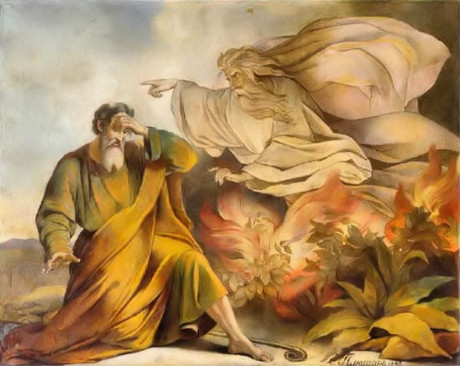
Moses & Jehovah

One may spend a lifetime searching this theology of Monotheism for a factual or rational proof of what it proclaims so pompously. But the search will be in vain. For, all the time it assumes what it wants to prove, and proves what it has already assumed. At its best, it is a syllogism of which the major as well as the minor premise are arbitrary assertions. – Sita Ram Goel

Let us for the time being forget the Freudian analysis of Christianity and Islam, though that analysis provides an intimate peep into the psyche of these primitive creeds. Let us have a look at the philosophy underlying their doctrines, and find out if they have any share in the spiritual seeking which is intrinsic to human beings and which stands systematized in Sanatana Dharma.

Christianity and Islam differ on many points of detail. But they share a common view of what they invoke as the creator and controller of the cosmos, as well as of the cosmic process. In the language of theology, they describe their basic dogma as Monotheism as opposed to what they denounce as Polytheism and Pantheism. It is this basic dogma which needs a philosophical probe deeper than that to which it has been subjected so far.

The term Monotheism casts such a magic spell on certain minds that they stop at its literal meaning—the concept of one God as opposed to many Gods. But the literal meaning tells us little, almost nothing, about its theological inspiration or its practical implications.

In the theology of Monotheism, God is extra-cosmic. He created the cosmos out of Nothing in order to demonstrate his almightiness and, consequently, kept himself outside and above the Cosmos. There is nothing in God’s creation which can partake of God’s divinity. The elements and forces of Nature are devoid of any divinity whatsoever. The sky is empty space, and the Sun and the Moon and the Stars are only bright spots in that sky. Matter is absolutely material, and animals and birds are mere brutes unless they are domesticated when they show some improvement. Trees are timber, and the flowers embody no more than colour and fragrance. Air and water and fire and earth are what they are, and point to nothing beyond.

It is only man who is placed on a higher pedestal because the Almighty God blew his own breath into the handful of dust which he used in order to manufacture Adam, the male ancestor of the human race. Woman cannot share man’s status because Eve, the female ancestor of the human race, was carved out of Adam’s rib without the benefit of God’s breath being blown into it. Man is thus the best of God’s creation, the ashraf-ul-makhlûqãt.

But it is an unpardonable folly and a cardinal sin for man to fancy that he shares even an iota of God’s divinity. The only privilege which man enjoys as God’s best creation is to lord it over the lower creation which God has made for man’s use and benefit. Man can exploit the material resources of the earth in whatever way he pleases. Man can eat every bird and fish and animal for God has created them specifically for man’s consumption. And man can marry and divorce and keep as his concubines any number of women, at any stage of his three score and ten years. (The monogamy we find in Christianity is not prescribed by the Christian scripture. It was an institution which it borrowed from the pagan Romans.)

As man is likely to be carried away by the freedom of will which has been bestowed on him, and forget his creator, God has been sending prophets from time to time to restrain him from worship of false gods and philosophical speculation, and to turn his thoughts towards a higher purpose—obedience to God’s will as revealed through the prophets. The complete code of such do’s and don’ts has been conveyed by God in his final revelation—the New Testament according to Christianity and the Quran according to Islam—through his only son who is Jesus for Christianity or the last prophet who is Muhammad for Islam.

The supreme purpose of man’s life is to worship this extra-cosmic God with whom man cannot communicate directly, lead a life of piety according to rules laid down in the final revelation which man cannot question, and seek the intercession of the only son or the last prophet whose claims man cannot scrutinize in terms of his natural reason or normal moral sense. If man can thus bid good-bye to his critical faculty and conscience, “the seats of the Satan”, he can hope for an eternal heaven at the end of the only life God has granted to him. But if man wavers, or questions, or criticizes, or tries to understand, or judge these mysteries by using his own mind or moral sense, he becomes bound for an eternal hell from which there is no escape, and where the torment turns worse and worse with the ticking of every moment.

Whether all this applies to woman as well has been a point of dispute among Christian and Muslim theologians. Nevertheless, this much is clear that Islam at least assigns the same role to woman in heaven as she is expected to play on this earth—to serve man in servile obedience and to provide sexual pleasure to her male master. The only concession extended to woman after she enters heaven is to be spared the pains of maternity and old age. She becomes a houri endowed with eternal youth and unfading beauty. In Christianity, woman is essentially a temptress who leads man to hell. Her role in the hereafter has not been clearly defined.

An added duty of all true believers is to band together in a Church or an Ummah for propagating the only true religion, and to prop up the only son or the last prophet by all means including force and fraud. The fraternity thus formed is expected to invite all unbelievers to get converted to the only true creed, and to declare a crusade or jihãd against all those who refuse to be persuaded peacefully for saving themselves from eternal perdition and for securing an eternal heaven. The Church is expected to secure the aid of its secular arm, and the Ummah is expected to convert itself into a theocratic state in order to carry forward the struggle.

There is no limit to what these holy wars can legitimately do to the unbelievers except the limit imposed by power equations at any time. The least that the wars should do at the first available opportunity is to destroy the false Gods of the unbelievers, and the unholy temples where those Gods are worshipped. The holy warriors are under no obligation at all to prove that they are better human beings as compared to those they are expected to convert, or kill, or enslave, or subjugate. Their only qualification is that they believe in the only son or the last prophet, and follow the only true religion.

Monotheism is disguised materialism

One may spend a lifetime searching this theology of Monotheism for a factual or rational proof of what it proclaims so pompously. But the search will be in vain. For, all the time it assumes what it wants to prove, and proves what it has already assumed. At its best, it is a syllogism of which the major as well as the minor premise are arbitrary assertions.

Is there a proof that a being called Almighty God exists, and controls the cosmos? The answer is that the only son or the last prophet has said so. Who has sent this son or appointed this prophet to tell us about God and his doings? The answer is that it is God who has proclaimed the son or the prophet. What is the proof that what the son or the prophet pronounces as a divine revelation comes from God? The answer is that the revelation says so. And so on, it is an endless exercise in casuistry with no reference to human experience or human reason at any point.

In the last analysis, God is really a superfluity in this system of thought. A time comes when God imparts his final revelation to the only son or the last prophet, and retires to a well-deserved rest after entrusting the fate of his world as well as of his creatures to the keeping of the son or the prophet. In due course, the son or the prophet also is dead and gone after bequeathing his monopoly over truth and virtue to the Church or the Ummah. The Church or the Ummah, in turn, is dominated by a single man or a clique that can control and use a mighty military machine which has been built in the meanwhile. In the final round, it all ends up as imperialist aggression against other people in which a veneer of religious verbiage is retained in order to sustain the self-righteousness of the aggressor. The idols of the conquered people are destroyed and their temples pillaged, not because their Gods have been found to be false but because an imperialist always aims at destroying the self-respect of a people upon whom he wants to secure a stranglehold. It is in the nature of imperialism to indulge in cultural genocide on the slightest pretext, or at the first favourable opportunity.

The plight of the Allah of Islam is portrayed by Shykh Muhammad Iqbal when he puts the following question to Allah in his Shikwã: “Tujhko ma’lûm hai letã thã kuî nãm tirã / Quwwat-i-bãzû-i-muslim nê kiyã kãm tirã (Do you know of anyone who bothered about you before we came forward? It was the muscle-power of the Muslim which came to your rescue).” The God of the Bible is in no better position. He has been held aloft all along by Christian bayonets or Christian bags of money.

History is witness that Christianity as well as Islam have always expanded by the power of the sword, and seldom by power of any truth contained in their scriptures. In the words of Iqbal again, “Par tire nãm pê talwãr uThãî kisnê? Kãt kar rakh diyê kuffãr kê lashkar kisnê (But who did draw their swords in defence of your name and fame? Who was it that slaughtered the armies of the infidels for your sake?).” It is obvious that the Allah of Islam had to be thrust down people’s throats at the point of the sword. Otherwise poor Allah was a non-existent entity which no one was prepared to affirm. The same can be said of the Jehovah of Christianity, though no Christian poet has had the honesty of Iqbal to come out with the naked truth in a frank and forthright manner.

It is small wonder, therefore, that this politics of power masquerading as religion, cannot understand the language of spirituality which speaks in terms of a Divinity secret in everything, everywhere, and which enables human beings to dwell constantly in the company of Gods and Goddesses. This politics is too busy amassing wealth and power and pleasures of a material world to care for things which belong to the realm of Spirit.

Pained by the poverty of Muslims and the decay of the power of Islam, Iqbal has lamented: “Qahar tõ yêh hai ke kãfir ko milê hûr-o-qusûr / Aur bechãrê musalmãñ kõ faqat wa’da-i hûr (The terrible tragedy is that the infidels live in palaces and make love to houris in this life, while the poor Muslim has to remain content only with the promise of houris hereafter).” This is the highest aspiration to which this venerable Allamah of Islam could ever attain. It speaks volumes about Islam as a religion. Christianity too aspires towards no goal higher than this. Only its spokesmen are not so crude (or honest) in putting forward its case.

Hindu society has not only to recover the source of its own psyche which speaks in the language of Gods and Goddesses, it has also to realize that the psyche of Christianity and Islam hides vulgar materialism and imperialist ambition under a welter of high-sounding verbiage. – Excerpted from Defence of Hindu Society, New Delhi, 19??

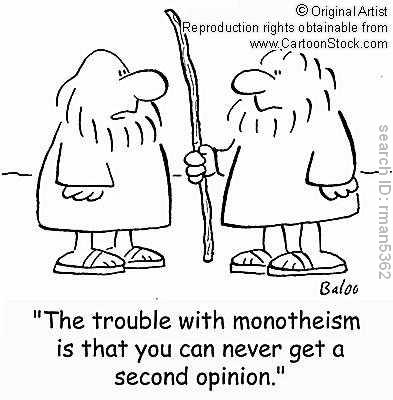
Monotheism : No second opinion!

About the ungodlike Abrahamic god – Michel Danino

Yahweh / Jehovah / Allah

I find it highly symbolic that Judaism should have been born in blood and fear, not out of love for its founding deity. It was a radical, unprecedented departure from the ancient world cultures. Naturally, it did not stop there and went on to find more fertile soils in Christianity and Islam. – Prof Michel Danino

Our first task … is to examine the Abrahamic concept of God at the root of the three monotheistic religions: Yahweh (later Jehovah) or Allah. I do not refer here to more ancient Greek, Norse or Celtic gods since, as we know, they lost the war against God with a capital “G”. (Some of them are now striving to revive, but even if they partly succeed, they will be little more than pale replicas of their original selves.)

The first thing that strikes the discerning Indian reader of the Old Testament, especially the Exodus, in which Jehovah first introduces himself to Moses under that name, is his ungodlike character. Jehovah is admittedly jealous: the second of the Ten Commandments reads, “You shall have no other gods before me,” while the third explicitly forbids the making and worship of any idols, “for I am a jealous God, punishing the children for the sin of the fathers”. Jehovah does speak as often of punishment as he does of sin, and periodically goes into a state of “fierce anger”, promising the most complete devastation of the Hebrews who reject him. Not content with cursing his reluctant followers, he also curses nation after nation, and finally the earth itself, which, as I pointed out earlier, he holds responsible for man’s sins: “The day of the Lord is coming—a cruel day, with wrath and fierce anger—to make the land desolate and destroy the sinners within it”. (Isaiah, 13:9). In fact, he is so obsessed with sin that one looks in vain in his oppressive berating and legislating for any hint of a higher spirituality, such as we find in the Upanishads or the Gita. Contrast his jealousy with Krishna’s insistence on spiritual freedom: “Whatever form of me any devotee with faith desires to worship, I make that faith of his firm and undeviating” (Gita, 7.21), or again: “Others … worship me in my oneness and in every separate being and in all my million universal faces” (9:15). But the god of the Bible and the Koran will have none of this catholicity.

If Jehovah had stopped there we might have found him to be simply a foul-tempered and libidinous god; after all, some Puranic gods too have such defects, although they usually retain a sense of their limits and compassion of which Jehovah is spotlessly guiltless. But he has a plan, he means business and knows that coercion alone can establish his rule: when the Hebrews over whom he is so keen to hold sway go back to their former worship of a “golden calf”, he orders through Moses that each of the faithful should “kill his brother and friend and neighbour” (Exodus 32:37). Instructions which were promptly complied with, for we are informed that 3,000 were killed on that fateful day; to crown his punishment, Jehovah “struck the people with a plague.”

Sri AurobindoI find it highly symbolic that Judaism should have been born in blood and fear, not out of love for its founding deity. As Sri Aurobindo put it, “The Jew invented the God-fearing man; India the God-knower and God-lover.” It probably took centuries for the old cults to disappear altogether, and a stream of prophets who sought to strike terror into the hearts of the Israelites. It was a radical, unprecedented departure from the ancient world cultures. Naturally, it did not stop there and went on to find more fertile soils in Christianity and Islam: earlier, Jehovah was content with being the god of the Hebrews alone; now, reborn in the new creeds, his ambition extended to the whole earth.

Increasingly aware of this cruel, irritable, egocentric and exclusivist character of Jehovah, many Western thinkers, specially from the eighteenth century onwards, rejected his claim to be the supreme and only god. Voltaire, one of the first to expose the countless inconsistencies in the Bible, could hardly disguise how it filled him with “horror and indignation at every page”. In particular, he found the plethora of laws dictated by Jehovah “barbaric and ridiculous”. The U.S. revolutionary leader and thinker Thomas Paine wrote of the Old Testament in his Age of Reason:

Whenever we read the obscene stories, the voluptuous debaucheries, the cruel and torturous executions, the unrelenting vindictiveness with which more than half the Bible is filled, it would be more consistent that we called it the word of a demon that the word of God. It is a history of wickedness, that has served  to corrupt and brutalise mankind; and, for my own part, I sincerely detest it, as I detest everything that is cruel.

Because a few intellectuals had the courage to state the obvious, the power of Christianity was greatly reduced in the West. Yet I have always marvelled that Indians should learn about Christianity neither from those bold Western thinkers nor from their own inquiry, but from bigots who continue to pretend that the Age of Enlightenment never happened. With the growth of materialistic science, in particular Darwinian evolution, such views which were revolutionary at the time of Voltaire, became widespread. Bernard Shaw, for example, described the Bible god as “a thundering, earth quaking, famine striking, pestilence launching, blinding, deafening, killing, destructively omnipotent Bogey Man.” Elizabeth Cady Stanton, the courageous U.S. pioneer of woman rights movement, wrote in 1898, “Surely the writers [of the Old Testament] had a very low idea of the nature of their God. They make Him not only anthropomorphic, but of the very lowest type, jealous and revengeful, loving violence rather than mercy. I know of no other books which so fully teach the subjection and degradation of woman.”  Mark Twain put it in his own way: “Our Bible reveals to us the character of our god with minute and remorseless exactness. The portrait is substantially that of a man—if one can imagine a man charged and overcharged with evil impulses far beyond the human limit…. It is perhaps the most damnatory biography that exists in print anywhere. It makes Nero an angel of light and leading by contrast.”  On another occasion he added, “It ain’t the parts of the Bible that I can’t understand that bother me, it is the parts that I do understand.” Freud, seeing in Jehovah an all too human creation, subjected him to psychoanalysis—a dream of a subject for a psychoanalyst. Aldous Huxley called the Old Testament “a treasure trove of barbarous stupidity [full of] justifications for every crime and folly.” In fact,  Huxley traced the “wholesale massacres” perpetrated by Christianity to Jehovah’s “wrathful, jealous, vindictive character, just as he attributed “the wholesale slaughter” of Buddhists and Hindus by invading Muslims to their devotion for a “despotic person”. Albert Einstein said, “I cannot imagine a God who rewards and punishes the objects of his creation, whose purposes are modelled after our own—a God, in short, who is but a reflection of human frailty.”

But is that all there is to the Abrahamic god? Are we simply faced with a man-made demon or the product of some fevered brain?  If you look at Jehovah in the light of Indian experience, it is striking that he has all the characteristic of an asura. Recall for a moment a being such as Hiranyakashipu: did he not, too, forbid all other cults? Did he not order that he alone should be worshipped as the supreme god? Did he not use fear and violence to try and coerce Prahlada? That he was stopped by a Divine manifestation, like many other asuras eager to possess this world, is another story; the point is that we find here the same seed of pride and cruelty as in Jehovah.

Now, to pinpoint Jehovah’s identity we must remember that he himself explains how “Yahweh” is a new name to the Hebrews: “By that name I did not make myself known to them” (Exodus 3:14 – 15, 6:3). But in the Old Testament Jehovah does not reveal his earlier name; it is only the early Christian Gnostic tradition, which was brutally suppressed by the growing orthodox school, that provides us with an answer—or rather two. In the Gnostic Gospels which survived centuries of persecution Jehovah is named either Samael, which means (appropriately) “the god of the blind”, or Ialdabaoth, “the son of chaos”. Thus one of the texts contain this revealing passage:

Ialdabaoth became arrogant in spirit, boasted himself over all those who were below him, and explained, “I am father, and God, and above me there is no one.”  His mother, hearing him speak thus, cried out against him, “Do not lie, Ialdabaoth; for the father of all, the primal Anthropos, is above you.

So not only was Jehovah not the Supreme God, but he also had a mother! For the Gnostics, like the Indians, refused to portray God as male only; God has to be equally female—and ultimately everything.

Another text , in the Secret Book of John, asks pertinently:

By announcing [that he is a jealous God] he indicated that another God does exist; for if there were no other one, of whom he be jealous?

In fact Jehovah is viewed in the Gnostic Gospels as no more than a demiurge or a subordinate deity—exactly as asuras are in Indian tradition. The French novelist Anatole France made use of apocryphal Gospels (rather the new fragments known in his time, for he wrote a few decades before the Nag Hammadi finds). In his perceptive novel The Revolt of the Angels, one of the rebellious angels depicts Jehovah thus:

I no longer think he is the one and only God; for a long time he himself did not believe so: he was a polytheist at first. Later on; his pride and flattery of his followers turned him into a monotheist…. And in fact, rather than a god he is a vain and ignorant demiurge. Those who, like me, know his true nature, call him “Ialdabaoth”…. Having seized a minuscule fragment of the universe, he has sown it with pain and death.

Now contrast this notion of God as tyrannical ruler wholly separate from his creation with the Indian notion of an all-encompassing, all-pervasive, all-loving Divine essence. In the language of the Upanishads:

He is the secret Self in all existence…. Eternal, pervading in all things and impalpable, that which is Imperishable … the Truth of things…. All this is Brahman alone, all this magnificent Universe.

If Jehovah depicts a radical departure from the ancient worships, it is in that he is “wholly other”, as Huxley puts it. Because of the unbridgeable gulf between him and his creation, no Jew or Christian would dare to declare, “I am Jehovah”, no  Muslim would dream of saying, “I am Allah.” But to the Hindu, so’ham asmi, “He am I”, or tat twam asi, “You are That”, is the most natural thing in the world—it is, in truth, the very first fact of the world. Again, can Christian parents christen their son “Jehovah” or Muslim parents name theirs “Allah” in the way a Hindu child can be called “Maheshwari”, “Purushottama” or “Parameshwara”?

Clearly, thus, if we use a single word—“God”—for such widely dissimilar concepts, we will land ourselves in total confusion. “God is one”, is perhaps, in the Vedantic sense that all is ultimately one, because all is ultimately Divine, and yet Hindu inquiry always discerned a whole hierarchy of beings, not all equally true or luminous:  a rakshasa, for instance, cannot be equated with a Krishna. Some may object to calling the Biblical or Koranic god an asura, but I use the word in the original sense of a mighty god who comes to his fall owing to ambition or pride. Moreover, the Indian approach has always claimed absolute freedom to inquire into every aspect of Divinity, from the most personal to the most transcendental: if the Abrahamic god happens to have the attributes of an asura rather than those of a supreme Reality, why should we look away from that essential difference? — Excerpt from Michel Danino’s book Indian Culture and India’s Future, via IndiaFacts, 17 December 2015

› French-born Prof Michel Danino is a historian and the author of The Lost River: On the Trail of the Sarasvati and Indian Culture and India’s Future. He used to teach at IIT Gandhinagar and is a member of the Indian Council of Historical Research.

Yahweh & Asherah