Dating Indian history all over again – Nanditha Krishna

Logo of the Asiatic Society of Bengal depicting Sir William Jones (1905).

Today, science gives us advantages that William Jones lacked. But sadly, some accounts of Indian history are still stuck in outdated methods of dating – Dr. Nanditha Krishna

In 1650, Irish theologian James Ussher claimed that the world was created on Sunday, October 23, 4004 BCE. Ussher based his calculation on a correlation of the Christian holy writ and West Asian and Mediterranean histories.

Tragically, his unscientific dating became a basis for dating Indian history—and, for some, continues even today.

In 1783, William Jones was appointed judge at Fort William in Bengal. He studied Sanskrit, the Vedas and ancient Hindu laws. He was captivated by Indian culture and founded the Asiatic Society in Calcutta. He proposed a relationship between European and Indo-Aryan languages, now known as the Indo-European languages. He suggested that Sanskrit, Greek and Latin had a common root and postulated a proto-Indo-European language uniting Sanskrit, Iranian, Greek, Latin, Germanic and Celtic.

Jones, a follower of Ussher, believed that “the foundation of the Indian empire (sic) was about 3,800 years” before 1790 CE, that is, between Ussher’s date of 4004 BCE and the Great Flood that Jones believed took place in 2350 BCE. He dated the Rig Veda unscientifically to 1500-1000 BCE and proposed an Aryan invasion of India, an idea that lacked any evidence.

For a long time, the West supposed India jumped from the Stone Age to the Buddha, whose date became very important for ancient Indian history. Eastern Buddhist tradition in China, Japan, Vietnam and Korea dated Siddhartha between his birth in 1026 BCE and his death in 949 BCE.

In 1821, John Davy chose the Sinhalese date of Buddha’s Nirvana as 543 BCE, when the Sinhalese system of reckoning time begins. This gave time between Jones’s date for the Vedas (1500 BCE) and the Buddha; hence it was “chosen”. Mahavira was never properly dated and was regarded merely as Buddha’s contemporary.

Alexander’s foray into Punjab in 326 BCE turned up yet another date. Jones decided that Sandrocottus, mentioned by Megasthenes as Seleucus Nicator’s Greek ambassador to Pataliputra, was Chandragupta Maurya. Why not Chandragupta I or II of the Gupta dynasty? They too ruled from Pataliputra. But that did not suit the British dating of the Vedic period, the Buddha and later Ashoka.

Jones decided that Megasthenes had visited Chandragupta Maurya’s empire, founded in 322 BCE. But we know of Chandragupta’s life only from Vishakhadatta’s Mudrarakshasa, where there are no Greeks or Megasthenes, and which was written over a thousand years later.

It is only with Ashoka’s inscriptions that scientific methodology entered Indian archaeology. James Prinsep worked at the Calcutta mint in 1819 and stayed for a while in Benares. He interpreted the three stages of Indian numismatics as punch-marked, die-struck and cast coins. But his greatest contribution was deciphering the Brahmi script.

Edicts from all over India were sent to him. The edicts mentioned a King Devanampiyadasi who filled Indian rocks and pillars with messages of dharma. Prinsep initially assumed him to be Sri Lankan.

The identification of Devanampiyadasi and Ashoka as the same person was established by the Maski and Gujarra inscriptions, which used both the names Devanampiyadasi and Ashokaraja. In his inscriptions, Ashoka also mentions Antiochus, Ptolemy, Antigonus, Magas and Alexanderas as receivers of his message of dharma. But they lived beyond India. The names on this list, though intriguing, were ignored in the dating process.

In the early 20th century, the ruins of Harappa and Mohenjo Daro were discovered by Indian archaeologists Daya Ram Sahni and Rakhal Das Banerji. Overnight, Indian civilisation went back in time from the 6th century to 3300-1300 BCE, and to 2600-1900 BCE in the ‘mature Harappan’ phase. It was spread over an area larger than the contemporary Egyptian and Mesopotamian civilisations.

It extended from Balochistan in the west to western Uttar Pradesh in the east, from Afghanistan in the north to Maharashtra in the south. Later, agriculture was found to have emerged in 7000 BCE in Balochistan. The dating was based on archaeology, and not 4004 BCE.

It was declared as pre-Vedic and Dravidian, but when was Vedic and what was Dravidian? It remains an enigma.

In the 19th century, the river Sarasvati, described in the Rig Veda as a ‘mighty’ one flowing from the hills to the sea, was identified with the Ghaggar-Hakra river system that now ends in the Thar desert. ISRO observed from satellite pictures that most Indus civilisation sites from Haryana and Rajasthan to Gujarat lay along its course. When the monsoons diminished, the river dried up some 4,000 years ago and the Harappan civilisation declined.

Now archaeology was used to delineate Indian history. New discoveries cropped up all over India: Arikamedu and Poompuhar in the south, Dwarka under the sea off the coast of Gujarat and so on. Mahabharata was identified with painted greyware sites dating to 1200 BCE. So the Vedas had to be much older.

Yet, students are still taught dates that are calculated from 4004 BCE. Their textbooks say that the Aryans came to India in 1500 BCE, the date of the Vedas, that the writing of the Mahabharata dates back to 500 BCE, that Chandragupta Maurya met Alexander and so on.

No effort has been made to study the dating system of Indian kings as mentioned in their inscriptions or their chronology lists. This too needs archaeological corroboration. The Buddha died in Kushinagara. His remains could be scientifically tested to find out the exact date of his death.

Today, science gives us advantages that William Jones lacked. But sadly, some accounts of history are still stuck in outdated methods of dating. – The New Indian Express, 29 September 2024

Dr. Nanditha Krishna is an author, historian, and environmentalist based in Chennai

Ashoka's Maski inscription with 'Buddha' word in Brahmi script, 3rd century BCE.

Aryan invasion theory and Dravidian distortions – Santishree D. Pandit

Aryan Invasion Theory (AIT)

We were civilised when Europe and the West were still picking stones. We were an outward-looking civilisation, we civilised them and not the reverse. Science and other evidence are disproving all these divisive conjectures constructed for the colonial-church-conversion project. Why are we still parroting the same? – Dr. Santishree Dhulipudi Pandit

Regardless of the domains, a theory is never considered the final word; it remains subject to criticism and debunking as they are just conjectures. The Aryan Invasion Theory is one such conjecture in history that stands out as one of the most flawed and divisive interpretations of Bharatiya civilisation and its rich history. For such reasons, the theory is increasingly treated with scepticism and disdain due to its lack of academic rigour and the ideological agenda it entailed. Moreover, other critical factors that caused the theory to lose credibility include the availability of archaeological evidence that has debunked the theory; and an increasing public interest in discovering the truth about India’s past, which has long been written by outsiders with vested interests. Unfortunately, the theory still lingers in small yet vocal circles of Left-leaning academics and intellectuals who view it as a potent tool for dividing the people based on the concept of race, caste and religion which is based on faulty assumed and prejudiced conjectures.

This theory has given rise to the faulty construct of a divide between Aryans and Dravidians by Bishop Robert Caldwell, whose purpose to convert was primary in his colonial-church agenda. What is surprising is, this false conjecture was constructed on Aryan invasions that never took place. This is the mainstay of the “distorians” of the Dravidian parties. Rationalism and atheism are anti all religions, but the hypocrisy of these parties is that many of them are faithful in Abrahamic faiths and attack only Hinduism. Hence, should one conclude that the Dravidian parties are the followers of Caldwell’s colonial-church-conversion construct and are creating Hinduphobia? Recent archaeological excavations at Rakhigarhi, Dwarka and many other places have proved by carbon dating that we are 8,000-10,000 years old. The geological theories prove the lost lands at the end of the Ice Age due to massive flooding especially in the Indian peninsula. So we were civilised when Europe and the West were still picking stones. We were an outward-looking civilisation, we civilised them and not the reverse. Science and evidence are disproving all these divisive conjectures constructed for the colonial-church-conversion project. Why are we still parroting the same?

A fallacious theory

The Aryan Invasion Theory (also referred to as the Indo-Aryan Migration Theory), often championed by Leftist historians, constitutes a part of a broader theoretical framework aimed at diminishing the historical significance of the ancient Bharatiya civilisation by attributing its establishment to an external race depicted as invaders. This theoretical perspective seeks to leverage linguistic connections among various contemporary and ancient languages, interpretations derived from philology, and findings from archaeological and anthropological research. This colonial endeavour reduced the millennia-old developments in the subcontinent to imagined notions of race that colonial powers believed in and employed during their imperial conquests. Also worth mentioning here is the pernicious Aryan-Dravidian divide that AIT encouraged and that was propagated by figures like Caldwell with his A Comparative Grammar of the Dravidian or South-Indian Family of Languages and Bishop Campbell, in the mid-19th century. This divisive narrative aimed to segregate Indian society along racial and caste lines, thus sowing seeds of divisions.

Erroneous to the core

The Aryan Invasion Theory has indeed been criticised endlessly for its flawed assumptions and ideologically driven agenda that transposed colonial ideas and racial divides onto the Indian subcontinent. Basically, the theory has been used to legitimise British colonialism in India by proposing a fallacious disposition that suggests Aryans colonised India. This narrative could arguably be seen as an effort to justify or normalise the British presence and actions in India by drawing parallels with an alleged ancient Aryan colonisation. Moreover, the theory seems to deflect colonial blame and shame from British shoulders. By suggesting that Aryans were historical colonisers, the theory sought to argue that Britain was not doing anything different from what India had seen in the past. In other words, the theory served as an attempt to diffuse the criticism of British colonialism by asserting that even Indians were guilty of colonisation and, therefore, Indians under British rule should accept British suzerainty without complaint.

In addition to the evident harm caused by such a pernicious theory, it is crucial to highlight the implicit strategies employed by the British to normalise it as the ultimate and unquestionable truth. As part of their so-called educational reforms aimed at undermining and demotivating the young populace of India, the British actively promoted the theory in schools and colleges. The relentless dissemination of the theory, without presenting credible evidence, critical viewpoints or alternative perspectives, led individuals of that time to accept it at face value. While the British, guided by their colonial interests, bear responsibility for these actions, perhaps more significant blame has to be assigned to Left intellectuals and historians who played an essential role in perpetuating this divisive narrative post-Independence.

Leftist embrace of AIT

A distorted mentality has influenced the propagation and spread of the AIT, mainly after Leftist ideologies gained prominence in India in the early 20th century and solidified under the Nehruvian government post-Independence. During this period, the AIT and the Aryan-Dravidian schism were embraced with enthusiasm by the Left, providing them with a tool to foster division, turning communities against one another and ushering in self-inflicted hate towards their own ancestors and history. As a result, a complex Indian consciousness emerged in the mid-20th century when numerous Indians began to harbour disdain for their history and origins. Essentially, these Leftist historians, wielding authoritative control over narratives, inherited and continued the interpretative legacy left by the British. Their influence further exacerbated existing divides by propagating views to keep the country divided. The authoritarian control over historical narratives allowed these scholars to shape and disseminate perspectives that reinforced divisive notions, contributing to the fragmentation of the Indian identity.

What remains most encouraging in discussions on the AIT and the Aryan-Dravidian divide is the transformed academic environment that today’s India provides, where such fallacious theories and misrepresentations are countered and debunked through facts, evidence, and logic. Recent archaeological excavations at Rakhigarhi, Dwarka and Keeladi have systematically dismantled myths surrounding these erroneous theories. In the spirit of Prime Minister Narendra Modi’s speech at the Ram Mandir Pran Pratishta (2024), where he united Indians under the roof of development and progress and urged citizens to “lay the foundation for the next thousand years of Bharat,” this foundation must be built on high intellectual traditions free of ideology, sycophancy, and falsehoods. Uprooting and debunking theories like AIT is a crucial part of this effort, and the youth must take the lead in challenging colonial-led assumptions and narratives that have beleaguered India for so long. A genuine history of the Bharatiya civilisation, rooted in truth and evidence, is the precursor for realising the vision of Viksit Bharat, which is a saga of continuity with change, realm with region, diversity and unity, tradition with modernity, balance with chaos, spiritual with the material, a holistic vision for all from the unique to the universal and the cosmos. – The Sunday Guardian, 10 March 2024

› Dr. Santishree Dhulipudi Pandit is the Vice-Chancellor of JNU.

Bishop Robert Caaldwell's statue on Marina Beach Chennai.

Vedic Saraswati Civilisation, not Harappan Civilisation – David Frawley

Archeological Survey of India has found 60 skeletons in excavations at Rakhigarhi.

The term ‘Harappa’ does not suggest any continuity in India’s history since the ancient period or give the Vedas any place in it. Those who proposed the name were proponents of the Aryan Invasion Theory like Mortimer Wheeler, and such a non-Vedic term was useful in perpetuating that theory. – Dr. David Frawley

It is time to remove the term ‘Harappan’ from designating the ancient civilisation of India, as it is inaccurate and ignores the nature and continuity of India’s civilisation as a whole. Harappan is an artificial and incidental term deriving from the archaeological site of Harappa in Pakistan along with Mohenjo-Daro, which were the major ancient urban sites in greater India discovered in the early twentieth century (1921-22) before the partition of the country. Western archaeologists arbitrarily chose it to designate an entire urban civilisation going back to 3500 BCE, which they viewed more as a lost civilisation than connected to the later history of India.

The term Harappa does not suggest any continuity in India’s history since the ancient period or give the Vedas any place in it. Those who proposed the name were proponents of the Aryan Invasion Theory like Mortimer Wheeler, and such a non-Vedic term was useful in perpetuating that theory. Wheeler also promoted the false theory of the massacre at Mohenjo-Daro by invading Aryans which has been archaeologically disproved.

Importance of Rakhigarhi

Today the site of Rakhigarhi in Haryana, located in the Saraswati River region of Kurukshetra, and traditionally regarded as the home of the Vedas, has been proven to be larger and older than Harappa and Mohenjo-Daro which were on the Indus. As Rakhigarhi is the largest Harappan site, it would be more accurate to associate this ancient Indian civilisation with Rakhigarhi rather than Harappa. It better reveals the geographical connections of these sites to later India and its prime historical regions.

The Harappan civilisation has also been called the Indus Valley Civilisation (IVC) as the Indus River (Sindhu in Indian languages) was the main location of the initial sites discovered. However, further excavations have revealed the majority of the so-called Harappan or Indus sites were located by the Saraswati River, famous in Vedic texts, which dried up around 4000 years ago, showing its antiquity.

An Ancient Maritime Civilisation

In addition, Harappan sites have been found in Gujarat by the ocean in what was then the delta region of the Saraswati River, indicating it was a maritime culture from the Saraswati to the sea. Vedic civilisation was also maritime, with 150 references to the ocean in the oldest Rig Veda alone, including noting the Saraswati River as flowing from the mountains to the sea.

Using nondescript terms like ‘Harappan’ fits in with the terminology of the Aryan Invasion Theory that separates the Vedas from the origins of India’s civilisation, which colonial scholars also maintained. Harappans are often called pre-Vedic or non-Vedic which the Rakhigarhi finds also disprove.

The rivers of Northwest India on which so-called Harappan sites have been found have ancient Vedic names including Sindhu, Saraswati, Vitasta, Parushni (Ravi), Vipas (Beas), Shutudri (Sutlej), Yamuna and Ganga. Vedic texts show a similar culture, artefacts and geography to what has been called Harappan, extending from fire altars to Shiva lingas. We see a continuity of civilisation in India from sites as old as 8000 years ago like Rakhigarhi or Bhirrana, another such ancient site in the Kurukshetra region in Haryana.

Saraswati-Sindhu Vedic Civilisation

In place of ‘Harappan’, the civilisation should be better called ‘Vedic Saraswati Civilisation’, or ‘Saraswati-Sindhu Civilisation’. Using the term ‘Harappan’ is misleading for the study of India’s history as it does not suggest the actual centre of the civilisation on the Saraswati River, along with its Vedic and Bharatiya connections.

Ramifications for India’s Textbook Accounts of History

Indian Marxist scholars like Romila Thapar and Irfan Habib who opposed the idea of the Saraswati civilisation were also, not surprisingly, the main academic opponents of the Ram Temple in Ayodhya. They denied that there ever was any Hindu temple at the Babri Masjid site, even after Prof. B.B Lal, Director General of the Archaeological Survey of India (ASI), showed the evidence. Lal also wrote extensively on the Harappan as a Saraswati and Vedic culture and was involved in the excavation of Harappan sites.

Unfortunately, these same Marxist scholars were given charge over India’s history textbooks by the Congress government, not only relative to the ancient period but medieval and modern periods as well, including India’s independence movement. The youth of India were given their distorted views of India’s history as authoritative, devised to get them to reject their own culture and dharmic civilisation, portraying India as a country of invaders and no such religion as Hinduism but only a series of local cults.

Congress did this trying to gain politically and made the Marxists their intellectual wing in a lack of any thinkers of their own. You can be certain that if the Congress ever came back to power, they would try to restore these academics and their views. Fortunately, Sri Ram has proved too strong for them and the Vedas can no longer be denied their core role in the history of Bharat. – Firstpost, 31 December 2023

› Dr. David Frawley (Pandit Vamadeva Shastri) is the director of the American Institute of Vedic Studies and the author of more than 30 books on yoga and Vedic traditions. 

Saraswati River Map

Warriors & Chariots: ASI finds proof Aryans were not invaders of India – Krishan Murari

Warrior burial site with chariots at Sinauli UP.

“Western scholars proposed that chariots and weapons came to India with the Aryan invasion. … The Sinauli excavation denies the entire agenda, as we have evidence of burials of warriors, weapons and chariots which is indigenous in nature.” – Dr. Sanjay Kumar Manjul

One of the knottiest and most hotly debated theories of ancient Indian history is that of the Aryan invasion around 2000-1500 BCE. The BJP and RSS have always claimed that India was the cradle of the Aryans—the tribe that introduced the chariot and horse to India and went on to compose the Vedas. Some biological evidence even points to this possibility.

Recent excavations from the nearly 4,000-year-old archaeological site in Sinauli, where a warrior tribe once lived around 1900 BCE, further bolsters this argument, at least according to the Archaeological Survey of India (ASI).

“Western scholars proposed that chariots and weapons came to India with the Aryan invasion, which changed society. The Sinauli excavation denies the entire agenda, as we have evidence of burials of warriors, weapons and chariots which is indigenous in nature,” said ASI’s joint director-general Sanjay Kumar Manjul at the National Museum in Delhi. The event was a lecture titled The Excavation of Sinauli: Revealing the Graves of Great Indian Warriors.

The excavations now form the earliest record of a warrior tribe in the subcontinent. It shows that these people were no ‘migrants’—but indigenous warriors with a culture distinct from that of the Harappan civilisation, though they existed around the same time as late Harappans. Their practices are echoed in ancient Hindu texts such as the Ramayana, Mahabharata and the Vedas.

Proving Mahabharata is no myth

Excavation of the Ganga-Yamuna doab in Sinauli, which is 70 km from Delhi, had begun in 2005 but was stalled for 13 years.

When the project was resumed in 2018, Manjul unearthed three chariots—and the possibility of re-examining widely accepted history. Now, carbon dating shows that the region was home to one of the earliest warrior tribes in the Indian subcontinent.  And archaeologists are still unpacking its secrets.

The chariots, along with the 10 other items Manjul’s team excavated, could be the missing link between ancient Indian history and Vedic culture, according to the ASI.

“The evidence at Sinauli is comparable with literature like the Mahabharata, Ramayana, and Vedas,” said Manjul. “There are references to great warriors like Ram, but there was no scientific proof for it.” For historians and archaeologists like Manjul, Sinauli is important for the cultural understanding of India’s literature.

“Sinauli opens a new chapter in the history of archaeology,” said director-general of National Museum B.R. Mani in his introduction to the lecture.

Chariots of war

In 2005, archaeologist D.V. Sharma was leading the project and discovered 116 burials; in 2018, Manjul and his team unearthed coffins, copper shields, and chariots dating back to the second millennium BCE—all pointing to the warrior nature of the Sinauli tribe. They found weapons with hilts and even a copper helmet. Slowly, they pieced together the culture of this tribe of the upper Ganga-Yamuna doab.

That this community was distinct from the Harappan civilisation can be proved due to the presence of ochre-coloured pottery (OCP), copper hoards, and burial sites in Sinauli, according to the ASI.

“The Yamuna belt has a different kind of culture, and 90 per cent of the things in Sinauli are indigenous,” said Manjul. Harappan imprint on Sinauli culture is only about a meagre 10 per cent.

The discovery of the three chariots changed everything for Manjul and his team—it was ‘myth’ getting materialised. The ‘vehicles’ were found buried with the dead warriors. “We only heard about chariots in our literature, but there was no physical evidence [for them],” said Manjul, who, through his 50-minute lecture, circled back many times to link the findings with Vedic literature while dismissing the Aryan invasion theory. He pointed out that the kind of wood used to make these chariots were similar to those described in the Vedas.

“The findings shocked the archaeological world and brought a new perspective about our history,” said Manjul.

All three chariots are two-wheeled and lightweight with a D-shaped chassis and copper decorations. They were built to be ridden by one person. While more research is needed, Manjul is inclined to believe that the chariot was invented in India.

The findings are in keeping with the RSS’s view. In an episode of the organisation’s Knowledge Series on YouTube titled The Myth of Aryan Invasions, RSS ideologue Krishna Gopal calls the invasion “a hypothesis of the British”.

“Arya means superior. The British questioned how the people of what they saw as a slave country could be superior. Hence, they gave a hypothesis that Aryans had come from outside,” he said.

The 2018 paper by 92 scientists that was published in the peer-reviewed journal Science concluded that the Aryans were Central Asian Steppe pastoralists who migrated to the Indian subcontinent roughly between 2000 BCE and 1500 BCE.

The rites of the dead

According to ASI, the antennae swords and their hilts attached with ornaments also played a ceremonial role. The Rig Veda mentions that warriors were buried in full attire with all their weapons. Many of the burials even have peculiar characteristics. “Some are wooden coffin burials, some are with copper sheathing and decorations with steatite inlays,” said Manjul, pointing to pictures on a slide show.

Manjul’s team also found the secret chamber where the priests performed the final rituals before the actual burial. The team postulates that the ritual could have been a day-long exercise.

The Sinauli findings are consistent with ancient Indian literature on another count—the ASI team discovered female remains at Sinauli. “In our literature [Mahabharata and Ramayana], we learned about the female warrior. Possibly the earlier clan [in Sinauli] had female warriors [too],” said Manjul.

A cat’s remains got everyone furrowing their eyebrows. “In previous excavations, archaeologists found burials of dogs. This is the first time a cat burial was found; possibly a domesticated cat,” said Manjul.

While most of the audience was hooked, some sat unconvinced that the Aryans were indigenous.

“They [ASI] just want to prove the Aryans are from this land, not the outsiders,” said Debadatta Ray, a retired engineer who was attending the event. – The Print, 17 November 2023

Krishan Murari is an author and senior subeditor at ThePrint.

Chariot found at Sinauli archaeological site in UP.

Why ‘eminent historians’ still swear by the debunked Aryan theory – Makkhan Lal

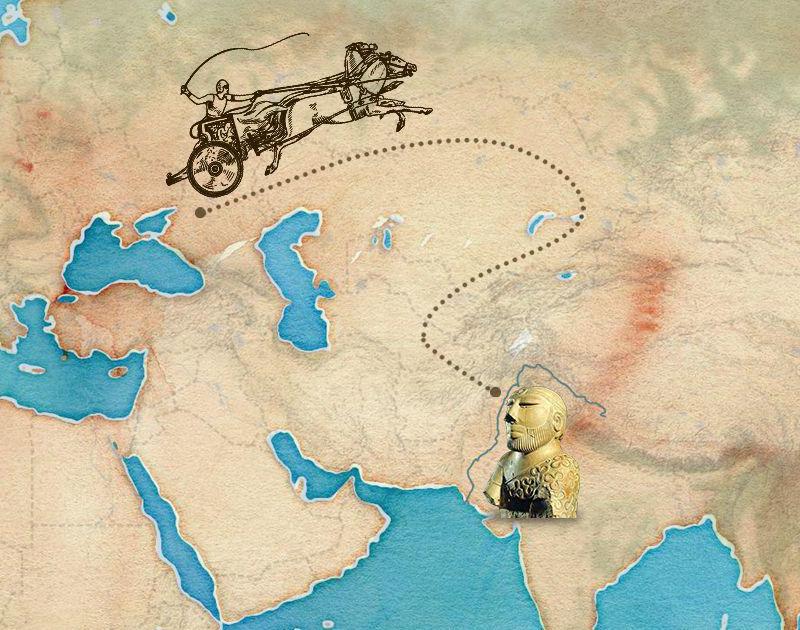
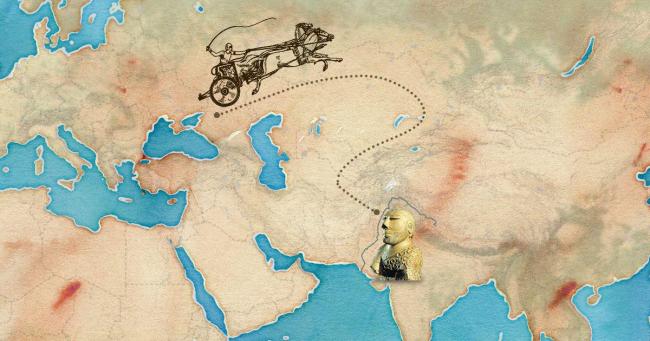
Image depicting the imaginary Aryan invasion of India from the Caspian Sea.

“It is difficult to say that all the earliest Aryans belonged to one race, but their culture was more or less the same type. Originally the Aryans seem to have lived somewhere in the steppes stretching from Southern Russia to Central Asia. On their way to India the Aryans first appeared in Central Asia and Iran. A little earlier than 1500 BC the Aryans appeared in India.” – R.S. Sharma

“By 1500 BC when the Aryans began to arrive in India, the Harappan culture had collapsed. We do not know where they came from; perhaps they came from north-eastern Iran or the region near the Caspian Sea or Central Asia.” – Romila Thapar

The two quotations from India’s two “eminent historians” sum up their approach to the Aryan Invasion Theory. Just look at expressions “difficult to say”, “seems to have”, “somewhere in steppes”, “we do not know where they come from”, “perhaps they came from north-eastern Iran or the region near Caspian Sea or Central Asia”. Despite so many probabilities, they are certain that Aryans came from outside. When and from where? No idea!

Despite all evidence to the contrary, why does the Aryan invasion/migration theory (AIT) continue to remain the lifeline of Indian Marxist historians? Let us now look at the AIT in historical perspectives.

Linguistic Evidence

Florentine merchant, Filippo Sassetti, who lived in Goa from AD 1583 to 1588, was struck by similarities between Sanskrit and European languages, especially Latin and Greek. Later, the relationship between Sanskrit and European languages was further elaborated by William Jones and many other scholars in the service of the East India Company. The efforts made towards understanding these linguistic similarities between Sanskrit on the one hand and Greek, Latin and some other modern European languages on the other gave rise to a new discipline called ‘comparative linguistics’. Its birth had questionably motivated considerations and in the last 200 years the discipline (if at all it is a discipline) of ‘Comparative Linguistics’ has shown a far greater variety of gymnastic exercises than the sport of gymnastics itself.

Since the earliest books (i.e. the Vedas) of the Aryans and so also all human beings are written in Sanskrit, it came to be recognised as the language of the Aryans. In the beginning, all European languages, along with Sanskrit, came to be clubbed as Aryan languages, and Sanskrit got identified as not only the oldest of all but also the mother of all European languages. Lord Monboddo was convinced that “Greek was derived from Sanskrit”. Frederick Schlegel, a highly respected German linguist wrote, “The Indian language is older and others [European languages] younger and derived from it.” Thus, Sanskrit came to be recognised as the mother of “all the less ancient Indo-European languages, as well as the modern European tongues and dialects”.

But these opinions did not last very long. Local pride, racial complexes and Evangelical considerations overshadowed everything as a part of a shift from ‘Indo-mania’ to ‘Indo-phobia’.

Though William Jones could not accept the earlier view that Sanskrit is the ‘mother’ of all Aryan languages. He advocated that Sanskrit is just a ‘sister’, i.e. a co-descendant of an earlier ancestor language. Following the lead provided by Jones, F. Bopp wrote: “I do not believe that Greek, Latin and other European languages are to be considered as derived from Sanskrit. I feel rather inclined to consider them together as subsequent variations of one original tongue, which however, the Sanskrit has preserved more perfect than its kindred dialects.”

So, a search for the original homeland of a language, namely ‘Proto-Indo-European’, led different scholars to different places. This search for the imagined original language homeland also meant the search for the ‘Original Homeland of Aryans’. This also gave rise to forging labels such as the ‘Indo-Aryan’, ‘Indo-European’, ‘Aryan languages’, ‘Indo-Aryan languages’, and the ‘Indo-European languages’. Sometime around the 1820s, the word ‘Aryan’ began to be dropped and it simply became ‘Indo-European’. Some German scholars even started using the term ‘Indo-German’ on the presumption that the Sanskrit and German languages, between them, covered the entire Indo-European speaking area—the farthest language to the east being Indic and German to the west.

Sanskrit, even today, may be “the greatest language of the world” or even if it “is of a wonderful structure, more perfect than Greek, more copious than Latin and more exquisitely refined” but so what? How could a language spoken by ‘niggers’ have been once the mother of languages today spoken by Europeans, i.e. white people? This position could not be accepted even by William Jones and Max Mueller, who have been so wholesome in their praise for Sanskrit.

Sanskrit was first demoted from mother to the position of a mere sister of all the ancient and modern European languages, but later on, with further building-up of the language tree, it came to be demoted to the position of grand-daughter, when it got linked to the so-called Indo-Iranian family. Thus, the position is: Proto-Indo-European language gave birth to the Indo-Iranian, which in turn produced Sanskrit. It’s already almost 200 years and the search for the grand-mother of Sanskrit (i.e. the Proto-Indo-European) is still on. We still do not know what she (the Proto-Indo-European Language) may have looked like, of what colour she may have been, or what may have been her physical and metaphysical structure. She still remains formless even in dreams. Quite often, these practitioners of philology were so illogical, so incoherent, so absurd, so adamant and arrogant, but, indeed, their impact has been so devastating that it has aptly been termed as ‘linguistic tyranny’.

Central Place Argument and Aryan Invasion

Once Sanskrit was demoted from the honoured status of being mother to all Indo-European languages and made a mere sister or niece of the European languages, a search started for the ‘original tongue’ i.e. the ‘Proto-Indo-European’. This cleared the deck also for legitimising the Aryan invasion of India; a theory which suggested that Sanskrit was brought here from the place where this imaginary language called ‘Proto-Indo-European’ was spoken. In 1842, A.W. von Schlegel claimed: “It is completely unlikely that the migrations which had peopled such a large part of the globe would have begun at its southern extremity (i.e. India) and would have continually directed themselves from there towards the northwest. On the contrary everything compels us to believe that the colonies set out in diverging directions from a central region.”

And for Schlegel this central region consisted of the areas around the Caspian Sea.

With the increasing hold of the British on India, the colonial and the Evangelical interests soon became a force in shaping Indian history for the rest of the academic world. Following the lead provided by A.W. von Schlegel, Max Mueller reiterated his position on the issue of the Aryan invasion and said in 1887: “If an answer must be given as to the place where our Aryan ancestors dwelt before their separation … I should still say, as I said forty years ago, ‘somewhere in Central Asia’ and no more.”

However, Srinivas Ayengar wrote in 1914: “The Aryans [in their entire literature] do not refer to any foreign country as their original home, do not refer to themselves as coming from beyond India, do not name any place in India after the names of places in their original land as conquerors and colonisers do, but speak of themselves exactly as sons of the soil would do. If they had been foreign invaders, it would have been humanly impossible for all memory of such invasion to have been utterly obliterated from memory in such a short time as represents the differences between the Vedic and Avestan dialects.”

It must be reiterated that it does not refer to a single name of flora and fauna found in Central Asia, Russia and Europe. If Rig Vedic people came from Central Asia how come they have no memory of it. Historically, linguistically and as per the oral traditions it is simply impossible.

The fallacy of this central-place theory as the origin of an imaginary language and then spreading all around can be explained with a contemporary example—English. Consider a situation wherein after a couple of thousand years, people forget that England was the place where the English language developed and spread from, and start looking for the place of its origin. The Central Place Theory will exclude England in the very first instance, as it is located on the outskirts of the world of the English language. The United States of America would be the natural choice from where it spread to Europe and Asia in the east, and Australia, New Zealand, Hawaii, etc, in the west and Canada in the north.

Lexicographic Evidence

Lexicography (the vocabulary of spoken/written words) is another area which was pressed in the service. Besides collecting a large number of the common words in various languages to prove their affinity, a number of words were chosen to prove the location of the language. For example, it has been argued that since there is no common word for the ocean in the Indo-European language, we can safely conclude that the Indo-European people were not aware of the ocean.

Varadpande rightly presses the points: “If we carry this reasoning further we shall have to suppose that ‘Indo-Europeans’ were living in a region where there was no air and no water, since there are no common words for air and water in all the ‘Indo-European’ Languages.”

The whole situation is that first a conjecture is turned into a hypothesis; to be later treated as a fact to be used in support of a new theory. For instance, language like Proto-Indo-European, Proto-Indo-Iranian and Proto-Dravidian are no more than hypothetical constructions, which may or may not have really existed; and yet these modern creations are often imposed on populations that lived thousands of years ago, to prove migrations theories.

Shaffer writes: “The Indo-Aryan invasion(s) as an academic concept in 18th-19th century Europe reflected the cultural milieu of that period. Linguistic data was used to validate the concept, which in turn, was used to interpret archaeological and anthropological data. What was theory, became an unquestioned fact that was used to interpret and organise all subsequent data. It is time to end the ‘linguistic tyranny’ that has prescribed interpretative frameworks of pre-and proto-historic cultural development in South Asia.”

The question of Aryan invasion/Aryan migration vis-a-vis philology has always been questioned. In the beginning of the last century, Aurobindo, while commenting on the philology, wrote: “Comparative philology has hardly moved a step beyond its origins; all the rest has been a mass of conjectural and ingenious learning of which the brilliance is equalled only by the uncertainty and unsoundness. … The very idea of the science of language is chimera.”

It is important to point out that in the last 30 years renowned linguists like Ram Bilash Sharma, S.S. Misra, S.G. Talgeri, N.S. Rajaram and Koenraad Elst have proved, on the basis of linguistic evidence itself, that this whole theory of Aryan invasion/migration is a fallacy.

Aryans, Racialism and Rig Veda

Subjugation of India by the British filled the masters with a desire to prove their all-round superiority. Racialism was one angle of it. Writings of Grant, Mill, Marx, Macaulay and their accomplices denigrated Indian people, culture, civilisation, society, history and religion.

Trautmann has traced the emergence of racialism and the development of physical anthropology as a resolution of the inescapable philological reality with the colonial need for cultural superiority over the natives of India. One of the most striking types of evidence of such an attitude is best seen in the writings of ACL Carlleyle. In 1879 he wrote: “We, British Europeans are Aryans, and far more pure and genuine Aryans than the Hindus, and no talk of the Hindus can alter our race, or make us any less or any different from what we are. It is the Hindus who have altered and deteriorated, and not we. The Hindus have become the coffee dregs, while we have remained the cream of the Aryan race. The Hindus are like the monkey.”

Some scholars think that the linguistic affinities of Indians and Europeans were also responsible for the development of physical anthropology leading the whole debate towards racialism. Most of the European scholars could not accept the view that Indians (‘niggers’, that is how most of the time Indians have been referred to in those writings) could have been once related to them and could have, indeed, been their forefathers, a conclusion which comparative linguistics was suggesting.

Edwin Bryant expresses it in the following words: “Even during the earlier phase of the homeland quest, when India was still a popular candidate, many scholars were uncomfortable about moving the Indo-Europeans too far from their biblical origins somewhere in the Near East. There were those among the British, in particular, whose colonial sensibilities made them reluctant to acknowledge any potential cultural indebtedness to the forefathers of the rickshaw pullers of Calcutta, and who preferred to hang on to the biblical Adam far more than their European contemporaries.”

Max Mueller himself was sad to note the mood of the day: “They would not have it, they would not believe that there could be any community origin between the people of Athens and Rome, and the so-called niggers of India.”

The newly developing science of physical anthropology was pressed into service to project Aryans as tall, white-skinned, blue-eyed, with sharp and high nose, and dolichocephalic. The non-Aryans came to be identified as natives with dark skin, flat nose, short stature, and so on. The dasas mentioned in the Rigveda were made to represent non-Aryans, i.e., the indigenous local population of India. Thus, the frame of the invasion of Aryans and the subjugation of the non-Aryan local population got corroborated with the evidence from Physical Anthropology.

The racial theory had a devastating impact on European polity. Each nation/state started claiming to be the real descendent of the Aryan race and considered others as inferiors. Max Mueller tried to intervene by declaring again and again: “If I say Aryans, I mean neither blood nor bones, nor hair nor skull. … How many misunderstandings and how many controversies are due to what is deduced by arguing from language to blood-relationship or from blood-relationship to language. … An ethnologist who speaks of an Aryan race, Aryan eyes and hair, and Aryan blood is as great a sinner as a linguist who speaks of a dolichocephalic dictionary or brachycephalic grammar.”

Alas! It was too late. The djinn created by Max Mueller had now grown up and was no longer under Mueller’s command. In the twilight years of his life, Max Mueller realised the devastating impact of distortions that he had made in Indian history in order to please his employers and the newly acquired faith. He died a sad man, preaching at the end of his career things like India: What Can It Teach Us.

He described India as: “The country most richly endowed with all the wealth, power and beauty that nature can bestow, … a very paradise on earth, … [a place where] human mind has most fully developed some of its choicest gifts, has most deeply pondered on the greatest problems of life.”

Racialism and DNA Evidence

In this context it will be useful to recall the studies carried out by K.A.R. Kennedy and his colleagues. For almost five decades they carried out a detailed study of a large number of pre- and proto-historic skeletons found in excavations from a large number of archaeological sites from all over the Indian sub-continent.

On the basis of their research, Kennedy and his colleagues concluded: “As for the question of biological continuity within the Indus valley, two discontinuities appear to exist. The first occurs between 6,000 and 4,500 B.C. The second occurs at some point after 800 B.C. but before 200 B.C.”

Both discontinuities exclude any adjustment for Aryan Invasion.

Besides the studies of Kennedy and his colleagues on ancient skeletons, an important study has come out recently on modern humans. Keeping in mind the AIT, Kivishield and his colleagues carried out a detailed study on gene pools of Western Eurasians and people of the Indian subcontinent. They studied the ‘genetic inheritance aspect’ of genes through the Mitochondrial DNA Test. It may be mentioned here that the mitochondrial DNA test can reveal the whole history of genetic changes and mutations that may have taken place even in the remote past i.e. several thousand years ago.

Kivishield and his colleagues have reached the conclusion that the Mitochondrial DNA, typical of Western Eurasians, is present among Europeans up to 70 percent whereas among Indians it is only up to 5.2 percent. The DNA gene pool of Western Europeans is very different from that of Indians. It has been very clearly stated that if there was any Aryan invasion of India a few thousand years ago, it must be visible in the mitochondrial DNA tests in terms of a splash in percentage of Western Eurasian genes. But this is not so. Further, the percentage and types of Western Eurasian genes present among south Indians and north Indians are almost the same. This fact establishes that there is no difference between the south Indian and north Indian gene pools, and the same goes against the Aryan invasion theory.

Conclusions

Now over a period of 200 years, the meaning of ‘Aryans’ has been constructed and reconstructed as being nomadic, pastoralists, sedentary agriculturists, dolichocephalic, brachycephalic, blond and fair, and from brown-haired to dark-haired. The Aryan homeland has been located and relocated everywhere, virtually from the North Pole to the South Pole, and from the shores of the Atlantic to Chinese deserts—South India, North India, Central India, Tibet, Bactria, Iran, the Black Sea, the Caspian Sea, Lithuania, the Caucasus, the Urals, the Volga Mountains, South Russia, the Steppes of Central Asia, Western Asia, Palestine, Anatolia, Scandinavia, Finland, Sweden, the Baltic, western Europe, northern Europe, central Europe, and eastern Europe.

The Aryan homeland, however, still remains elusive. J.P. Mallory has put the whole thing very succinctly: “One does not ask, ‘Where is the Indo-European homeland?’ but rather ‘where they put it now?’”

Anthropologist Edmund Leach of Cambridge University has most aptly summed up the whole question of the Aryan Invasion Theory. In 1990 in his article, Aryan Invasions over Four Millennia, Leach wrote: “Why do serious scholars persist in believing in the Aryan invasion? Why is this sort of thing attractive? Who finds it attractive? Why has the development of Sanskrit come so dogmatically associated with the Aryan invasion? The details of this theory fit in with this racist framework. … The origin myth of British imperialism helped the elite administrators in the Indian Civil Service to see themselves as bringing ‘pure’ civilisation to a country in which civilisation of the most sophisticated kind was already nearly 6,000 years old. Here, I will only remark that the hold of this myth on the British middle-class imagination is so strong that even today, 44 years after the death of Hitler and 43 years after the creation of an independent India and independent Pakistan, the Aryan invasions of the second millennium BC are still treated as if they were an established fact of history. … The Aryan invasion never happened at all.” – Firstpost, 20 July 2022

  Prof. Dr. Makkhan Lal is a well-known historian and the founder director of the Delhi Institute of Heritage Research and Management.

Rig Veda