Pakistan is contradiction personified. It is a declared Islamic nation that kills more Muslims than most non-Muslim regimes. It allies with powers that bomb or erase Muslims elsewhere and survives by playing the sidekick to global powers. It is an ideological construct consumed by hatred of its own pre-Islamic heritage, history, and civilisational traits, such as plurality. – Balbir Punj
The suicide bombing at the Khadija Tul Kubra Shia Mosque in Islamabad on February 6, 2026, which killed at least 36 worshippers and left over 160 injured during Friday prayers, was not merely another act of terrorism in Pakistan’s troubled history. It was not an isolated tragedy either.
It was, in fact, part of a grim continuum. In November 2024, a Shia procession in Parachinar was attacked, killing 44 civilians, including women and children. In March 2022, the Islamic State-Khorasan Province (ISKP) bombed the Kucha Risaldar Shia Mosque in Peshawar, killing over 60 worshippers.
In 2015, a Shia mosque in Shikarpur was targeted during Friday prayers, leaving 61 dead. Earlier still, the Hazara Shia community of Quetta endured near-genocidal violence, including the twin bombings of 2013 that killed over 200 people.Pakistan today is home to more than 40 million Shia Muslims—nearly one-fifth of its population. Yet more than 4,000 Shias have been killed in sectarian attacks in the past two decades alone. These are not accidental casualties of instability; they are victims of a sustained ideological assault.
A state that cannot – or will not—protect such a large section of its Muslim population forfeits its claim to Islamic legitimacy. Sectarian targeting has become a structural feature of Pakistan’s internal life. Even more telling was the state’s immediate instinct to deflect responsibility. Pakistan’s Defence Minister Khawaja Asif rushed to blame India and Afghanistan—without evidence or investigation.
But facts are stubborn things. Pakistan’s sectarian violence is neither imported nor imposed. It is indigenous, ideologically nurtured, and politically patronised.
The reasons for mass murders committed in the name of Islam lie not only in theology but also in governance. Pakistan has failed to act as a neutral guarantor of religious plurality. Instead, it has repeatedly aligned itself with extremist Sunni majoritarianism, allowing sectarian hatred to harden into political currency.
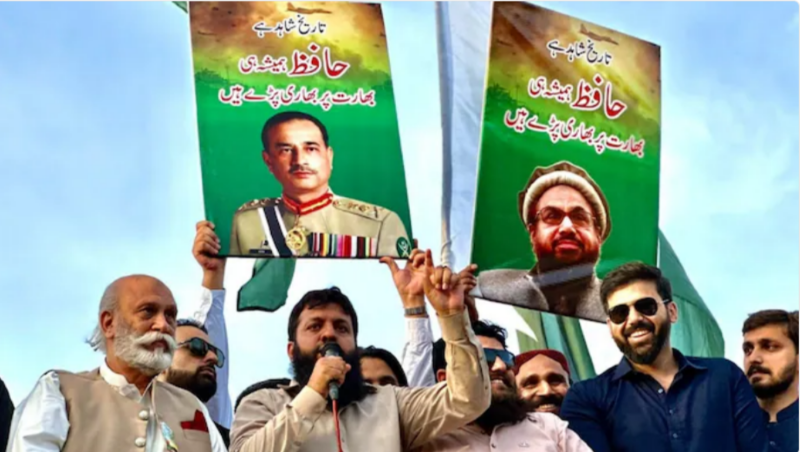
Groups such as Tehreek-e-Labbaik Pakistan (TLP) and Ahl-e-Sunnat-Wal-Jamaat (ASWJ), globally recognised for their virulent anti-Shia ideology, have been allowed to operate openly. In September 2020, more than 30,000 extremists marched through Karachi, openly calling Shias “blasphemers” and demanding their beheading. Similar rallies followed in Islamabad. These were not clandestine gatherings; they were public demonstrations of ideological impunity.
Legislative measures such as Punjab’s Tahaffuz-e-Bunyad-e-Islam Bill (2020) further marginalised Shias by privileging a singular Sunni interpretation of Islam. Electoral expediency has repeatedly trumped constitutional responsibility. Extremists are not confronted; they are courted, because they deliver street power and votes.The deeper question remains: how does such an ideology repeatedly find fertile ground in Pakistan?
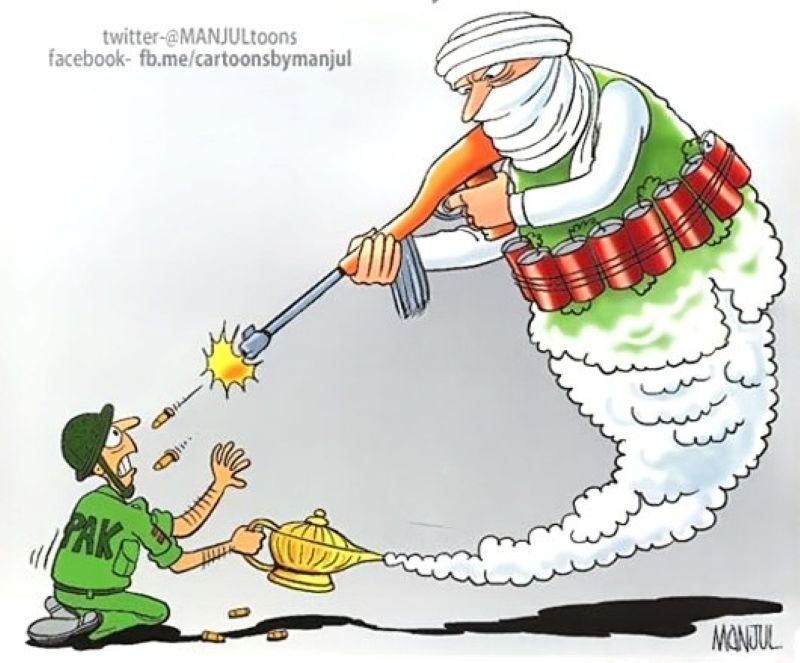
The answer lies in the circumstances leading to its birth and decades of state policy. A state that once distinguished between “good” and “bad” terrorists should not feign surprise when violence turns inward. Islam, reduced to an instrument of power, inevitably devours its own.
Pakistan’s well-worn narrative, in which India is portrayed as inherently anti-Muslim and anti-Islamic, collapses under empirical scrutiny. At the time of Partition, residual India had roughly 30 million Muslims. Today, that number exceeds 220-240 million, making India home to one of the largest Muslim populations in the world. Over eight decades, Indian Muslims have grown demographically, participated politically, and lived under a secular constitutional framework that guarantees religious freedom.
India maintains strong relations with Saudi Arabia, the UAE, Iran, and other Islamic nations. Even under Prime Minister Narendra Modi—frequently caricatured by Pakistani propaganda—India’s engagement with the Islamic world has deepened. Pakistan’s accusation is not grounded in reality; it is an ideological necessity to sustain its founding hostility.
Contrast this with Pakistan, where non-Muslims and non-Sunni Muslims, including Ahmadiyas, have been reduced to statistical insignificance, treated as second-class citizens, and are virtually invisible in the country’s public spaces.
Pakistan’s antagonism towards India is less theological and more civilisational. Pakistan was conceived not as a cultural continuation but as a negation of the subcontinent’s pre-Islamic past. Official Pakistani historiography traces its origins to Muhammad bin Qasim’s invasion of Sindh in 712 CE. Islamic invaders who destroyed temples and erased indigenous traditions are glorified as ideological ancestors.
This civilisational rupture was not accidental. As documented by former Indian diplomat Narendra Singh Sarila in The Shadow of the Great Game and economist Prasenjit K. Basu in Asia Reborn, the partition of India was deeply embedded in Britain’s imperial strategy.
Classified British correspondence reveals that on May 5, 1945, Prime Minister Winston Churchill commissioned a secret report recommending that Britain retain a military presence in India’s north-west—present-day Pakistan—to counter the Soviet Union. The report advocated detaching Baluchistan to safeguard British interests in the Gulf and the Middle East, highlighting its value as a military base, transit hub, and reservoir of “manpower of good fighting quality”.
On June 3, 1947, British Foreign Secretary Ernest Bevin candidly admitted that the division of India would help Britain consolidate its position in the Middle East. A 1947 British military report went further, stating that Britain’s strategic requirements in the subcontinent could be met through an agreement with Pakistan alone, even if India refused cooperation.
As Prasenjit K. Basu notes, Pakistan was integral to Britain’s grand strategy of retaining influence over the oil-rich regions of Iran, Iraq, and the Gulf. This logic seamlessly transferred to the United States during the Cold War. Pakistan joined SEATO and CENTO, became a frontline ally against the Soviet Union, and hosted CIA operations, including from the Peshawar airbase.
The United States later used Pakistan as a conduit to China and, during the 1971 war, openly sided with Islamabad against India. America replicated the weaponisation of Islam that Britain had perfected—most dramatically in Afghanistan. To counter the Soviet Union, Washington built a global jihadist ecosystem, with Pakistan as its ideological and logistical incubator.
Post-9/11, Pakistan became indispensable once again, even as it played a double game. Islam was never the objective; it was the instrument.
If Pakistan genuinely loved Islam, it would stand unequivocally with Muslim causes worldwide. Pakistan does not.
While Gaza burns and Iran faces sustained Israeli-American hostility, Pakistan’s establishment maintains strategic silence—or worse, strategic collaboration. Reports of Pakistani facilities being used indirectly by US forces against Iran, and the Pakistani Army Chief’s simultaneous engagements in Washington, expose the hollowness of Ummah rhetoric.
Nowhere is Pakistan’s moral bankruptcy clearer than in its embrace of China. While Beijing systematically erases Uyghur Islamic identity—demolishing mosques, banning Quranic practices, and incarcerating over a million Muslims in “re-education camps”—Pakistan remains conspicuously mute.
A self-proclaimed Islamic state reduced to a surrogate of an empire committing cultural genocide against Muslims is a contradiction too grotesque to ignore: loans, corridors, and strategic relevance purchase Pakistan’s silence.
Perhaps the most devastating indictment came from Shia protesters in Kashmir, who marched with the Indian tricolour, asking a simple but searing question, as media reported: “Shia Muslims are targeted in Pakistan. It is painful to see Muslims being killed inside mosques during prayers. What kind of jihad is this?” Pakistan is contradiction personified. It is a declared Islamic nation that kills more Muslims than most non-Muslim regimes. It allies with powers that bomb or erase Muslims elsewhere and survives by playing the sidekick to global powers. It is an ideological construct consumed by hatred of its own pre-Islamic heritage, history, and civilisational traits, such as plurality. – The Pioneer, 28 February 2026
› Balbir Punj is a columnist, author, and former Chairman of the Indian Institute of Mass Communication (IIMC).
 VOICE OF INDIA