Christianity’s fraudulent legacy – M. Paulkovich


Jesus saves ...or else!

The cult of Christianity has an incalculable amount of blood on its hands. And the Jesus tale seems to have been nothing more than oral legend, with plenty of hoax and fraud perpetrated along the ages. – Michael Paulkovich

Most historians hold the position I had once harbored as true, being a Bible skeptic but not a Christ mythicist. I had maintained that the Jesus person probably existed, having fantastic and impossible stories later foisted upon his earthly life, passed by oral tradition then recorded many decades after Jesus lived.

After exhaustive research for my first book, I began to perceive both the brilliance and darkness from history. I discovered that many early Christian fathers believed with all pious sincerity their savior never came to earth—or when he did, it was Star-Trekian style, beamed down pre-haloed and fully-grown, sans transvaginal egress. Moreover I expose many other startling bombshells in my book No Meek Messiah: Christianity’s Lies, Laws, and Legacy.

I embarked upon one exercise to revive research into Jesus-era writers who should have recorded Christ tales, but did not. John Remsburg enumerated forty-one “silent” historians in his book The Christ (1909). I dedicated months of research to augment Remsburg’s list, finally tripling his count. In No Meek Messiah I provide a list of 126 writers who should have recorded something of Jesus, with exhaustive references.

Perhaps the most bewildering “silent one” is the mythical super-savior himself, Jesus the Son of God ostensibly sent on a suicide mission to save us from the childish notion of “Adam’s Transgression” as we learn from Romans 5:14. The Jesus character is a phantom of a wisp of a personage who never wrote anything. So, add one more: 127.

The Jesus character is a phantom 

Jesus is lauded as a wise teacher, savior, and a perfect being. Yet Jesus believed in Noah’s Ark (Mt. 24:37, and Lk. 17:27), Adam and Eve and their son Abel (Lk. 3:38 and Lk. 11:51), Jonah living in a fish or whale (Mt. 12:40), and Lot’s wife turning into salt (Lk. 17:31-32). Jesus believed “devils” caused illness, and even bought into the OT notion (Jn. 3:14) that a magical pole proffered by the OT (Num. 21:9) could cure snake bites merely by gazing upon it.

Was Jesus smarter than a fifth grader?

Apollonius of Tyana

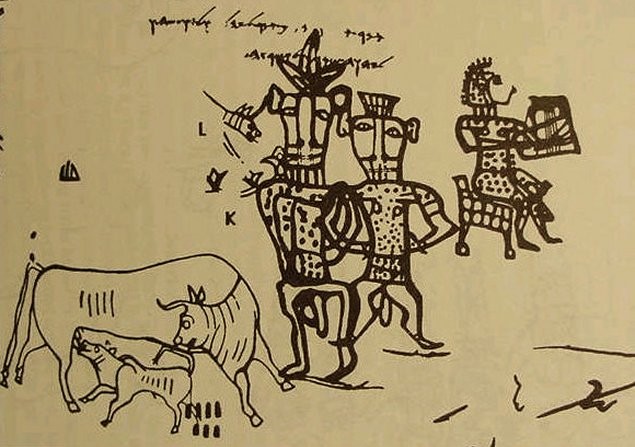
But perhaps no man is more fascinating than Apollonius Tyaneus, saintly first century adventurer and noble paladin. Apollonius was a magic-man of divine birth who cured the sick and blind, cleansed entire cities of plague, foretold the future and fed the masses. He was worshipped as a god, and son of god. Despite such nonsense claims, Apollonius was a real man recorded by reliable sources.

As Jesus ostensibly performed miracles of global expanse (e.g. Mt. 27), his words going “unto the ends of the whole world” (Rom. 10), one would expect virtually every literate person on earth to record those events during his time. A Jesus contemporary such as Apollonius should have done so, as well as those who wrote of Apollonius. Such is not the case. In Philostratus’ third century chronicle, Vita Apollonii, there is no hint of Jesus. Nor in the works of other Apollonius epistolarians and scriveners: Emperor Titus, Cassius Dio, Maximus, Moeragenes, Lucian, Soterichus Oasites, Euphrates, Marcus Aurelius, or Damis of Hierapolis. It seems none of these writers from first to third century ever heard of Jesus, global miracles and alleged worldwide fame be damned.

Another bewildering author is Philo of Alexandria. He spent his first century life in the Levant, even traversing Jesus-land. Philo chronicled Jesus contemporaries—Bassus, Pilate, Tiberius, Sejanus, Caligula—yet knew nothing of the storied prophet and rabble-rouser enveloped in glory and astral marvels. Historian Josephus published Jewish War ca. 95. He had lived in Japhia, one mile from Nazareth—yet Josephus seems to have been unaware of both Nazareth and Jesus. (I devoted a chapter to his interpolated works, pp. 191-198.) You may encounter Christian apologists claiming that Pliny the Younger, Tacitus, Suetonius, Phlegon, Thallus, Mara bar-Serapion, or Lucian wrote of Jesus contemporary to the time. In No Meek Messiah I thoroughly debunk such notions.

The Bible venerates the artist formerly known as Saul of Tarsus, an “apostle” essentially oblivious to his heavenly saviour. Paul is unaware of the virgin mother, and ignorant of Jesus’ nativity, parentage, life events, ministry, miracles, apostles, betrayal, trial and harrowing passion. Paul knows neither where nor when Jesus lived, and considers the crucifixion metaphorical (Gal. 2:19-20). Unlike the absurd Gospels, Paul never indicates Jesus had been to earth. And the “five hundred witnesses” claim (1 Cor. 15) is a well-known forgery.

Qumran, the stony and chalky hiding place for the Dead Sea Scrolls lies twelve miles from Bethlehem. The scroll writers, coeval and abutting the holiest of hamlets one jaunty jog eastward never heard of Jesus. Dr. Jodi Magness wrote, “Contrary to claims made by a few scholars, no copies of the New Testament (or precursors to it) are represented among the Dead Sea Scrolls.

Christianity was still wet behind its primitive and mythical ears in the second century, and Christian father Marcion of Pontus in 144 CE denied any virgin birth or childhood for Christ—Jesus’ infant circumcision (Lk. 2:21) was thus a lie, as well as the crucifixion! Marcion claimed Luke was corrupted, and his saviour self-spawned in omnipresence, a spirit without a body (see Dungan, 43). Reading the works of second century Christian father Athenagoras, one never encounters the word Jesus (or Ἰησοῦς or Ἰησοῦν, as he would have written)—Athenagoras was thus unacquainted with the name of his saviour it would seem. Athenagoras was another pious early Christian, unaware of Jesus (see also Barnard, 56).

The original booklet given the name “Mark” ended at 16:8, later forgers adding the fanciful resurrection tale (see Ehrman, 48). The booklet “John” in chapter 21 also describes post-death Jesus tales, another well-known and well-documented forgery (see Encyclopedia Biblica, vol. 2, 2543). Millions should have heard of the Jesus “crucifixion” with its astral enchantments: zombie armies and meteorological marvels (Mt. 27) recorded not by any historian, but only in the dubitable scriptures scribbled decades later by superstitious yokels. The Jesus saga is further deflated by the reality of Nazareth, having no settlement until after the 70 CE war—suspiciously around the time the Gospels were concocted, as René Salm demonstrates in his book. I also include in my book similarities of Jesus to earlier God-sons, too striking to disregard. The Oxford Classical Dictionary and Catholic Encyclopedia, as well as many others, corroborate. Quite a few son-of-gods myths existed before the Jesus tales, with startling similarities, usually of virgin mothers, magical births and resurrection: Sandan, Mithra, Horus, Attis, Buddha, Dionysus, Krishna, Hercules, Isiris, Orpheus, Adonis, Prometheus, etc.

The one true religion

If you encounter a Christian defending her faith purely based on its popularity, you would do well to inform her that Christianity was a very minor cult in the fourth century, while “pagan” religions, especially Mithraism, were much more popular in the Empire—and the Jesus cult would have faded into oblivion if not for an imperial decree.

From No Meek Messiah: It is 391 CE now as Roman Emperor Theodosius elevates Jesus (posthumously) to divinity, declaring Christianity the only “legitimate” religion of the world, under penalty of death. The ancient myth is rendered law. This decision by Theodosius is possibly the worst ever made in human history: what followed were century after century of torture and murder in the name of this false, faked, folkloric “prophesied saviour” of fictional virgin mother. Within a year after the decree by Theodosius, crazed Christian monks of Nitria destroy the majestic Alexandrian Library largely because philosophy and science are taught there—not the Bible. In Alexandria these are times of the highest of intellectual pursuits, all quashed by superstitious and ignorant Christians of the most godly and murderous variety: they had the “Holy Bible” on their side.

Emperor Theodosius I could have had no idea how much harm this blunder would cause humanity over the centuries that followed. Christianity was made the only legal cult of the empire, and for the next 1500 years, good Christians would murder all non-Christians they could find by the tens of millions.

Frauds and forgeries

Along the centuries the Church has sought to gain power and wealth, and No Meek Messiah exposes their many scams and deceits and obfuscations in detail including:

  • Abgar Forgeries (4th century)
  • Apostolic Canons (400 CE)
  • Hypatia the Witch (415 CE)
  • Symmachian Forgeries (6th century)
  • St. Peter Forgery (ca. 751)
  • False “Donation of Constantine” (8th century)
  • False Decretals (8th century)
  • Extermination of the Cathar “witches” (13th century)
  • Murder of the Stedinger “devils” (1233)
  • The Manifest Destiny decree (1845) and eradication of Native Americans
  • Invention of the “Immaculate Conception” (1854)
  • The Lateran Treaty (1929)

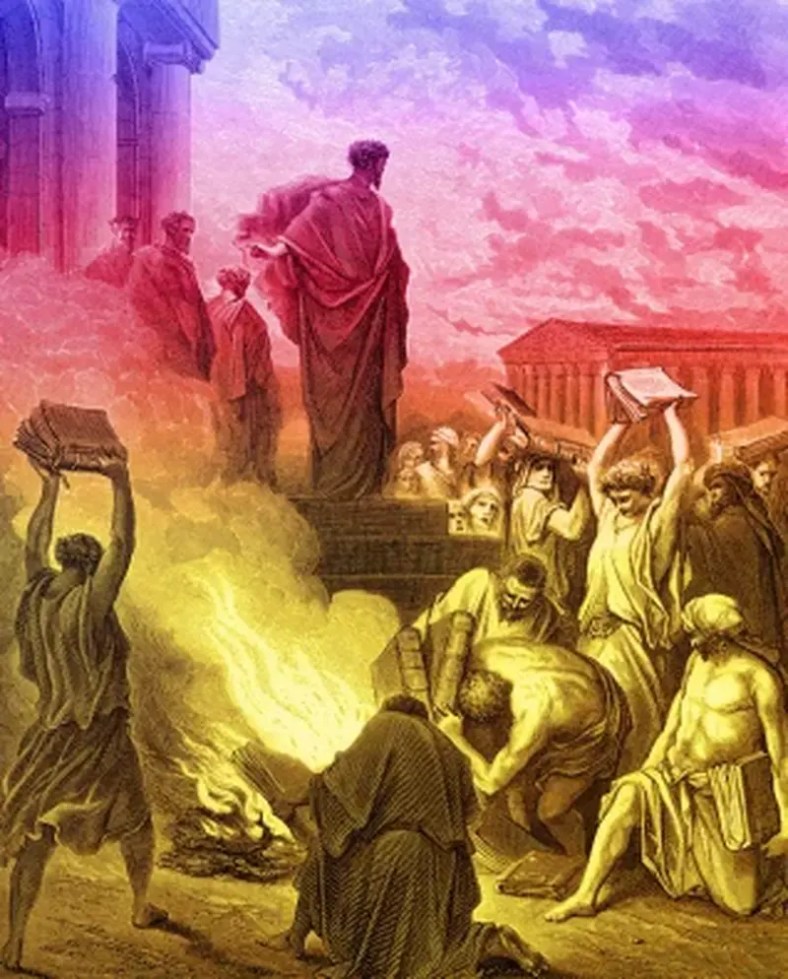
St. Paul overseeing the burning of books at Ephesus.

The good that Jesus brought

Early Christians believed all necessary knowledge was in the Bible and thus closed down schools, burned books, forbade teaching philosophy and destroyed libraries. The Jesus person portrayed in the Bible taught that “devils” and “sin” cause illness, and thus for some 1700 years good Christians ignored science and medicine to perform exorcisms on the ill.

The Bible decrees “Thou shalt not suffer a witch to live” (Ex. 22:18, with support from Dt. 18:10-12, Lev. 20:27, 2 Chr. 33:6, Micah. 5:12, and 1 Sam. 28:3). In the New Testament, Paul in Galatians 5:19-21 joins the anti-witchcraft credo. But let’s face it: Paul claims to be a devoted Hebrew, full of credulity and misogyny. Paul will “suffer not a woman to teach” and thus along the centuries women have been second-class citizens, especially within the Church. These juvenile and immoral Bible edicts are not left in the past.

From No Meek Messiah: Remember the witch hunts? Long ago and far away, past atrocities forgotten? So perhaps we should forgive and forget. Around the world, the Christian Bible is still used to accuse people, usually children, of “witchcraft” and to punish them. Refer to The Guardian, Sunday, 9 December 2007, “Child ‘witches’ in Africa”; Huffington Post, October 18, 2009, “African Children Denounced As ‘Witches’ By Christian Pastors”; and The Guardian, Friday 31 December 2010, “Why are ‘witches’ still being burned alive in Ghana?” The scripture normally cited regarding witches is Exodus 22:18, and there are many more. In Ghana, a study found that “accused witches were physically brutalised, tortured, neglected, and in two cases, murdered.” In Kinshasa, Congo, “80% of the 20,000 street children … are said to have been accused of being witches.” Even to this day the Bible’s proclamations against witches are still considered valid by many Christians. In places like Indonesia, Tanzania, the Congo and Ghana superstitious fundamental Christians actively pursue and execute witches, including murdering child “sorcerers.” In Malawi, accused witches are routinely jailed.

Christians are typically kept ignorant of certain evil and immoral words placed into the mouth of this mythical mystery-man:

“If any man come to me, and HATE NOT his father, and mother, and wife, and children, and brethren, and sisters, yea, and his own life also, he cannot be my disciple.” – Luke 14:26.

Jesus is actually portrayed as a pitiful man in desperate need of praise:

“He that loveth father or mother more than me is not worthy of me: and he that loveth son or daughter more than me is not worthy of me.” – Matt. 10:37.

Not only does Jesus never advise against slavery, but he recommends savage whipping of disobedient slaves:

“And that servant, which knew his lord’s will, and prepared not himself, neither did according to his will, shall be beaten with many stripes.” – Luke 12:47.

Jesus has nothing against stealing, as he instructs his apostles to pinch a horse and a donkey from their rightful owner:

“And when they drew nigh unto Jerusalem, and were come to Bethphage, unto the Mount of Olives, then sent Jesus two disciples, Saying unto them, Go into the village over against you, and straightway ye shall find an ass tied, and a colt with her: loose them, and bring them unto me. And if any man say ought unto you, ye shall say, The Lord hath need of them; and straightway he will send them.” – Matt. 21:1-3.

Gentle and meek and mythical

I personally know several Christians who accept evolution as scientific fact. Okay, they kind of ignore the Old Testament, but I asked one born again Christian about the genealogy of Jesus and she was only aware of another one in Luke.

From No Meek Messiah: Christianity absolutely depends on mythical “Adam.” Without Adam, Eve, and a talking snake, Jesus’ mission is moot and pointless and void. Christians are generally oblivious of this because they have been shown a genealogy in Matthew (which only goes back to “Abraham”), and are rarely if ever exposed to Luke’s disparate and childlike version—which if true would negate all of evolution and in fact most known history and science. According to the anonymous author of Luke, a mere seventy-five generations separate “Adam”—and the beginning of the universe—from the birth of Jesus some 2,000 years ago.

This “meek” messiah boasted he was “greater than Solomon” (Mt. 12:42), saying he “came not to send peace, but a sword” (Mt. 10:34), and  (Lk. 12:49). Jesus desperately needs your praise (Mt. 10:37), and advises you to beat your slaves.

Yahweh / Jehovah

This Jesus character speaks highly of father Yahweh‘s genocidal tantrums in Matthew 11:20-24. Jesus is referring to the book of Joshua where his father declares he will wipe out all people of Sidon: “All the inhabitants of the hill country from Lebanon unto Misrephoth-maim, and all the Sidonians, them will I drive out from before the children of Israel”.

You may have heard Christians claim that the only “god hates fags” verbiage comes from the Old Testament (Lev. 18:22), but both Paul (in Rom. 1:26-27) and Jesus speak out against it, as the J-man praises the ruin of Gaytown, Canaan: “But the same day that Lot went out of Sodom it rained fire and brimstone from heaven and destroyed them all.” – Luke 17:29.

Onward Christian soldiers

Christianity has a violent “holy book” as its authority, granting followers supremacy over the entire earth (e.g. Gen. 1:28) which they used to justify land grabs, genocide and holy conflicts. The following wars were perpetrated by Christians in the name of their saviour:

  1. War against the Donatists, 317 CE
  2. Roman-Persian War of 441 CE
  3. Roman-Persian War of 572-591 CE
  4. Charlemagne’s War against the Saxons, 8th century
  5. Spanish Christian-Muslim War of 912-928
  6. Spanish Christian-Muslim War of 977-997
  7. Spanish Christian-Muslim War of 1001-1031
  8. First Crusade, 1096
  9. Jerusalem Massacre, 1099
  10. Second Crusade, 1145-1149
  11. Spanish Christian-Muslim War, 1172-1212
  12. Third Crusade, 1189 CE
  13. War against the Livonians, 1198-1212
  14. Wars against the Curonians and Semigallians, 1201-90
  15. Fourth Crusade, 1202-04
  16. Wars against Saaremaa, 1206-61
  17. War against the Estonians, 1208-1224
  18. War against the Latgallians and Selonians, 1208-1224
  19. Children’s Crusade, 1212
  20. Fifth Crusade, 1213
  21. Sixth Crusade, 1228 War against the Livonians, 1198-1212
  22. Spanish Christian-Muslim War, 1230-1248
  23. Seventh Crusade, 1248
  24. Eighth Crusade, 1270
  25. Ninth Crusade, 1271-1272
  26. The Inquisitions
  27. War against the Cathars, 1209-1229 and onward
  28. War against the Stedingers of Friesland, 1233
  29. Spanish Christian-Muslim War, 1481-1492
  30. Four Years War of 1521-26
  31. Count’s War of 1534-36
  32. Schmalkaldic War, 1546
  33. Anglo-Scottish War of 1559-1560
  34. First War of Religion,1562
  35. Second War of Religion, 1567-68
  36. Third War of Religion, 1568-70
  37. Fourth War of Religion, 1572-73
  38. Fifth War of Religion, 1574-76
  39. Sixth War of Religion, 1576-77
  40. Seventh War of Religion, 1579-80
  41. Eighth War of Religion, 1585-98
  42. War of the Three Henrys, 1588
  43. Ninth War of Religion, 1589—1598
  44. Ottoman-Habsburg wars, 15th to 16th century
  45. War against the German Farmers (“peasants”), 16th Century
  46. The French Wars of Religion, 16th Century
  47. Shimabara Revolt, 1637
  48. Covenanters’ Rebellion of 1666
  49. Covenanters’ Rebellion of 1679
  50. Covenanters’ Rebellion of 1685
  51. The Thirty Years War, 17th Century
  52. The Irish rebellion of 1641
  53. Spanish Christian extermination of South American natives
  54. Manifest Destiny
  55. War of the Sonderbund, 1847
  56. Crimean War, 1853-1856
  57. Tukulor-French War, 1854-1864
  58. Taiping Rebellion, 1851 and 1864
  59. Serbo-Turkish War, 1876-78
  60. Russo-Turkish War, 1877-1878
  61. Russian Revolution killing of the Jews, late 19th century
  62. First Sudanese Civil War, 1955-1972
  63. Nigerian Civil War, 1967
  64. Lebanese Civil War, 1975
  65. Sabra and Shatila massacre, 1982
  66. Second Sudanese Civil War, 1983
  67. Yelwa Massacre, 2004
  68. Bosnian War

A relatively unknown contrivance occurred in the thirteenth century when Pope Innocent III ordered a genocidal attack against the entire region of Languedoc France. The pope depicted the Cathars as witches; of being cannibals; desecrating the cross; and having “sexual orgies.”

Yet malefic sounds of sibilance emanated only from the Vatican, and not from its contrived enemies living peaceably in France with their pure and righteous ways. The Church murdered over a million innocent Cathars over the period of 35 years—men, women, children. Christian forces wiped them from the face of the planet. At the height of the siege, Christian forces were burning hundreds at the stake at a time. The Christian colossus exterminated them, then annexed much of Languedoc—some for the Church, some from northern French nobles. The extravagant Palais de la Berbie (construction began in 1228) and the Catholic fortress-cathedral Sainte Cécile (began 1282) are just two examples that remain to this day.

The Silent Historians

Conclusion

When I consider those 126 writers, all of whom should have heard of Jesus but did not, and Paul and Marcion and Athenagoras and Matthew with a tetralogy of opposing Christs, the silence from Qumran and Nazareth and Bethlehem, conflicting Bible stories, and so many other mysteries and omissions, I must conclude this “Jesus Christ” is a mythical character. “Jesus of Nazareth” was nothing more than urban (or desert) legend, likely an agglomeration of several evangelic and deluded rabbis who might have existed.

The “Jesus mythicist” position is regarded by Christians as a fringe group. But after my research I tend to side with Remsburg—and Frank Zindler, John M. Allegro, Thomas Paine, Godfrey Higgins, Robert M. Price, Charles Bradlaugh, Gerald Massey, Joseph McCabe, Abner Kneeland, Alvin Boyd Kuhn, Harold Leidner, Peter Jensen, Salomon Reinach, Samuel Lublinski, Charles-François Dupuis, Rudolf Steck, Arthur Drews, Prosper Alfaric, Georges Ory, Tom Harpur, Michael Martin, John Mackinnon Robertson, Alvar Ellegård, David Fitzgerald, Richard Carrier, René Salm, Timothy Freke, Peter Gandy, Barbara Walker, Thomas Brodie, Earl Doherty, Bruno Bauer and others—heretics and iconoclasts and freethinking dunces all, according to “mainstream” Bible scholars.

If all this evidence and non-evidence including 126 silent writers cannot convince, I’ll wager we will uncover much more. Yet this is but a tiny tip of the mythical Jesus iceberg: nothing adds up for the fable of the Christ. In the Conclusion of No Meek Messiah I summarise the madcap cult of Jesus worship that has plagued the world for centuries. It should be clear to even the most devout and inculcated reader that it is all up for Christianity, and in fact has been so for centuries. Its roots and foundation and rituals are borrowed from ancient cults: there is nothing magical or “God-inspired” about them. The “virgin birth prophecy” as well as the immaculate conception claims are fakeries, the former due to an erroneous translation of the Tanakh, the latter a nineteenth century Catholic apologetic contrivance, a desperate retrofitting.

Jesus was no perfect man, no meek or wise messiah: in fact his philosophies were and are largely immoral, often violent, as well as shallow and irrational. There have been many proposed sons of god, and this Jesus person is no more valid or profound than his priestly precursors. In fact, his contemporary Apollonius was unquestionably the superior logician and philosopher.

Christianity was a very minor and inconsequential cult founded late in the first century and then—while still quite minor—forced upon all the people of the Empire, and all rival kingdoms in the fourth century and beyond, as enforceable law with papal sanction. Christianity has caused more terror and torture and murder than any similar phenomenon. With its tyrannical preachments and directives for sightless and mindless obedience, the Bible is a violent and utterly useless volume, full of lies and immoral edicts and invented histories, no matter which of the many “versions” you may choose to read—including Thomas Jefferson’s radical if gallant abridgement.

The time to stop teaching the tall tales and nonsense to children, frightening them with eternal torture administered by God’s minions, has long ago passed. Parents who do so are likely deluded, and most surely are guilty of child abuse of the worst sort….

The cult of Christianity has an incalculable amount of blood on its hands. And the “Jesus” tale seems to have been nothing more than oral legend, with plenty of hoax and fraud perpetrated along the ages. It is my hope that mankind will someday grow up and relegate the Jesus tales to the same stewing pile that contains Zeus and his son Hercules, roiling away in their justifiable status as mere myth. – JNE, 19 July 2014

Thomas Paine Quote

Bibliography

  1. Catholic Encyclopedia, first edition. The Encyclopedia Press, 1907-1913.
  2. Dungan, David L., Constantine’s Bible, Minneapolis: Fortress Press, 2007.
  3. Ehrman, Bart, Jesus, Interrupted, New York: HarperCollins, 2009.
  4. Encyclopedia Biblica: A Critical Dictionary of the Literary, Political and Religious History: The Archeology, Geography and Natural History of the Bible, Edited by Thomas Kelly Cheyne and J. Sutherland Black. 1899.
  5. Magness, Jodi, The Archaeology of Qumran and the Dead Sea Scrolls, Grand Rapids: Eerdmans, 2002.
  6. Oxford Classical Dictionary. New York: Oxford University Press, 1996.
  7. Salm, René, The Myth of Nazareth, Parsippany: American Atheist Press, 2008.

Further Reading

  1. Alfaric, Prosper, Jésus a-t-il existé? 1932.
  2. Allegro, John M., The Dead Sea Scrolls and the Christian Myth, Amherst: Prometheus Books, 1992.
  3. Barnard, Leslie William, Athenagoras: A Study in Second Century Christian Apologetic, Paris: Éditions Beauchesne, 1972.
  4. Bradlaugh, Charles, Who Was Jesus Christ? London: Watts and Co., 1913.
    Brodie, Thomas, Beyond the Quest for the Historical Jesus: Memoir of a Discovery, Sheffield: Sheffield Phoenix, 2012.
  5. Carrier, Richard, Proving History: Bayes’s Theorem and the Quest for the Historical Jesus, Amherst: Prometheus, 2012.
  6. Doherty, Earl, Neither God nor Man, Ottawa: Age of Reason, 2009.
  7. Drews, Arthur, Hat Jesus gelebt? Mainz: 1924.
  8. Dupuis, Charles-François, L’origine de tous les cultes, ou la religion universelle, Paris: 1795.
  9. Ellegård, Alvar, Jesus One Hundred Years Before Christ, New York: Overlook Press, 2002.
  10. Fitzgerald, David, Nailed: Ten Christian Myths That Show Jesus Never Existed at All, Lulu.com, 2010.
  11. Freke, Timothy, and Gandy, Peter, The Jesus Mysteries: Was the “Original Jesus” a Pagan God? New York: Three Rivers Press, 1999.
  12. Harpur, Tom, The Pagan Christ: Recovering the Lost Light, Toronto: Thomas Allen Publishers, 2005.
  13. Higgins, Godfrey, Anacalypsis, A&B Books, 1992.
  14. Jensen, Peter, Moses, Jesus, Paul: Three Variations on the Babylonian Godman Gilgamesh, 1909.
  15. Kneeland, Abner, A Review of the Evidences of Christianity, Boston: Free Enquirer, 1829.
  16. Kuhn, A. B., Who Is This King of Glory? Kessinger Publishing, LLC; Facsimile Ed edition, 1992.
  17. Leidner, Harold, The Fabrication of the Christ Myth, Survey Press, 2000.
  18. Lublinski, Samuel, Die Entstehung des Christentums; Das werdende Dogma vom Leben Jesu, Köln: Eugen Diederichs, 1910.
  19. Martin, Michael, Atheism: A Philosophical Justification, Philadelphia: Temple University Press, 1992.
  20. Massey, Gerald, Ancient Egypt, the Light of the World, Sioux Falls: NuVision, 2009.
  21. McCabe, Joseph, The Myth of the Resurrection and Other Essays, Amherst: Prometheus Books, 1993.
  22. Ory, Georges, Le Christ et Jésus, Paris: Éditions du Pavillon, 1968.
  23. Paine, Thomas, The Age of Reason, Paris: Barrots, 1794.
  24. Price, Robert M., Deconstructing Jesus, Amherst: Prometheus, 2000.
  25. Price, Robert M., The Case Against the Case for Christ, Cranford: American Atheist Press, 2010.
  26. Reinach, Salomon, Orpheus, a History of Religions, New York: Liveright, 1933.
  27. Remsburg, John, The Christ, New York: Truth Seeker, 1909. Reprinted by Prometheus Books, 1994.
  28. Robertson, John M., A Short History of Christianity, London: Watts & Co., 1902.
  29. Steck, Rudolf, Der Galaterbrief nach seiner Echtheit untersucht nebst kritischen Bemerkungen zu den Paulinischen Hauptbriefen, Berlin: Georg Reimer, 1888.
  30. Walker, Barbara, The Women’s Encyclopedia of Myths and Secrets, New York: HarperOne, 1983.
  31. Zindler, Frank, The Jesus the Jews Never Knew, Cranford: American Atheist Press, 2003.

» Michael Paulkovich is an aerospace engineer, historical researcher, freelance writer, and a frequent contributor to Free Inquiry and Humanist Perspectives magazines. His book No Meek Messiah was published in 2013 by Spillix.

No Meek Messiah: Christianity's Lies, Laws and Legacy - Michael Paulkovich

The K.K. Muhammed Interview – TNIE

K.K. Muhammed

Archaeologist Dr. K.K. Muhammed, 71, was part of the Archaeological Survey of India team that excavated the Babri Masjid site in Ayodhya in 1976 where the Ram Temple now stands. While stating the demolition of Babri Masjid did shock him as an archaeologist, Dr. Muhammed is of the view Muslims must willingly hand over Gyanvapi and Mathura mosques to Hindus. He thinks that will heal many wounds. While stressing the Congress Party should have decided to participate in the inauguration of the Ram Temple on January 22, Dr. Muhammed terms the BJP rule under Narendra Modi a dark age for the ASI. Excerpts from his conversation with the New Indian Express Interrogation Team 

Q : You were part of the ASI team that excavated Babri Masjid/Ram Janmabhoomi in 1976. What were your findings?

A : It was a team led by Professor B.B. Lal that carried out the excavation and I was part of it. We came across pillars of a Hindu temple, with poornakalasa engraved on them. Forms of defaced gods and goddesses were also discovered. Terracotta statues traditionally associated with temples, too, were unearthed. We will never find statues of humans in mosques, as these are haram for Muslims. That’s how we concluded that a temple had stood there before the mosque was constructed.

Q : But some, like Professor Syed Ali Rizvi of AMU, allege you were not part of the excavation team? 

A : I was a postgraduate diploma student then at ASI’s School of Archaeology. Ten of us went as a team, including senior Congress leader Jairam Ramesh’s wife Jaisree Ramanathan. I was engaged in the excavation of Trench B.

Q : Have the findings of these studies been published in any academic journal?

A : Yes. It’s there in the Indian Archaeological Review. But ASI, especially Professor Lal, never wanted to make it an issue. It was more of an academic nature.

Q : ASI excavations found structures to prove that there was a temple. … But was there any proof of it being a Ram Temple?

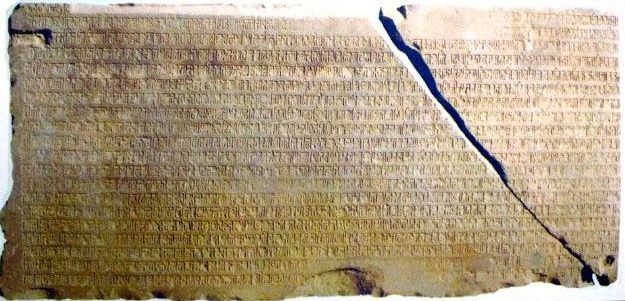
A : Yes. They got an inscriptionVishnuharisila Phalakam—after the masjid was demolished in 1992. It clearly states that this temple is dedicated to the Mahavishnu who killed Bali.

Hari-Vishnu Inscription

Q : So the crucial evidence was discovered during demolition, not during excavation?  

A : Yes. They got this evidence after the Masjid demolition, not during excavation. The critics first said it was an 18th-century inscription. Later they backed out. In reality, it’s a 12th-century inscription. There was also an allegation that such evidence was planted there. So, we checked with the Lucknow Museum. They confirmed that the inscription they possess remains with them.

Q : The popular narrative is that Babar demolished a temple and constructed a masjid. But do we have evidence to prove that Babar had demolished the temple? 

A : Babar’s military commander Mir Baqi (Baqi Tashqandihad led the demolition of the temple. There was an inscription in Persian which said Mir Baqi had demolished the temple. It could also have been a dilapidated structure.

Q : But there is a huge difference between demolishing a temple to build a masjid and constructing a masjid on the ruins of a dilapidated temple…. 

A : Many temples were demolished in medieval India. If you visit Delhi you can see Quwwat-ul-Islam Mosque near Qutub Minar (the mosque was built over the site of a temple). Some pages of Babar Nama have gone missing. Pages describing the activities of three months are missing. But there was an inscription that Mir Baqi had constructed the masjid. The demolition was part of a war and the Muslims of the current generation are in no way responsible for the act. But at the same time, Muslims should not defend the demolition of temples by some invaders. Christians do not justify what the Portuguese did in Goa.

Q : What were the findings of the 2003 excavations?

A : In 2003, a team led by B.R. Mani carried out an excavation using the Ground Penetrating Radar and found out there was a structure underneath. During the excavation, 12 pillars and more than 50 brick bases were discovered. The excavation team had experts from JNU/AMU  in addition to the Waqf committee’s lawyers, VHP people and members of the judiciary. It was fully recorded. About one-fourth of the workers were Muslims.

Q : Going by what you say, there was a 12th-century temple, and later a masjid was built on top of it in the 16th century. As an archaeologist do you agree with the demolition of a structure to unearth another one? 

A : No archaeologist would agree to the demolition of any historical structure. In this case, it had already been demolished. We now need to think about what’s the way forward.

Q : As an archaeologist, what did you feel when Babri Masjid was demolished in 1992? 

A : We were all shaken. Senior IAS officer I. Mahadevan had stated that we should not do wrong to correct a historical mistake that happened centuries ago. We were all against the demolition. It shouldn’t have happened.

Q : And as an Indian Muslim?

A : An archaeologist can never be a Muslim or a Hindu. We look at such matters objectively. I have faced stiff opposition from the Muslim community and Hindu groups on various occasions.

Q : Similar demands are now being made about Gyanvapi and Mathura? 

A : The Muslim community should be ready to willingly hand over its rights (to the structures at) Varanasi and Mathura, too, to the Hindus. Tension is bound to be there. But from a historic perspective, there cannot be a lasting solution to the whole issue without handing these two over. I always remind the Muslims that India, even after Partition, remains a secular country because of its Hindu majority.

Aurangzeb's firman against the Keshava Rai Temple in Mathura (13 October 1666).

Q : But won’t it lead to more tension? 

A : Ayodhya, Kashi and Mathura are three places as important to Hindus as Mecca and Medina are to Muslims. Hence, Muslims should be ready to willingly hand over these places.

Q : Is there sufficient evidence in Gyanvapi to support claims of a temple there? 

A : Yes. There may be Islamic inscriptions, but in totality, it is a Hindu structure. Also, there are many literatures which support this. This issue has created a major divide between the Hindus and the Muslims. So, handing it over to Hindus is the only lasting solution.

Aurangzeb's firman ording the demolition of the Vishwanath Temple at Kashi (August 1669).

Q : Gyanvapi is an 18th century structure. As an archaeologist, do you support demolishing such an old structure? 

A : The same issue had come up about Babri Masjid too. We can transplant these structures as such, without demolishing them. So far only four such transplants have been carried out in India. Of these, two were led by me—the Kurudi Mahadeva Temple and the Chaubis Avatar Temple in Madhya Pradesh.

Q : Whether Babri Masjid or Gyanvapi Mosque, these structures came into being as part of some historical moments. If we start correcting such historical errors, where would it lead us to?

A : That’s right. It’ll go on without any beginning or end. In Kerala itself, there are many such Buddhist temples and Jain temples that have later become Hindu temples. But if we take these three places as an exception—Ram Janmabhoomi, Krishna’s birthplace and Siva temple—that could prove to be the only and lasting solution to this issue. I think, if these two are handed over, all religious groups together can resolve this issue once and for all.

Q : Isn’t that just wishful thinking? The RSS-VHP reportedly has a list of close to 2,000 temples that were demolished to construct mosques….  

A : There won’t be any end if we go on like this. But unlike Semitic religions, the Hindu mind will not approve of such aggressiveness. You have to remember that many Hindus have stood with the Muslims in the fight against the Ram Mandir movement. Can you remember one instance where the Muslims stood for the cause of the Hindus?

Q : Isn’t Ayodhya more of a political issue than an archaeological or historical issue?

A : Yes, correct. It’s a political issue. It’s a fact that the BJP and the RSS try to use it with a motive to make political gains. At the same time, we need to understand the pain of lakhs of ordinary Hindu devotees. It would have been better if the Muslims could understand the pain of the Hindus.

Q : But aren’t these emotions created by politicians?

A : I accept there were attempts to whip up emotions. But even during my visit to Ayodhya in 1976-77, I could understand the heart-wrenching agony of the poor Hindus. Had it been Mecca or Medina, how many bombs would have exploded by now? Hindus allowed that structure to remain there for 500 years. We have to understand this magnanimity of Indian culture and Hinduism.

Q : A 16th century structure has been demolished and a huge structure built using modern technology. Do you think justice has been served?

A : The issue is not whether the act is justified or not. The structure has been demolished. If it was not demolished, ASI would not have allowed the construction of another structure within 300 metres from the structure. The disputed structure has gone and the new building has been constructed considering the requirements of the current time. It is an issue of faith and we have to make some compromises.

Q : Do you think the Ram Temple issue had been a pan-India issue at any point of time?

A : It was not a pan-India issue. But now it is growing to such levels. I accept that it is a political project.

Q : You say the Hindus were magnanimous. Where can we see such large-hearted Hindus now?

A : Compared to (followers of) other religions, Hindus are far better even now. They may react recklessly, playing with emotions, but they will think and correct themselves later. The Semitic religions will never be ready to compromise on their faith.

Q : Do you think there is an attempt to Semiticise the Hindu religion?

A : Yes. The Semitic religions have started influencing Hinduism. But it is a temporary phenomenon and will not be sustained. I am more concerned about the false scientific claims of Pushpaka Vimana, surgery, and stem cells mooted by even educated people who are inspired by the Hindu revival. The king of Saudi Arabia will not present the claims of Arab mythology in a science congress. But PM Modi had presented the claims of Indian sages who pioneered surgery. This has created concerns that Hinduism is losing its values.

Q : The lock of Babri Masjid was opened, allowing pooja, during the term of former Prime Minister Rajiv Gandhi. How significant was that move?

A : Opening the lock of the Masjid, in 1986, was the first important decision. Later, in 1989, he allowed pooja at the disputed structure. There was an unwritten agreement between renowned Islamic scholar Abdul Hassan Ali Nadwi and Rajiv Gandhi to solve the issue. The agreement was that if the Muslims allowed the opening of Babri Masjid, the government would bring a bill to overcome the Shah Bano case verdict.

Q : What happened then?

A : The Waqf committee, including Syed Shahabuddin, had favoured the agreement. But once the Shah Bano bill was passed, all except Abdul Hassan Ali Nadwi changed their stance. After Rajiv Gandhi’s death, the agreement was forgotten.

Q : It is rumoured that historian Irfan Habib played a role in scuttling the agreement. Is it true?

A : I don’t know about his role. I will not be objective while speaking about Irfan Habib, because I have personal enmity with him. He is my teacher but I have no respect for him.

Q : Do you think the stand of Kerala CPM in the Babri Masjid issue is inspired by arguments of the Marxist historians?

A : Irfan Habib plays a prominent role in influencing the stand of the Communists. Besides, the CPM took it as a political stand to win the support of Muslims. I found the stand of the Muslim League more acceptable.

Q : How do you see Congress’ decision not to attend the consecration ceremony?

A : Congress should have come forward in these things because Rajiv Gandhi took the initiative to open the lock of Babri Masjid. Congress should have understood the feelings of Hindus, but those who control Congress do not think along those lines.

Q : Do you mean to say the Congress failed to understand the north Indian Hindu psyche?

A : That’s what I feel. And they are also scared of the consequences. If Congress becomes irrelevant, who else is remaining? BJP has become a group that can stoop to any level. We feel sad in seeing the misuse of the agencies like the ED.

Q : But many consider you a BJP person? 

A : That’s what people think. I didn’t attend their (BJP’s) meeting though they invited me. I can be considered a Congressman because I share their liberal ideology.

Q : Your book Njanenna Bharatheeyan has created a controversy because you stated that the ASI is in a dead state during the BJP rule? 

A : Yes. The ASI has become a dead organisation and 10 years of BJP rule is a dark age of the organisation. I had undertaken the renovation of 80 temples that were destroyed in the earthquake in the Chambal area. We expected they (BJP) would be in the forefront of the renovation efforts. But not a single temple has been renovated in the last nine years.

Bateshwar temple ruins in the Chambal Valley. MP.

Q : According to you, Modi has not shown any interest in renovating other temples, but was keen on Ayodhya temple. So, Modi’s interest in Ayodhya is not religious, but political?

A : They (BJP) themselves admit that it was a political project (laughs out). It is a mix of both (smiles).

Q : You are a person familiar with different archaeological structures. In your opinion, which are the most amazing structures in India?

A : Hampi and Halebidu in Karnataka. If they were renovated properly, they would be more beautiful than Rome.

Q : Have heard you saying that the collection of books that Hiuen Tsang took from India was the basis for China’s development?    

A : (Hiuen Tsang) carried 751 books on the back of 20 horses to China. I-tsing carried with him 400 manuscripts. They translated these works and used them for their future growth. But our knowledge collections were destroyed by invaders.

Q : But isn’t it a usual practice for kings and emperors to destroy temples or mosques as part of the conquests? Do you think there is a religious undertone to it? 

A : Damage is indeed a part of subjugation, but there is a religious undertone too in the case of Semitic religions. But in the case of Indian conquests of other countries, like Indonesia or Malaysia, you will not see this kind of destruction.

Q : But Marathas also ransacked  many temples during their raids. … Similarly, Pandya king is said to have torched the Kanthaloor Sala in Thiruvananthapuram….

A : Yes … they ransacked temples, but they did not destroy them like Semitic invaders. Semitic religions think only they are correct.

Q : Is there any archaeological proof for the happenings in Ramayana and Mahabharata?

A : Yes. Events in Mahabharata must have happened after iron ore was discovered. As per our estimate, it happened between 1200 BC and 1300 BC. Ramayana happened in 1500 BC. There are archaeological findings in the regions between Kurukshetra and Mathura where events in Mahabharata may have unfolded.

Q : So, Ramayana and Mahabharata are not mythology but history?

A : Communists will say these are mythologies while right-wingers say it happened two lakh years before. Archaeologists will not accept any of these. Truth is actually in between. Mahabharata war must have been a tribal warfare, and not a world war as it has been made out (smiles).

Q : What are the changes that you have observed in Indian society since the day you joined ASI in 1976?

A : People in general have become more religious. This change is more evident in the case of Hindus. I would say Hindus are in a way being forced to be more organised like the Semitic religions.

Q : Upanishads are your favourite books?

A : Yes. I am a follower of Vivekananda (smiles).

Q : Heard you received many threats after the Ayodhya verdict?

A : Yes, there were threats. I had police security for three years. Even now I don’t go out frequently.

Q : Have you received an invitation for the consecration of the Ram Temple?

A : Yes. I have received an invitation. But I may not go due to health reasons. – The New Indian Express, 14 January 2024

The New Indian Express Team

Tracing the roots of hostility among Jews, Christians and Muslims – Arvind Sharma

Abrahamic Religions

The Arabs trace their origin to Ishmael, and the Jews trace their origin to Isaac. The struggle between them, therefore, dates back to the question: Who was the rightful heir to Abraham? – Prof. Arvind Sharma

The current tensions in the Middle East compel one to probe the roots of the hostility of the Christians and the Muslims towards the Jews, especially the hostility between the Jews and the Muslims. To trace the roots, one needs to go back to around 1800 BCE. That is the age in which Abraham, who is venerated by all three traditions, lived.

The Arabs trace their origin to Ishmael, and the Jews trace their origin to Isaac. The struggle between them, therefore, dates back to the question: Who was the rightful heir to Abraham? This issue has been the source of a lasting sibling rivalry.

It is not all conflict, however. According to the standard narrative, both the brothers buried Abraham together when he passed away.

The Jews, descendants of Isaac, finally found their kingdom in the promised land. They prospered, especially around 1000 BCE, giving us the legendary figures of David and Solomon. Thereafter, however, the Jewish kingdom fell prey to the various empires which arose in the Middle East, such as the Assyrian, the Babylonian, the Persian, and the Roman.

We fast forward now to the beginning of the Christian era when the Romans were ruling over the Jews. The prolonged period of political servitude had instilled in the Jews the hope that a great saviour, a messiah, would arise in due course to restore their sovereignty. It was in such an atmosphere of messianic expectation that Jesus was born. His charismatic personality and the miracles he performed raised the expectation in some quarters that he might be the messiah. But others wondered whether that could be the case, because of the aura of non-violence around him. Those who continued to believe that he was the messiah, even after his crucifixion, became the founders of Christianity. In other words, the key issue between the Jews and the Christians is whether Jesus was the messiah. The Christians accept him as such, and the Jews reject him as such.*

Just as the difference between the Jews and the Muslims goes back to the legacy of Abraham; the difference between the Jews and the Christians goes back to the legacy of Jesus Christ.

The difference between the Jews and the Christians is aggravated by the fact that, in the Christian scriptures, the Jews are depicted as responsible for the crucifixion of Jesus, although the crucifixion was formally carried out by the Romans. In Christian theology, Jesus is sometimes identified with God and, therefore, the Christians held the Jews responsible not just for the killing of Jesus Christ, but for killing God, or what is known as deicide.

Some historians argue that this was the result of the spread of Christianity in the Roman Empire. The Romans could not be held responsible for killing Jesus, because they were proving receptive to the message of Christianity, and therefore the blame for the death of Jesus Christ had to be shifted to the Jews. Christian theology not only aggravates but also complicates the relationship between the Jews and the Christians. Because Jews and Christians worship the same God, the Christians felt that God’s word to the Jews had also to be redeemed in some form. That is why Jews survived as a sect in the Roman Empire even though Christianity eliminated all other rival sects within the empire once it became the official religion.

Thus the hostility of both the Muslims and the Christians towards the Jews has deep historical roots. In recent times, however, the hostility between the Christians and the Jews has diminished because of the Holocaust, in which almost six million Jews were eliminated during the Nazi regime. Many Christians now feel guilty about this, and therefore tend to favour Israel.

The hostility between the Jews and the Muslims also went through a period when it was not as acute as it is now. During the sixteenth century, when the Jews were expelled from Christian Spain, they found shelter in the Muslim Ottoman Empire. Therefore, although the hostility between the Jews and the Muslims and the Jews and the Christians has deep historical roots, one should not fall prey to historical determinism and imagine it must always be so. It is possible that a modus vivendi may yet emerge. – News18, 23 November 2023

* Jews also reject the prophethood of Muhammad. – Editor

Prof. Arvind Sharma is the Birks Professor of Comparative Religion at McGill University in Montreal Canada, where he has taught for over thirty years. He has also taught in Australia and the United States and at Nalanda University in India. He has published extensively in the fields of Indian religions and world religions.

Abraham with Sarah and Hagar and their respective childrem Isaac and Ishmael.

About the ungodlike Abrahamic god – Michel Danino

Yahweh / Jehovah / Allah

I find it highly symbolic that Judaism should have been born in blood and fear, not out of love for its founding deity. It was a radical, unprecedented departure from the ancient world cultures. Naturally, it did not stop there and went on to find more fertile soils in Christianity and Islam. – Prof Michel Danino

Our first task … is to examine the Abrahamic concept of God at the root of the three monotheistic religions: Yahweh (later Jehovah) or Allah. I do not refer here to more ancient Greek, Norse or Celtic gods since, as we know, they lost the war against God with a capital “G”. (Some of them are now striving to revive, but even if they partly succeed, they will be little more than pale replicas of their original selves.)

The first thing that strikes the discerning Indian reader of the Old Testament, especially the Exodus, in which Jehovah first introduces himself to Moses under that name, is his ungodlike character. Jehovah is admittedly jealous: the second of the Ten Commandments reads, “You shall have no other gods before me,” while the third explicitly forbids the making and worship of any idols, “for I am a jealous God, punishing the children for the sin of the fathers”. Jehovah does speak as often of punishment as he does of sin, and periodically goes into a state of “fierce anger”, promising the most complete devastation of the Hebrews who reject him. Not content with cursing his reluctant followers, he also curses nation after nation, and finally the earth itself, which, as I pointed out earlier, he holds responsible for man’s sins: “The day of the Lord is coming—a cruel day, with wrath and fierce anger—to make the land desolate and destroy the sinners within it”. (Isaiah, 13:9). In fact, he is so obsessed with sin that one looks in vain in his oppressive berating and legislating for any hint of a higher spirituality, such as we find in the Upanishads or the Gita. Contrast his jealousy with Krishna’s insistence on spiritual freedom: “Whatever form of me any devotee with faith desires to worship, I make that faith of his firm and undeviating” (Gita, 7.21), or again: “Others … worship me in my oneness and in every separate being and in all my million universal faces” (9:15). But the god of the Bible and the Koran will have none of this catholicity.

If Jehovah had stopped there we might have found him to be simply a foul-tempered and libidinous god; after all, some Puranic gods too have such defects, although they usually retain a sense of their limits and compassion of which Jehovah is spotlessly guiltless. But he has a plan, he means business and knows that coercion alone can establish his rule: when the Hebrews over whom he is so keen to hold sway go back to their former worship of a “golden calf”, he orders through Moses that each of the faithful should “kill his brother and friend and neighbour” (Exodus 32:37). Instructions which were promptly complied with, for we are informed that 3,000 were killed on that fateful day; to crown his punishment, Jehovah “struck the people with a plague.”

Sri AurobindoI find it highly symbolic that Judaism should have been born in blood and fear, not out of love for its founding deity. As Sri Aurobindo put it, “The Jew invented the God-fearing man; India the God-knower and God-lover.” It probably took centuries for the old cults to disappear altogether, and a stream of prophets who sought to strike terror into the hearts of the Israelites. It was a radical, unprecedented departure from the ancient world cultures. Naturally, it did not stop there and went on to find more fertile soils in Christianity and Islam: earlier, Jehovah was content with being the god of the Hebrews alone; now, reborn in the new creeds, his ambition extended to the whole earth.

Increasingly aware of this cruel, irritable, egocentric and exclusivist character of Jehovah, many Western thinkers, specially from the eighteenth century onwards, rejected his claim to be the supreme and only god. Voltaire, one of the first to expose the countless inconsistencies in the Bible, could hardly disguise how it filled him with “horror and indignation at every page”. In particular, he found the plethora of laws dictated by Jehovah “barbaric and ridiculous”. The U.S. revolutionary leader and thinker Thomas Paine wrote of the Old Testament in his Age of Reason:

Whenever we read the obscene stories, the voluptuous debaucheries, the cruel and torturous executions, the unrelenting vindictiveness with which more than half the Bible is filled, it would be more consistent that we called it the word of a demon that the word of God. It is a history of wickedness, that has served  to corrupt and brutalise mankind; and, for my own part, I sincerely detest it, as I detest everything that is cruel.

Because a few intellectuals had the courage to state the obvious, the power of Christianity was greatly reduced in the West. Yet I have always marvelled that Indians should learn about Christianity neither from those bold Western thinkers nor from their own inquiry, but from bigots who continue to pretend that the Age of Enlightenment never happened. With the growth of materialistic science, in particular Darwinian evolution, such views which were revolutionary at the time of Voltaire, became widespread. Bernard Shaw, for example, described the Bible god as “a thundering, earth quaking, famine striking, pestilence launching, blinding, deafening, killing, destructively omnipotent Bogey Man.” Elizabeth Cady Stanton, the courageous U.S. pioneer of woman rights movement, wrote in 1898, “Surely the writers [of the Old Testament] had a very low idea of the nature of their God. They make Him not only anthropomorphic, but of the very lowest type, jealous and revengeful, loving violence rather than mercy. I know of no other books which so fully teach the subjection and degradation of woman.”  Mark Twain put it in his own way: “Our Bible reveals to us the character of our god with minute and remorseless exactness. The portrait is substantially that of a man—if one can imagine a man charged and overcharged with evil impulses far beyond the human limit…. It is perhaps the most damnatory biography that exists in print anywhere. It makes Nero an angel of light and leading by contrast.”  On another occasion he added, “It ain’t the parts of the Bible that I can’t understand that bother me, it is the parts that I do understand.” Freud, seeing in Jehovah an all too human creation, subjected him to psychoanalysis—a dream of a subject for a psychoanalyst. Aldous Huxley called the Old Testament “a treasure trove of barbarous stupidity [full of] justifications for every crime and folly.” In fact,  Huxley traced the “wholesale massacres” perpetrated by Christianity to Jehovah’s “wrathful, jealous, vindictive character, just as he attributed “the wholesale slaughter” of Buddhists and Hindus by invading Muslims to their devotion for a “despotic person”. Albert Einstein said, “I cannot imagine a God who rewards and punishes the objects of his creation, whose purposes are modelled after our own—a God, in short, who is but a reflection of human frailty.”

But is that all there is to the Abrahamic god? Are we simply faced with a man-made demon or the product of some fevered brain?  If you look at Jehovah in the light of Indian experience, it is striking that he has all the characteristic of an asura. Recall for a moment a being such as Hiranyakashipu: did he not, too, forbid all other cults? Did he not order that he alone should be worshipped as the supreme god? Did he not use fear and violence to try and coerce Prahlada? That he was stopped by a Divine manifestation, like many other asuras eager to possess this world, is another story; the point is that we find here the same seed of pride and cruelty as in Jehovah.

Now, to pinpoint Jehovah’s identity we must remember that he himself explains how “Yahweh” is a new name to the Hebrews: “By that name I did not make myself known to them” (Exodus 3:14 – 15, 6:3). But in the Old Testament Jehovah does not reveal his earlier name; it is only the early Christian Gnostic tradition, which was brutally suppressed by the growing orthodox school, that provides us with an answer—or rather two. In the Gnostic Gospels which survived centuries of persecution Jehovah is named either Samael, which means (appropriately) “the god of the blind”, or Ialdabaoth, “the son of chaos”. Thus one of the texts contain this revealing passage:

Ialdabaoth became arrogant in spirit, boasted himself over all those who were below him, and explained, “I am father, and God, and above me there is no one.”  His mother, hearing him speak thus, cried out against him, “Do not lie, Ialdabaoth; for the father of all, the primal Anthropos, is above you.

So not only was Jehovah not the Supreme God, but he also had a mother! For the Gnostics, like the Indians, refused to portray God as male only; God has to be equally female—and ultimately everything.

Another text , in the Secret Book of John, asks pertinently:

By announcing [that he is a jealous God] he indicated that another God does exist; for if there were no other one, of whom he be jealous?

In fact Jehovah is viewed in the Gnostic Gospels as no more than a demiurge or a subordinate deity—exactly as asuras are in Indian tradition. The French novelist Anatole France made use of apocryphal Gospels (rather the new fragments known in his time, for he wrote a few decades before the Nag Hammadi finds). In his perceptive novel The Revolt of the Angels, one of the rebellious angels depicts Jehovah thus:

I no longer think he is the one and only God; for a long time he himself did not believe so: he was a polytheist at first. Later on; his pride and flattery of his followers turned him into a monotheist…. And in fact, rather than a god he is a vain and ignorant demiurge. Those who, like me, know his true nature, call him “Ialdabaoth”…. Having seized a minuscule fragment of the universe, he has sown it with pain and death.

Now contrast this notion of God as tyrannical ruler wholly separate from his creation with the Indian notion of an all-encompassing, all-pervasive, all-loving Divine essence. In the language of the Upanishads:

He is the secret Self in all existence…. Eternal, pervading in all things and impalpable, that which is Imperishable … the Truth of things…. All this is Brahman alone, all this magnificent Universe.

If Jehovah depicts a radical departure from the ancient worships, it is in that he is “wholly other”, as Huxley puts it. Because of the unbridgeable gulf between him and his creation, no Jew or Christian would dare to declare, “I am Jehovah”, no  Muslim would dream of saying, “I am Allah.” But to the Hindu, so’ham asmi, “He am I”, or tat twam asi, “You are That”, is the most natural thing in the world—it is, in truth, the very first fact of the world. Again, can Christian parents christen their son “Jehovah” or Muslim parents name theirs “Allah” in the way a Hindu child can be called “Maheshwari”, “Purushottama” or “Parameshwara”?

Clearly, thus, if we use a single word—“God”—for such widely dissimilar concepts, we will land ourselves in total confusion. “God is one”, is perhaps, in the Vedantic sense that all is ultimately one, because all is ultimately Divine, and yet Hindu inquiry always discerned a whole hierarchy of beings, not all equally true or luminous:  a rakshasa, for instance, cannot be equated with a Krishna. Some may object to calling the Biblical or Koranic god an asura, but I use the word in the original sense of a mighty god who comes to his fall owing to ambition or pride. Moreover, the Indian approach has always claimed absolute freedom to inquire into every aspect of Divinity, from the most personal to the most transcendental: if the Abrahamic god happens to have the attributes of an asura rather than those of a supreme Reality, why should we look away from that essential difference? — Excerpt from Michel Danino’s book Indian Culture and India’s Future, via IndiaFacts, 17 December 2015

› French-born Prof Michel Danino is a historian and the author of The Lost River: On the Trail of the Sarasvati and Indian Culture and India’s Future. He used to teach at IIT Gandhinagar and is a member of the Indian Council of Historical Research.

Yahweh & Asherah