Rushdie’s Duplicity: A victim of Islamist violence makes Hindu nationalism an easy target – Utpal Kumar

Salman Rushdie

To watch Rushdie reprimand “Hindu nationalism” after surviving a near-fatal Islamist attack is therefore to witness a tragic spectacle: a man shaped by fear into criticising the safest opponent available. – Utpal Kumar

Soon after Salman Rushdie was stabbed by an Islamist madman in New York in August 2022, Gopalkrishna Gandhi wrote an article in the Hindustan Times, ‘The scorching truth of Rushdie’s ordeal’. While examining the Rushdie stabbing, Gandhi seemed oblivious to the attacker’s identity—the writer didn’t mention even once why the novelist was attacked, who the attacker was, or why Rushdie was forced to stay under cover for years despite issuing several apologies. Instead, he invoked Mahatma Gandhi’s assassination by a Hindu in 1948. His verdict became intriguingly problematic when he wrote, “The attack on Rushdie comes from the same source?”

Really!

Salman Rushdie’s latest warning about the “rise of Hindu nationalism” in Bharat seems to follow the same Left-‘liberal’ pattern—of, first, denying or at least minimising the scale of Islamist violence; and, second, if the scale of violence is too vast to ignore, creating an equivalence in Hinduism. It reads less like a principled stand and more like a man barking up the only tree that never bit him while fastidiously avoiding the forest of blades that left him with one eye less and a badly damaged liver.

The documented record of violence against Rushdie is neither vague nor debatable. It is exhaustively chronicled by many scholars, including Daniel Pipes, who, in his book The Rushdie Affair (1990), coined the term “Rushdie Rules” to describe how “editors, newspapers, publishers, and academic teachers abide by a new set of rules—new to modern Westerners at least—which limit the freedom to discuss Islam with the same methods, terminology and frank inquisitiveness that are considered normal in discussing Christianity or Hinduism”. Rushdie had himself written extensively about this in his 2012 memoir, Joseph Anton.

It was Ayatollah Khomeini’s fatwa that sent Rushdie into hiding. Then, there was the selective killing of no less than 45 people worldwide associated in one way or the other with The Satanic Versesthis included the murder of its Japanese translator, Hitoshi Igarashi, in 1991. Many were stabbed, including an Italian translator of the book in Milan; a Norwegian publisher was shot in Oslo. And, finally, it was an Islamist radical, Hadi Matar, who in 2022 stormed a stage in New York and plunged a knife repeatedly into Rushdie’s neck and abdomen, leaving him almost dead. All this is a living testament to the fact that Khomeini’s decree, as Daniel Pipes emphasises, “was never simply a religious opinion, but a death sentence with no expiry date”.

In contrast, Rushdie’s affair with Hindu nationalism is not only bloodless, it is anti-climactic in many ways. When he mocked Bal Thackeray and caricatured Hindu figures in The Moor’s Last Sigh (1995), the much-anticipated Hindutva havoc never materialised. Thackeray, far from issuing anything resembling a fatwa, responded with a shrug and the suggestion that his secretary could read the book for him.

This civilisational lopsidedness was noted by Koenraad Elst in his preface to The Rushdie Affair, where he contrasted the Ayatollahs’ unforgiving wrath despite Rushdie’s repeated apology with the quick closure of the Shivaji Maharaj controversy when Khushwant Singh apologised for calling the Maratha hero “a bastard”. In the Hindu case, an apology ended the matter. In the Islamist case, apology merely confirmed guilt. The difference is civilisational, not rhetorical.

Given this stark historical-civilisational difference, Rushdie’s latest denunciation of “Hindu nationalism” appears less like conviction and more like reflex—the reflex of a man who has learnt, through his own bloody experience, which ideologies kill and which merely complain. It is psychologically understandable, even if morally disappointing and intellectually dishonest.

A traumatised man avoids the bully but lectures the weak and gentle. Writers like Ayaan Hirsi Ali have described this phenomenon as the “fear-shaped silence” that hangs over critiques of Islamism. Rushdie may not be totally silent, but he is certainly cautious, careful to look for the safer target while framing his criticisms of Islamism within layers of diplomatic phrasing. He is well aware, better than anyone else, of the one ideology that puts a global contract on life that never gets revoked.

To watch Rushdie reprimand “Hindu nationalism” after surviving a near-fatal Islamist attack is therefore to witness a tragic spectacle: a man shaped by fear into criticising the safest opponent available. It is not courage; it is self-preservation masquerading as principle. And it underscores a deeper truth about our intellectual climate—the willingness of cultural elites to condemn, even cut, the tree that never struck them while tiptoeing around the jungle that nearly swallowed one of their own.

Rushdie’s warning about Hindu nationalism may win him applause in Left-‘liberal’ salons, but it is a misdirection that obscures the true, documented, bloodstained threat that has shadowed him for the past 36 years. If he is barking, he is barking up the wrong tree—and perhaps the only one that never bared its teeth.

Hindu nationalism, after all, did not force Rushdie into hiding. Hindu nationalism did not murder his colleagues. Hindu nationalism did not stab him on an American stage. Hindu nationalism did not declare that repentance is insufficient and that the sentence is eternal. Islamism did all of this, openly and repeatedly—an ideology that celebrates the likes of Hadi Matar.

Perhaps Rushdie the rebel, which he was once in the 1980s, is no more, as he himself had suggested in Joseph Anton. Recalling the moment in 1989 when a fatwa was issued against him by the Ayatollah of Iran, he remembered receiving a call from a woman BBC reporter who asked, “How does it feel to know that you have just been sentenced to death by the Ayatollah Khomeini?” It was a sunny Tuesday in London, but Rushdie had never felt the world so dark. “It doesn’t feel good,” he replied, though inwardly he thought, “I’m a dead man.”

Rushdie, the rebel writer, is long dead. Long live Rushdie! – Firstpost, 9 December 2025

› Utpal Kumar is Opinion Editor at Firstpost and News18 and is the author of the book “Eminent Distorians: Twists and Truths in Bharat’s History”.

From Dharma to Dogma: The genesis of caste – Acharya Prashant

Indians

India’s tragedy is that somewhere in history, caste and dharma were kneaded together like salt in dough. What began as a division of labour merged with notions of virtue and sin. Acting within one’s caste became dharma; going outside it became sin. – Acharya Prashant

Every few years, incidents remind us that caste persists in different avatars. Our Constitution guarantees equality, yet divisions control how we live, marry, vote, and worship. Knowingly or unknowingly, we judge people by birth. Caste survives despite legal systems, educational programs, and metropolitan anonymity.

We wrongly believe social reform alone can fix what is mostly psychological. Caste is not a census number; it is a paradigm of evaluation. People constitute systems; as long as people don’t inwardly change, systemic change won’t help much.

Caste and the Constitution

The Constitution guarantees liberty, equality, and fraternity. Yet caste persists because exclusivity, superiority, and material benefits are irresistible. Caste has become ingrained in habit, rooted in livelihood, kinship, and identity. Our constitutional principles are like rangoli patterns on the ground; they cannot change the soil underneath.

That soil pervades everyday life. Many trades favour one community over another. Marriage remains mostly endogamous, with nine of ten unions within caste. Lineage maps out towns and villages. And when voting time comes, we rarely cast our vote; we vote our caste.

When Caste Masquerades as Dharma

The persistence of caste cannot be explained by sociology alone. Laws may impact behaviour and reforms may change customs, but neither explains nor eradicates how caste has been sanctified in dharma’s name.

For humans, consciousness is paramount. An insult to self-worth hurts far more than bodily injury. More than our flesh, we protect our ‘feeling’ of being right: our dharma. Dharma is the inner compass for right seeing and living, man’s most sacred possession, guiding all people.

India’s tragedy is that somewhere in history, caste and dharma were kneaded together like salt in dough. What began as a division of labour merged with notions of virtue and sin. Acting within one’s caste became dharma; going outside it became sin.

If caste were only a social structure, reformers would have erased it. If merely legal, the Constitution would suffice. But caste is sustained in religious belief. It persists because it hides behind Dharma’s name.

As long as this false dharma based on birth endures, caste will endure. What is worshipped will not be questioned, and what is not questioned will not change.

The History of Caste: The Distortion of Dharma

To understand why caste became inseparable from Indian life, let’s start from the beginning. The Purusha Sukta in the Rigveda speaks of an all-encompassing Being from whom everything comes. The hymn is metaphorical: the Brahmin came from His mouth, the Kshatriya from His arms, the Vaishya from His thighs, the Shudra from His feet. The symbolism points at how every form of work emerges from the same living whole, without any mention of hierarchy.

The Rigveda differentiates between Arya and Dasa, indicating early social stratification. There is still a dispute about whether varna was originally fluid or hierarchical. The goal is not to prove a perfect history, but to understand that any tradition has both liberating and limiting parts. It is our ethics that decide the thread we will follow next.

The Upanishads are the best argument against caste because they don’t just reject birth-based differences; they also reject body identification. The Vajrasuchika Upanishad, for example, directly emphasises that caste is unreal. The Bhagavad Gita said that varna comes from guna (individual physical tendencies) and karma (individual choices), not birth.

Such scriptures were being composed and had sublime philosophy emphasizing egalitarianism. However, there was a critical lapse: the scriptures were limited to a few meditative thinkers who mostly remained aloof and out of touch with mainstream society. The authors of the scriptures presented their insights in books, but did not get into grounded social activism to turn the spiritual insights into social reality. So, concurrently with the heights of meditative revelations, the social order continued to have strong currents of discrimination. By about 400 BC, the Dharmasutras emerged to become practical social guides. ‘Dharma’ began to mean social order. Spiritual symbolism became social distortion, and these new ‘scriptures’ started to show inequality based on caste. Over time, these grew into Dharmashastras, remembered as law codes such as the Manusmriti. Here lay the tipping point. The Purusha Sukta was reread with harmful additions: claims of Brahmin superiority, prohibitions on hearing the Vedas, and punishments for non-compliance. The spiritual metaphor became a manual of social control.

Later, the Puranas reinforced these distortions. With the Puranas’ dualistic approach came theism, and the social order was declared divinely ordained. Now, rebelling against caste meant rebelling against God, who made the caste system. Story after story contained subtle caste validation. Divine avatars were consistently born into upper castes, while those who challenged varna faced curses or calamity. The logic was circular but effective: if the gods themselves observed caste, it must be cosmic law. In dualistic theology, God becomes the author of worldly hierarchy. What Advaitic philosophy had rejected, mythology now sanctified.

Advaita Vedanta maintained a steadfast intellectual stance: since all distinctions are illusory, how can caste be authentic? But as caste became the dominant social system, even Advaita found itself compromised between transcendental truth (paramarthik) and practical social order (vyavaharik). The peak of truth was accepted as the highest, but was made distant from the ground of lived reality.

Caste’s story, however, is not one of unbroken supremacy. The Buddha did not accept the authority of the Brahmins. Bhakti poets Saints Kabir, Ravidas, and Chokhamela ridiculed caste. Basava’s Veerashaivism and Guru Nanak’s teachings went against the idea of a hierarchy. However, even as Bhakti emphasized that all individuals are equal in the eyes of God, it did not quite revolt against the unequal social hierarchy. A strange co-existence of unequal social order with equality before God was not just accepted, but institutionalized in Bhakti mythology, social order and rituals.

The reform movements show that resistance to caste often does arise within the religious system. But the idea of equality is often reabsorbed by the strong current of social inertia. What started as a misinterpretation of scripture became a social law, then a habit, and finally institutionalized heredity. The lesson is serious: to fight caste, you need both spiritual clarity and institutional change.

The Economics of Discrimination

Endogamy, or marrying within one’s own group, is at the heart of caste. It keeps bloodlines and a sense of belonging, while creating psychological walls. When marriage becomes restricted, so does social intimacy—families stop sharing meals, homes, and lives with those outside their group. Communities that marry within closed circles risk losing genetic diversity and cultural exchange. The biological costs are real, but the cultural impoverishment runs deeper: when people cannot marry across lines, they struggle to see each other as equals.

Yet caste continues not just as a belief but also as a source of profit. The priest’s ritual authority gave him power over knowledge, while the landlord’s caste position made his hold on land and labour even stronger. Endogamy preserved not just bloodlines but property. By ensuring daughters married within the caste, families kept wealth and land concentrated, turning social boundaries into economic moats that protected privilege across generations.

The Path Forward: Returning from Smriti to Shruti

The solution cannot principally come from courts; it must arise from understanding dharma itself. Sanatan Dharma was never meant to be a set of strict rules and inherited beliefs. It was the dharma of Shruti, the direct revelation of Truth. The emphasis was on clarity of consciousness, not on divine commandments. Social order was to be a spontaneous and fluid outcome of individual realization. Over time, however, we began living by Smriti, frozen law, and social convention.

As long as Smriti remained faithful to Shruti, it guided society; when it diverged, it enslaved society. Much of what we call “Hindu practice” belongs to this later distortion, drawn more from the Manusmriti and Puranas than the Upanishads. We talk about Vedic heritage, yet we live by hierarchies that came after the Vedic period.

This appeal to return to Shruti has a crucial objection: what if the texts themselves are complicit? What if hierarchy is inherent rather than incidental?

We need to consider this criticism. If the Upanishads were enough, why did Vedantic philosophy persist alongside millennia of discrimination? Sublime texts alone do not ensure accurate interpretation. The conclusion is stark: for each truthful scripture, we also need an equally truthful interpreter. The interpretation, practically, is as important as the scripture itself. And this interpretation must be made socially widespread, though that task will face resistance from those whose power depends on distortion. So, we need culture and powerful institutions to ensure and defend scriptural wisdom’s rigorous interpretation and dissemination.

And a note of caution to the sage-philosopher: your job doesn’t stop at meditation, revelation and publication. You need to get into the society and ensure that the light seen by you becomes the living light of the common man. The philosopher, the meditator, the thinker can’t afford to hide in his cave, he will have to be, firstly a rebellious social activist, and secondly, a meticulous institution-builder. This will mean getting into the din of public life and sacrificing the serenity he so lovingly cherishes, but that’s the sacrifice life and history demand of him. If he refuses, the consequences of his self-absorption will be socially devastating.

Democratization of Interpretation

We must ask who has the authority to interpret Shruti. In the past, only Brahmins, especially priests, had that right. But we cannot have the same gatekeepers who let the truth get distorted in charge of bringing it back.

It is important to make interpretation more democratic. Shruti should be accessible not as a privilege but as a birthright of consciousness. This means having translations of the Upanishads in the vernacular language, open discourse, and the recognition that spiritual realisation, not lineage, is what qualifies someone to understand the Upanishads.

When religion diverges from philosophy, it transforms into a blind and violent force, serving as a tool of fear rather than liberation. The Upanishadic view starts where hierarchy stops. It sees the sacred not in birth but in realisation.

In Vedanta’s light, every division dissolves. The way forward is cleansing religion, valuing truth over tradition, realisation over recollection. No interpretation of any scripture is valid if it violates the principles inherent in the Mahavakyas “Aham Brahmasmi” and “Tat Tvam Asi”.

The Path in Practice

It begins with modern, scientific education of the ego-self in school and college curricula. Students must be exposed to the process of biological and social conditioning, the matter of false identities, and the question “Who am I?”.

Cultural change valuing the Upanishads over the Manusmriti must be promoted, as well as rigorous interpretation of Smriti texts true to the spirit of Vedanta. Religious institutions must open doors regardless of birth, and spiritual leaders should publicly reject caste-based privilege.

Legal and economic measures too remain vital: affirmative action, anti-discrimination enforcement, and equalisation of opportunity. The soil is renewed not by one hand alone but by many: the teacher, the reformer, the legislator, and the rebel. – The Pioneer, 8 November 2025

Acharya Prashant is a spiritual teacher, philosoper, poet and author of wisdom literature.

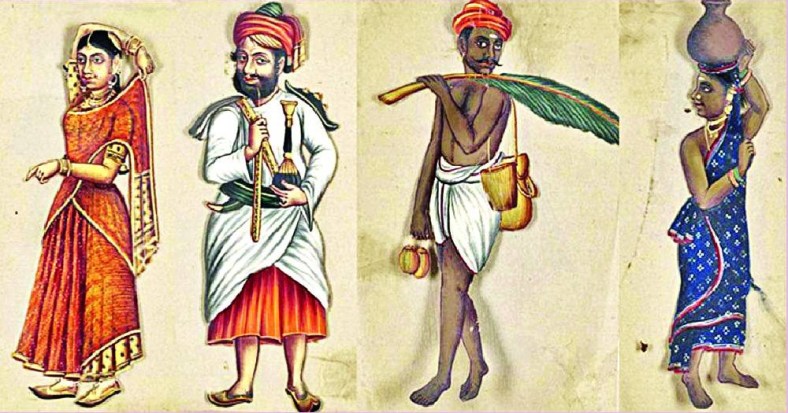
There are Brahmin, Kshatriya, Patel, Jain, Bania, Parsi, Saiyad, Pathan and Christian sanitation workers in Gujarat.

Hollywood’s distortion of Hindu symbols – Gautam Chintamani

J.R. Oppenheimer

By blurring the sacred with the profane, Hollywood erodes the capacity for distinction itself. If the Hindu swastika and the Nazi cross are interchangeable, if Krishna’s revelation and the mushroom cloud are comparable, if Bushido is nothing more than gangster loyalty, then moral categories collapse. The West’s darkest deeds can be cloaked in Eastern wisdom, while the East’s oldest traditions are dragged into the West’s nightmare. – Gautam Chintamani

Hollywood has always had a way of flattening differences. In the grand illusion of cinema, two things as far apart as night and day can, with the right framing, appear indistinguishable. The business of film thrives on archetypes, but sometimes the archetypes are chosen with so little care—or perhaps so much calculation—that they collapse distinct histories and philosophies into one misleading picture. As the world approaches the eightieth anniversary of the end of the Second World War, it is worth revisiting how Hollywood has systematically placed Eastern symbols into Western nightmares, encouraging audiences to see the sacred through the lens of the profane.

Two films, separated by more than sixty years, offer a striking study of this phenomenon: Stanley Kramer’s Judgment at Nuremberg (1961) and Christopher Nolan’s Oppenheimer (2023). Both films confront cataclysmic episodes in modern history—the Nazi crimes against humanity and the making of the atomic bomb—yet each imports Hindu symbols at decisive moments, almost as if to suggest that the moral ambiguities of the West and the spiritual legacies of the East occupy the same continuum. To the uninitiated viewer—and let us assume this is the overwhelming majority—these moments collapse cultural distances, turning difference into sameness.

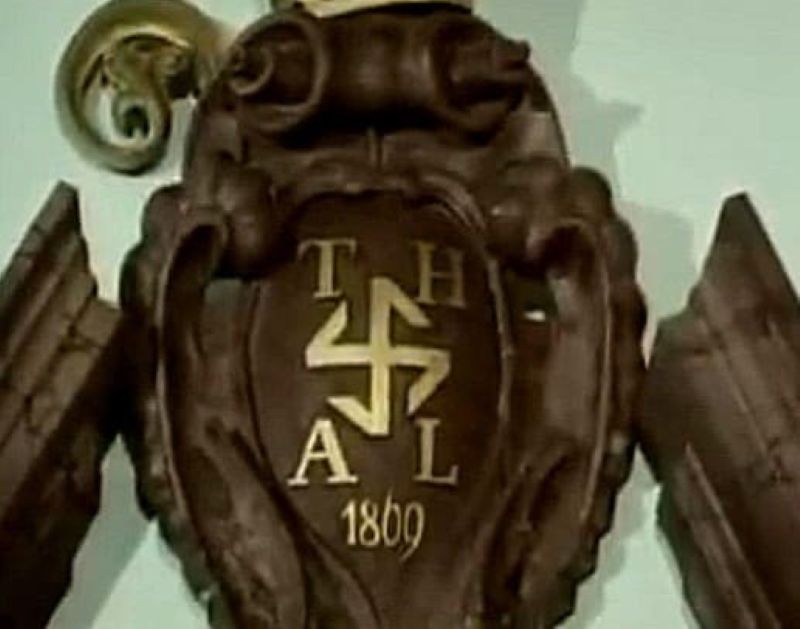
Consider Judgment at Nuremberg, whose opening credits depict the shattering of a swastika. At first glance, the symbolism is unambiguous: the icon of Nazi horror reduced to rubble. Yet the image that lingers on screen is not the crooked, tilted hakenkreuz of Hitler’s Reich but the upright, balanced form of the Hindu swastika, a sacred sign of prosperity and cosmic order that predates Nazism by millennia. The misrepresentation is not trivial. Symbols are repositories of collective memory. The Hindu swastika embodies cycles of life, cosmic balance, and good fortune; it appears on thresholds, marriage rituals, and the opening pages of business ledgers. By confusing it with a twentieth-century emblem of genocide, the film extends the Nazi theft of the symbol into the cultural memory of the West. The original meaning is obscured, the millennia-old inheritance distorted.

This conflation continues to reverberate. In 2021, a bill introduced in the New York Senate proposed that schools teach the swastika as a hate symbol, without distinction. Hindu and Buddhist organisations protested, pleading for nuance, but the damage was already in place. Once a sign has been recast on screen, it tends to stay recast.

If Kramer’s film blurs visual iconography, Nolan’s Oppenheimer entwines philosophy with spectacle. In one of the film’s most startling sequences, Robert Oppenheimer quotes from the Bhagavad Gita not in the laboratory or the lecture hall, but in the intimacy of a sexual encounter. As Jean Tatlock presses him to read aloud from a Sanskrit verse, he recites Krishna’s cosmic proclamation: “Now I am become Death, the destroyer of worlds.” The scene conflates erotic vulnerability with spiritual revelation, suggesting that the scientist’s deepest confession emerges not through moral reckoning but through carnal intimacy.

The quotation itself has long been debated. Oppenheimer knew Sanskrit and genuinely engaged with the Gita. Yet in the film, the context trivialises the source. Krishna’s words on the battlefield of Kurukshetra are a divine disclosure of cosmic duty and the eternity of the soul; they are not an endorsement of technological annihilation. By placing this moment in a boudoir rather than a battleground, the film distorts not just the scripture but its moral gravity. More troubling is the film’s broader posture.

Nolan’s portrait of Oppenheimer is sympathetic, even indulgent. The architect of the atomic bomb emerges as a tragic genius, crushed by politics and scapegoated by lesser men. The deaths at Hiroshima and Nagasaki recede into abstraction, almost footnotes to the protagonist’s inner torment. The climactic scene with President Truman, who dismisses Oppenheimer as a “crybaby,” allows the audience to pity the scientist while diverting attention from the annihilated civilians. The film invites us to grieve for the maker, not the victims. Hardly surprising then that the studios were clear in not releasing the film in Japan in its initial run—a market that for long has been second home for Hollywood.

In this reframing, Eastern philosophy functions as an alibi. The Gita becomes the text that gives Oppenheimer a language for his burden, as if the destruction of worlds could be sanctified by scripture. The appropriation universalises the bomb: no longer the invention of one nation’s scientists, but the cosmic destiny of humankind.

The misappropriation of Hindu symbols is not an isolated case. Hollywood has long repurposed Asian traditions, plucking them from their contexts and suturing them into Western narratives where their meanings are inverted or hollowed out.

As the world marks eighty years since the end of the Second World War, it is crucial to remember not only the horrors perpetrated but the symbols misused in their narration. The hakenkreuz was not the swastika; the Gita was not a manual for atomic warfare. Each had meanings far older, richer, and more humane than the distortions allowed.

These are not small distortions. Why do they persist? One answer lies in Hollywood’s appetite for the exotic. For decades, India, Japan, and China have been backdrops of mysticism, storehouses of symbols repurposed to lend profundity or menace.

Another answer is more unsettling. By blurring the sacred with the profane, Hollywood erodes the capacity for distinction itself. If the Hindu swastika and the Nazi cross are interchangeable, if Krishna’s revelation and the mushroom cloud are comparable, if Bushido is nothing more than gangster loyalty, then moral categories collapse. The West’s darkest deeds can be cloaked in Eastern wisdom, while the East’s oldest traditions are dragged into the West’s nightmare.

This was never a mere accident. Hollywood has long been an unofficial arm of the American state. FBI files and Cold War records show cultural appropriation was part of the soft-power playbook: projecting American myths while bending other civilisations’ icons inward. When the swastika is recast as eternal evil, or the Gita becomes the language of apocalypse, the damage is geopolitical.

A generation in India grows up unsure of what belongs to them, quick to doubt their inheritance. And the irony is unbearable: heirs to millennia of civilisation outsourcing their doubts to California while their certainties wither at home. Unless we wake up to these distortions, the oldest philosophies in the world will survive only as Hollywood subtitles — mistranslated, misused, and mistaken for someone else’s truth. – News18, 30 september 2025

Gautam Chintamani is a film historian, a voracious cinephile attuned to writing on the world cinema, Bollywood and everything in between.

Hakenkreuz in the Benedictine Monastery, Lambach, Austria.

Max Müller to Doniger to Orsini: The West sends Trojan horses to India – Abhijit Majumder

Trojan Horse

The West repeatedly sends academic Trojan horses who would erase and distort Indian history, attack self-esteem, construct divisive narratives, and collude with India’s own sell-out intelligentsia to project credibility. – Abhijit Majumder

India is the imperialist’s unfinished project. Few lands that have been touched by Christian or Islamic imperialists have managed to remain largely unconverted and geopolitically intact. In a little over 100 years since 1900, the centuries-old fluid indigenous faiths in the entire African continent, for instance, dwindled from 76 per cent of the population to just 8 per cent, having been replaced by the two hardcoded religions.

Bharat, or what remains of it after Pakistan and Bangladesh were created, still has not given in. Sanatan Dharma is still the way of life for more than 75 per cent of Indians, and in spite of the best efforts of invaders and colonialists, its nationalism and civilisational self is rising again, its economy rapidly growing, its military gaining muscle.

The mere presence of Bharat—with its staggering size, diversity, and potential—has unnerved the West enough across ages to repeatedly send academic Trojan horses who would erase and distort history, attack self-esteem, construct divisive narratives, and collude with India’s own sell-out intelligentsia to project credibility.

The controversy around Francesca Orsini, Hindi scholar from London-based SOAS, is a continuation of that. A white woman specialising in an Indian language may fascinate us, but a look into her political activism in academic guise begins to reveal a different story.

She accuses the very language she teaches, Hindi, of political usurpation of other languages. She has a problem with Indian nationalism. In 2020, she introduced a resolution in the Seattle City Council against India’s Citizenship Amendment Act (CAA) and the National Register of Citizens (NRC).

While India is not obligated to host those arriving to spread intellectual poison, Orsini was deported recently after landing in Delhi for gross violation of visa conditions during her previous visits. Orsini is a rather mediocre entrant in the galaxy of Western radicals who have got into the study of Indology, history, Sanskrit and other languages only to undermine Bharat.

German philologist Friedrich Max Müller, hired by the British colonialists in 1847, came with a mission to bury the Vedas, which he described in a letter to his wife as “the root of their religion, and to show them what that root is, I feel sure, the only way of uprooting all that has sprung from it during the last 3,000 years”. He also wrote: “The ancient religion of India is doomed, and if Christianity does not step in, whose fault will it be?”

Then there was James Mill, a Scottish historian and economist whose work, The History of British India (1817), divided Indian history into Hindu, Muslim, and British periods. In his book, Mill extensively describes Hindus as “uncivilised”, “barbaric”, “savage”, and “rude”. This gentleman wrote with astonishing confidence on India without once stepping on this land and no knowledge whatsoever of Indian languages.

The more recent gift horses from the West to India like Wendy Doniger, Sheldon Pollock, and Audrey Truschke employ a more sophisticated packaging but are no less venomous. Doniger uses psychoanalytic quackery to introduce a homosexual angle to the relationship between Ramkrishna Paramhansa and his disciple Swami Vivekananda; Pollock blames the Sanskrit language for the Holocaust; and Truschke swoons over the genocidal Mughal Aurangzeb.

India’s intellectual tradition is among the most welcoming mindscapes in the world. Bharat has continuously assimilated knowledge and made “outsiders” its own. Even in the modern era, it has been enriched by foreigners from Sister Nivedita to David Frawley, Michael Danino to Koenraad Elst, Francois Gautier to Maria Wirth. These scholars have taken a dharmic approach. They did not approach Indic knowledge with the mission to debase it.

But ultimately, Indians will have to take a major part of the blame for not taking up their own knowledge universe seriously, neglecting languages like Sanskrit, writing their own history, and leaving a vast vacuum for the likes of Orsini to fill.

Unless Bharat begins to take its own story seriously, vultures will come to feast. – News18, 25 October 2025

Abhijit Majumder is a senior journalist and editor-in-chief at Earshot Media, New Delhi. He is the author of the book, ‘India’s New Right’. 

George Orwell Quote


Why Hindu Americans can’t do what Jewish and Muslim Americans can – Surajit Dasgupt

Hindu Americans

The grievance that Hindu Americans do not lobby for India as Jews do for Israel is both premature and misplaced. Diaspora power is earned over generations, not asserted overnight. As Indian Americans mature politically, their challenge will be to balance pride in their roots with the pluralism that defines their adopted homeland. – Surajit Dasgupt

When Shashi Tharoor raised a seemingly provocative question about the global Hindu community’s inability to lobby for India the way Jews in the US advocate for Israel or Muslims campaign for Palestine, he tapped into a long-standing unease within sections of India’s diaspora. His remarks, made at a public event, drew swift responses from several non-resident Indians (NRIs) and persons of Indian origin (PIOs) in America. They countered that India’s decision-makers seldom consult them before taking major policy decisions—such as buying oil from Russia or voting at the United Nations—and that they are often treated merely as emotional extensions of the homeland rather than as stakeholders in policy outcomes.

At one level, the NRI lament is outlandish. No sovereign country consults its overseas citizens before making foreign or economic policy choices. Yet, Tharoor’s pin prick touched a raw nerve because it revealed a deeper question about influence: Why have Hindu Americans, despite their wealth and education, not attained the political leverage that Jewish-Americans enjoy, or the ideological coherence that binds American Muslims on issues like Palestine?

This comparison is not new, but it is newly urgent. Indian-Americans have risen rapidly in visibility over the past two decades, producing senior officials, business leaders and even members of Congress. Still, their collective political voice remains fragmented. To understand why, it helps to explore how other diasporas—particularly Jewish-Americans—built power over generations. That contrast begins with history.

Jewish experience, American integration

Jewish migration to America began in waves through the 19th century, driven by persecution in Europe and the promise of religious freedom. It was not easy, as American Christians were no less swayed by the notion that Jews were the ‘killers’ of Jesus Christ. One thing that the older Americans perhaps did not throw at the Jews is envy. European Christians—as much as Asian Muslims—were jealous of Jews, seeing the Israelites become the first among the followers of the three Abrahamic faiths to become rich, thanks to the business of interest on money considered evil in Christianity and Islam but not in Judaism. There were enough rich men in the capitalist US to resent Jewish riches.

Yet, the early Jewish settlers faced hostility, discrimination and exclusion. If Europe saw Jews portrayed as villains, American cinema portrayed Jews (and Blacks) as villains too.

Examples from classic English literature

  • The Canterbury Tales (c 1400): In “The Prioress’s Tale,” Jewish characters are depicted in a classic antisemitic blood libel, accused of murdering a devout Christian child.
  • The Jew of Malta (1590s): Christopher Marlowe’s play features Barabas, a greedy, treacherous, and murderous character, who helped define the “villain Jew” stereotype on the English stage.
  • The Merchant of Venice (c 1600): William Shakespeare’s Shylock is the most famous example of this archetype. Though given a humanising monologue, he is characterised as a vengeful moneylender who demands a “pound of flesh” and is ultimately forced to convert to Christianity—a “happy ending” for the Christian characters.
  • Oliver Twist (1838): Charles Dickens’s Fagin is a villainous “crafty old Jew” who runs a school for child pickpockets. Dickens initially referred to Fagin as “the Jew” over 250 times, reinforcing the association of criminality with his Jewish identity. After a Jewish reader criticised the portrayal, Dickens removed many of the references in later editions and created a positive Jewish character, Riah, in a later novel.
  • Trilby (1894): George du Maurier’s novel features Svengali, a manipulative Jewish rogue and hypnotist who dominates a young woman. The character was so influential that his name entered the English language as a term for a sinister manipulator.

When film emerged in the 20th century, many of these same stereotypes were transferred to the screen.

  • Antisemitic caricatures: The early 20th century saw the phenomenon of “Jewface,” vaudeville acts that featured exaggerated Jewish stereotypes with props like putty noses and fake beards. Early cinema adapted many of these tropes.
    Nazi propaganda: In the 1930s and 1940s, Nazi Germany weaponised these historical caricatures in its propaganda films to portray Jewish people as satanic, greedy, and inferior.
  • A 1943 production of The Merchant of Venice in Vienna, for example, depicted Shylock as a demonic figure to support Nazi ideology.
  • Controversial adaptations: The 1948 film adaptation of Oliver Twist was denounced by Jewish groups in America for its antisemitic depiction of Fagin, leading to the film’s postponement in the US.
  • The “Jewish American Princess” stereotype: Post-war Jewish male writers, and later cinema, popularised the “JAP” stereotype, portraying young, materialistic, and spoiled Jewish women.

That was until several rights movements in the 1960s forced the American racists to climb down their high horses.

Over time, the Jews in America organised themselves into tight-knit communities centred on synagogues, charities and cultural institutions. From the outset, Jewish immigrants recognised the necessity of solidarity to survive in a majority-Christian society. That solidarity evolved into political coordination.

By the early 20th century, Jewish newspapers, cultural organisations and philanthropic networks had formed a vast informal infrastructure for communal representation. After the horrors of the Holocaust, Jewish activism entered a new phase: moral urgency fused with political strategy. Groups such as the American Jewish Committee, the Anti-Defamation League (ADL), and later the American Israel Public Affairs Committee (AIPAC) refined lobbying into an art. They cultivated bipartisan connections, funded research centres and established think-tanks that shaped American opinion about Israel and anti-Semitism.

It took decades of sustained effort. Jewish leaders worked patiently to normalise pro-Israel positions within Washington’s mainstream. When critics today call US Middle East policy “tilted” towards Israel, they overlook how that tilt emerged from generations of community-building, strategic philanthropy and civic participation. The result is not merely influence over foreign policy but a broad societal sympathy for Jewish concerns—a by-product of cultural immersion through education, arts and civil rights movements.

Muslim identity, shared faith

The Muslim-American story is very different but equally instructive. Muslims in the US are far more ethnically diverse—comprising Arabs, South Asians, Africans and converts—yet they have gradually coalesced around faith-based advocacy. Their political influence is still evolving, but organisations such as the Council on American-Islamic Relations (CAIR) and the Islamic Society of North America (ISNA) have given them a public voice.

The Palestinian issue provides a coherent moral and political framework to all Muslims in the US, transcending their respective nationalities, with their advocacy prioritising a global Muslim identity. This communal psychology contributes to their emotional unity. Not the case with the Hindu-American community! Predominantly Indian in origin, Hindus in the US represent a single country but lack an equivalent unifying ideology. Moreover, if individually, Indians constitute no more than 1% of the American population—too small for lobbying—and Pakistanis, Bangladeshis, or Arabs are fewer than Indians, the Islamic collective makes up for the absence of a large number of migrants from one given country.

As a saving grace, Indian-Americans are hardly casteist and their separate denominations—like Vaishnava, Shaiva, Shakta, Smartha, etc—do not manifest in the US to the point where Hindu unity would become a tough ask. However, India’s internal political polarisation often spills into the diaspora, dividing Indian-Americans between secular liberals and those aligned with the ruling Bharatiya Janata Party (BJP).

Indian-American paradox

Indian-Americans are among the most prosperous ethnic groups in the United States, with high median incomes and remarkable educational attainment. Silicon Valley, academia and medicine are full of Indian success stories. Yet political power does not automatically follow economic success. Unlike Jewish or Muslim groups, Indian-Americans have not built long-term institutions for coordinated lobbying. The existing organisations—such as the US-India Political Action Committee (USINPAC) or the Hindu American Foundation (HAF)—operate in silos and often struggle for mainstream acceptance.

There is also a generational factor. The first wave of Indian immigrants in the 1960s and 70s arrived under professional visas, focused on assimilation and career advancement. Political activism was rare. Their children, more culturally confident and socially integrated, are beginning to enter politics—figures such as Pramila Jayapal, Ro Khanna, and Vivek Ramaswamy illustrate this new visibility—but ideological divisions persist. Jayapal’s left-leaning stance on India’s human rights record often clashes with the nationalist sentiment of conservative Hindus. Consider how desperate Ramaswamy was during the Trump campaign to prove Hinduism isn’t too un-Christian, after all!

Most awkwardly, Hindus under the overseas wings of the Sangh Parivar need to work in coordination with Pakistani and Indian Muslims—including with CAIR and ISNA activists—in the US so that the South Asian identity looks significant and prominent enough to pressure the American policy makers.

Even symbolic recognition has come slowly. When one American state declared October 2022 as the “Hindu Heritage Month”, it was celebrated as a milestone. But as the activists who pushed for it admitted, Hispanics took nearly three decades to achieve comparable recognition. Diaspora influence takes time—and unity.

Politics of access, perception of influence

The optics of Prime Minister Narendra Modi’s warm rapport with Donald Trump during the latter’s first presidency created an illusion of extraordinary Indian-American influence. The “Howdy Modi” rally in Houston in 2019, where the two leaders walked hand in hand before a cheering crowd, suggested that the community had arrived as a political force. Yet that perception was misleading. It reflected personal chemistry, not institutional power.

When Trump returned to office for a second term, expectations of deeper India-US alignment quickly met geopolitical reality. Washington’s interests in China, trade and global security do not shift with diaspora enthusiasm. The limits of Indian-American leverage became clear, underscoring how different it is from the entrenched Jewish lobby or even the organised Muslim advocacy on Palestine and civil rights.

Long road to influence

Diaspora influence, as history shows, matures over generations. The Jewish experience offers the clearest example. From the early 20th century to the post-Holocaust era, Jewish-Americans worked through education, philanthropy and coalition-building. They forged alliances with African-Americans during the civil rights movement, ensuring moral reciprocity when they later defended Israel’s legitimacy. Their activism was institutional, not episodic.

For Indian-Americans, such institutional continuity is still forming. The community’s philanthropic energies are vast but scattered. Major donors fund temples, educational foundations and disaster relief, yet few invest strategically in think-tanks or policy advocacy. Nor is there consensus on which issues to champion. Should lobbying focus on India’s image, on global Hindu identity, or on broader multicultural representation? Each objective attracts different constituencies, often at cross purposes.

Cultural perception, historical memory

Then, influence does not depend on money or access alone; your narrative is an edifice built upon the foundation of the memories of your community as a collective. For Jewish-Americans, the memory of persecution provided a moral foundation for activism. Anti-Semitism in Western literature and film gradually gave way to empathy and representation, transforming public attitudes. Today, Jewish characters in American media are complex, human and often central to moral storytelling. This cultural normalisation underpins political legitimacy.

Indian-Americans, by contrast, are still defining their narrative. The Western imagination often reduces India to stereotypes of spirituality or poverty. Despite recent Bollywood popularity and the global reach of Indian cuisine, the Hindu identity remains poorly understood. Worse, political controversies—over caste, majoritarianism or Kashmir—have made the term “Hindutva” contentious abroad, complicating outreach efforts.

Future of diaspora advocacy

If Indian-Americans are to build real influence, they must learn from the patience and organisation of their Jewish counterparts. Effective lobbying requires consensus, credible institutions and a shared sense of purpose beyond partisan divides. It also demands bridging the gap between India’s domestic politics and the pluralist expectations of American democracy.

For now, the community’s most powerful asset remains its credibility: hardworking professionals with high civic participation and low crime rates. Translating that respectability into political leverage will take time—and strategic discipline.

The grievance that Hindus do not lobby for India as Jews do for Israel is, therefore, both premature and misplaced. Diaspora power is earned over generations, not asserted overnight. As Indian-Americans mature politically, their challenge will be to balance pride in their roots with the pluralism that defines their adopted homeland.

Tharoor’s question, then, was less an accusation than an invitation—to imagine what an organised, confident and inclusive Indian-American voice could achieve if it learned from history. – News18, 15 October 2025

Surajit Dasgupta is a senior journalist and writer.

Hinduphobia


Christianity’s fraudulent legacy – M. Paulkovich


Jesus saves ...or else!

The cult of Christianity has an incalculable amount of blood on its hands. And the Jesus tale seems to have been nothing more than oral legend, with plenty of hoax and fraud perpetrated along the ages. – Michael Paulkovich

Most historians hold the position I had once harbored as true, being a Bible skeptic but not a Christ mythicist. I had maintained that the Jesus person probably existed, having fantastic and impossible stories later foisted upon his earthly life, passed by oral tradition then recorded many decades after Jesus lived.

After exhaustive research for my first book, I began to perceive both the brilliance and darkness from history. I discovered that many early Christian fathers believed with all pious sincerity their savior never came to earth—or when he did, it was Star-Trekian style, beamed down pre-haloed and fully-grown, sans transvaginal egress. Moreover I expose many other startling bombshells in my book No Meek Messiah: Christianity’s Lies, Laws, and Legacy.

I embarked upon one exercise to revive research into Jesus-era writers who should have recorded Christ tales, but did not. John Remsburg enumerated forty-one “silent” historians in his book The Christ (1909). I dedicated months of research to augment Remsburg’s list, finally tripling his count. In No Meek Messiah I provide a list of 126 writers who should have recorded something of Jesus, with exhaustive references.

Perhaps the most bewildering “silent one” is the mythical super-savior himself, Jesus the Son of God ostensibly sent on a suicide mission to save us from the childish notion of “Adam’s Transgression” as we learn from Romans 5:14. The Jesus character is a phantom of a wisp of a personage who never wrote anything. So, add one more: 127.

The Jesus character is a phantom 

Jesus is lauded as a wise teacher, savior, and a perfect being. Yet Jesus believed in Noah’s Ark (Mt. 24:37, and Lk. 17:27), Adam and Eve and their son Abel (Lk. 3:38 and Lk. 11:51), Jonah living in a fish or whale (Mt. 12:40), and Lot’s wife turning into salt (Lk. 17:31-32). Jesus believed “devils” caused illness, and even bought into the OT notion (Jn. 3:14) that a magical pole proffered by the OT (Num. 21:9) could cure snake bites merely by gazing upon it.

Was Jesus smarter than a fifth grader?

Apollonius of Tyana

But perhaps no man is more fascinating than Apollonius Tyaneus, saintly first century adventurer and noble paladin. Apollonius was a magic-man of divine birth who cured the sick and blind, cleansed entire cities of plague, foretold the future and fed the masses. He was worshipped as a god, and son of god. Despite such nonsense claims, Apollonius was a real man recorded by reliable sources.

As Jesus ostensibly performed miracles of global expanse (e.g. Mt. 27), his words going “unto the ends of the whole world” (Rom. 10), one would expect virtually every literate person on earth to record those events during his time. A Jesus contemporary such as Apollonius should have done so, as well as those who wrote of Apollonius. Such is not the case. In Philostratus’ third century chronicle, Vita Apollonii, there is no hint of Jesus. Nor in the works of other Apollonius epistolarians and scriveners: Emperor Titus, Cassius Dio, Maximus, Moeragenes, Lucian, Soterichus Oasites, Euphrates, Marcus Aurelius, or Damis of Hierapolis. It seems none of these writers from first to third century ever heard of Jesus, global miracles and alleged worldwide fame be damned.

Another bewildering author is Philo of Alexandria. He spent his first century life in the Levant, even traversing Jesus-land. Philo chronicled Jesus contemporaries—Bassus, Pilate, Tiberius, Sejanus, Caligula—yet knew nothing of the storied prophet and rabble-rouser enveloped in glory and astral marvels. Historian Josephus published Jewish War ca. 95. He had lived in Japhia, one mile from Nazareth—yet Josephus seems to have been unaware of both Nazareth and Jesus. (I devoted a chapter to his interpolated works, pp. 191-198.) You may encounter Christian apologists claiming that Pliny the Younger, Tacitus, Suetonius, Phlegon, Thallus, Mara bar-Serapion, or Lucian wrote of Jesus contemporary to the time. In No Meek Messiah I thoroughly debunk such notions.

The Bible venerates the artist formerly known as Saul of Tarsus, an “apostle” essentially oblivious to his heavenly saviour. Paul is unaware of the virgin mother, and ignorant of Jesus’ nativity, parentage, life events, ministry, miracles, apostles, betrayal, trial and harrowing passion. Paul knows neither where nor when Jesus lived, and considers the crucifixion metaphorical (Gal. 2:19-20). Unlike the absurd Gospels, Paul never indicates Jesus had been to earth. And the “five hundred witnesses” claim (1 Cor. 15) is a well-known forgery.

Qumran, the stony and chalky hiding place for the Dead Sea Scrolls lies twelve miles from Bethlehem. The scroll writers, coeval and abutting the holiest of hamlets one jaunty jog eastward never heard of Jesus. Dr. Jodi Magness wrote, “Contrary to claims made by a few scholars, no copies of the New Testament (or precursors to it) are represented among the Dead Sea Scrolls.

Christianity was still wet behind its primitive and mythical ears in the second century, and Christian father Marcion of Pontus in 144 CE denied any virgin birth or childhood for Christ—Jesus’ infant circumcision (Lk. 2:21) was thus a lie, as well as the crucifixion! Marcion claimed Luke was corrupted, and his saviour self-spawned in omnipresence, a spirit without a body (see Dungan, 43). Reading the works of second century Christian father Athenagoras, one never encounters the word Jesus (or Ἰησοῦς or Ἰησοῦν, as he would have written)—Athenagoras was thus unacquainted with the name of his saviour it would seem. Athenagoras was another pious early Christian, unaware of Jesus (see also Barnard, 56).

The original booklet given the name “Mark” ended at 16:8, later forgers adding the fanciful resurrection tale (see Ehrman, 48). The booklet “John” in chapter 21 also describes post-death Jesus tales, another well-known and well-documented forgery (see Encyclopedia Biblica, vol. 2, 2543). Millions should have heard of the Jesus “crucifixion” with its astral enchantments: zombie armies and meteorological marvels (Mt. 27) recorded not by any historian, but only in the dubitable scriptures scribbled decades later by superstitious yokels. The Jesus saga is further deflated by the reality of Nazareth, having no settlement until after the 70 CE war—suspiciously around the time the Gospels were concocted, as René Salm demonstrates in his book. I also include in my book similarities of Jesus to earlier God-sons, too striking to disregard. The Oxford Classical Dictionary and Catholic Encyclopedia, as well as many others, corroborate. Quite a few son-of-gods myths existed before the Jesus tales, with startling similarities, usually of virgin mothers, magical births and resurrection: Sandan, Mithra, Horus, Attis, Buddha, Dionysus, Krishna, Hercules, Isiris, Orpheus, Adonis, Prometheus, etc.

The one true religion

If you encounter a Christian defending her faith purely based on its popularity, you would do well to inform her that Christianity was a very minor cult in the fourth century, while “pagan” religions, especially Mithraism, were much more popular in the Empire—and the Jesus cult would have faded into oblivion if not for an imperial decree.

From No Meek Messiah: It is 391 CE now as Roman Emperor Theodosius elevates Jesus (posthumously) to divinity, declaring Christianity the only “legitimate” religion of the world, under penalty of death. The ancient myth is rendered law. This decision by Theodosius is possibly the worst ever made in human history: what followed were century after century of torture and murder in the name of this false, faked, folkloric “prophesied saviour” of fictional virgin mother. Within a year after the decree by Theodosius, crazed Christian monks of Nitria destroy the majestic Alexandrian Library largely because philosophy and science are taught there—not the Bible. In Alexandria these are times of the highest of intellectual pursuits, all quashed by superstitious and ignorant Christians of the most godly and murderous variety: they had the “Holy Bible” on their side.

Emperor Theodosius I could have had no idea how much harm this blunder would cause humanity over the centuries that followed. Christianity was made the only legal cult of the empire, and for the next 1500 years, good Christians would murder all non-Christians they could find by the tens of millions.

Frauds and forgeries

Along the centuries the Church has sought to gain power and wealth, and No Meek Messiah exposes their many scams and deceits and obfuscations in detail including:

  • Abgar Forgeries (4th century)
  • Apostolic Canons (400 CE)
  • Hypatia the Witch (415 CE)
  • Symmachian Forgeries (6th century)
  • St. Peter Forgery (ca. 751)
  • False “Donation of Constantine” (8th century)
  • False Decretals (8th century)
  • Extermination of the Cathar “witches” (13th century)
  • Murder of the Stedinger “devils” (1233)
  • The Manifest Destiny decree (1845) and eradication of Native Americans
  • Invention of the “Immaculate Conception” (1854)
  • The Lateran Treaty (1929)

St. Paul overseeing the burning of books at Ephesus.

The good that Jesus brought

Early Christians believed all necessary knowledge was in the Bible and thus closed down schools, burned books, forbade teaching philosophy and destroyed libraries. The Jesus person portrayed in the Bible taught that “devils” and “sin” cause illness, and thus for some 1700 years good Christians ignored science and medicine to perform exorcisms on the ill.

The Bible decrees “Thou shalt not suffer a witch to live” (Ex. 22:18, with support from Dt. 18:10-12, Lev. 20:27, 2 Chr. 33:6, Micah. 5:12, and 1 Sam. 28:3). In the New Testament, Paul in Galatians 5:19-21 joins the anti-witchcraft credo. But let’s face it: Paul claims to be a devoted Hebrew, full of credulity and misogyny. Paul will “suffer not a woman to teach” and thus along the centuries women have been second-class citizens, especially within the Church. These juvenile and immoral Bible edicts are not left in the past.

From No Meek Messiah: Remember the witch hunts? Long ago and far away, past atrocities forgotten? So perhaps we should forgive and forget. Around the world, the Christian Bible is still used to accuse people, usually children, of “witchcraft” and to punish them. Refer to The Guardian, Sunday, 9 December 2007, “Child ‘witches’ in Africa”; Huffington Post, October 18, 2009, “African Children Denounced As ‘Witches’ By Christian Pastors”; and The Guardian, Friday 31 December 2010, “Why are ‘witches’ still being burned alive in Ghana?” The scripture normally cited regarding witches is Exodus 22:18, and there are many more. In Ghana, a study found that “accused witches were physically brutalised, tortured, neglected, and in two cases, murdered.” In Kinshasa, Congo, “80% of the 20,000 street children … are said to have been accused of being witches.” Even to this day the Bible’s proclamations against witches are still considered valid by many Christians. In places like Indonesia, Tanzania, the Congo and Ghana superstitious fundamental Christians actively pursue and execute witches, including murdering child “sorcerers.” In Malawi, accused witches are routinely jailed.

Christians are typically kept ignorant of certain evil and immoral words placed into the mouth of this mythical mystery-man:

“If any man come to me, and HATE NOT his father, and mother, and wife, and children, and brethren, and sisters, yea, and his own life also, he cannot be my disciple.” – Luke 14:26.

Jesus is actually portrayed as a pitiful man in desperate need of praise:

“He that loveth father or mother more than me is not worthy of me: and he that loveth son or daughter more than me is not worthy of me.” – Matt. 10:37.

Not only does Jesus never advise against slavery, but he recommends savage whipping of disobedient slaves:

“And that servant, which knew his lord’s will, and prepared not himself, neither did according to his will, shall be beaten with many stripes.” – Luke 12:47.

Jesus has nothing against stealing, as he instructs his apostles to pinch a horse and a donkey from their rightful owner:

“And when they drew nigh unto Jerusalem, and were come to Bethphage, unto the Mount of Olives, then sent Jesus two disciples, Saying unto them, Go into the village over against you, and straightway ye shall find an ass tied, and a colt with her: loose them, and bring them unto me. And if any man say ought unto you, ye shall say, The Lord hath need of them; and straightway he will send them.” – Matt. 21:1-3.

Gentle and meek and mythical

I personally know several Christians who accept evolution as scientific fact. Okay, they kind of ignore the Old Testament, but I asked one born again Christian about the genealogy of Jesus and she was only aware of another one in Luke.

From No Meek Messiah: Christianity absolutely depends on mythical “Adam.” Without Adam, Eve, and a talking snake, Jesus’ mission is moot and pointless and void. Christians are generally oblivious of this because they have been shown a genealogy in Matthew (which only goes back to “Abraham”), and are rarely if ever exposed to Luke’s disparate and childlike version—which if true would negate all of evolution and in fact most known history and science. According to the anonymous author of Luke, a mere seventy-five generations separate “Adam”—and the beginning of the universe—from the birth of Jesus some 2,000 years ago.

This “meek” messiah boasted he was “greater than Solomon” (Mt. 12:42), saying he “came not to send peace, but a sword” (Mt. 10:34), and  (Lk. 12:49). Jesus desperately needs your praise (Mt. 10:37), and advises you to beat your slaves.

Yahweh / Jehovah

This Jesus character speaks highly of father Yahweh‘s genocidal tantrums in Matthew 11:20-24. Jesus is referring to the book of Joshua where his father declares he will wipe out all people of Sidon: “All the inhabitants of the hill country from Lebanon unto Misrephoth-maim, and all the Sidonians, them will I drive out from before the children of Israel”.

You may have heard Christians claim that the only “god hates fags” verbiage comes from the Old Testament (Lev. 18:22), but both Paul (in Rom. 1:26-27) and Jesus speak out against it, as the J-man praises the ruin of Gaytown, Canaan: “But the same day that Lot went out of Sodom it rained fire and brimstone from heaven and destroyed them all.” – Luke 17:29.

Onward Christian soldiers

Christianity has a violent “holy book” as its authority, granting followers supremacy over the entire earth (e.g. Gen. 1:28) which they used to justify land grabs, genocide and holy conflicts. The following wars were perpetrated by Christians in the name of their saviour:

  1. War against the Donatists, 317 CE
  2. Roman-Persian War of 441 CE
  3. Roman-Persian War of 572-591 CE
  4. Charlemagne’s War against the Saxons, 8th century
  5. Spanish Christian-Muslim War of 912-928
  6. Spanish Christian-Muslim War of 977-997
  7. Spanish Christian-Muslim War of 1001-1031
  8. First Crusade, 1096
  9. Jerusalem Massacre, 1099
  10. Second Crusade, 1145-1149
  11. Spanish Christian-Muslim War, 1172-1212
  12. Third Crusade, 1189 CE
  13. War against the Livonians, 1198-1212
  14. Wars against the Curonians and Semigallians, 1201-90
  15. Fourth Crusade, 1202-04
  16. Wars against Saaremaa, 1206-61
  17. War against the Estonians, 1208-1224
  18. War against the Latgallians and Selonians, 1208-1224
  19. Children’s Crusade, 1212
  20. Fifth Crusade, 1213
  21. Sixth Crusade, 1228 War against the Livonians, 1198-1212
  22. Spanish Christian-Muslim War, 1230-1248
  23. Seventh Crusade, 1248
  24. Eighth Crusade, 1270
  25. Ninth Crusade, 1271-1272
  26. The Inquisitions
  27. War against the Cathars, 1209-1229 and onward
  28. War against the Stedingers of Friesland, 1233
  29. Spanish Christian-Muslim War, 1481-1492
  30. Four Years War of 1521-26
  31. Count’s War of 1534-36
  32. Schmalkaldic War, 1546
  33. Anglo-Scottish War of 1559-1560
  34. First War of Religion,1562
  35. Second War of Religion, 1567-68
  36. Third War of Religion, 1568-70
  37. Fourth War of Religion, 1572-73
  38. Fifth War of Religion, 1574-76
  39. Sixth War of Religion, 1576-77
  40. Seventh War of Religion, 1579-80
  41. Eighth War of Religion, 1585-98
  42. War of the Three Henrys, 1588
  43. Ninth War of Religion, 1589—1598
  44. Ottoman-Habsburg wars, 15th to 16th century
  45. War against the German Farmers (“peasants”), 16th Century
  46. The French Wars of Religion, 16th Century
  47. Shimabara Revolt, 1637
  48. Covenanters’ Rebellion of 1666
  49. Covenanters’ Rebellion of 1679
  50. Covenanters’ Rebellion of 1685
  51. The Thirty Years War, 17th Century
  52. The Irish rebellion of 1641
  53. Spanish Christian extermination of South American natives
  54. Manifest Destiny
  55. War of the Sonderbund, 1847
  56. Crimean War, 1853-1856
  57. Tukulor-French War, 1854-1864
  58. Taiping Rebellion, 1851 and 1864
  59. Serbo-Turkish War, 1876-78
  60. Russo-Turkish War, 1877-1878
  61. Russian Revolution killing of the Jews, late 19th century
  62. First Sudanese Civil War, 1955-1972
  63. Nigerian Civil War, 1967
  64. Lebanese Civil War, 1975
  65. Sabra and Shatila massacre, 1982
  66. Second Sudanese Civil War, 1983
  67. Yelwa Massacre, 2004
  68. Bosnian War

A relatively unknown contrivance occurred in the thirteenth century when Pope Innocent III ordered a genocidal attack against the entire region of Languedoc France. The pope depicted the Cathars as witches; of being cannibals; desecrating the cross; and having “sexual orgies.”

Yet malefic sounds of sibilance emanated only from the Vatican, and not from its contrived enemies living peaceably in France with their pure and righteous ways. The Church murdered over a million innocent Cathars over the period of 35 years—men, women, children. Christian forces wiped them from the face of the planet. At the height of the siege, Christian forces were burning hundreds at the stake at a time. The Christian colossus exterminated them, then annexed much of Languedoc—some for the Church, some from northern French nobles. The extravagant Palais de la Berbie (construction began in 1228) and the Catholic fortress-cathedral Sainte Cécile (began 1282) are just two examples that remain to this day.

The Silent Historians

Conclusion

When I consider those 126 writers, all of whom should have heard of Jesus but did not, and Paul and Marcion and Athenagoras and Matthew with a tetralogy of opposing Christs, the silence from Qumran and Nazareth and Bethlehem, conflicting Bible stories, and so many other mysteries and omissions, I must conclude this “Jesus Christ” is a mythical character. “Jesus of Nazareth” was nothing more than urban (or desert) legend, likely an agglomeration of several evangelic and deluded rabbis who might have existed.

The “Jesus mythicist” position is regarded by Christians as a fringe group. But after my research I tend to side with Remsburg—and Frank Zindler, John M. Allegro, Thomas Paine, Godfrey Higgins, Robert M. Price, Charles Bradlaugh, Gerald Massey, Joseph McCabe, Abner Kneeland, Alvin Boyd Kuhn, Harold Leidner, Peter Jensen, Salomon Reinach, Samuel Lublinski, Charles-François Dupuis, Rudolf Steck, Arthur Drews, Prosper Alfaric, Georges Ory, Tom Harpur, Michael Martin, John Mackinnon Robertson, Alvar Ellegård, David Fitzgerald, Richard Carrier, René Salm, Timothy Freke, Peter Gandy, Barbara Walker, Thomas Brodie, Earl Doherty, Bruno Bauer and others—heretics and iconoclasts and freethinking dunces all, according to “mainstream” Bible scholars.

If all this evidence and non-evidence including 126 silent writers cannot convince, I’ll wager we will uncover much more. Yet this is but a tiny tip of the mythical Jesus iceberg: nothing adds up for the fable of the Christ. In the Conclusion of No Meek Messiah I summarise the madcap cult of Jesus worship that has plagued the world for centuries. It should be clear to even the most devout and inculcated reader that it is all up for Christianity, and in fact has been so for centuries. Its roots and foundation and rituals are borrowed from ancient cults: there is nothing magical or “God-inspired” about them. The “virgin birth prophecy” as well as the immaculate conception claims are fakeries, the former due to an erroneous translation of the Tanakh, the latter a nineteenth century Catholic apologetic contrivance, a desperate retrofitting.

Jesus was no perfect man, no meek or wise messiah: in fact his philosophies were and are largely immoral, often violent, as well as shallow and irrational. There have been many proposed sons of god, and this Jesus person is no more valid or profound than his priestly precursors. In fact, his contemporary Apollonius was unquestionably the superior logician and philosopher.

Christianity was a very minor and inconsequential cult founded late in the first century and then—while still quite minor—forced upon all the people of the Empire, and all rival kingdoms in the fourth century and beyond, as enforceable law with papal sanction. Christianity has caused more terror and torture and murder than any similar phenomenon. With its tyrannical preachments and directives for sightless and mindless obedience, the Bible is a violent and utterly useless volume, full of lies and immoral edicts and invented histories, no matter which of the many “versions” you may choose to read—including Thomas Jefferson’s radical if gallant abridgement.

The time to stop teaching the tall tales and nonsense to children, frightening them with eternal torture administered by God’s minions, has long ago passed. Parents who do so are likely deluded, and most surely are guilty of child abuse of the worst sort….

The cult of Christianity has an incalculable amount of blood on its hands. And the “Jesus” tale seems to have been nothing more than oral legend, with plenty of hoax and fraud perpetrated along the ages. It is my hope that mankind will someday grow up and relegate the Jesus tales to the same stewing pile that contains Zeus and his son Hercules, roiling away in their justifiable status as mere myth. – JNE, 19 July 2014

Thomas Paine Quote

Bibliography

  1. Catholic Encyclopedia, first edition. The Encyclopedia Press, 1907-1913.
  2. Dungan, David L., Constantine’s Bible, Minneapolis: Fortress Press, 2007.
  3. Ehrman, Bart, Jesus, Interrupted, New York: HarperCollins, 2009.
  4. Encyclopedia Biblica: A Critical Dictionary of the Literary, Political and Religious History: The Archeology, Geography and Natural History of the Bible, Edited by Thomas Kelly Cheyne and J. Sutherland Black. 1899.
  5. Magness, Jodi, The Archaeology of Qumran and the Dead Sea Scrolls, Grand Rapids: Eerdmans, 2002.
  6. Oxford Classical Dictionary. New York: Oxford University Press, 1996.
  7. Salm, René, The Myth of Nazareth, Parsippany: American Atheist Press, 2008.

Further Reading

  1. Alfaric, Prosper, Jésus a-t-il existé? 1932.
  2. Allegro, John M., The Dead Sea Scrolls and the Christian Myth, Amherst: Prometheus Books, 1992.
  3. Barnard, Leslie William, Athenagoras: A Study in Second Century Christian Apologetic, Paris: Éditions Beauchesne, 1972.
  4. Bradlaugh, Charles, Who Was Jesus Christ? London: Watts and Co., 1913.
    Brodie, Thomas, Beyond the Quest for the Historical Jesus: Memoir of a Discovery, Sheffield: Sheffield Phoenix, 2012.
  5. Carrier, Richard, Proving History: Bayes’s Theorem and the Quest for the Historical Jesus, Amherst: Prometheus, 2012.
  6. Doherty, Earl, Neither God nor Man, Ottawa: Age of Reason, 2009.
  7. Drews, Arthur, Hat Jesus gelebt? Mainz: 1924.
  8. Dupuis, Charles-François, L’origine de tous les cultes, ou la religion universelle, Paris: 1795.
  9. Ellegård, Alvar, Jesus One Hundred Years Before Christ, New York: Overlook Press, 2002.
  10. Fitzgerald, David, Nailed: Ten Christian Myths That Show Jesus Never Existed at All, Lulu.com, 2010.
  11. Freke, Timothy, and Gandy, Peter, The Jesus Mysteries: Was the “Original Jesus” a Pagan God? New York: Three Rivers Press, 1999.
  12. Harpur, Tom, The Pagan Christ: Recovering the Lost Light, Toronto: Thomas Allen Publishers, 2005.
  13. Higgins, Godfrey, Anacalypsis, A&B Books, 1992.
  14. Jensen, Peter, Moses, Jesus, Paul: Three Variations on the Babylonian Godman Gilgamesh, 1909.
  15. Kneeland, Abner, A Review of the Evidences of Christianity, Boston: Free Enquirer, 1829.
  16. Kuhn, A. B., Who Is This King of Glory? Kessinger Publishing, LLC; Facsimile Ed edition, 1992.
  17. Leidner, Harold, The Fabrication of the Christ Myth, Survey Press, 2000.
  18. Lublinski, Samuel, Die Entstehung des Christentums; Das werdende Dogma vom Leben Jesu, Köln: Eugen Diederichs, 1910.
  19. Martin, Michael, Atheism: A Philosophical Justification, Philadelphia: Temple University Press, 1992.
  20. Massey, Gerald, Ancient Egypt, the Light of the World, Sioux Falls: NuVision, 2009.
  21. McCabe, Joseph, The Myth of the Resurrection and Other Essays, Amherst: Prometheus Books, 1993.
  22. Ory, Georges, Le Christ et Jésus, Paris: Éditions du Pavillon, 1968.
  23. Paine, Thomas, The Age of Reason, Paris: Barrots, 1794.
  24. Price, Robert M., Deconstructing Jesus, Amherst: Prometheus, 2000.
  25. Price, Robert M., The Case Against the Case for Christ, Cranford: American Atheist Press, 2010.
  26. Reinach, Salomon, Orpheus, a History of Religions, New York: Liveright, 1933.
  27. Remsburg, John, The Christ, New York: Truth Seeker, 1909. Reprinted by Prometheus Books, 1994.
  28. Robertson, John M., A Short History of Christianity, London: Watts & Co., 1902.
  29. Steck, Rudolf, Der Galaterbrief nach seiner Echtheit untersucht nebst kritischen Bemerkungen zu den Paulinischen Hauptbriefen, Berlin: Georg Reimer, 1888.
  30. Walker, Barbara, The Women’s Encyclopedia of Myths and Secrets, New York: HarperOne, 1983.
  31. Zindler, Frank, The Jesus the Jews Never Knew, Cranford: American Atheist Press, 2003.

» Michael Paulkovich is an aerospace engineer, historical researcher, freelance writer, and a frequent contributor to Free Inquiry and Humanist Perspectives magazines. His book No Meek Messiah was published in 2013 by Spillix.

No Meek Messiah: Christianity's Lies, Laws and Legacy - Michael Paulkovich

Audrey Truschke: A demagogue with a megaphone – Sankrant Sanu

Audrey Truschke

Hinduism, as a non-Abrahamic tradition, remains open season in many Western academic spaces. This double standard isn’t just unjust—it’s intellectually dishonest. – Sankrant Sanu

On the streets of New York, Audrey Truschke—then assistant professor of South Asian history at Rutgers University—stood with a megaphone and declared to a crowd: “Prime Minister Narendra Modi and his political party, the BJP, openly adhere to Hindutva.”

She then launched into her historical comparison: “Hindutva came about roughly 100 years ago. … It was inspired in its early days by Nazism. Did I say Nazis? Yeah, I said Nazis.” She emphasised: “I want to be clear that I am talking about real, actual, historical Nazis.”

Then came the most inflammatory claim: “Early Hindutva espousers openly admired Hitler. … They praised Hitler’s treatment of the Jewish people in Germany as a good model for dealing with India’s Muslim minority.”

With this inflammatory rhetoric, she branded India’s ruling BJP and its adherence to Hindutva as Nazi-like—by extension tarring the hundreds of millions of Indians who democratically elected this government, as fascists. It wasn’t scholarship; it was street theatre designed to demonise an entire community. For Hindus across America, this wasn’t just academic discourse—it was public vilification. To rub salt into the wound, the department of history at Rutgers gleefully posted Truschke’s diatribe on their Facebook feed with the endorsement: “That’s what we call public history.”

Now, with her latest book India: 5,000 Years of History on the Subcontinent hitting shelves this month, Truschke’s troubling methodology is reaching an even wider audience. The timing couldn’t be more urgent for examining what happens when academic platforms become weapons of ideological warfare.

The Hitler Analogy: History stripped of context

Truschke’s accusation draws from a controversial passage in We or Our Nationhood Defined, published in March 1939 and attributed to M.S. Golwalkar of the RSS. The reality is more complex than her megaphone moment suggests.

The book wasn’t authored by Golwalkar but paraphrased and translated by him. The historical context matters crucially: in 1939, the full extent of Nazi atrocities against Jews was not yet known. The Holocaust — the systematic extermination of six million Jews—wouldn’t begin until 1941. For many colonised peoples worldwide, including some Indians, Hitler was viewed primarily as an enemy of Britain—their colonial oppressor.

The passage reflects the ideological uncertainty of that era, when colonised peoples worldwide were grappling with competing definitions of nationalism and looking to various models of national reorganisation. More importantly, the RSS has explicitly disavowed this misattributed quote, and decades of subsequent Hindutva writings have evolved far beyond these early formulations. But such nuance doesn’t fit Truschke’s narrative.

Most perversely, her Hitler comparison erases a remarkable historical truth: Hindus have never persecuted Jews. For over two millennia, India has been a haven for Jewish communities—in Kerala, Maharashtra, and Bengal. While Jews faced pogroms in Europe, ghettos in the Middle East, and extermination in Nazi camps, they found safety and dignity in Hindu-majority India.

To draw parallels between Hindutva and Hitler isn’t just inflammatory—it’s a moral inversion of history that anachronistically applies knowledge of the Holocaust to judge a misattributed quote from an earlier period—and then use that nearly 100-year-old aside to define a contemporary political movement. This is not academic history; it is political pamphleteering.

A pattern of distortion

This isn’t an isolated incident. Truschke’s 2017 book Aurangzeb: The Life and Legacy of India’s Most Controversial King whitewashes a well-documented record of temple destruction, discriminatory taxation, and forced conversions. Despite abundant evidence from Aurangzeb’s own firmans (imperial decrees) documenting systematic iconoclasm and forced conversion of Hindus, she claims he “simply left temples alone” and was a protector of Hindus, dismissing documented destructions as merely following “an Indian stance dating back, at least, to the Chalukyas and Pallavas”.

This false equivalency ignores a crucial theological distinction. When Aurangzeb’s contemporary sources praise him for hitting against the “infidels” and spreading Islam through “holy war,” these aren’t political calculations—they’re expressions of religious doctrine. In Islamic theology, idol worship is the gravest sin, making temple destruction an act of piety. Hinduism contains no such mandate. Political motivations aren’t identical to doctrinal imperatives.

Truschke dismisses scholars like Jadunath Sarkar as unreliable while downplaying Persian sources that contradict her narrative. Her approach isn’t history—it’s revisionism designed to obscure inconvenient truths.

Her recently published India: 5,000 Years of History on the Subcontinent promises more of the same: selective citations, interpretive sleights, and wholesale demagoguery. We can expect the 600-page tome to follows the familiar pattern—Hinduism cast as irredeemably oppressive, Islam framed as emancipatory. There’s little interest in balance, complexity, or competing narratives. It is only in the politicised ghetto of “South Asian Studies”, where practicing Hindus have little voice, that an academic would get away with this level of propaganda.

Silencing students, stifling dialogue 

At a recent Georgia Tech event, a Hindu student described confronting Truschke at Princeton about her portrayals. Instead of engaging his respectful questions, she dismissed his concerns as “Hindutva propaganda” and shut him down. The room fell silent—a moment of intimidation, not academic exchange.

Hindu students at Rutgers report similar experiences: hesitating to speak in her classes, fearing they’ll be branded bigots for defending their faith. Many now avoid her courses entirely. In 2021, students petitioned against her teaching Hinduism, citing her claim that the Bhagavad Gita “rationalises mass slaughter” and her suggestion linking Hindus to the January 6 Capitol riot.

Rutgers defended her academic freedom and promised dialogue with the Hindu community. That dialogue never materialised.

The double standard problem

American universities rightfully crack down on antisemitism, Islamophobia, and anti-Black racism. Yet when Hindu students raise similar concerns, institutions often look away, or worse, actively endorse such writing.

Truschke positions herself as the victim of “Hindu nationalist trolls” while sidestepping legitimate concerns from students who feel unsafe in her academic spaces. When she tweeted that Lord Rama was a “misogynistic pig”—later claiming scholarly translation—even Robert Goldman, the scholar she cited, publicly rejected her framing. One wonders how the academy would react if a professor used the same language about a different revered figure, say Prophet Mohammad.

The damage spreads beyond academia. Hindu students report being mocked as “cow piss drinkers”, stereotyped as “Brahmin oppressors”, or casually equated with fascists. When they respond, they’re accused of extremism—silenced not by force, but by fear.

Drawing the line

This isn’t about suppressing legitimate criticism of Hindutva politics. It’s about distinguishing between scholarly critique and rhetorical abuse.

Truschke’s defenders, including Romila Thapar and Sheldon Pollock, argue that attacking Hindutva isn’t Hinduphobia.  In practice, targeting Hindutva often disguises targeting Hindus.

When Truschke abuses Rama, she is attacking an iconic figure in the Hindu tradition, revered across the length and breadth of India. There can be no better evidence of what her target is.

Would such treatment be tolerated toward any other faith community?

The answer is obvious. Hinduism, as a non-Abrahamic tradition, remains open season in many Western academic spaces. This double standard isn’t just unjust—it’s intellectually dishonest.

The path forward

Universities must confront this hypocrisy. If “safe spaces” truly exist for all, Hindu students deserve the same dignity afforded every other community. That means distinguishing between legitimate academic inquiry and inflammatory demagoguery—whether delivered through peer-reviewed journals, street megaphones, or 600-page histories now being peddled as the history of India.

Academic freedom must be balanced with academic responsibility. Scholars have the right to challenge religious and political traditions, but they also have an obligation to maintain scholarly standards, engage in good faith, and create inclusive learning environments.

With Truschke’s latest work now in circulation, the stakes have never been higher. Her interpretive framework isn’t confined to specialised academic journals—it’s shaping how a new generation learns about Indian civilisation.

Until universities address this imbalance, the promise of inclusive academia remains hollow. Hindu Americans will continue raising their voices—not to suppress debate, but to demand what every community deserves: fairness, intellectual honesty, and basic respect.

The megaphone may be loud, but truth has a voice of its own. – News18, 16 June 2025

Sankrant Sanu is an author, entrepenour, and researcher based in Seattle nad Gurgoan.