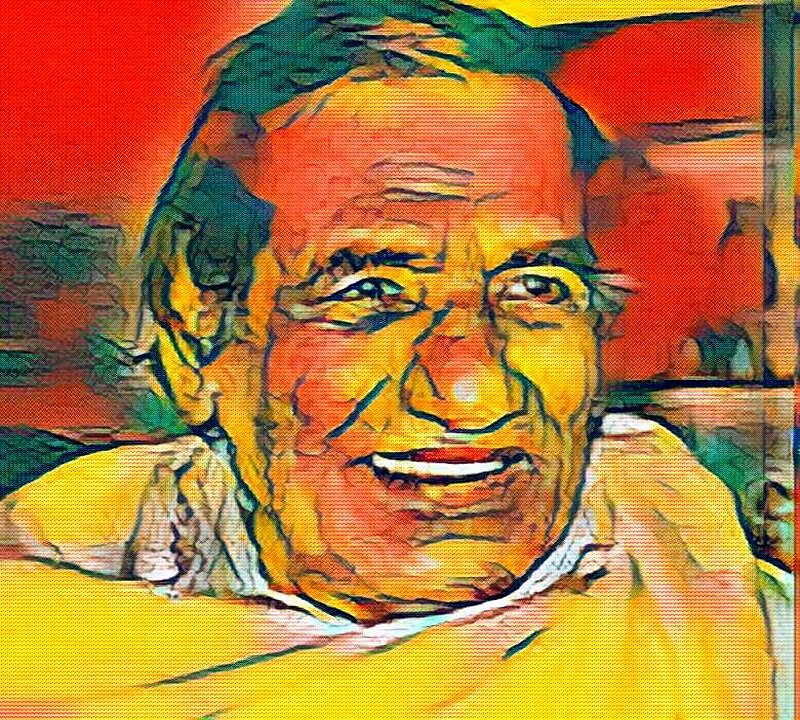
Sita Ram Goel’s essay has an enduring value and provides an extraordinary window to understand both that period—the 1940s—and what is unfolding today in India and elsewhere. – Sandeep Balakrishna
Introduction
The deserved fame of Ram Swarup and Sita Ram Goel as the pioneers of sculpting and disseminating original and penetrating critiques of Islam and Christianity has overshadowed their equally original and substantial contributions in dismantling Communism and Marxism at a time when it had a stranglehold on India’s political, economic, societal, educational and institutional life. That calls for an independent study in its own right.
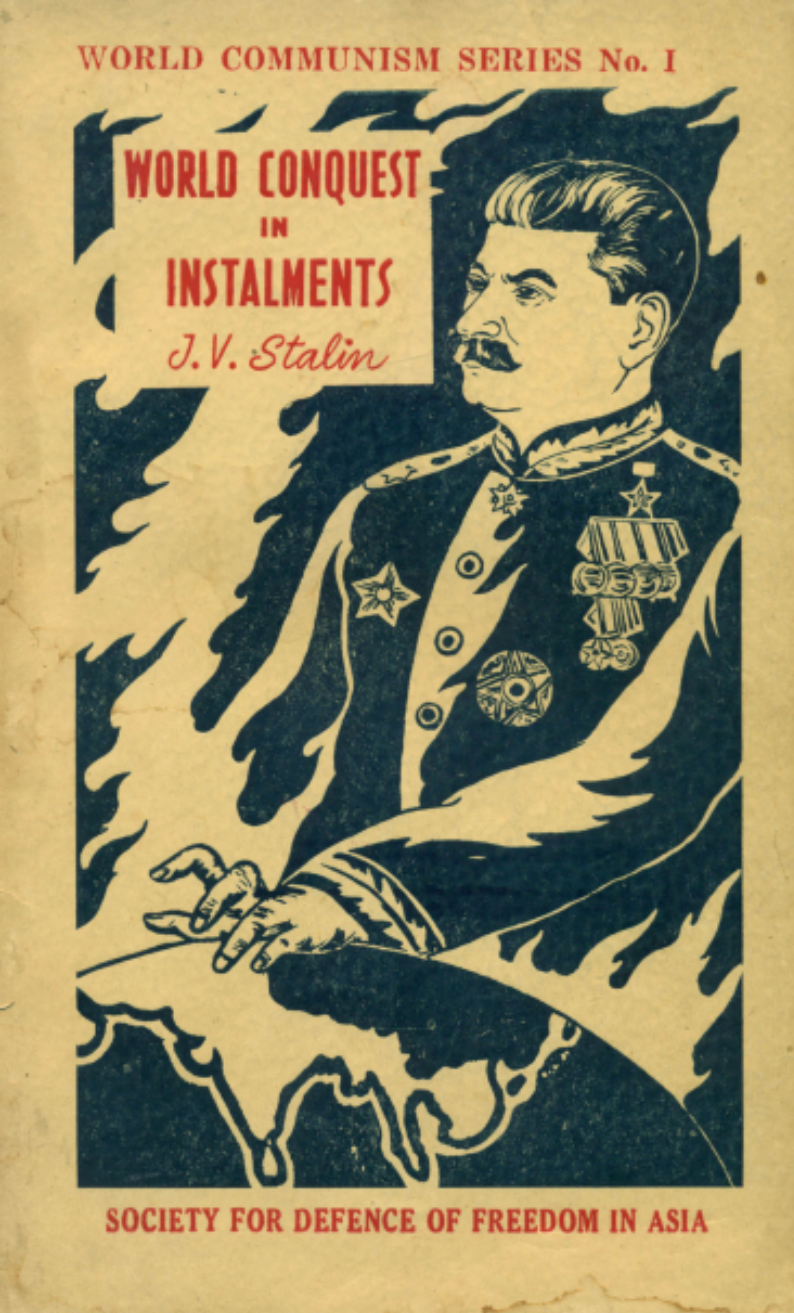
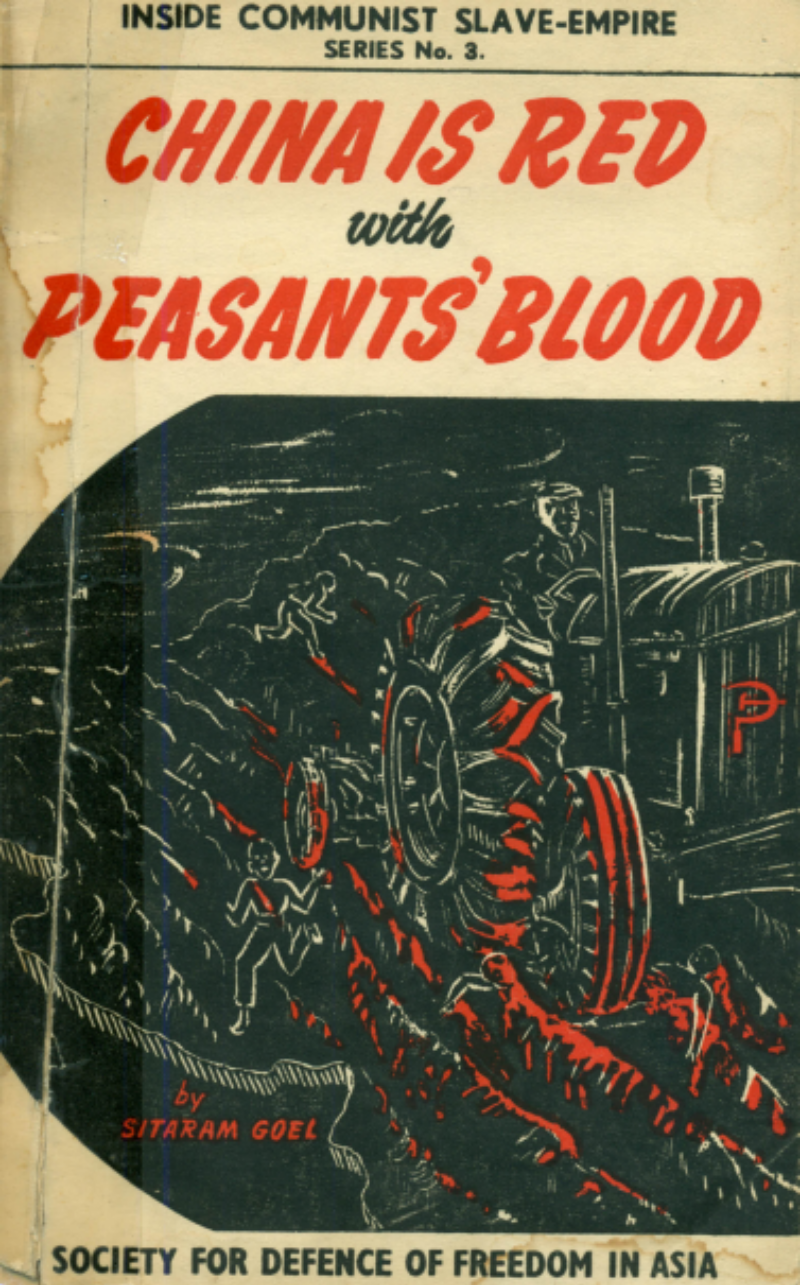
Beginning in the late 1940s, they launched the trailblazing Society for the Defence of Freedom in Asia, an organisation dedicated to blasting Communism in all its forms. Sita Ram Goel also occasionally wrote for other publications both in India and abroad giving recurrent warnings about this genocidal ideology.
In 1956, he submitted a comparative analysis that dealt with capitalism, communism, dialectical materialism and the American political and social system to a conservative U.S. magazine. The magazine rejected it. However, it was picked up by a French scholar working for the NATO, who cited it. That attracted the attention of a West German magazine, which then published it in full. The interesting element was the fact that the magazine was being published by refugees from Stalin’s USSR. Given the fact that the Cold War was at its peak at that time, the antlers of the U.S. immediately stood alert. Goel’s article then promptly found its way to the U.S. Congressional Record.
By all accounts, the essay is not only eye-opening but has an enduring value and provides an extraordinary window to understand both that period and what is unfolding today both in India and elsewhere.
Sita Ram Goel’s analysis is narrated in the form of a conversation that he had with an imaginary friend who recounts his experiences of attending an international seminar. Excerpts of the essay follow.
A Nightmarish Interpretation of Waking Life
It was a nightmarish interpretation of waking life.
A bunch of Indian eggheads had gathered in a highbrow seminar to compile an inventory of US sins. The roll was quite formidable. Monopoly capitalism, dollar imperialism, H-bomb militarism, MacCarthy fascism, negro-lynching racialism, alcoholism, crime fiction, horror comics, juvenile delinquency, jazz music, and coca cola. Dante’s inferno erupted right in our midst.
The young swami in saffron looked bored and unimpressed. His lips twirled in a gesture of contempt as he surveyed the august assembly. Then he stood up, and summarily dismissed the eggheads as denizens of darkness dishing out dirt and disease. The singular sin of the United States, he said, was Dialectical Materialism.
The eggheads stabbed him with hostile stares which soon exploded in angry outbursts. How did this swine of a swami steal into the company of sober scientists? It was suggested that his person be subjected to thorough search. Some crevice of his ridiculous robe was suspected of being loaded with dollar bills. But better counsels prevailed and the seminar dispersed hastily. The holy hoax was not worth an audience.
I accosted the swami on the road outside. He certainly seemed to be a very interesting man. Absolutely convinced. And immovably calm in a world where convictions created convulsions of hatred and righteousness. Very soon, I was sitting before him on a lawn, trying to share his uncanny insight. He smiled indulgently and spoke in simple terms:
“The United States has an idea. Democracy. She has practised it for long, and has prospered on it. There is no doubt that she cherishes the idea with sincere devotion. Her one ambition is to share it with every other country. And she spends billions to spread and safeguard it in all parts of the world.
“What does she do? She proclaims that democracy can be distilled from the standard of living. So let every country improve its agriculture and industry, and develop schools, cinemas, railways, roads. Let there be taller and heavier bodies which last better and longer. Let everyone have fruit juice for breakfast, wear a silk hat, ride a Mercedes, and giggle at Marylin Monroe. And democracy will develop to the detriment of all other ideas.
“The United States protests that democracy must perforce depend upon dictators who can push through plans for industrialization. She seeks out the Nehrus, Nassers, and Sukarnos who have power, prestige and pugnacity. She turns a deaf ear to the denunciations they daily hurl at her. Dip them with another darned good dose of dollars, and in due course they shall deliver democracy. That is the formula.
“The United States cannot bother about blighters who believe in democracy, and who write and fight for it. After all, the miserable scribes have no power to persecute or protect. She cannot waste her august attention on inspired idiots and discredited do-nothings. She cannot afford to provoke people in power for a pack of funny friends, hated and hunted by their own people. No. She is practical. And she is precise.
“Now, all this is exactly what we know as Dialectical Materialism. In the universe presided over by this deity, consciousness oozes out of matter like oil from sunflower seeds, ideas are concomitants of material changes, and the human mind an effeminate evolute of the human body. It is a universe of objective and subjective necessities, in which there is no freedom and, therefore, no place for faith.”
There was a pause. I gave him my reactions. I had suddenly become very optimistic about peaceful coexistence, now that I knew that both the Soviet Union and the United States shared the same creed. The Swami laughed aloud and said:
“Who told you the Soviet Union promotes Dialectical Materialism? That is a damned lie, as big as the other lie that the United States promotes Humanism. The Soviet Union only sells Dialectical Materialism to those she wants to defeat and destroy. As for herself, she stands for what in philosophy we call Idealism, a rigorous and uncompromising type of Idealism.
“The Soviet Union too has an idea. Totalitarianism. She has polished and perfected it over the years. She is passionately dedicated to it. She wants this idea to prevail permanently, for, without it, she sees no hope for humanity. And she also spends billions to spell and secure it in every corner of the world.
“What does she do? She propounds that the standard of living and much more follow from faith in totalitarianism. She elaborates the idea in an unending stream of books, pamphlets, posters, handbills, and films, produced in every language and suited to the lowest intelligence and the meanest pocket. She employs an army of men and women to retail this idea on a mass scale in order to convert or corrode as many people as possible, and to ultimately impose it with force of arms in true crusading fashion.
“The material conditions may differ from Czechoslovakia to Albania to Tibet. But they are all equally ripe for totalitarianism. The triumphal march of an idea does not and should not depend on any material preparation. The idea cannot and should not wait for slow and stupid material changes. What the idea needs is human minds, their craving for it. The minds can be captured and the craving created by means of books and the party apparatus.
“Nor does the Soviet Union seek for any credentials of power or prestige in choosing her friends. All she cares for is their convictions. Let the convinced ones be obscure and unknown. She makes them famous overnight by powerful publicity. Let the convinced ones be poor. She makes them prosperous by placing them in her paid hierarchy. Let the convinced ones be hated by their own people. She makes them loved by discovering in them virtues which no one ever suspected.
“If you can turn a phrase, you can be turned into a world famous author, without your ever bothering to write a line. People everywhere will be informed by the Soviet network that your wonderful works are under translation. Royalties on enormous editions will come pouring into your pocket. And so on, you can be a renowned scientist, or doctor, or lawyer, or musician, or poet, or priest, as it suits your taste, and go about as an honoured guest in every capital of the world. All you have to do is to believe in and seek for totalitarianism, and the rest in added unto you.
“This is not Dialectical Materialism. This is Idealism, according to which consciousness converses with consciousness as one lamp is lighted by another, ideas implement ideas, and one human mind meets another, directly without any material aid. In this universe, the ill-fed and ill-clad underdogs have as much capacity as their more privileged fellow-beings. For, this is the universe of freedom, and of faith.”
There was another pause. I was too flabbergasted to offer any comment. After a while, the swami himself resumed:
“You were talking of peaceful coexistence. I do not know what that phrase really means. What I see before my eyes is a neat division of labour between the United States and the Soviet Union, at least in this part of the world. The United States is trying to take care of our bodies, our hearths, and our homes. The Soviet Union is taking care of our heads, and showing extreme concern for our mental, moral and spiritual needs.
“The United States builds schools and spreads literacy among the peasants. The Soviet Union provides them the newspapers they read. The United States erects factories in which the workers can earn a livelihood. The Soviet Union bands them into trade unions, trains their leaders, and gives them a cause to die for. The United States gives scholarships to promising students for studies abroad. The Soviet Union equips them with political glasses through which they can survey the world. The United States builds hospitals and furnishes them with soft beds and rare medical supplies. The Soviet Union indoctrinates the nurses who attend and attract the patients. The United States spends on library premises. The Soviet Union stocks the shelves within with her own choice of literature. The United States pampers regime after regime with the paraphernalia for pomp. The Soviet Union creates an elite capable of possessing power in every land….”
The swami looked at his watch, and stood up. He was now in a hurry. I accompanied him to the nearest bus stand, and shot my only question at him: “Why do you think Dialectical Materialism is a sin?” He raised his eyebrows, looked grim, and whispered:
“I am a man of God. I have seen Him face to face, even as I see you. I know He is pure, unmixed Consciousness. Self-existing, All-sustaining and Blissful Consciousness.”
And then suddenly pointing his well-shaped finger towards a heap of dirt, he roared: “Dialectical Materialism says that Mahatma Gandhi and Albert Einstein evolved out of that filth. That is blasphemy. And a sin. A cardinal sin.”
I woke up with a start. There was no swami, no bus stand, and no heap of dirt. Instead, I lay in a bed scattered with the writings of the Right Reverend Pandit Jawaharlal Nehru. Perhaps I had been bored to an early doze by his bad paraphrase of Communist scriptures.
Epilogue
That is how Sita Ram Goe’s brilliant essay concludes. More than three decades later, he adds an epilogue of sorts, notable for its Goelesque sucker punch. The punch is also a handy guide for those who wish to follow the path he laid down in order to effectively combat and defeat all these nihilistic, soul-crushing and civilisation-destroying ideologies.
India is the home of Sanatana Dharma, a world-view which is at once eternal and universally valid. All other spiritual world-views have imprisoned themselves within the confines of a particular book, or a particular prophet, or a particular church. Sanatana Dharma alone rises above all sectarian semantics and sophistry, and takes us straight into that sunshine of the Supreme Spirit which has sanctioned the rise and spread of Communism, and which will sanction its death and destruction as well. Let the spirit of Sanatana Dharma re-awaken and spread once more in the land of its first though immemorial dawns. Let us look at Pandit Nehru and his hoodlums from the vantage point of that spirit. Then we shall see immediately as to who is the arch-villain in this dismal drama, and stop wasting our time and energy in weeping and whining against mere minions like Comrade Krishna Menon.
This attitude, this spirit and this call to be energetic is eminently relevant today more than ever, and will remain so till the aforementioned arch-villains are put in their proper place. – Dharma Dispatch, 5 Februaru 2021

 VOICE OF INDIA