Genocide in Kashmir: Forgotten and Buried – Vivek Gumaste

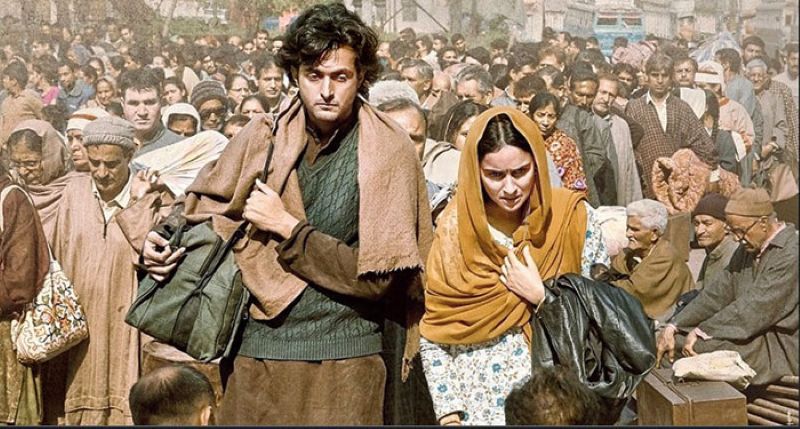
Kashmiri Pandit exodus from Kashmir (representative image)

The ethnic cleansing of Pandits from Kashmir is the greatest moral lapse of independent India, unmatched in its magnitude, specificity, or completeness when compared to other such similar social upheavals—over a quarter million Indian citizens wronged. – Vivek Gumaste

The passage of time has the uncanny ability to blur our memory, numb our conscience, and mellow the intensity of our reactions, so much so that even the most horrendous of crimes become gradually cemented into history, fade into the background, and come to be accepted as a part of normalcy; accountability is evaded and life moves on. One such horrific event is the ethnic cleansing and genocide of Kashmiri Hindu Pandits from the Valley of Kashmir that began in the late 1980s (more than 35 years ago) and continues to this day. During this genocide, over a quarter million Hindu Indian citizens were driven from their homes to become refugees in their own land, over 1000 were killed, and close to 16000 of their homes were burnt to cinder. More than 500 Hindu temples were desecrated or destroyed. This is unequivocally the greatest moral lapse of independent India, unmatched in its magnitude, specificity, or completeness when compared to other such similar social upheavals—over a quarter million Indian citizens wronged.

The purpose of recalling the horrific, blood-curdling events of those dark days is to reawaken the indifferent conscience of a country that has basically decided to callously brush aside the pain and agony of over a quarter million of its citizens and move on with its life. It is also possible that this indifference stems from ignorance. Today, over 40 per cent of Indians are below 30 years of age, and this pertains to events that happened before they were born. Therefore, it becomes vitally important to make them aware of this gruesome episode of their country’s recent past.

For a democratic, secular nation to be viable, it must demonstrate its ability to uphold the lofty principles it espouses. There is still time to rectify this wrong and salvage the credibility of a nation and prove (not to others) but to ourselves that we truly believe in the ideals of secularism. Hence this reminder.

Definition

The events that transpired in Kashmir were so comprehensive in their cruelty—killings, burning of homes, expulsion, and destruction of sacred sites—that we did not have a single term to describe this phenomenon of evil, then. Only in the mid-nineties, when journalists began to use the word “ethnic cleansing” to describe the forced migration of Bosnian Muslims from Serb territories of the former Yugoslavia, did we realise what had happened in Kashmir and were able to give it a name.

A United Nations Commission, with reference to the happenings in the former Yugoslavia, defined ethnic cleansing as “… rendering an area ethnically homogeneous by using force or intimidation to remove persons of given groups from the area.”

As per the United Nations, genocide is defined as “acts committed with intent to destroy, in whole or in part, a national, ethnical, racial or religious group”.

The exodus of Kashmiri Pandits fits the bill of both ethnic cleansing and genocide. This was also endorsed by the NHRC, headed by the former Chief Justice of India, M.N. Venkatachaliah, which concluded in 1995 that the ethnic cleansing of Kashmiri Pandits was “akin to genocide”.

Ethnic cleansing and genocide, with reference to Kashmir, are not flippant terms concocted by Hindu fanatics but officially vetted descriptions. By appropriately labelling a crime, we not only define its scope for public and international understanding but also induct a sense of urgency to seek its redress.

Kashmir History

What makes this ethnic cleansing even more egregious is that the Kashmiri Pandits are the original inhabitants of Kashmir and the carriers of a culture and tradition that goes back 5000 years, making them and the land an inalienable part of our Vedic civilisation. The oft-repeated phrase—Kashmir is an integral part of India—is not merely a political slogan to counter Pakistan’s claims but a historical reality.

As per the Nilmata Purana, one of our ancient scriptures, the word “Kashmir” is widely believed to be derived from the Vedic sage Kashyap, who is credited with making Kashmir habitable. Kashmir also finds mention in Panini’s Ashtadhyayi, written around the 5th century BC. Other Hindu scriptures like the Puranas (Vishnu, Vayu, Matsya), which modern methodology dates to around 3 to 10th century CE (in their written form—oral versions existed much before), also refer to Kashmir.

Over the centuries, Kashmir established itself as a great centre of Hindu and Buddhist learning. Sharada Peeth, a temple university now in ruins and located 10 kms from the LOC in Pakistan, flourished between 6-12th century CE. Learned and scholarly, Kashmiri Pandits have produced a galaxy of intellectuals like Abhinavagupta, the noted philosopher and poet, and Utpaladeva (10th CE) and others who expounded the theology of Kashmir Saivism. The holy shrines of Vaishno Devi and Amarnath, located in Kashmir, which thousands of Hindus from all over India visit every year despite terrorist threats and the vagaries of the weather, is another example of the importance of Kashmir to our civilisation.

Historically and spiritually, Kashmir is inextricably intertwined with the rest of India and our civilisation; it is the northernmost outpost as exemplified in the 8th century by the extent of Shankaracharya’s religious outreach. Today, Shankaracharya Hill, a majestic mound overlooking the capital Srinagar, marks the site of Shankaracharya’s stay in Kashmir, testifying to this reality.

The purpose of reiterating these historical facts is to demonstrate that Kashmir is ancient Hindu land from which Hindu Kashmiri Pandits are being driven out, today.

Islam is a late entrant to Kashmir. Kashmir remained predominantly Hindu and Buddhist till the 14th Century, ably defended by Hindu rulers. In 1339, Shah Mir established the first Islamic dynasty of Kashmir and started the process of conversion using both fear and inducement. Sikander Shah (1389-1412), labelled “Butshikan” (iconoclast), the sixth ruler of the dynasty, was notorious for his anti-Hindu atrocities, destroying temples by the thousands and forcing people to convert. By the time he died in 1413, a mere 70 years after Shah Mir established his dynasty, nearly 60 per cent of the population had been converted to Islam, mostly by force. Over the next 600 years till present times, different Muslim kings tried to rid the Valley of its Hindu inhabitants or forcibly converted them to Islam. Times changed, people became more educated, but the intention never changed—Project Kafir, whose aim is to rid the Valley of infidels, remained on track.

After 1819, Kashmir became a part of Maharaja Ranjit Singh’s Sikh empire and eventually passed into the hands of the Dogra dynasty. While these periods provided some respite to the Hindus, the tolerant nature of both Sikh and Hindu rulers failed to reverse the new culture of intolerance that had been forced on the majority of Kashmiris who now accepted it as their destiny.

Since the reign of Sikander Shah, Kashmiri Pandits have been forced to flee the Valley because of religious harassment at least seven times, under different Muslim rulers. The current ethnic cleansing is the latest in this gory saga of ugly religious persecution.

Grievances

The political aura given to the “Kashmir Problem” in recent times is a sham. Machinations of New Delhi, the rigging of the 1987 elections, and the Pakistani Hand have all been invoked as explanations for the targeting of Pandits. But none of these explanations are logically sound or morally tenable. Secular grievances against a third party cannot justify the killings and expulsion of a helpless minority that is an intrinsic part of one’s community. If that were the benchmark, we would see a hundred reverse-Kashmirs in the rest of India. Even at the height of the Gujarat riots, we did not see the scale of migration that Kashmir has witnessed.

There is and remains only one explanation for this depravity: the Hindu identity of the Kashmiri Pandits. The reasons put forth are mere excuses to camouflage the ultimate hidden agenda—the Islamisation of Kashmir.

Even before matters came to a head in the late 80s and early nineties, what we see in Kashmir from the beginning of the 20th century is a sustained anti-Hindu animosity. Nearly every modern political leader of Kashmir has adopted this game plan.

Sheikh Abdullah (1905-1982), the grandfather of Omar Abdullah, was one of the tallest leaders of modern Kashmir, supposedly known for his broad secular outlook. But under the façade of secularism, he practised a rank communalism that discriminated against Hindus and Kashmiri Pandits. In 1931, he was at the forefront of a popular rising against Dogra rule. On July 13 (observed as Martyr’s Day by Muslim Kashmiris on either side of LOC), the Maharaja’s forces fired on an unruly mob, killing 22 Muslims. The Muslims in turn directed their ire on the Kashmir Pandits, killing several of them, looting their shops, desecrating temples, and raping their women. These riots, called the Maharajganj riots, were the beginning of the latest campaign to evict the Kashmiri Pandits from the Valley.

Following independence, when Dogra rule ended and governance fell into the hands of the National Conference, persecution of Kashmiri Pandits became even more blatant. Land reforms were introduced that effectively stole the livelihood of Kashmiri Pandits, many of whom actually belonged to the low-income group. To justify these reforms, Kashmiri Pandits were cast as rich feudal landlords, a myth that the left-liberal lobby and their lapdogs in Western academia latched on to. The reality was quite different—lucrative sericulture, horticulture, and floriculture land meant for farming of fruits, flowers, and silk was under control of the Muslim majority. Even compensation for the land acquired was delayed, and Pandits were discriminated against in jobs, forcing many Kashmiri Pandits to move away from the Valley.

Ghulam Mohammed Shah, who was the CM from 1984 to 1986, openly followed a policy of communalism. In 1986, he authorised the construction of a mosque in Jammu Secretariat where an old Hindu temple stood. And later that year, when Rajiv Gandhi opened the doors of the Ram Mandir-Babri Masjid to Hindus for prayer, he incited Muslims to riot by declaring, “Islam khatre mein hai ” (Islam is in danger). Kashmiri Pandits again bore the brunt of Muslim anger. A mini-pogrom engulfed Kashmir in which Anantnag was the epicentre—hence called the Anantnag riots. An investigation revealed that it was the so-called secular parties that engineered the violence. In Kashmir, there is a thin line between secular and non-secular parties with regard to their core ideology—persecution of Hindus.

In 1986, Ghulam Shah was dismissed and President’s rule was imposed. The 1987 elections that were allegedly rigged, reinstalled Farooq Abdullah as the chief minister. Law and order collapsed during this period, allowing Muslim separatists and Pakistan a free run. Added to this, a weak V.P. Singh government that was both clueless and directionless took power at the centre.

Time was ripe for the final phase of ethnic cleansing of Kashmiri Pandits and the Islamisation of the Valley that started 600 years ago, to be executed. – News18, 24 January 2026

Vivek Gumaste is an academic and political commentator based in the US. This is the first part of a two part article.
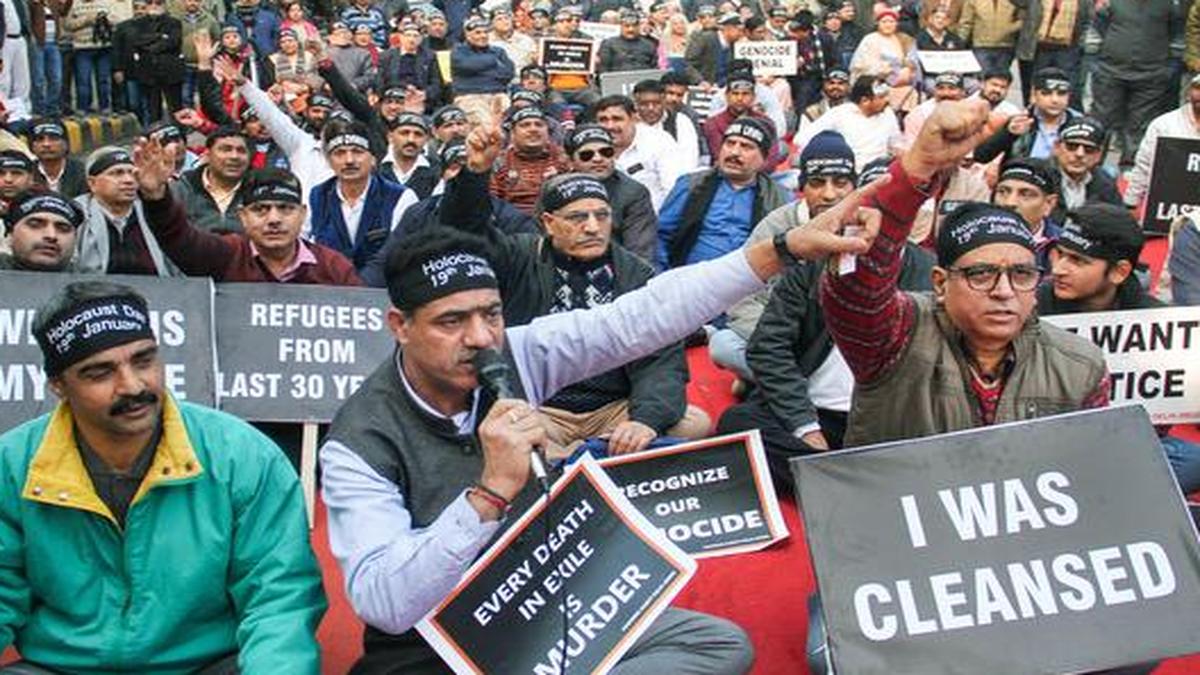
Kashmiri Pandits demonstrate in support of the Citizenship Amendment Act at Jantar Mantar in New Delhi, Sunday, Jan. 19, 2020.

How the West has sustained an anti-India bias on Kashmir till today – Claude Arpi

Maj. William Brown

Despite Raja Hari Singh having signed the Instrument of Accession and joined India, Maj. William Brown of the Gilgit Scouts refused to acknowledge the orders of the Maharaja, and on November 1, 1947, he handed over the entire area of Gilgit-Baltistan to Pakistan. – Claude Arpi

On May 4, during an interactive session at the Arctic Circle India Forum 2025, External Affairs Minister S. Jaishankar spoke of broader geopolitical upheavals affecting the world, in particular Europe, which “must display some sensitivity and mutuality of interest for deeper ties with India”.

Answering a question on India’s expectations from Europe, Jaishankar said, “When we look out at the world, we look for partners; we do not look for preachers, particularly preachers who do not practice at home and preach abroad.”

This sharp answer came after the EU’s top diplomat, Kaja Kallas, urged both India and Pakistan to exercise restraint.

Kaja Kallas, the High Representative of the European Union for Foreign Affairs and Security Policy, formerly a Prime Minister of Estonia, was obviously ill-informed about the situation in Kashmir (and along the India-Pakistan border).

The attitude of certain Western countries (as well as the UN General Secretary) represents a great danger for India today; it has been so in the past.

The Kashmir Issue

A few years ago, while researching in the Nehru papers, I came across a “Top Secret” note written in the early 1950s by Sir Girja Shankar Bajpai, then secretary-general of the Ministry of External Affairs and Commonwealth Affairs; it was entitled “Background to the Kashmir Issue: Facts of the Case”; it made fascinating reading.

It started with a historical dateline: “Invasion of the state by tribesmen and Pakistan nationals through or from Pakistan territory on October 20, 1947; the ruler’s offer of accession of the state to India supported by the National Conference, a predominantly Muslim though non-communal political organisation, on October 26, 1947; acceptance of the accession by the British Governor-General of India on October 27, 1947; under this accession, the state became an integral part of India.”

Unfortunately, in a separate note, Lord Mountbatten, the Governor General of India, mentioned a plebiscite which would “take place at a future date when law and order had been restored and the soil of the state cleared of the invader”, then “the people of the state were given the right to decide whether they should remain in India or not.”

It was an unnecessary addition, but Mountbatten wanted to show British (so-called) legendary fairness.

Anyway, the conditions were clear and in two parts: first, the Pakistani troops or irregulars should withdraw from the Indian territory that they occupied, and later a plebiscite could be envisaged.

Bajpai’s note also observed: “Pakistan, not content with assisting the invader, has itself become an invader, and its army is still occupying a large part of the soil of Kashmir, thus committing a continuing breach of international law.”

The Gift of Gilgit

Worse was to come; Maj. William Brown, a British officer, illegally offered Gilgit to Pakistan. The British paramountcy had lapsed on August 1, 1947, and Gilgit had reverted to the Maharaja’s control. Lt. Col. Roger Bacon, the British political agent, handed his charge to Brig. Ghansara Singh, the new governor appointed by Maharaja Hari Singh, while Maj. Brown remained in charge of the Gilgit Scouts.

Despite Hari Singh having signed the Instrument of Accession and joined India, Maj. Brown refused to acknowledge the orders of the Maharaja under the pretext that some leaders of the Frontier Districts Province (Gilgit-Baltistan) wanted to join Pakistan.

On November 1, 1947, he handed over the entire area to Pakistan, in all probability ordered by the British generals.

An interesting announcement appeared in the 1948 London Gazette mentioning that the King “has been graciously pleased … to give orders for … appointments to the Most Exalted Order of the British Empire.…” The list included “Brown, Major (acting) William Alexander, Special List (ex-Indian Army)”. Brown was knighted for having served the Empire.

At the time, the entire hierarchy of the Indian and Pakistan Army were still British. In Pakistan, Sir Frank Messervy was commander-in-chief of the Pakistan Army in 1947-48, and Sir Douglas Gracey served in 1948-51; while in India, the commander-in-chief was Sir Robert Lockhart (1947-48) and later Sir Roy Bucher (1948), and let us not forget that Sir Claude Auchinleck (later elevated to Field Marshal) served as the supreme commander (India and Pakistan) from August to November 1947.

Who can believe that all these senior generals were kept in the dark by a junior officer like Maj. Brown?

The Western influence or manipulation continued in the following years and decades; the Americans soon entered the scene too.

India and the Western Powers

After China invaded northern India in 1962, Delhi decided to ask for the help of the Western nations, particularly the United States. The latter was only too happy to offer it and thus gain leverage over India, which until that time had been “neutral and non-aligned”.

Seeing northern India invaded by Chinese troops, it seemed logical that the United States would come to India’s aid, but it turned out differently.

Soon after the ceasefire declared by the Chinese on November 22, 1962, and instead of helping India, Great Britain and the United States decided that the time had come to resolve the Kashmir dispute between their Pakistani ally and India, now begging for help.

Two days after the ceasefire, Averell Harriman, the US Under Secretary of State, and Duncan Sandys, the British Commonwealth Secretary, visited the two capitals of the subcontinent to persuade the “warring brothers” that it was time to bury the hatchet and find a solution to the fifteen-year-old Kashmir question. Harriman and Sandys signed a joint communiqué and asked the two countries to resume negotiations.

India’s invasion by China was forgotten.

Delhi, in a position of extreme weakness, had doubts about the possibility of obtaining positive results from negotiations conducted under such circumstances, but Nehru did not refuse the “offer”.

On December 22, 1962, he wrote to the provincial chief ministers: “I have to speak to you briefly on the Indo-Pakistan question, and particularly on Kashmir. In four days, Sardar Swaran Singh [the Minister of External Affairs] will lead a delegation to Pakistan to discuss these problems. We realise that this is not the right time to have a conference like this, as the Pakistani press has vitiated the atmosphere with insults and attacks directed against India. Nevertheless, we have agreed to go and will do our best to arrive at a reasonable solution.”

The two delegations ultimately held a series of six meetings; nothing came of them. The first negotiations took place in Rawalpindi; Swaran Singh and Zulfikar Ali Bhutto, Pakistan’s foreign minister, limited themselves to a historical presentation of the problem and the reiteration of their respective points of view. During the talks, India reaffirmed that it wanted to explore all possibilities to resolve the issue, as it wanted to live in peace with Pakistan, which insisted that the UN resolutions of August 1948 and January 1949 must be implemented as soon as possible (without them vacating the occupied part of Hari Singh’s kingdom).

The negotiations got off on a bad start: just before they began, the Pakistani government announced that it had reached an agreement in principle with China on its border issue. Just a month after the end of the Sino-Indian War, Pakistan was prepared to give China a piece of territory that India considered its own. What a slap in the face for India! Were the Western powers aware of the secret negotiations between Pakistan and China? Probably.

It is indeed surprising that Pakistan, an ally of the United States and the Western world, chose this moment to make this announcement. It was proof that Pakistan expected nothing from the talks with Delhi.

Negotiations on Kashmir continued between January 16 and 19, 1963, in Delhi and February 8 and 11 in Karachi, of course without any tangible results. Pakistan wanted a plebiscite, but India insisted on the prior demilitarisation of the regions occupied by Pakistan.

Talks took place in Calcutta between March 12 and 14. India proposed some readjustments of the Line of Control, but these were rejected by Pakistan.

During the fifth round of talks held in Karachi between April 22 and 25, India protested that Pakistan had ceded part of Kashmiri territory to China; there was no longer any chance of finding a negotiated solution to the Kashmir issue.

During the sixth and final round of talks, India clarified that it had no intention of replacing a democratically elected government with an international organisation that it believed had no knowledge of local issues. India therefore rejected the proposals.

Retrospectively, 63 years later, it is not surprising that in an interview with Sky News, when the interviewer Yalda Hakim questioned him about Pakistan’s long history of backing, supporting and training terrorist organisations, Pakistan Defence Minister Khawaja Asif admitted, “Well, we have been doing this dirty work for the United States for about three decades, you know, and the West, including Britain.”

India should indeed beware of some Western powers. – Firstpost, 10 May 2025

› Claude Arpi is Distinguished Fellow, Centre of Excellence for Himalayan Studies, Shiv Nadar Institution of Eminence, Delhi. He is the director of the Pavilion of Tibetan Culture at Auroville.

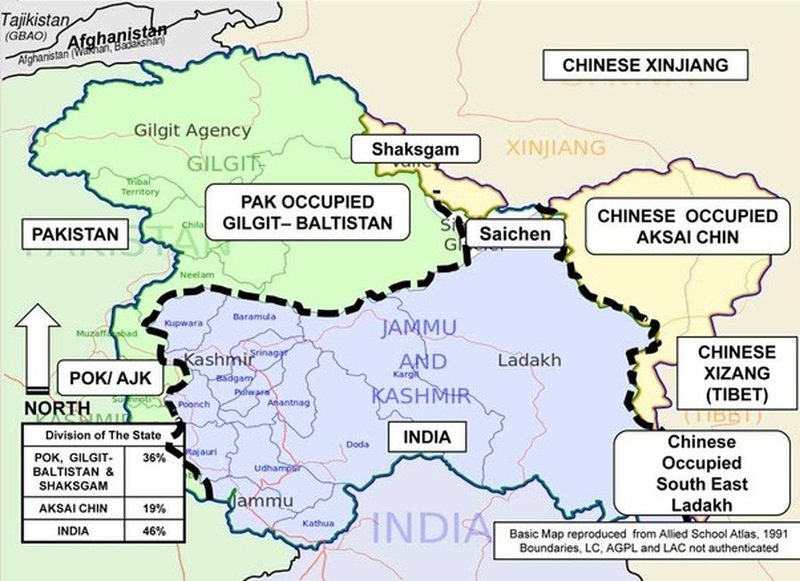
Kashmir Map

Op Sindoor Banner

India’s Pakistan conundrum – Claude Arpi

Attari-Wagha Border


India’s ‘dharmic genes’ have made it more generous towards a deceitful Pakistan without any receprocity. History can’t be rewritten, but one should perhaps learn from it. – Claude Arpi 

It has been argued that “Bharat has become a victim of its own innate dharmic nature—and, of course, democratic laws.”

This is a historical fact.

The Simla Agreement of 1972, repudiated by Pakistan after Delhi denounced the Indus Water Treaty of 1960, provided for the return of Pakistani prisoners of war. Unfortunately, India’s ‘dharmic’ genes accepted to release more than 90,000 Pakistani prisoners of war, against very little compensation. The Indian leadership probably thought that it was unethical (or adharmic) to keep so many Pakistani nationals in custody.

There are many more examples of the “dharmic” nature of the Indian leadership. We shall mention three here; if India had listened to saner elements, the situation would have been different on the borders today. It can, of course, be argued that it was plain stupidity, not ‘dharma’, which guided the Delhi establishment at that time.

Take Lahore

Lt. Gen Nathu Singh Rathore was one of the most remarkable officers of the Indian Army post-independence. When offered the post of first Indian Commander-in-Chief of the Indian Army, he refused and told the defence minister that Gen. K.M. Cariappa would do a better job than him.

But Gen. Nathu always spoke frankly, sometimes too frankly for the politicians in Delhi. At the end of 1947, he thought of taking Lahore to force the raiders and their Pakistani supporters to leave Kashmir and return to their bases. The general decided to speak to Nehru; his biographer wrote: “When he reached the prime minister’s house, he found him sitting on the lawn, talking to some ministers and civilian officials. Presently, Nehru got up and went inside. The others present there asked Nathu Singh for his views on the best way to deal with the crisis in Kashmir. Nathu Singh replied that if he had his way, he would use the minimum troops to hold the passes and, with maximum force, attack and capture Lahore. This would force Pakistan to withdraw and vacate all occupied territory in Jammu and Kashmir.”

The biographer continues: “The civilians were impressed by the logic of this argument, and when Nehru returned, they told him that the general had a good plan to throw out the invaders. When Nehru asked him to repeat what he had said, Nathu Singh demurred, saying that he would rather not, since he knew it would not find favour. But Nehru insisted, and Nathu repeated what he had told the others.”

But Nehru was horrified and became angry: “How can a responsible senior officer think of such a foolhardy scheme? It could cause an international crisis.”

Incidentally, in 1965, a similar plan was approved by Lal Bahadur Shastri, then prime minister, and the threat to Lahore probably saved Kashmir.

After the Pahalgam massacre, it is worth remembering this. Had the Indian Army advanced on Lahore in 1947, there would be no Kashmir issue today. But would the British have allowed it? This is another question.

Occupy Chumbi Valley

In October 1950, after the Chinese had captured Chamdo, the capital of Eastern Tibet, and were ready to advance towards Lhasa, Harishwar Dayal, an extremely bright ICS officer posted as Political Officer (PO) in Sikkim (looking after Tibet, Sikkim and Bhutan), wrote to the Ministry of External Affairs in Delhi about the Chinese advances on the Tibetan plateau.

Dayal quoted from a letter from Hugh Richardson, the Indian Head of the Mission in Lhasa dated June 15, 1949, who had then suggested that India might consider occupying Chumbi Valley up to Phari “in an extreme emergency” (meaning if China threatened to invade Tibet).

More than a year later, Dayal brought back the idea: “This suggestion was NOT favoured by the Government of India at the time. It was, however, proposed as a purely defensive measure and with NO aggressive intention. An attack on Sikkim or Bhutan would call for defensive military operations by the Government of India.”

China’s PLA planners today call this “active defence”.

Dayal explained his reasoning: “In such a situation, occupation of the Chumbi Valley might be a vital factor in defence. In former times it formed part of the territories of the rulers of Sikkim, from whom it was wrested by the Tibetans by force. It is now a thin wedge between Sikkim and Bhutan, and through it lie important routes to both these territories. Control of this region means control of both the Jelep La and Nathu La routes between Sikkim and Tibet as well as of the easiest routes into Western Bhutan, both from our side and from the Tibetan side.”

Dayal expressed his strategic views further: “It is a trough with high mountains to both east and west and thus offers good defensive possibilities. I would therefore suggest that the possibility of occupying the Chumbi Valley be included in any defensive military plans, though this step would NOT, of course, be taken unless we became involved in military operations in defence of our borders.”

Dayal had probably not realised that China was “friend” (or “brother”) of the leadership in Delhi; a few days earlier, the prime minister had already severely reprimanded the PO and Sumul Sinha, who had replaced Richardson in Lhasa, for not understanding that China was India’s friend.

What prompted Dayal to write this letter was probably his meeting with some of the members of the Himmat Singhji Committee, who would have asked him to put his views in writing in order to bring some pressure on the pacifists in South Block, who could only see the “wider perspectives”.

One can only wishfully dream of the implications an Indian advance in Chumbi would have had (no Siliguri Corridor, etc).

1971: Why not take Baltistan?

Another case: in August 1971, as the clouds were gathering over the Indo-Pakistan border, a young Ladakhi officer, Chewang Rinchen, joined again his old regiment, the Ladakh Scouts; he was asked to report with Colonel Udai Singh, his commanding officer, to his beloved Nubra Valley. Rinchen had already been awarded a Maha Vir Chakra in 1947 at the age of 17.

Rinchen confidently told his GOC that the Ladakhi Scouts and the Nubra Guards (known as the Nunnus they were later integrated into the Scouts) would do the “job” and repel the Pakistani forces.

The army base for the sector was located at Partapur in the Valley, and since 1960 an airfield had been opened at Thoise (till today the base camp for the operations on the Siachen Glacier).

The Nunnu was a good tactician; he always sought the cooperation of the local people, whether they were Buddhist, Muslim or Christian. He knew that most of the time, the troops had to depend upon local vegetables, meat and other supplies to survive.

While most of the commanders favoured a riverbed approach, Rinchen decided to cross over the mountains with his Dhal Force and follow the ridge. He argued that the enemy must be waiting with mines and machine gun nests near the river; he chose to capture Pt. 18,402, the highest Pakistan-occupied post, and then roll down to Chulunkha, the Pakistani base.

Soon after, on December 8, from the top of Pt. 18,402, Rinchen could see the entire valley from Turtok and Chulunkha in the east to the Indian Army headquarters at Partapur and the airfield at Thoise in the west. Rinchen’s tactics had paid off. He told his men, “Enjoy the Pakistani blankets and food”.

On December 9, advancing along the ridges, Rinchen and his men descended towards the Chulunkha defence complex, trying not to be seen by the enemy. Soon, Rinchen got a wireless message from Maj. Thapa informing him that Thapa’s team had managed to enter the enemy bunkers and a few Pakistani soldiers had been killed and a JCO captured.

On December 14 morning, soon after shelling started to destroy the roadblocks near the Turtok axis, the Dhal Force began its advance again.

At 10 pm, shelling was stopped, and the troops entered the Turtok village. Surprisingly, the village was absolutely silent.

The next phase of the operations was Tyakshi village, 6 km. from Turtok. It was concluded on December 14 in the evening. A few Pakistani soldiers were captured with arms and ammunition.

On December 17, Rinchen ordered his troops to get ready to launch an attack against Prahnu and Piun in Baltistan (Khapalu, the first large town in Baltistan, is located 28 miles away); it was never to happen.

In the afternoon, the Pakistani government agreed to a ceasefire. The Dhal Force was ordered to cease fire, greatly disappointing Chewang Rinchen’s men; they knew that in a few days they could liberate the entire Baltistan. Rinchen could not disobey orders from Delhi.

Had this been done, Pakistan would have lost its base for the Siachen Glacier operations, which were to start 13 years later.

Many such stories could be recounted, but history can’t be rewritten; but one should perhaps learn from history. – Firstpost, 27 April 2025

Claude Arpi is Distinguished Fellow, Centre of Excellence for Himalayan Studies, Shiv Nadar Institution of Eminence, Delhi. He is the director of the Pavilion of Tibetan Culture at Auroville.

Kashmir Map

Op Sindoor Banner