Is the Ganga really self-cleaning? – Pranay Lal

Shiva with Ganga Devi in the raging river at Rishikesh.

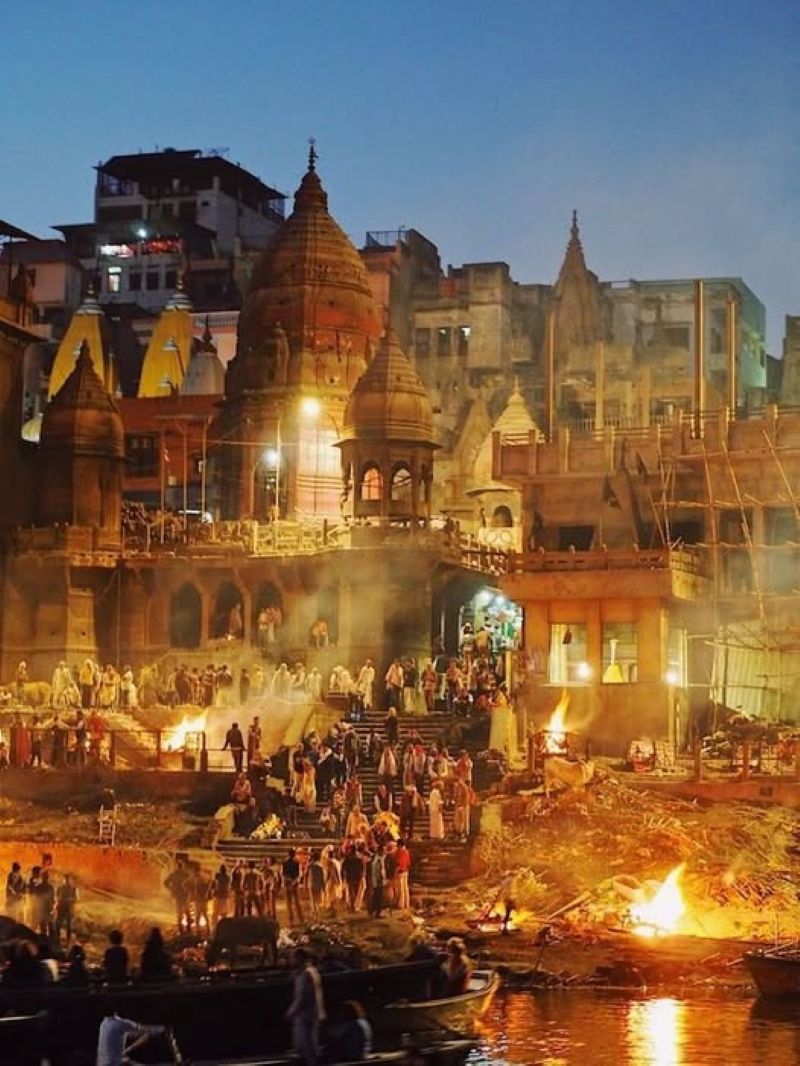
The Ganga is no longer the self-cleansing river it once was. Its silicate-rich water, and less so, its myriad bot-like bacteriophages, are fading as the human stain deepens. – Dr. Pranay Lal

In 1896, a British bacteriologist named Ernest Hankin stood on the banks of the Ganga, watching as locals filled clay pots with water. He hoped that the dreaded cholera outbreak would not occur under his watch. In his attempt to avert it, Hankin discovered something extraordinary: water drawn from the river seemed to kill the pathogen within hours. In wells where the Ganga’s water was not introduced, however, the bacteria flourished.

Intrigued, Hankin conducted experiments, filtering and heating the water to determine what made it so inhospitable to cholera. He hypothesised that an unseen biological agent was at work. The notion that the Ganga could retain its self-purifying properties defied conventional wisdom. Even as evidence mounted, the idea was dismissed as anecdotal—a quirk of the river’s mythology rather than a function of science.

Hankin’s discovery would take another three decades to be recognised as the action of bacteriophages: viruses that prey exclusively on bacteria. It wasn’t until the 21st century that modern research tools finally confirmed what Hankin had suspected.

Several recent studies have mapped the prevalence of bacteriophages in the Ganga, in water samples collected from Hardwar to Varanasi. These studies have found unusually high concentrations of phages targeting common pathogens of waterborne diseases. Some scientists have even isolated bacteriophages that neutralise deadly, antibiotic-resistant bacteria.

When phage therapy was first discovered, researchers were elated that the Ganga was an untapped reservoir.

But bacteriophages exist only because its prey, the bacteria, is found in abundance. They would not exist without them. Simply put, the presence of bacteria-killing viruses is a symptom of bacterial pollution. It is not the sign of some potent power of the river.

Further, the presence of bacteriophages is only a small part of the Ganga story. The secret of the river’s anti-bacterial water lies in its unique geochemical properties.

All about silicates

On the slopes of the Himalayas and in the waters of the Ganga and its tributaries, an invisible process unfolds. It was first articulated by Nobel laureate Harold Urey, who proposed a deceptively simple equation: CO2 reacts with calcium-bearing silicate rocks, forming limestone and releasing silicates. This reaction, playing out over geological time, acts as a planetary thermostat, drawing carbon dioxide from the air and locking it away in ocean sediments. This entrapment, called deep carbon burial, prevents the carbon from returning to the atmosphere, helping regulate atmospheric CO2 and global warming.

Nowhere is this process more pronounced than in the Himalayas, where young, rapidly eroding rock faces provide an ideal surface for chemical weathering. Rain, made slightly acidic by atmospheric CO2, scrubs the mountain’s flanks, washing sediments down the Ganga and ultimately to the deep basins of the Bay of Bengal. There, carbon mineralises and settles into long-term storage, part of a vast, slow-moving cycle that has regulated global temperatures for millions of years.

In theory, this should be a stabilising force. The amount of organic carbon buried in the Bengal basin alone accounts for up to 20 per cent of terrestrial organic carbon reaching oceanic sediments. But this process is not immune to disruption. Some climate scientists have turned their attention to what happens when pollution, deforestation, unchecked urbanisation, and large and small dams interfere with the carbon reaction explained by Urey.

The Ganga’s seemingly staid landscape is actually quite complex. The rocks and sediments that get carried down from the high Himalayas define its chemistry. In the highlands, calcium, magnesium, and bicarbonate dominate, pointing to carbonate weathering. But as the river descends, sodium, potassium, and excess bicarbonate take over—evidence of silicate weathering and inputs from alkaline soils and groundwater.

The clays and sediments of each river are unique, and they entomb a variety of silicate-rich minerals. These minerals deter bacterial growth, killing them or reducing their reproduction. The river, along its course, deposits different silicate concentrations: the higher the concentration, the lower the bacterial counts.

No longer a purifying force

A 2024 paper has found that the Ganga’s dissolved silicon (DSi) and silicon isotopes build up in the river but their potency reduces downstream, in the plains.

At higher elevations, only some silicates bind with iron oxides and carbonates. When the river meets the Yamuna and the Gomti, more silicon gets added, from other rocks and river sands. At the place where the Gomti meets the Ganga, the silicate concentration reaches its maximum limit.

As sewage gets dumped into the river, farm and industrial pollution builds up and much of the silicates get bound. By the time that the silicates reach the mid-Ganga, they’re completely sequestered. Most get bound to organic molecules like bacteria or sewage. This would not have been the case in the pre-industrial era. As cities and industries have grown, Ganga’s silicate potential has diminished. Instead of trapping CO2, it now combines with human waste.

The Ganga is no longer the self-cleansing force it once was. Its silicate-rich water, and less so, its myriad bot-like bacteriophages, are fading as the human stain deepens. Restoring the river isn’t just a matter of environmental conservation or a public health imperative. It is critical that this ceaseless engine of carbon capture isn’t lost to modern neglect. – The Print, 25 October 2025

Dr. Pranay Lal is a biochemist and natural history writer. He is the author of ‘Indica: A Deep Natural History of the Indian Subcontinent’ and ‘Invisible Empire: The Natural History of Viruses’. 

Sri Devi dies on the Ganga bank in Kolkata.

Time for India to stop wearing the ‘secular’ and ‘socialist’ labels – Abhijit Majumder

Preamble to the Indian Constitution

It is time for Bharat to do away with “secular” and “socialist” labels—one a colonial, Western construct weaponised against India’s civilisation; the other, an infatuation with the rise of the Soviet Union and its oppressive communist economy, which ultimately failed. – Abhijit Majumder

The words of RSS sarkaryavah or general secretary Dattatreya Hosabale have often been the bellwether to profound and unexpected change. His statement [qualifying] decriminalisation of homosexuality under Section 377 of the Indian Penal Code, for instance, paved the way for the Indian Right bringing down its wall of resistance towards the reform.

So, when “Datta-ji” calls for a debate on the words “secular” and “socialist”, which were inserted into the Preamble of the Constitution not by Parliament but through the backdoor during Emergency, his words carry both weight and edge.

“Later, these words were not removed. Should they remain or not, a debate must happen. These two words were not in Dr. Ambedkar’s Constitution. During the Emergency, the country had no functioning Parliament, no rights, no judiciary and yet these two words were added,” Hosabale said.

Has the Narendra Modi dispensation made up its mind to remove “secular” and “socialist” from India’s Constitution?

It seems so.

Late last year, Tamil Nadu governor R.N. Ravi too had brought it up.

Secularism was a European concept that evolved after a conflict between the Church and the King, he said. He argued Bharat is a dharma-centric nation, and therefore, “secularism” was not part of the Constitution but added during the Emergency by “one insecure prime minister”.

The founding parents of the Indian Constitution had extensively debated the subject before deciding not to include the two terms.

On November 15, 1948, K.T. Shah proposed an amendment to the draft of the Indian Constitution to include “Secular, Federal, Socialist Union of States”. However, B.R. Ambedkar, the chairman of the Drafting Committee, junked the proposal.

He said, “What should be the policy of the state, how society should be organised in its social and economic side, are matters which must be decided by the people themselves according to time and circumstances.”

Ambedkar was staunchly against codifying an ideology like socialism in the Constitution and restricting future generations from choosing their own path.

“It cannot be laid down in the Constitution itself because that is destroying democracy altogether,” he said.

Ambedkar argued that the Constitution blueprint already had socialist principles laid down through the Directive Principles of State Policy. He pointed to Article 31 of the draft, which already prescribed a strong dose of socialism by preventing the concentration of wealth and providing equal pay for equal work.

And both Jawaharlal Nehru and Ambedkar argued that the term “secular” did not need to be explicitly mentioned in the Preamble. Ambedkar said the Constitution had already made it clear that India would not recognise any religion.

Articles 16 and 19, for instance, prohibit discrimination against any person based on religion.

Nehru said the notion of Western secularism did not fit Bharat’s ideas of religious tolerance and respect for all cultures, ironically echoed by Ravi and the RSS-BJP ecosystem so many decades later.

But Congress member of the Constituent Assembly Lokanath Misra was perhaps one of the most outspoken and unabashed voices against “secularism”. He called “secular State” a “slippery phrase, a device to bypass the ancient culture of the land”. He argued that religion could not be divorced from life.

“If religion is beyond the ken of our State, let us clearly say so and delete all reference to rights relating to religion. If we find it necessary, let us be brave enough and say what it should be,” he said.

Here is a particularly impassioned—many may say politically incorrect—excerpt of his speech at the Constituent Assembly debates.

“We have no quarrel with Christ or Mohammad or what they saw and said. We have all respect for them. To my mind, Vedic culture excludes nothing. Every philosophy and culture has its place but now, the cry of religion is a dangerous cry. It denominates, it divides and encamps people in warring ways.

In the present context what can this word ‘propagation’ in Article 19 mean? It can only mean paving the way for the complete annihilation of Hindu culture, the Hindu way of life and manners. Islam has declared its hostility to Hindu thought. Christianity has worked out the policy of peaceful penetration by the backdoor on the outskirts of our social life.

This is because Hinduism did not accept barricades for its protection. Hinduism is just an integrated vision and a philosophy of life and cosmos, expressed in organised society to live that philosophy in peace and amity.

But Hindu generosity has been misused and politics has overrun Hindu culture. Today religion in India serves no higher purpose than collecting ignorance, poverty and ambition under a banner that flies for fanaticism. The aim is political, for in the modern world all is power-politics and the inner man is lost in the dust.

Let everybody live as he thinks best but let him not try to swell his number to demand the spoils of political warfare. Let us not raise the question of communal minorities anymore. It is a device to swallow the majority in the long run. This is intolerable and unjust.”

It is time for Bharat to do away with “secular” and “socialist” labels—one a colonial, Western construct weaponised against India’s civilisation; the other, an infatuation with the rise of the Soviet Union and its oppressive communist economy, which ultimately failed.

The new India must carefully choose what it wears, what it wants to be. – News18, 27 June 2025

Abhijit Majumder is an author, editor, journalist and media entrepreneur in New Delhi.

Constituent Assembly Members (1950)

Audrey Truschke: A demagogue with a megaphone – Sankrant Sanu

Audrey Truschke

Hinduism, as a non-Abrahamic tradition, remains open season in many Western academic spaces. This double standard isn’t just unjust—it’s intellectually dishonest. – Sankrant Sanu

On the streets of New York, Audrey Truschke—then assistant professor of South Asian history at Rutgers University—stood with a megaphone and declared to a crowd: “Prime Minister Narendra Modi and his political party, the BJP, openly adhere to Hindutva.”

She then launched into her historical comparison: “Hindutva came about roughly 100 years ago. … It was inspired in its early days by Nazism. Did I say Nazis? Yeah, I said Nazis.” She emphasised: “I want to be clear that I am talking about real, actual, historical Nazis.”

Then came the most inflammatory claim: “Early Hindutva espousers openly admired Hitler. … They praised Hitler’s treatment of the Jewish people in Germany as a good model for dealing with India’s Muslim minority.”

With this inflammatory rhetoric, she branded India’s ruling BJP and its adherence to Hindutva as Nazi-like—by extension tarring the hundreds of millions of Indians who democratically elected this government, as fascists. It wasn’t scholarship; it was street theatre designed to demonise an entire community. For Hindus across America, this wasn’t just academic discourse—it was public vilification. To rub salt into the wound, the department of history at Rutgers gleefully posted Truschke’s diatribe on their Facebook feed with the endorsement: “That’s what we call public history.”

Now, with her latest book India: 5,000 Years of History on the Subcontinent hitting shelves this month, Truschke’s troubling methodology is reaching an even wider audience. The timing couldn’t be more urgent for examining what happens when academic platforms become weapons of ideological warfare.

The Hitler Analogy: History stripped of context

Truschke’s accusation draws from a controversial passage in We or Our Nationhood Defined, published in March 1939 and attributed to M.S. Golwalkar of the RSS. The reality is more complex than her megaphone moment suggests.

The book wasn’t authored by Golwalkar but paraphrased and translated by him. The historical context matters crucially: in 1939, the full extent of Nazi atrocities against Jews was not yet known. The Holocaust — the systematic extermination of six million Jews—wouldn’t begin until 1941. For many colonised peoples worldwide, including some Indians, Hitler was viewed primarily as an enemy of Britain—their colonial oppressor.

The passage reflects the ideological uncertainty of that era, when colonised peoples worldwide were grappling with competing definitions of nationalism and looking to various models of national reorganisation. More importantly, the RSS has explicitly disavowed this misattributed quote, and decades of subsequent Hindutva writings have evolved far beyond these early formulations. But such nuance doesn’t fit Truschke’s narrative.

Most perversely, her Hitler comparison erases a remarkable historical truth: Hindus have never persecuted Jews. For over two millennia, India has been a haven for Jewish communities—in Kerala, Maharashtra, and Bengal. While Jews faced pogroms in Europe, ghettos in the Middle East, and extermination in Nazi camps, they found safety and dignity in Hindu-majority India.

To draw parallels between Hindutva and Hitler isn’t just inflammatory—it’s a moral inversion of history that anachronistically applies knowledge of the Holocaust to judge a misattributed quote from an earlier period—and then use that nearly 100-year-old aside to define a contemporary political movement. This is not academic history; it is political pamphleteering.

A pattern of distortion

This isn’t an isolated incident. Truschke’s 2017 book Aurangzeb: The Life and Legacy of India’s Most Controversial King whitewashes a well-documented record of temple destruction, discriminatory taxation, and forced conversions. Despite abundant evidence from Aurangzeb’s own firmans (imperial decrees) documenting systematic iconoclasm and forced conversion of Hindus, she claims he “simply left temples alone” and was a protector of Hindus, dismissing documented destructions as merely following “an Indian stance dating back, at least, to the Chalukyas and Pallavas”.

This false equivalency ignores a crucial theological distinction. When Aurangzeb’s contemporary sources praise him for hitting against the “infidels” and spreading Islam through “holy war,” these aren’t political calculations—they’re expressions of religious doctrine. In Islamic theology, idol worship is the gravest sin, making temple destruction an act of piety. Hinduism contains no such mandate. Political motivations aren’t identical to doctrinal imperatives.

Truschke dismisses scholars like Jadunath Sarkar as unreliable while downplaying Persian sources that contradict her narrative. Her approach isn’t history—it’s revisionism designed to obscure inconvenient truths.

Her recently published India: 5,000 Years of History on the Subcontinent promises more of the same: selective citations, interpretive sleights, and wholesale demagoguery. We can expect the 600-page tome to follows the familiar pattern—Hinduism cast as irredeemably oppressive, Islam framed as emancipatory. There’s little interest in balance, complexity, or competing narratives. It is only in the politicised ghetto of “South Asian Studies”, where practicing Hindus have little voice, that an academic would get away with this level of propaganda.

Silencing students, stifling dialogue 

At a recent Georgia Tech event, a Hindu student described confronting Truschke at Princeton about her portrayals. Instead of engaging his respectful questions, she dismissed his concerns as “Hindutva propaganda” and shut him down. The room fell silent—a moment of intimidation, not academic exchange.

Hindu students at Rutgers report similar experiences: hesitating to speak in her classes, fearing they’ll be branded bigots for defending their faith. Many now avoid her courses entirely. In 2021, students petitioned against her teaching Hinduism, citing her claim that the Bhagavad Gita “rationalises mass slaughter” and her suggestion linking Hindus to the January 6 Capitol riot.

Rutgers defended her academic freedom and promised dialogue with the Hindu community. That dialogue never materialised.

The double standard problem

American universities rightfully crack down on antisemitism, Islamophobia, and anti-Black racism. Yet when Hindu students raise similar concerns, institutions often look away, or worse, actively endorse such writing.

Truschke positions herself as the victim of “Hindu nationalist trolls” while sidestepping legitimate concerns from students who feel unsafe in her academic spaces. When she tweeted that Lord Rama was a “misogynistic pig”—later claiming scholarly translation—even Robert Goldman, the scholar she cited, publicly rejected her framing. One wonders how the academy would react if a professor used the same language about a different revered figure, say Prophet Mohammad.

The damage spreads beyond academia. Hindu students report being mocked as “cow piss drinkers”, stereotyped as “Brahmin oppressors”, or casually equated with fascists. When they respond, they’re accused of extremism—silenced not by force, but by fear.

Drawing the line

This isn’t about suppressing legitimate criticism of Hindutva politics. It’s about distinguishing between scholarly critique and rhetorical abuse.

Truschke’s defenders, including Romila Thapar and Sheldon Pollock, argue that attacking Hindutva isn’t Hinduphobia.  In practice, targeting Hindutva often disguises targeting Hindus.

When Truschke abuses Rama, she is attacking an iconic figure in the Hindu tradition, revered across the length and breadth of India. There can be no better evidence of what her target is.

Would such treatment be tolerated toward any other faith community?

The answer is obvious. Hinduism, as a non-Abrahamic tradition, remains open season in many Western academic spaces. This double standard isn’t just unjust—it’s intellectually dishonest.

The path forward

Universities must confront this hypocrisy. If “safe spaces” truly exist for all, Hindu students deserve the same dignity afforded every other community. That means distinguishing between legitimate academic inquiry and inflammatory demagoguery—whether delivered through peer-reviewed journals, street megaphones, or 600-page histories now being peddled as the history of India.

Academic freedom must be balanced with academic responsibility. Scholars have the right to challenge religious and political traditions, but they also have an obligation to maintain scholarly standards, engage in good faith, and create inclusive learning environments.

With Truschke’s latest work now in circulation, the stakes have never been higher. Her interpretive framework isn’t confined to specialised academic journals—it’s shaping how a new generation learns about Indian civilisation.

Until universities address this imbalance, the promise of inclusive academia remains hollow. Hindu Americans will continue raising their voices—not to suppress debate, but to demand what every community deserves: fairness, intellectual honesty, and basic respect.

The megaphone may be loud, but truth has a voice of its own. – News18, 16 June 2025

Sankrant Sanu is an author, entrepenour, and researcher based in Seattle nad Gurgoan.

Which is the oldest Dravidian language? – Anirudh Kanisetti

Kota people from the Nilgiris

The speakers of Proto-Dravidian, according to archaeological and linguistic streams of evidence, lived in the Krishna-Godavari valley in present-day north Karnataka and Andhra Pradesh. – Anirudh Kanisetti

Veteran actor Kamal Haasan courted controversy by declaring that “Kannada was born out of Tamil.” The question of which Indian language is oldest—and, by extension, most native to the soil—has been a political hot topic since the mid-20th century. Some say Sanskrit, others say Tamil. But beneath the nationalist furore, paleobotanists, historical linguists, and archaeologists have made stunning discoveries about the linguistic heritage of all Indians.

From the lost Gangetic ‘Language X’, to the possible origins of Southeast Asian languages, to the homeland of Proto-Dravidian speakers, it turns out prehistoric Indian languages were as diverse as today’s.

Where do Dravidian languages come from?

The term “Dravidian” today is often associated with India’s southern states, linked to ideas of ethnicity, culture and politics. Here I use it only in the linguistic sense. In The Dravidian Languages (2003), linguist Bhadriraju Krishnamurti writes that Dravidian languages are spoken from the tip of the peninsula deep into Central India; one isolated Dravidian language, Brahui, is spoken as far west as Balochistan in present-day Pakistan.

Anthropologist and historian Thomas Trautmann, in Dravidian Kinship (1981), also found a Dravidian substrate in many place-names in Maharashtra, and pointed out that Dravidian cultural practices—such as first-cousin and maternal uncle-niece marriages—are practiced by a few castes in Sindh and even Gujarat. Speakers of Dravidian languages, and their descendants, are extremely widespread.

Given this vast geographic range, it’s natural to ask: who were the ‘original’ Dravidian speakers? How did they spread and why? By looking at the earliest shared features of all Dravidian languages, we can assemble a hypothetical Proto-Dravidian language from which all modern Dravidian languages descend. We can figure out what plants and animals they saw, what their climate was like, and what their politics and settlements were like. Then we can look at the ecology of the subcontinent, archaeological digs, and we can see what matches.

Distinguished linguist Franklin C. Southworth, in his paper Proto-Dravidian Agriculture” (2005), made the most rigorous attempt yet to reconstruct this lost world. Proto-Dravidian speakers had a word for “king”. They used a similar word for “hut” and “village”, suggesting small populations of related families. They knew of various agricultural and hunting tools, and a wide variety of wild animals.

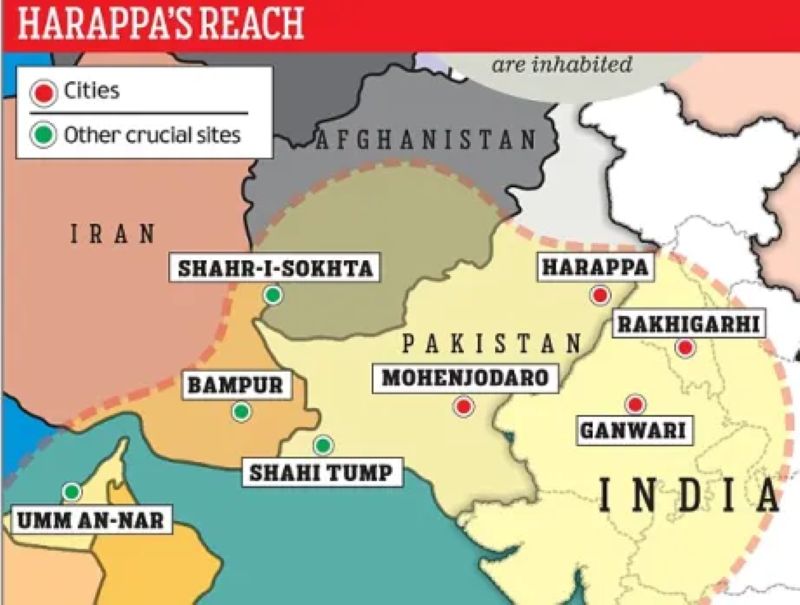
Around the 3rd millennium BCE—when the Harappan civilisation was thriving on the Indus Valley—the speakers of Proto-Dravidian were also aware of many crops, such as sorghum and various types of millet and gram. They also had terms for cattle pens and domesticated sheep and goats. Finally, as archaeobotanist Dorian Q. Fuller writes in “Non-Human Genetics, Agricultural Origins and Historical Linguistics in South Asia” (2007), Proto-Dravidian speakers seem to have lived in a dry, deciduous forest environment.

One region seems a good match for all these criteria. It is a region where the ranges of the modern Dravidian language families—Northern, Central, South-Central and South—overlap, and possibly where they radiated from. This is supported by extensive archaeological findings of a “Southern Neolithic” period, with evidence of small mud homes, remains of domesticated and wild animals, and crops.

There is a 73 per cent match between Southworth’s Proto-Dravidian vocabulary of plants and those found in Southern Neolithic sites. Surprisingly, these sites are rather distant from the hotbeds of South Indian linguistic nationalism today. They are neither in south Karnataka nor in Tamil Nadu. Rather, the speakers of Proto-Dravidian, according to archaeological and linguistic streams of evidence, lived in the Krishna-Godavari valley in present-day north Karnataka and Andhra Pradesh.

The archaeology of languages

To be clear, this is not to say that all Dravidian speakers originated from the Krishna-Godavari valley. (If we are being cheeky, no human being truly ‘originated’ anywhere except Eastern Africa.) The fact is, even the Proto-Dravidian language has some words borrowed from other language families, namely Austro-Asiatic—spoken mostly in Southeast Asia today, with the Munda families of Odisha and Chhattisgarh being the Indian representatives. This may suggest that the speakers of even earlier stages of Dravidian migrated to the Krishna-Godavari valley from elsewhere, picking up influences from other languages on the way. Some genetic and linguistic theories link early Dravidian speakers to the Iranian Plateau and the Harappan civilisation, but that’s a matter for another day.

Interestingly, the Proto-Dravidian language is not a perfect match for Southern Neolithic excavations: the peoples of the Southern Neolithic practised urn burials, but there’s no vocabulary for it in Proto-Dravidian. It also doesn’t match other archaeological candidates, such as the Harappan civilisation. If their cities are anything to go by, Harappans must have had a vocabulary for engineering and geometry, but it’s practically nonexistent in Proto-Dravidian. Proto-Dravidian also doesn’t have a word for ‘rhinoceros’, which are often depicted on Harappan seals. This doesn’t mean that no Dravidian speakers lived in Harappan cities—such a vast civilisation must have been multilingual. It just means there may have been another, now-extinct early branch of Dravidian languages, which could have evolved separately from Proto-Dravidian.

Proto-Dravidian has words for some crops—especially wheat—which may be of Harappan origin, suggesting, at the very least, agricultural exchanges. The true “homeland” of the Dravidians, then, is still unclear. All we can say for certain is that around 3000 BCE, Proto-Dravidian speakers deep in the South Indian peninsula harnessed agriculture and, as their population exploded around 1100 BCE, they spread out in waves across the Indian Subcontinent.

“Broadly, the default Proto-Dravidian agricultural practice was dry farming of millets, pulses and tubers. Irrigated rice farming (alongside cash crops like cotton and sugarcane) became more important in the late 1st millennium BCE,” Dr Sureshkumar Muthukumaran, a historian, curator and lecturer at the National University of Singapore, told me. Over the centuries, Dravidian speakers traded words, animals and crops not only with North India but also with Southeast Asia. A particularly influential branch headed south, giving rise to the South Dravidian languages. Some groups, relatively isolated on the Nilgiri hills, developed languages such as Irula and Toda. Others, settling into the expansive coasts and plains, spoke the ancestors of Kannada, Tamil and Malayalam.

The language that became Tamil, according to Krishnamurti (Dravidian Languages), branched off around 600 BCE, roughly when the first cities were growing on the Gangetic Plains far to the North. Three centuries later, it had developed into Old Tamil, the first Dravidian language to have a written culture, composed in thriving new trading towns with rice-farms. Old Tamil itself was composed of many dialects, which evolved into Middle Tamil and eventually modern Tamil centuries later. Between 800–1200 CE, some Middle Tamil dialects branched off into Malayalam.

We can say with confidence that the ancestor of Kannada is not Tamil: it is a lost South Dravidian language related both to the languages of the Nilgiris and to Old Tamil. Unfortunately, the earliest written examples of Kannada date to c. 450 CE, so we don’t have a clear picture of how the language evolved in the centuries prior. Thereafter, though, many dialects of Kannada evolved, through Old Kannada into Middle and thence modern Kannada. In North Karnataka, Kannada dialects had a fertile exchange with Indo-Aryan languages such as Marathi, which in turn had a Dravidian substrate.

The mosaic of Indian languages

It is becoming increasingly clear that this complex mosaic of linguistic borrowings, evolutions, migrations, and shifts is the story of all Indians, indeed of all humanity. Rig Vedic Sanskrit provides another early example. Prof Michael Witzel, a linguist and scholar of the Vedas, writes in “Substrate Languages in Old Indo-Aryan” (1999) that already by 1500 BCE, the earliest Indo-Aryan languages had absorbed a chunk of vocabulary from now-lost Austro-Asiatic languages in Punjab—a hypothetical Harappan language called “Meluhhan” in Sindh, and a language called “Language X”, probably spoken by the earliest Neolithic farmers in the Gangetic plains. A few centuries later, c. 800 BCE, Dravidian words suddenly appear in the Vedas, possibly hinting at now-lost North Dravidian languages.

As noted above, Tamil literature and writing appeared around 300 BCE. The earliest Tamil literature is called the Sangam poetry, after assemblies of poets who compiled it. Linguists, however, generally agree that the word “Sangam” itself is borrowed from Indo-Aryan languages, while Old Tamil poets were clearly aware of Vedic mythology. Meanwhile, around the same time in North India, Prakrit literatures blossomed, overpowering the dominance of Sanskrit in religion and ritual. Krishnamurti (The Dravidian Languages) argues that Prakrits probably developed from the integration of the speakers of now-lost regional Dravidian languages into the North Indian mainstream. And, in the medieval period, starting around 600 CE, all the major Southern Dravidian languages, including both Kannada and Tamil, borrowed extensive political, grammatical, and religious terms from a revitalised Classical Sanskrit.

So, what is indigenous and what is foreign? Which language is “oldest” when all have branched off from already-diverse origins, and borrowed from or lent to each other across centuries? India’s modern linguistic diversity didn’t appear out of nowhere: all the evidence is telling us that we are the inheritors of a complex, multidimensional mixing of genes, words, technologies, and ideas across timescales of truly mind-boggling proportions. Banal statements that language A is older than language B might set social media aflame and rally nationalists to a cause. But, as is increasingly clear, patriotic oversimplifications always trample on the histories and dignities they claim to protect. – The Print, 5 June 2025

Anirudh Kanisetti is an author and public historian. 

Dravidian Language Map


Srinivasa Ramanujan: A genius who transformed mathematics – B. Sathish

Srinivasa Ramanujan

In just five years at Cambridge, Ramanujan earned the reputation of being the greatest mathematician of the twentieth century. He solved numerous complex mathematicam problems that had remained unsolved for centuries. – B. Sathish

Among the world’s legendary mathematicians, such as Leonhard Euler, Carl Gauss, and Carl Jacobi, a common trait is that they were trained by professionals. In stark contrast, Srinivasa Ramanujan (22nd Dec 1887–26th Apr 1920) was a self-taught mathematician. He once said, “An equation for me has no meaning unless it expresses a thought of God.” Ramanujan believed his mathematical insights were divine revelations bestowed by Goddess Namagiri Thayar of the ancient sixth-century temple in Namakkal. Deeply devout, he maintained that his discoveries were not merely the result of study, but were revealed to him in dreams by the Goddess.

Early Days

Ramanujan’s father, Kuppuswamy Srinivasa Iyengar, worked as a clerk in a sari shop, while his mother, Komalathammal, played a significant role in nurturing his early education. They lived in a small, traditional home in Kumbakonam. At the age of 21, Srinivasa Ramanujan married a ten-year-old girl, Janakiammal, on 14 July 1909. Although they had no children, Janakiammal’s life was remarkable in its own right. Ramanujan’s wife and mother lived with him until he left for England on 17 March 1914.

By the age of 15, Ramanujan had mastered trigonometry, algebra, geometry, cubic equations, and more. However, due to his intense obsession with mathematics, he lost his scholarship at Kumbakonam Government College in 1904 and subsequently failed to obtain a degree from Presidency College, Madras, in 1907. Interestingly, at just 18 years old, Ramanujan left home following a misunderstanding—an incident that was reported in The Hindu newspaper under the headline “A Missing Boy”.

Well-Wishers

Thanks to Ramaswamy Aiyer, the founder of the Indian Mathematical Society (IMS), who recognised the potential of this gifted mathematician. Ramanujan first published “Some Properties of Bernoulli’s Numbers” in 1910, and from then on, he published a total of 12 research papers in the Journal of the Indian Mathematical Society.

In 1912, after securing a clerical job at the Madras Port Trust, Ramanujan joined the University of Madras as its first research scholar in May 1913.

Ramaswamy Aiyer introduced him to Sheshu Aiyar, who, in turn, gave Ramanujan a note of recommendation to meet Dewan Bahadur R. Ramachandra Rao, the then District Collector of Nellore and a noted mathematics enthusiast. On the suggestion of Sheshu Aiyar, Ramanujan began writing to well-known mathematicians in Britain, starting with unsuccessful attempts to reach M.J.M. Hill, E.W. Hobson, and H.F. Baker.

It was in January 1913 that Ramanujan wrote one of the most famous letters in the history of mathematics. The recipient was G.H. Hardy, a lecturer at Trinity College, Cambridge, and one of Britain’s foremost pure mathematicians. Without Hardy’s intervention, Ramanujan might never have been recognised as the greatest mathematician of the twentieth century. It was Hardy who truly discovered Ramanujan’s genius. (Explore the Hardy–Ramanujan number 1729!)

Hardy wrote of Ramanujan: “Here was a man who could work out modular equations and theorems … to orders unheard of, whose mastery of continued fractions was … beyond that of any mathematician in the world.”

Ramanujan travelled to England on 17 March 1914, after seeking the permission of Goddess Namagiri Thayar of Namakkal, and stayed for about five years until 1919. In just five years, he earned the reputation of being the greatest mathematician of the twentieth century, even as the world was engulfed in the First World War. He solved numerous complex problems that had remained unsolved for centuries.

How could a non-mathematician even imagine such achievements? For his work, Ramanujan’s name was accepted for the Fellowship of the Royal Society, and he was also elected a Fellow of Trinity College, Cambridge.

In 2012, Ken Ono of Emory University, United States, finally solved a problem that had remained an open challenge to mathematicians for 90 years—a problem originating from Srinivasa Ramanujan’s last mysterious letter. Professor Ono referred to the problem mentioned in Ramanujan’s final letter to Professor G.H. Hardy. In his speech, Professor Ono said, “No one was talking about black holes back in the 1920s when Ramanujan first came up with the mock modular forms, and yet, his work may unlock secrets about them.”

Ramanujan’s most celebrated works include number theory, infinite series, elliptic functions, modular forms, and mock theta functions, among others.

School education departments should make it mandatory for students to visit the little-known Ramanujan Museum (established in 1993 in Parry’s, Chennai), which houses a collection of some of his works—thanks to the efforts of mathematics educator P.K. Srinivasan.

A young Ramanujan with his wife Janaki Ammal.

Janaki Ammal

It would be an injustice not to mention Janaki Ammal and how her life unfolded after the sudden demise of Ramanujan at the young age of 32. After Ramanujan’s passing, Janaki Ammal lived in Mumbai for eight years, where she learnt tailoring and English. She returned to Madras in 1932, choosing to live as an independent woman. Hanumantharayan Koil Street in Triplicane became her home for the next 50 years. Tailoring helped her to survive financially.

She later adopted W. Narayanan after her close friend Soundravalli passed away. As a foster mother, Janaki Ammal ensured that Narayanan received a proper education and got him married in 1972. Narayanan and his wife, Vaidehi, took great care of Janaki Ammal until her death on 13 April 1994, at the age of 94.

In her later years, Janaki Ammal fondly recalled: “I considered it my good fortune to give him rice, lemon juice, buttermilk, etc., at regular intervals and to give fomentation to his legs and chest when he reported pain. The two vessels used then for preparing hot water are still with me; these remind me often of those days.”

Thanks are due to the governments of Tamil Nadu, Andhra Pradesh, and West Bengal, Madras University, and various mathematical institutions for their constant financial support to Janaki Ammal. The Hinduja Foundation also donated Rs 20,000 towards her welfare.

Janaki Ammal was a philanthropist as well, providing financial support to many students.

In interviews conducted soon after the discovery of Ramanujan’s “lost” notebook by George Andrews in 1976, Janaki Ammal lamented that a statue of Ramanujan had never been made, despite earlier promises. After the efforts of hundreds of mathematicians, a bronze bust was finally created from the only authentic passport-sized photograph of Ramanujan by American sculptor Paul Granlund. A copy of the bust was presented to Mrs Ramanujan at a formal function at the University of Madras in 1985—after a gap of 60 years.

I leave it to readers: are we truly celebrating him? If not, we must learn about Srinivasa Ramanujan and educate our children about his legacy. It is not only the government’s responsibility; it is ours as well.

One can only hope that, as centuries pass, Srinivasa Ramanujan will be remembered alongside other luminaries such as Aryabhata, Brahmagupta, and Bhaskara. – New18, 26 April 2025

B. Sathish is an engineer in the automotive industry.

Sri Namagiri Lakshmi Narasimhaswami Temple, Nammakal.

How the West has sustained an anti-India bias on Kashmir till today – Claude Arpi

Maj. William Brown

Despite Raja Hari Singh having signed the Instrument of Accession and joined India, Maj. William Brown of the Gilgit Scouts refused to acknowledge the orders of the Maharaja, and on November 1, 1947, he handed over the entire area of Gilgit-Baltistan to Pakistan. – Claude Arpi

On May 4, during an interactive session at the Arctic Circle India Forum 2025, External Affairs Minister S. Jaishankar spoke of broader geopolitical upheavals affecting the world, in particular Europe, which “must display some sensitivity and mutuality of interest for deeper ties with India”.

Answering a question on India’s expectations from Europe, Jaishankar said, “When we look out at the world, we look for partners; we do not look for preachers, particularly preachers who do not practice at home and preach abroad.”

This sharp answer came after the EU’s top diplomat, Kaja Kallas, urged both India and Pakistan to exercise restraint.

Kaja Kallas, the High Representative of the European Union for Foreign Affairs and Security Policy, formerly a Prime Minister of Estonia, was obviously ill-informed about the situation in Kashmir (and along the India-Pakistan border).

The attitude of certain Western countries (as well as the UN General Secretary) represents a great danger for India today; it has been so in the past.

The Kashmir Issue

A few years ago, while researching in the Nehru papers, I came across a “Top Secret” note written in the early 1950s by Sir Girja Shankar Bajpai, then secretary-general of the Ministry of External Affairs and Commonwealth Affairs; it was entitled “Background to the Kashmir Issue: Facts of the Case”; it made fascinating reading.

It started with a historical dateline: “Invasion of the state by tribesmen and Pakistan nationals through or from Pakistan territory on October 20, 1947; the ruler’s offer of accession of the state to India supported by the National Conference, a predominantly Muslim though non-communal political organisation, on October 26, 1947; acceptance of the accession by the British Governor-General of India on October 27, 1947; under this accession, the state became an integral part of India.”

Unfortunately, in a separate note, Lord Mountbatten, the Governor General of India, mentioned a plebiscite which would “take place at a future date when law and order had been restored and the soil of the state cleared of the invader”, then “the people of the state were given the right to decide whether they should remain in India or not.”

It was an unnecessary addition, but Mountbatten wanted to show British (so-called) legendary fairness.

Anyway, the conditions were clear and in two parts: first, the Pakistani troops or irregulars should withdraw from the Indian territory that they occupied, and later a plebiscite could be envisaged.

Bajpai’s note also observed: “Pakistan, not content with assisting the invader, has itself become an invader, and its army is still occupying a large part of the soil of Kashmir, thus committing a continuing breach of international law.”

The Gift of Gilgit

Worse was to come; Maj. William Brown, a British officer, illegally offered Gilgit to Pakistan. The British paramountcy had lapsed on August 1, 1947, and Gilgit had reverted to the Maharaja’s control. Lt. Col. Roger Bacon, the British political agent, handed his charge to Brig. Ghansara Singh, the new governor appointed by Maharaja Hari Singh, while Maj. Brown remained in charge of the Gilgit Scouts.

Despite Hari Singh having signed the Instrument of Accession and joined India, Maj. Brown refused to acknowledge the orders of the Maharaja under the pretext that some leaders of the Frontier Districts Province (Gilgit-Baltistan) wanted to join Pakistan.

On November 1, 1947, he handed over the entire area to Pakistan, in all probability ordered by the British generals.

An interesting announcement appeared in the 1948 London Gazette mentioning that the King “has been graciously pleased … to give orders for … appointments to the Most Exalted Order of the British Empire.…” The list included “Brown, Major (acting) William Alexander, Special List (ex-Indian Army)”. Brown was knighted for having served the Empire.

At the time, the entire hierarchy of the Indian and Pakistan Army were still British. In Pakistan, Sir Frank Messervy was commander-in-chief of the Pakistan Army in 1947-48, and Sir Douglas Gracey served in 1948-51; while in India, the commander-in-chief was Sir Robert Lockhart (1947-48) and later Sir Roy Bucher (1948), and let us not forget that Sir Claude Auchinleck (later elevated to Field Marshal) served as the supreme commander (India and Pakistan) from August to November 1947.

Who can believe that all these senior generals were kept in the dark by a junior officer like Maj. Brown?

The Western influence or manipulation continued in the following years and decades; the Americans soon entered the scene too.

India and the Western Powers

After China invaded northern India in 1962, Delhi decided to ask for the help of the Western nations, particularly the United States. The latter was only too happy to offer it and thus gain leverage over India, which until that time had been “neutral and non-aligned”.

Seeing northern India invaded by Chinese troops, it seemed logical that the United States would come to India’s aid, but it turned out differently.

Soon after the ceasefire declared by the Chinese on November 22, 1962, and instead of helping India, Great Britain and the United States decided that the time had come to resolve the Kashmir dispute between their Pakistani ally and India, now begging for help.

Two days after the ceasefire, Averell Harriman, the US Under Secretary of State, and Duncan Sandys, the British Commonwealth Secretary, visited the two capitals of the subcontinent to persuade the “warring brothers” that it was time to bury the hatchet and find a solution to the fifteen-year-old Kashmir question. Harriman and Sandys signed a joint communiqué and asked the two countries to resume negotiations.

India’s invasion by China was forgotten.

Delhi, in a position of extreme weakness, had doubts about the possibility of obtaining positive results from negotiations conducted under such circumstances, but Nehru did not refuse the “offer”.

On December 22, 1962, he wrote to the provincial chief ministers: “I have to speak to you briefly on the Indo-Pakistan question, and particularly on Kashmir. In four days, Sardar Swaran Singh [the Minister of External Affairs] will lead a delegation to Pakistan to discuss these problems. We realise that this is not the right time to have a conference like this, as the Pakistani press has vitiated the atmosphere with insults and attacks directed against India. Nevertheless, we have agreed to go and will do our best to arrive at a reasonable solution.”

The two delegations ultimately held a series of six meetings; nothing came of them. The first negotiations took place in Rawalpindi; Swaran Singh and Zulfikar Ali Bhutto, Pakistan’s foreign minister, limited themselves to a historical presentation of the problem and the reiteration of their respective points of view. During the talks, India reaffirmed that it wanted to explore all possibilities to resolve the issue, as it wanted to live in peace with Pakistan, which insisted that the UN resolutions of August 1948 and January 1949 must be implemented as soon as possible (without them vacating the occupied part of Hari Singh’s kingdom).

The negotiations got off on a bad start: just before they began, the Pakistani government announced that it had reached an agreement in principle with China on its border issue. Just a month after the end of the Sino-Indian War, Pakistan was prepared to give China a piece of territory that India considered its own. What a slap in the face for India! Were the Western powers aware of the secret negotiations between Pakistan and China? Probably.

It is indeed surprising that Pakistan, an ally of the United States and the Western world, chose this moment to make this announcement. It was proof that Pakistan expected nothing from the talks with Delhi.

Negotiations on Kashmir continued between January 16 and 19, 1963, in Delhi and February 8 and 11 in Karachi, of course without any tangible results. Pakistan wanted a plebiscite, but India insisted on the prior demilitarisation of the regions occupied by Pakistan.

Talks took place in Calcutta between March 12 and 14. India proposed some readjustments of the Line of Control, but these were rejected by Pakistan.

During the fifth round of talks held in Karachi between April 22 and 25, India protested that Pakistan had ceded part of Kashmiri territory to China; there was no longer any chance of finding a negotiated solution to the Kashmir issue.

During the sixth and final round of talks, India clarified that it had no intention of replacing a democratically elected government with an international organisation that it believed had no knowledge of local issues. India therefore rejected the proposals.

Retrospectively, 63 years later, it is not surprising that in an interview with Sky News, when the interviewer Yalda Hakim questioned him about Pakistan’s long history of backing, supporting and training terrorist organisations, Pakistan Defence Minister Khawaja Asif admitted, “Well, we have been doing this dirty work for the United States for about three decades, you know, and the West, including Britain.”

India should indeed beware of some Western powers. – Firstpost, 10 May 2025

› Claude Arpi is Distinguished Fellow, Centre of Excellence for Himalayan Studies, Shiv Nadar Institution of Eminence, Delhi. He is the director of the Pavilion of Tibetan Culture at Auroville.

Kashmir Map

Op Sindoor Banner

India’s Pakistan conundrum – Claude Arpi

Attari-Wagha Border


India’s ‘dharmic genes’ have made it more generous towards a deceitful Pakistan without any receprocity. History can’t be rewritten, but one should perhaps learn from it. – Claude Arpi 

It has been argued that “Bharat has become a victim of its own innate dharmic nature—and, of course, democratic laws.”

This is a historical fact.

The Simla Agreement of 1972, repudiated by Pakistan after Delhi denounced the Indus Water Treaty of 1960, provided for the return of Pakistani prisoners of war. Unfortunately, India’s ‘dharmic’ genes accepted to release more than 90,000 Pakistani prisoners of war, against very little compensation. The Indian leadership probably thought that it was unethical (or adharmic) to keep so many Pakistani nationals in custody.

There are many more examples of the “dharmic” nature of the Indian leadership. We shall mention three here; if India had listened to saner elements, the situation would have been different on the borders today. It can, of course, be argued that it was plain stupidity, not ‘dharma’, which guided the Delhi establishment at that time.

Take Lahore

Lt. Gen Nathu Singh Rathore was one of the most remarkable officers of the Indian Army post-independence. When offered the post of first Indian Commander-in-Chief of the Indian Army, he refused and told the defence minister that Gen. K.M. Cariappa would do a better job than him.

But Gen. Nathu always spoke frankly, sometimes too frankly for the politicians in Delhi. At the end of 1947, he thought of taking Lahore to force the raiders and their Pakistani supporters to leave Kashmir and return to their bases. The general decided to speak to Nehru; his biographer wrote: “When he reached the prime minister’s house, he found him sitting on the lawn, talking to some ministers and civilian officials. Presently, Nehru got up and went inside. The others present there asked Nathu Singh for his views on the best way to deal with the crisis in Kashmir. Nathu Singh replied that if he had his way, he would use the minimum troops to hold the passes and, with maximum force, attack and capture Lahore. This would force Pakistan to withdraw and vacate all occupied territory in Jammu and Kashmir.”

The biographer continues: “The civilians were impressed by the logic of this argument, and when Nehru returned, they told him that the general had a good plan to throw out the invaders. When Nehru asked him to repeat what he had said, Nathu Singh demurred, saying that he would rather not, since he knew it would not find favour. But Nehru insisted, and Nathu repeated what he had told the others.”

But Nehru was horrified and became angry: “How can a responsible senior officer think of such a foolhardy scheme? It could cause an international crisis.”

Incidentally, in 1965, a similar plan was approved by Lal Bahadur Shastri, then prime minister, and the threat to Lahore probably saved Kashmir.

After the Pahalgam massacre, it is worth remembering this. Had the Indian Army advanced on Lahore in 1947, there would be no Kashmir issue today. But would the British have allowed it? This is another question.

Occupy Chumbi Valley

In October 1950, after the Chinese had captured Chamdo, the capital of Eastern Tibet, and were ready to advance towards Lhasa, Harishwar Dayal, an extremely bright ICS officer posted as Political Officer (PO) in Sikkim (looking after Tibet, Sikkim and Bhutan), wrote to the Ministry of External Affairs in Delhi about the Chinese advances on the Tibetan plateau.

Dayal quoted from a letter from Hugh Richardson, the Indian Head of the Mission in Lhasa dated June 15, 1949, who had then suggested that India might consider occupying Chumbi Valley up to Phari “in an extreme emergency” (meaning if China threatened to invade Tibet).

More than a year later, Dayal brought back the idea: “This suggestion was NOT favoured by the Government of India at the time. It was, however, proposed as a purely defensive measure and with NO aggressive intention. An attack on Sikkim or Bhutan would call for defensive military operations by the Government of India.”

China’s PLA planners today call this “active defence”.

Dayal explained his reasoning: “In such a situation, occupation of the Chumbi Valley might be a vital factor in defence. In former times it formed part of the territories of the rulers of Sikkim, from whom it was wrested by the Tibetans by force. It is now a thin wedge between Sikkim and Bhutan, and through it lie important routes to both these territories. Control of this region means control of both the Jelep La and Nathu La routes between Sikkim and Tibet as well as of the easiest routes into Western Bhutan, both from our side and from the Tibetan side.”

Dayal expressed his strategic views further: “It is a trough with high mountains to both east and west and thus offers good defensive possibilities. I would therefore suggest that the possibility of occupying the Chumbi Valley be included in any defensive military plans, though this step would NOT, of course, be taken unless we became involved in military operations in defence of our borders.”

Dayal had probably not realised that China was “friend” (or “brother”) of the leadership in Delhi; a few days earlier, the prime minister had already severely reprimanded the PO and Sumul Sinha, who had replaced Richardson in Lhasa, for not understanding that China was India’s friend.

What prompted Dayal to write this letter was probably his meeting with some of the members of the Himmat Singhji Committee, who would have asked him to put his views in writing in order to bring some pressure on the pacifists in South Block, who could only see the “wider perspectives”.

One can only wishfully dream of the implications an Indian advance in Chumbi would have had (no Siliguri Corridor, etc).

1971: Why not take Baltistan?

Another case: in August 1971, as the clouds were gathering over the Indo-Pakistan border, a young Ladakhi officer, Chewang Rinchen, joined again his old regiment, the Ladakh Scouts; he was asked to report with Colonel Udai Singh, his commanding officer, to his beloved Nubra Valley. Rinchen had already been awarded a Maha Vir Chakra in 1947 at the age of 17.

Rinchen confidently told his GOC that the Ladakhi Scouts and the Nubra Guards (known as the Nunnus they were later integrated into the Scouts) would do the “job” and repel the Pakistani forces.

The army base for the sector was located at Partapur in the Valley, and since 1960 an airfield had been opened at Thoise (till today the base camp for the operations on the Siachen Glacier).

The Nunnu was a good tactician; he always sought the cooperation of the local people, whether they were Buddhist, Muslim or Christian. He knew that most of the time, the troops had to depend upon local vegetables, meat and other supplies to survive.

While most of the commanders favoured a riverbed approach, Rinchen decided to cross over the mountains with his Dhal Force and follow the ridge. He argued that the enemy must be waiting with mines and machine gun nests near the river; he chose to capture Pt. 18,402, the highest Pakistan-occupied post, and then roll down to Chulunkha, the Pakistani base.

Soon after, on December 8, from the top of Pt. 18,402, Rinchen could see the entire valley from Turtok and Chulunkha in the east to the Indian Army headquarters at Partapur and the airfield at Thoise in the west. Rinchen’s tactics had paid off. He told his men, “Enjoy the Pakistani blankets and food”.

On December 9, advancing along the ridges, Rinchen and his men descended towards the Chulunkha defence complex, trying not to be seen by the enemy. Soon, Rinchen got a wireless message from Maj. Thapa informing him that Thapa’s team had managed to enter the enemy bunkers and a few Pakistani soldiers had been killed and a JCO captured.

On December 14 morning, soon after shelling started to destroy the roadblocks near the Turtok axis, the Dhal Force began its advance again.

At 10 pm, shelling was stopped, and the troops entered the Turtok village. Surprisingly, the village was absolutely silent.

The next phase of the operations was Tyakshi village, 6 km. from Turtok. It was concluded on December 14 in the evening. A few Pakistani soldiers were captured with arms and ammunition.

On December 17, Rinchen ordered his troops to get ready to launch an attack against Prahnu and Piun in Baltistan (Khapalu, the first large town in Baltistan, is located 28 miles away); it was never to happen.

In the afternoon, the Pakistani government agreed to a ceasefire. The Dhal Force was ordered to cease fire, greatly disappointing Chewang Rinchen’s men; they knew that in a few days they could liberate the entire Baltistan. Rinchen could not disobey orders from Delhi.

Had this been done, Pakistan would have lost its base for the Siachen Glacier operations, which were to start 13 years later.

Many such stories could be recounted, but history can’t be rewritten; but one should perhaps learn from history. – Firstpost, 27 April 2025

Claude Arpi is Distinguished Fellow, Centre of Excellence for Himalayan Studies, Shiv Nadar Institution of Eminence, Delhi. He is the director of the Pavilion of Tibetan Culture at Auroville.

Kashmir Map

Op Sindoor Banner

The legend of St. Thomas in India is not factual – Koenraad Elst

St. Thomas the Apostle: There was no Cross or Bible in the 1st century. Both were adopted by Christians for use after the 3rd/4th century.

The belief that Thomas settled in South India came about as an honest mistake, the claim that he was martyred by Brahmins was always a deliberate lie. … If Indian bishops have any honour, they will themselves remove this false allegation of murder from their discourse and their monuments. Indeed, they will issue a historic declaration expressing their indebtedness to Hindu hospitality and pluralism and pledging to renounce their anti-Hindu animus. – Dr. Koenraad Elst

A predictable component of platitudinous speeches by secularist politicians is that “Christianity was brought to India by the apostle Thomas in the 1st century AD, even before it was brought to Europe”. The intended thrust of this claim is that, unlike Hinduism which was imposed by the “Aryan invaders”, Christianity is somehow an Indian religion, even though it is expressly stated that it “was brought to India” from outside. As a matter of detail, St. Paul reported on Christian communities living in Greece, Rome and Spain in the 40s AD, [1] while St. Thomas even according to his followers only came to India in 52 AD, so by all accounts, Christianity still reached Europe before India. [2] At any rate, its origins lay in West Asia, outside India. But this geographical primacy is not the main issue here. More importantly, there is nothing factual, nor secular, about the claim that Thomas ever came to India.

That claim is a stark instance of what secularists would denounce in other cases as a “myth”. By this, I don’t mean that it was concocted in a backroom conspiracy, then propagated by obliging mercenary scribes (the way many Hindus imagine the colonial origins of the “Aryan invasion myth” came into being). It came about in a fairly innocent manner, through a misunderstanding, a misreading of an apocryphal text, the miracle-laden hagiography Acts of Thomas. This is not the place to discuss the unflattering picture painted of Thomas in his own hagiography, which credits him with many anti-social acts. The point for now is that the text never mentions nor describes the subcontinent but merely has the apostle go from Palestine eastwards to a desert-like country where people are “Mazdei” [Zoroastrian] and have Persian names. This is definitely not lush and green Kerala. Not only is there no independent record of Thomas ever coming near India, but the only source claimed for this story, doesn’t even make this claim either.

However, we know of a Thomas of Cana [3] who led a group of Christian refugees from Iran in the 4th century, when the christianisation of the Roman empire caused the Iranians to see their Syriac-speaking Christian minority as a Roman fifth column. The name “Thomas Christians” may originally have referred to this 4th-century leader. [4]

Then again, those refugees may also have been “Thomas Christians” before their migration to India in the sense that their Christian community had been founded in Iran by the apostle Thomas [viz. Church of Fars]. That he lived and worked in some Iranian region is attested and likely, but in no case did he ever settle in India.

Bishop Eusebius of Caesarea (c. 260/265 CE – 30 May 339 CE), Christianity's first historian, recorded that St. Thomas went to Parthia (Iran).

The Church Fathers Clement of Alexandra, Origen and Eusebius confirm explicitly that he settled in “Parthia”, a part of the Iranian world. From the 3rd century, we do note an increasing tendency among Christian authors to locate him in a place labelled “India”, as does the Acts of Thomas. But it must be borne in mind that this term was very vague, designating the whole region extending from Iran eastwards. [5] Remember that when Columbus had landed in America, which he thought was East Asia, he labelled the indigenous people “Indians”, meaning “Asians”. Afghanistan is one area that was Iranian-speaking and predominantly Mazdean [Zoroastrian] but often considered part of “India”. Moreover, in some periods of history it was even politically united with parts of “India” in the narrow sense. So, Afghanistan may well be the “Western India” where Pope Benedict placed St. Thomas in his controversial speech in September 2006, to the dismay of the South Indian bishops.

While the belief that Thomas settled in South India came about as an honest mistake, the claim that he was martyred by Brahmins was always a deliberate lie, playing upon a possible confusion between the consonants of the expression “be ruhme”, meaning “with a spear”, and those of “Brahma” (Semitic alphabets usually don’t specify vowels). That was the gratitude Hindus received in return for extending their hospitality to the Christian refugees: being blackened as the murderers of the refugees’ own hero. If the Indian bishops have any honour, they will themselves remove this false allegation from their discourse and their monuments, including the cathedral in Chennai built at the site of Thomas’s purported martyrdom (actually the site of a Shiva temple). Indeed, they will issue a historic declaration expressing their indebtedness to Hindu hospitality and pluralism and pledging to renounce their anti-Hindu animus.

Secularists keep on reminding us that there is no archaeological evidence for Rama’s travels, and from this they deduce the non sequitur that Rama never existed, indeed that “Rama’s story is only a myth”. But in Rama’s case, we at least do have a literary testimony, the Ramayana, which in the absence of material evidence may or may not be truthful, while in the case of Thomas’s alleged arrival in India, we don’t even have a literary account. The text cited in the story’s favour doesn’t even have him come to a region identifiable as South India. That is why Christian scholars outside India have no problem abandoning the myth of Thomas’s landing in Kerala and of his martyrdom in Tamil Nadu. I studied at the Catholic University of Louvain, and our Jesuit professor of religious history taught us that there is no data that could dignify the Thomas legend with the status of history.

This eliminates the last excuse the secularists might offer for repeating the Thomas legend, viz. that the historical truth would hurt the feelings of the Christian minority. It is clear enough that many Christians including the Pope have long given up the belief in Thomas’s Indian exploits, or (like the Church Fathers mentioned above) never believed in them in the first place. In contrast with European Christians today, Indian Christians live in a 17th century bubble, as if they are too puerile to stand in the daylight of solid historical fact. They remain in a twilight of legend and lies, at the command of ambitious “medieval” bishops who mislead them with the St. Thomas in India fable for purely selfish reasons. – Extracted from the foreword to The Myth of Saint Thomas and the Mylapore Shiva Temple, Voice of India, New Delhi, 1995.

› Dr. Koenraad Elst is an author and historian from Belgian who frequently visits India to lecture. He is a leading Voice of India author.

Notes

1. India’s political leaders are fond of telling their constituents and the nation that Christianity arrived in India before it arrived in Europe. This historical conceit is not true. Apostle Paul says in Romans 15:24 & 15:28 that he plans to visit Spain (which already had a Christian community). In Acts 19:21 he travels from Ephesus to Greece—Macedonia and Achaia—en route to Jerusalem, and then on to Rome. This took place in the 40s CE—some historians say he was writing after 44 CE. So even if it was true that Apostle Thomas landed in Kerala in 52 CE—the spurious date is of 19th century origin—Christianity would still have arrived in Europe a decade earlier. – IS

2. Pandit Jawaharlal Nehru provides an excellent example of how some innocents abroad lap up lies sold by powerful organizations. “You may be surprised to learn,” he wrote his daughter, Indira, on April 12, 1932, “that Christianity came to India long before it went to England or Western Europe, and when even in Rome it was a despised and proscribed sect. Within a hundred years or so of the death of Jesus, Christian missionaries came to South India by sea. … They converted a large number of people.” (Glimpses of World History, OUP reprint, 1987, quoted by Sita Ram Goel in History of Hindu-Christian Encounters: AD 304 to 1996, Second Revised Edition, Voice of India, New Delhi, 1996.) – IS

3. Thomas of Cana, known variously as Thomas Cananius, Thomas of Jerusalem, Thomas the Merchant, and to Syrian Christians as Knai Thoma, led the first group of 72 Syrian Christian families to India in 345 AD. There is no record of Christian communities in India prior to this date, and the date 345 AD is also not verified.  Thomas of Cana and his companion Bishop Joseph of Edessa also brought with them the tradition of St. Thomas the Apostle of the East. Later, Christian communities in Kerala would identify Knai Thoma with Mar Thoma—Thomas of Cana with Thomas the Apostle—and claim St. Thomas had arrived in Kerala in AD 52 and established the first Christian church at Musiris—the ancient port near present day Kodungallur—the main trading center of the day.

The Rev. Dr. G. Milne Rae of the Madras Christian College, in The Syrian Church in India, did not allow that St. Thomas came further east than Afghanistan (Gandhara). He told the Syrian Christians that they reasoned fallaciously about their identity and wove a fictitious story of their origin. Their claim that they were called “St. Thomas” Christians from the 1st century was also false.

The Christian monk and merchant trader Cosmas Indicopleustes of Alexandria visited the Malabar coast in the 6th century and is the first writer to record the presence of Christian communities in India. The observation in his book Christian Topography (ca. 550 AD) is considered the first authentic record of Christians in India. – IS

4. Syrian Christians were called Nasranis (from Nazarean) or Nestorians (by Europeans) up to the 14th century. Bishop Giovanni dei Marignolli the Franciscan papal legate in Quilon invented the appellation “St. Thomas Christians” in 1348 to distinguish his Syrian Christian converts from the low-caste Hindu converts in his congregation. – IS

5. The oriental ubiquity of St. Thomas’s apostolate is explained by the fact that the geographical term “India” included, apart from the subcontinent of this name, the lands washed by the Indian Ocean as far as the China Sea in the east and the Arabian peninsula, Ethiopia, and the African coast in the west. Ancient writers used the designation “India” for all countries south and east of the Roman Empire’s frontiers. India included Ethiopia, Arabia Felix, Edessa in Syria (in the Latin version of the Syriac Diatessaron), Arachosia and Gandhara (Afghanistan and Pakistan), and many countries up to the China Sea. In the Acts of Thomas, the original key text to identify St. Thomas with India (which all other India references follow), historians agree that the term India refers to Parthia (Persia) and Gandhara (Afghanistan-Pakistan). The city of Andrapolis named in the Acts, where Judas Thomas and Abbanes landed in India, has been tentartively identified as Sandaruck (one of the ancient Alexandrias) in Balochistan. – IS

San Thome Cathedral: This tableau of St. Thomas and his Hindu assassin was built after the publication of Ishwar Sharan's book in 1995. Its objective is to malign the Hindu community with the accusation of the murder of a Christian apostle and saint, and to further the propagation of the St. Thomas legend which has made India's bishops very wealthy and supports their political claim on India.

Analysing the ‘phallacy’ of the Shiva lingam – Arvind Sharma

Shiva Lingabhavad Image

“The Shiva linga is part of a vast natural symbolism of ascending cosmic energy. Such linga forms include mountains, fire, trees, standing stones, pyramid, sun, moon, lightning, and OM. It’s sexual reduction by modern scholars is part of their sexual obsession overall.” – Dr David Frawley quoted by Prof. Sharma 

The claim that a Shiva linga may have been discovered at the Gyanvapi mosque in Varanasi has raised some questions about what it stands for. The issue is important considering the comments made on it on social media. The professor of a college in Delhi, on seeing its picture, wondered whether Lord Shiva had been circumcised. Another voice on social media seemed to wonder whether it spouted semen, perhaps because it was claimed to be a fountain by the opposing party. More recently, a lady from Jaipur seemed to give a foreplay dimension to the changes in its size mentioned at various times. And so on.

What is significant here is the temptation to take it, some would say mistake it, for a phallic symbol, which is its chosen interpretation in Western Indology. This tendency to take it as a body part, therefore, on the part of some may be attributed to the way Western Indology tends to view it. This leads to the next question: To what extent is this description justified?

Sometimes it is argued that the word itself stands for the penis. This is problematic because the term is used to signify gender in Sanskrit, and more generally stands for a mark or sign. Thus the words corresponding to masculine, feminine, and neuter gender in Sanskrit are pullinga, strilinga, and napunsakalinga. It is clear that translating these terms by using the word penis will lead to hilarious results. The use of the word varna and its apparent translation as colour, similarly, created serious problems in Indology from which it is still trying to emerge.

At a religious rather than verbal level, a Hindu, in general, finds the interpretation of the term linga as a phallus jarring, to say the least. Mahatma Gandhi noted that he first learnt from a book by a missionary that it had any “obscene” significance. This radical divergence in understanding the significance of the Shiva linga is a striking example of how the insider’s and the outsider’s perspective might differ on a point. The outsider may associate it with a fertility cult. In Hindu lore, however, the Shiva linga represents the axis mundi, the pillar upholding the universe as it were. In the Puranas it represents the pillar of fire or light, the form in which Shiva appeared when the three gods of the Hindu trinity—Brahma, Vishnu and Shiva—were competing among themselves to determine who was the greatest among them. Shiva proved his pre-eminence because the other gods could not discover the beginning or the end of the pillar, which the linga represents.

It is not that the Shiva linga has not been sometimes interpreted as a body part. According to one scholar, it happens about 10 per cent of the time. Thus this does not happen often, however, even when it happens its understanding continues to be an elevated one. For instance, in the Mahabharata, sage Upamanyu states that the use of the linga and yoni to depict Shiva and Parvati means that they pervade all beings. Ramakrishna states that we worship Shiva in this form to pray for release from the process of rebirth. In a Yogic context, the linga represents the conversion of sexual energy into spiritual energy. Paradoxically, the upright but unshed penis symbolises spiritual ascent brought about by celibacy. Alberuni, the Muslim savant, records that according to one account it denotes Shiva, because when Shiva was ordered by Brahma to create imperfect human beings, Shiva refused to do so, and indicated his displeasure by chopping off the symbol of creation and procreation.

The recovery of the Shiva linga at the Gyanvapi mosque would not be complete until we also recover its proper meaning from the obfuscations under which it has been buried. It is worth reflecting on the following comment by David Frawley at this point: “The Shiva linga is part of a vast natural symbolism of ascending cosmic energy. Such linga forms include mountains, fire, trees, standing stones, pyramid, sun, moon, lightning, and OM. It’s sexual reduction by modern scholars is part of their sexual obsession overall.”

In a review of two books by Wendy Doniger—The Hindus: An Alternative History (2009) and On Hinduism (2014)—in Foreign Affairs (September-October 2014), Ananya Vajpeyi notes how Doniger “argues that the lingam, a symbol of the Hindu deity Shiva that is found in temples should be understood ‘unequivocally as an iconic representation of the male sexual organ in erection, in particular as the erect phallus’.” The shock the Hindu feels in the face of such misrepresentation could only be compared to that of the Christian, upon being told that when the Christian participates in the Mass on Sunday he or she is practising cannibalism, as the Christian then consumes the flesh (wafer) and blood (wine) of Jesus Christ. – Firstpost, 12 June 2022

Prof. Arvind Sharma, formerly of the IAS, is the Birks Professor of Comparative Religion at McGill University in Montreal, Canada, where he has taught for over thirty years. He has also taught in Australia and the United States and at Nalanda University in India. He has published extensively in the fields of Indian religions and world religions. 

Worshiping a Shiva lingam in the Ganga.

The British Empire didn’t end slavery, it reinvented it – Monidipa Bose Dey

Indian indentured labour in Guyana ca. 1920.

The notion that the British Empire abolished slavery across most of the world is, in reality, a myth. What the Empire simply did was quickly devise an alternative means of reintroducing slavery, by terming it as ‘indentured labour’ across its colonies, and that sounded politically correct and socially more acceptable to the white Western world. – Monidipa Bose Dey

A post on X by Elon Musk, stating that “the British Empire was the driving force behind ending the vast majority of global slavery,” brought forth a great deal of outrage from his Indian readers, and rightfully so. Slavery, which was officially abolished in the British colonies on August 28, 1833, with the passing of the Slavery Abolition Act, created severe labour shortages in British-ruled plantation islands, as newly freed former slaves refused to work for the meagre wages offered at the time.

This shortage compelled the British Empire, under pressure from wealthy white planters, to find a politically acceptable alternative for obtaining “unfree labour” from the native populations in British colonies such as India. Consequently, the indentured labour system was introduced, with clauses such as “restrictions on freedom of movement”, penalties for “negligence”, “absence from work” being made into criminal offences.

Thus, indentured labour was nothing but “slavery with a contract”. The notion that the British Empire abolished slavery across most of the world is, in reality, a myth. What the Empire simply did was quickly devise an alternative means of reintroducing slavery, by terming it as “indentured labour” across its colonies, and that sounded politically correct and socially more acceptable to the white Western world.

Owing to the numerous territorial conquests by Britain during this period, the British Empire liberally utilised its colonies as both sources and destinations for indentured labour. The primary destinations for Indian indentured labour were the British colonies of Trinidad, Mauritius, and British Guyana.

A brief overview of the European slave trade in India before the Slavery Abolition Act of 1833

The arrival of Europeans in India during the 17th century introduced a new dimension to the already thriving slave market under Islamic rulers. European powers entered the slave trade in the early 17th century, sourcing war captives from raids and conquests carried out by Arakanese rulers in the Bay of Bengal region. These raids created a systematic network of kidnappings, with countless Bengalis being captured and sold, turning ports such as Arakan, Chittagong, Hooghly, and Tamluk into infamous slave markets.

By the 1620s, the Arakanese were supplying over 1,000 slaves annually to the Dutch market. Not to be outdone, the Portuguese began conducting their own slave raids, targeting settlements along the Ganga belt. However, these activities soon drew the attention of the Mughals. By the mid-17th century, the Dutch were accused of illegally trafficking around 5,000 Bengalis annually to Batavia. Consequently, by the 1660s, the Arakan-Bengal slave trade was brought to a halt.

However, as the Bengal source of slaves dried up, another alternative supply of labour emerged, which provided irregular yet large numbers of more compliant Indian labour from both north and south India for European factories. Famines and wars led to the self-selling or “voluntary” sale of many adults and children, who were desperate to save themselves from starvation. The purchase of slaves of this kind is historically documented in Odisha, Bengal, Thanjavur, Madurai, and Chingleput, and this continued for the next two centuries.

One documented slave purchase took place in 1622, after a prolonged drought (1618–20), when the Dutch bought 1,000 slaves on the Coromandel Coast and sent them to work in Banda and Batavia.

In cases of local wars, entire families were often sold, and between 1658 and 1662, more than 7,000 slaves were bought and sent to Sri Lanka. In the 1670s, a prolonged period of crop failures led to large-scale slave sales from Tuticorin, with slaves being sent to Sri Lanka and Batavia. Indian slaves were also exported to the Dutch colonies in South-East Asia. In the first half of the 17th century, besides the Dutch, Danish, and Portuguese, English traders were also heavily involved in the slave trade, sending Indian slaves from these regions to work on rice and pepper plantations in various foreign destinations. In the latter half of the 17th century, English slave traders also shipped slaves from the port of Madras.

In the 18th century, India saw a rising number of political instabilities, armed conflicts, general financial mismanagement by the ruling classes, and increasing taxes. All these factors combined to create the horrific Bengal famine of 1770, which wiped out almost one-third of the population of Bengal. As the value of money fell, an overall decline in living standards led to an increasing outward flow of labour.

Additionally, as Indian political control over the ports weakened, slave markets began thriving around European colonial settlements. By the second half of the 18th century, French and Dutch colonies were taking in large numbers of Indian slaves, particularly when a series of famines struck eastern India.

In 1785, after a crop failure, many children were put up for sale, and the Collector of Dhaka reported seeing boats “loaded with children of all ages.” A few years later, Lord Cornwallis wrote, “Hardly a man or woman exists in a corner of this populous town [Calcutta] who hath not at least one slave child … most of them were stolen from their parents or bought for perhaps a measure of rice, in times of scarcity.”

Those exported as slaves often included nomadic farmers, poor labouring classes, or aboriginal people known as “Hill Coolies” or “dhangurs”. These people were chosen based on their being young, active, and able-bodied. Most were unaware of where they were being sent, the nature of the work they would undertake, or the length of their journey.

Bowing to pressure from the abolitionists back home in Britain, by the end of the 18th century, the British were forced to start seizing ships carrying slaves, even though their main focus was on the ships of their trading enemies (Dutch and Portuguese); and the Slavery Abolition Act was passed in 1833. However, soon after the 1833 Act was passed, a solution to the labour crisis in colonial plantations arising from the abolishment of slavery was chalked out. Indians were turned into “indentured labourers” by British policymakers and exported to their sugar colonies under the new indenture system.

Where Indian indentured labour went in the Bristish colonies.

After the abolition of slavery

After the abolition of slavery in 1833, plantation owners explored various options for procuring labour, including sourcing workers from Africa, Canada, Europe, and China, but none of these proved viable. These failures turned the Empire’s attention to India as a long-term and reliable source of labour, and in the 19th century, India became the primary supplier of labour to the sugar colonies across the British Empire. As noted by the Royal Commission of Labour in 1892, the “importation of East Indian coolies did much to rescue the sugar industry from bankruptcy.”

The Indian indenture system was entirely state-controlled and involved a written and so-called “voluntary” contract (an “agreement,” also known as Girmitiyas in Fiji), which emigrants signed or provided a thumbprint for before leaving India. While the contract contained certain protective clauses for the workers, there were significant disparities between the rhetoric given in the contract paper and the ground realities on the plantations. There were innumerable reports of fraud and the use of force during the recruitment and transportation of labourers, as well as the appalling conditions under which Indian workers were forced to labour on the plantations.

A look at the indenturing process of labour from India reveals considerable evidence of the harsh treatment meted out to the indentured workers. In Jamaica, an ordinance fixed the wage rates at one shilling per working day (9 hours) for adult males, and 9 pence for women and children; however, the actual wages paid were much lower (around 10 pence for adult males). New labourers were provided with rations free of charge for the first three months, but the cost of the rations was later deducted from their already meagre wages. Wages were so low that the labourers could hardly make any savings, and furthermore, indentured labourers were not allowed to earn extra income. Absence from work was dealt with harshly by most employers. The harsh working conditions faced by the indentured labourers in Jamaica were evident in the high suicide rates among them. Death rates from tuberculosis and malaria were also high. Similar harsh conditions prevailed in Mauritius and Demerara, while in Trinidad, indentured labourers from India faced additional racial biases, being labelled as barbarians, pagans, and so on.

Conclusion

Thus, similar to slavery, the use of indentured labour in colonial plantations remained a process of extracting maximum profits by reducing transportation costs and keeping wages at a bare minimum. Additionally, wages were deducted for taking leave from work or for other work-related negligence, with imprisonment sometimes awarded for such offences. In this way, indentured labour was nothing but slavery with a written contract that claimed the workers had agreed to all the terms and conditions.

The use of indentured labour from colonies like India to serve the British Empire’s trade and financial interests in the 19th and 20th centuries tells a story of uneven power dynamics between the labourers from the colonies and the profits flowing into the ruling country. Supplying indentured labour from India provided additional benefits, enabling maximum profit extraction by employing workers in plantations under near-slave conditions, with little compensation for their extremely hard work and harsh living conditions. – News18, 23 Novemeber 2024

Monidipa Bose Dey is a well-known travel and heritage writer.

Indian indentured labour build the Uganda railroad in ca. 1890.