The Hindu-Buddhist impact on Christianity – Koenraad Elst

Jesus & Buddha

Christianity is not as original as it flatters itself to be. Just as it is now widely accepted that the Old Testament has profusely borrowed from older Mesopotamian and Egyptian sources, the New Testament has likewise borrowed some of its core imagery and defining beliefs from the ambient Hellenistic cosmopolitan culture and from the Indic teachings which had gained a certain popularity in the Eastern Mediterranean region. This implies that rather than being a direct gift from God, Christianity is simply a human construct, just as it already believes all other religions to be. Those who are inspired by Jesus’ example and teachings might do well to study their Saviour’s own sources of inspiration. – Dr. Koenraad Elst

Christianity was born in a region and age full of cross-pollination between different religions and philosophies. In particular, Indic traditions had been influencing the intellectual climate in the Eastern Mediterranean and among them, Buddhism made its mark most strongly on the scriptures and doctrines of the nascent religion named after Jesus Christ. Some of these borrowings are anecdotal and peripheral, others go to the heart of Christianity’s distinctive beliefs, e.g. the doctrine of Incarnation. The Christian doctrine of Salvation (in a non-worldly sense, as distinct from the Jewish belief in a political “salvation” amounting to the restoration of David’s kingdom by the Messiah) is borrowed in its essential features from Upanishadic-Buddhist notions of Liberation transformed in a devotional-theistic sense. It sets Christianity apart from the other members of the “Abrahamic” tradition. Indeed, a closer study of the Indic elements in Christianity reveals a dimension which cuts through the neat dichotomy between Abrahamic and Pagan religions.

1. Jesus in India?

In the 19th century, the Hindu reform movement Brahmo Samaj (1820) tried to protect the essence of Hinduism against the perceived threat from missionary Christianity by incorporating the latter’s most attractive elements and “recognizing” them as somehow part of Hinduism’s own tradition. In particular, monotheism, the notion of “the fatherhood of God and the brotherhood of man” and the rejection of idol-worship were borrowed from Protestant Christianity. The Brahmoists didn’t simply replace Hindu notions with Christian ones but rather reinterpreted Hinduism, e.g. they explained Hindu polytheism as a masked monotheism (“polymorphous theism”), taking support from the Vedic verse: “Indra, Agni, Varuna, the wise ones call the One True Being by many names”.

Another reform movement, the Arya Samaj (1875), followed suit: though it took a more polemical stand against the Christian missionaries than the Brahmos ever did, it professed monotheism and actively campaigned against idol worship. Next, the mixed Indian-European membership of the syncretistic Theosophical Society added more colourful ideas of Hindu-Buddhist-Christian interaction and mystical common denominators, e.g. by explaining the Christian notion of “the Kingdom of God” as referring to a blissful yogic state of consciousness. The Brahmo Samaj and the Theosophical Society, though numerically small, were very influential among the anglicized bourgeoisie, while the Arya Samaj exercised a strong influence on India’s national liberation movement and on Hindu nationalism. Though the strictures against idol-worship and participation in popular Hindu festivals gradually gave way to an accommodation with the Hindu mainstream, some doctrinal innovations persisted and started influencing the mainstream in turn. It should not come as a surprise, then, that numerous Hindus have interiorized certain Christian notions, most prominently a highly favourable prejudice regarding the person of Jesus Christ.

With hindsight, we can say that this partial incorporation of Christian elements was the most effective defence of Hinduism against the lure of Christian conversion campaigns under circumstances of Christian colonial dominance. Rather than confronting Christianity, this approach neutralized its appeal by understanding Jesus in Hindu terms, as a spiritual teacher, venerable yet only one among many, not as a unique saviour. By giving Jesus a place, it made the acceptance of the full doctrinal package of Christianity seem superfluous. Instead, modern Hindus including Mahatma Gandhi started evaluating all religions as roughly equivalent “paths” leading to the same goal. Most of them don’t realize that this idea is not welcomed but rather abhorred by orthodox Christians.

The incorporation of Jesus in Indian spiritual tradition was given a more concrete shape in the belief that Jesus learned his trade in India before going on an eventful preaching tour in Palestine whence he returned to stay and breathe his last in Kashmir at the ripe age of 115 (e.g. Kersten 1986). This claim of Jesus’s sojourn among Indian yogis is frequently heard among Hindus, Theosophists, some South Asian Muslims and even—since Indian spirituality is internationally often identified with its Buddhist variant—among Buddhists from Japan to California. In 1983, I attended a lecture by the Japanese Zen teacher Hogen-san, in which he held up a photograph of an ancient painting purportedly showing a meeting of the Buddha and Christ!

This story apparently comes from the Ahmadiyyas (following Notovitch), a Muslim sect founded in the later 19th century by Mirza Ghulam Ahmad . He claimed to be a prophet in defiance of the Islamic dogma that Mohammed was the final prophet. The belief that Jesus, a high-ranking prophet in Islam, had lived in India, was meant to buttress Ahmad’s claim that India, though far away from the West-Asian homeland of the Abrahamic religions, could nonetheless be the locus of a legitimate prophet’s mission. It is sometimes given additional support with the late-medieval theory that the Pathans, who live just to the west of Kashmir, are descendants of the lost tribes of Israel, which would explain how Jesus’ Jewish parents could send their son to distant relatives in north-western India for his education. Or how one eccentric theory can carry an even more eccentric one in its bosom.

Meanwhile, there have also been Christian overtures towards Hinduism, particularly in the “Christian ashram” movement. The idea was launched by a Bengali convert, Brahmabandhab Upadhyay (d. 1907), who was enough of a nationalist to insist on giving a Hindu colouring to his adopted Christian religion. He clashed with his superiors when he held a devotional ritual to goddess Saraswati and gave praise to Krishna and the Vedas. After independence, his inculturation experiments were revived by Catholic missionaries like Jules Monchanin (d. 1957), Henri Le Saux (d. 1973) en Bede Griffiths (d. 1999), who justified this move as a necessary strategy to speed up the disappointingly slow process of converting India.

In their “ashrams”, designed with temple-like architecture and ornamentation, they served vegetarian meals, wore homespun saffron robes and incorporated into their liturgy Vedic phrases such as: “Lead me from death to immortality”. Le Saux renamed himself Abhishiktananda, “bliss of the Anointed One [i.e. the Messiah]”, while Monchanin called his hermitage the Sacchidananda Ashram, “hermitage of Being-Consciousness-Bliss”: fortunately for them, Hindu religious vocabulary contained not only explicitly polytheistic and un-Christian god-names but also many abstract spiritual concepts which a Christian may use without overtly lapsing into heresy.

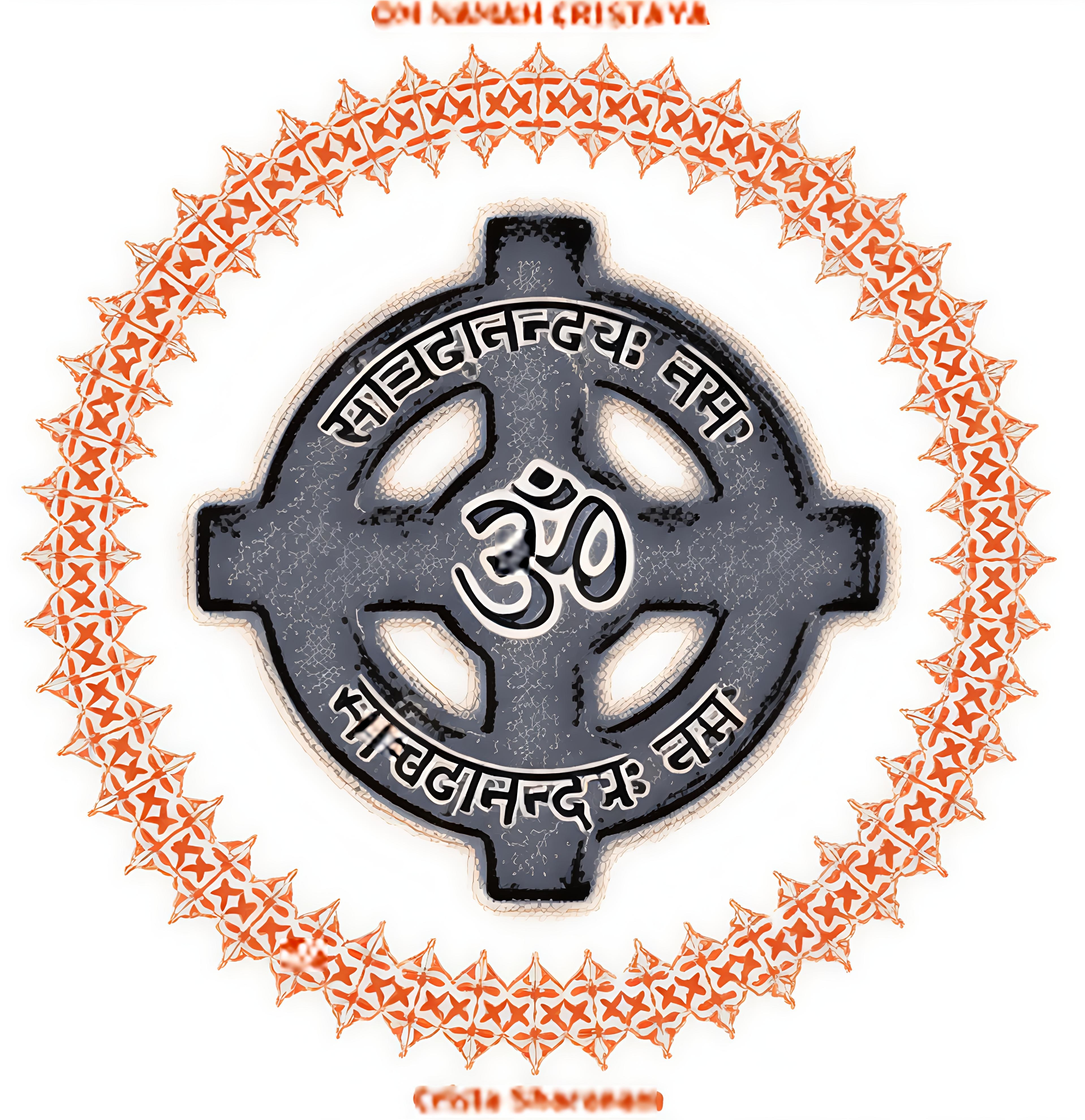
Om on Cross image used by Fr. Bede Griffiths

All the same, Indian Christians and especially recent converts rejected this “paganization of Christianity”. So do the guardians of orthodoxy, e.g. in his book Crossing the Threshold of Hope (1994), Pope John-Paul II denounced the trend among Christian monks and laymen to explore Eastern forms of meditation, and in 2000, his statement Dominus Jesus reaffirmed that salvation can only come through Jesus, not through other “paths”. Genuine Hindus aren’t too enthusiastic either. Thus, one of the favourite symbols of the Christian ashram movement was the Aum sign on a cross. The combination is absurd, at least if the cross is taken in its Christian sense as the symbol of suffering. Though Hinduism has a place for the notions of suffering and sin, the Aum sign by contrast represents the cosmic vibration and eternal bliss.

In this paper, we have no intention of arguing for this relatively recent tradition of Hindu-Christian syncretism or for the thesis of Jesus’ sojourn in India. Instead, we will explore the unsensational possibility of India-related influences on Christianity which can be explained through cultural tendencies present in the Eastern Mediterranean, in Jesus’ surroundings. We will survey indications that some elements in Judaism, in Jesus’s preachings and in mature Church doctrine can indeed be traced to the broader Indo-Iranian tradition through three of its layers and offshoots: (1) the basic Indo-European culture of which certain motifs were still palpable in the ambient Hellenistic culture; (2) Zarathustra’s Mazdeism, a (partly rebellious) offshoot of the Indo-Iranian religion, which influenced Judaism in the 6th-4th century BCE, and whose Romano-Hellenistic offshoot Mithraism influenced the nascent Christian doctrine; (3) ideas from missionary Buddhism and other Indian schools of thought which were in the air in the eastern Roman empire and influenced the Gospels, sometimes through the mediation of other Hellenistic philosophy schools. For our present purposes, a brief overview of these common or borrowed elements will suffice before we focus on their meaning and implications for the science of comparative religion.

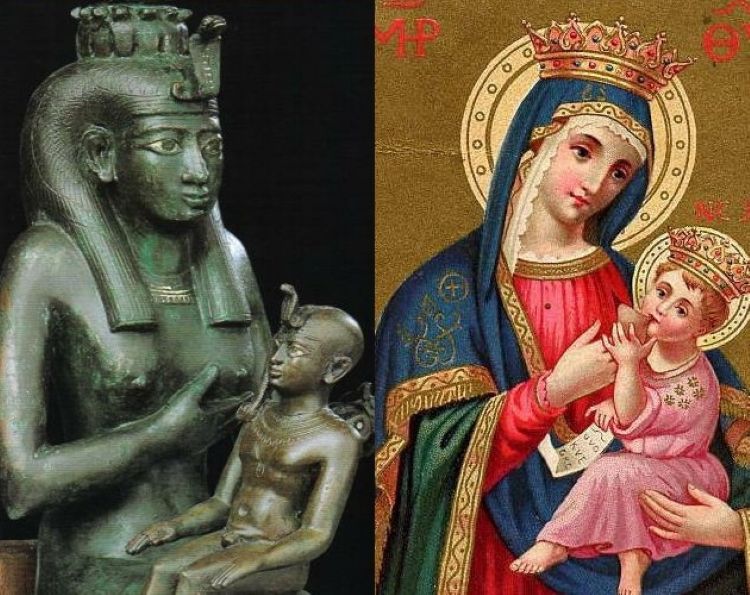
Isis & Horus - Mary & Jesus

2. More than inculturation

It is well-known that in its campaigns of conversion, Christianity followed a policy of inculturation. This means that it adopted Pagan elements in christianised form in order to ease the transition from Paganism to Christianity. To be sure, the reinterpretation of religious items long predates Christianity: Judaism turned an ancient spring festival into a day of remembrance of the exodus from Egypt (replacing universal nature with national history as its religious point of reference), Hindus turned an ancient harvest celebration into a commemoration of victorious Rama’s coronation (Diwali), and Buddhists turned May Day into a celebration of the Buddha’s birth or enlightenment (Wesak). But Christianity was the first to use this type of reinterpretation systematically as a strategy for conversion.

Pagan gods became Christian saints, e.g. Isis with the babe Horus became the Madonna with Child. The bearded and horse-borne Germanic god Wodan became Saint Nicolas, later americanized as Santa Claus. Even the Buddha found a place on the saints’ calendar under the name Saint Josaphat. The autumnal celebration of the dead became All Saints’ Day and All Souls’ Day, which is nowadays regaining its purely Pagan colours in the form of Hallowe’en. The date of Easter (from the Germanic dawn goddess Eostra/Ostarra) combines the Pagan symbolism of spring equinox and full moon with the Christian innovation of Sunday as the day of the Lord—an innovation which itself was borrowed from the solar cult of Mithraism, a late-Roman type of Masonic Lodge inspired by both Iranian Mazdaism and astrology. Winter solstice as its feast of the Invincible Sun became Christmas.

In fact, the whole cult of the year cycle in Mithraism (not unrelated to that of the Vedic year-cycle god Prajapati) deeply influenced the Christian liturgical calendar, so that Protestant fundamentalists would later protest quite accurately that most Church festivals including even Christmas are Pagan borrowings devoid of scriptural foundation. The ritual of the Eucharist, in which Christians are deemed to be drinking Christ’s blood (sacrilege to Jews), may also be of Mithraic origin.

A separate priesthood was created along with a standard liturgy, on the model of religious professionalism in the established Pagan religions or in the popular mystery cults. Concepts and terms from Greek philosophy were incorporated in Christian theology. Among the typically Christian innovations vis-à-vis Judaism, the notion of the Divine Trinity (rejected by Jews and Muslims as crypto-polytheistic) clearly bears the imprint of the Indo-European tripolar cosmology known as trifunctionality, well-attested in the ancient Roman religion. Churches arose where temples or sacred trees had stood, so that worshippers could keep on coming to their old places of worship and gradually get used to the Christian liturgy there.

In this process of inculturation, the Christian Church remained in control: it adapted old forms to its new message, but made sure that through the Pagan veneer the Christian doctrine was impressed upon the converts. However, the incorporation of Indic and particularly Buddhist elements which we will now discuss, has had a far deeper impact. It preceded the genesis of a discernible Christian religion and Church and determined some of their most central doctrines.

The Gospels contain a number of almost literal repetitions of phrases, parables and scenes from the Buddhist canon, particularly from the Mahaparinirvana Sutra: the master walking on water (and saying to the baffled disciples: “It’s me”), the simile of the blind leading the blind, the multiplication of the loaves of bread, the master asking and accepting water from a woman belonging to a despised community, the call not to pass judgment on others, the call to respond to hostility with love, and other overly well-known motifs. (Gruber & Kersten 1995, Derrett 2001) Both doctrinal elements and biographical anecdotes have been borrowed. The Buddha’s mother saw in a dream how a white elephant placed the promising boy in her womb while a heavenly being revealed the great news to the father, roughly like the annunciation to Mary and Joseph. The loose but devout woman Mary Magdalene is a neat copy of the Buddha-revering courtesan Amrapali. (Lindtner 2000) The iconography of Jesus resembles that of the expected future Buddha Maitreya, a name derived from maitri, “fellow-feeling, friendship”, close enough to the Christian notion of agape/charity. The Maitreya is depicted with lotus flowers in the places where Jesus has stigmata of the crucifixion.

This is becoming too much for coincidence, and the similarity is moreover strengthened by very specific details. Thus, Jesus relates how a widow offers two pennies from her humble possessions and thereby earns more merit than a wealthy man who gives a larger gift from his abundant riches. In Buddhist texts we find the same message in several variants, among them that of a widow offering two pennies; a holy monk disregards the larger gift of a wealthy man and praises the widow’s piety.

Not to make all this too idyllic, we can point out a less fashionable item which Christianity may have borrowed from Buddhism: the depreciation of woman as focus of lust and continuator of life in this vale of tears. We do not mean the belief in the inequality of man and woman, which is near-universal, even in fertility-promoting religions like Judaism, Vedic Brahmanism or Confucianism. While these cultures celebrate intercourse with woman and the harvest of her womb as a grand sacrament of life, Christianity and Buddhism tend to condemn life as tainted by sin and suffering, hence procreation and sexuality as sources of misery, and woman as an inauspicious temptress. Celibacy as the Buddhist monks’ way of life was foreign to both Greeks and Jews but was adopted and held up as ideal by Saint Paul and the Christian monks. Buddhism and Christianity allow sex and procreation to the outer circle of half-hearted followers (“better to marry than to burn”), but prefer total asceticism for the inner circle of true seekers.

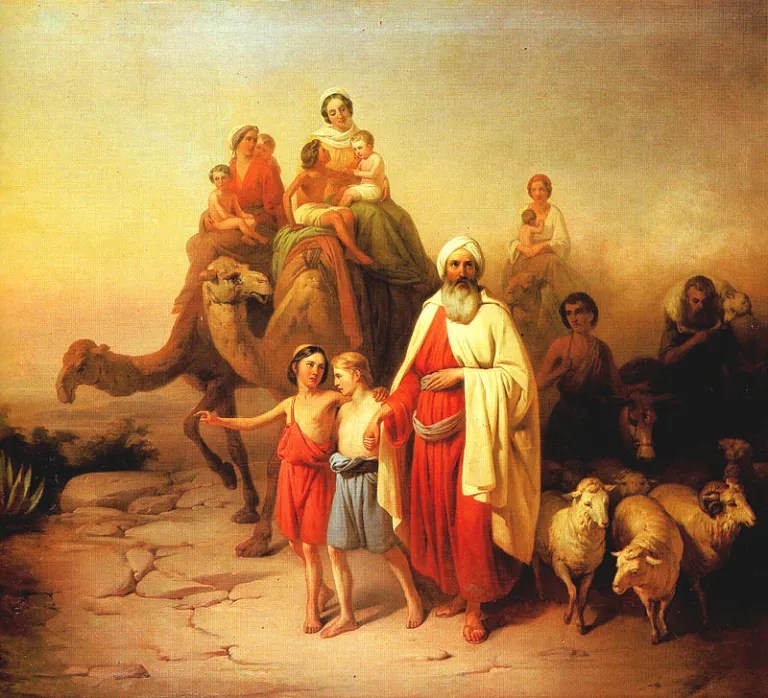
Abraham with sons Isaac and Ishmael.

3. Abrahamic versus Pagan

The gap between the Hindu-Buddhist tradition and Christianity is at first sight much deeper than that between Christianity and Judaism or Islam. Unlike the latter two, Indic religions have no common “Abrahamic” roots with Christianity. Hinduism in particular may count as par excellence the representative of the ancient hate object and scapegoat of the Abrahamic religions including Christianity: Paganism. Hostility towards Paganism is historically the first and defining commitment of the Abrahamic tradition. “Thou shalt have no other Gods”, or: “There is no God except Allah”, concretely meant to its original audiences: “Fight Paganism and its false Gods.”

As mentioned above, many modern Hindus have interiorized the Abrahamic strictures against polytheism and against the use of icons in worship. It is only in recent decades that the late Ram Swarup (1980, 1992) has taken up the defence of both polytheism and “idolatry”. He dismisses the numerical quarrel over one or many as silly and irrelevant to Hinduism, which acknowledges both the unity and the multiplicity of the Divine. Concerning idolatry, he points out that depictions of the Godhead are only visual aides to mental concentration on the Divine Person behind the image (as the Roman Catholic and Orthodox segments of the Abrahamic family have also argued). As even ordinary Hindus are heard arguing: does keeping a photograph of a loved one diminish or harm your love for him or her? Does destroying the photograph make the love more authentic? Ram Swarup also adds a spiritual critique: Christian (and mutatis mutandis, Islamic) exclusivism, which limits salvation to those who believe in Christ’s divinity and resurrection, betrays a lack of confidence in God’s omnipresence.

In contemporary forums for Jewish-Christian or Muslim-Christian dialogue, the “common Abrahamic roots” are eagerly highlighted. The religions concerned are said to have plenty in common, starting with their belief in One Creator and in His Self-Revelation through prophets. The dialogue delegates, and even the less dialogue-minded orthodox theologians, agree that certain basic doctrines set the Abrahamic religions collectively apart from all the other religions, collectively known as Paganism. While inter-religious dialogue is a recent fad, Christians have always made the distinction between the Abrahamic (viz. Muslim or Jewish) and the Pagan non-Christians, acknowledging in the former a far greater religious kinship with themselves than in the latter.

Along with Ram Swarup, many contemporary Hindus have interiorized this dichotomy between Abrahamic and Pagan religions, but this time to line up against the Abrahamic alternative, deemed narrow-minded and spiritually immature. While the disagreement about which doctrine is good and which is bad remains, there is now an agreement between these Hindu ideologues and their Abrahamic opponents about at least this fundamental division of the religious landscape in two opposing poles: the Pagan religions professed and practised by mankind since the Palaeolithic, and Abrahamic religions springing from God’s Self-revelation to selected human beings in West Asia in the last few millennia. And yet, this dichotomy may not be all that neat.

Yahweh

Firstly, it has often been pointed out that the crucial belief in monotheism may well have as one of its tributaries an evolute of the Indo-Iranian religion, hence a sister of the Vedic religion, viz. Iranian Mazdeism. In at least some layers of Mazdeic scripture, we find the rejection of the Indo-Iranian gods (daevas), who are turned into devils, in favour of the double-god Mitra-Varuna, extolled under the appellative name Ahura Mazda, “Lord Wisdom”. This seems to prefigure Mohammed’s rejection of most Arab gods in favour of a single one among them, Allah, and also to resemble Moses’s rejection of Semitic gods like Ba’al in favour of Yahweh alone. Given that the genesis of true monotheism in ancient Israel was a slow and complicated process, and given the occupation of West Asia by the Mazdeic Iranians in the 6th century BCE (where they explicitly helped to re-establish the Yahwist cult in the rebuilt temple of Jerusalem), it is not far-fetched to propose a Mazdeic influence on Israelite monotheism, though its outline remains vague.

However, if there was such a Mazdeic influence, it cannot be construed as an indirect influence from the Vedic upon the Israelite religion, for it concerns precisely that part of Mazdeism which originated in the break-away from and reaction against the Indo-Iranian polytheist mainstream as preserved in the Vedas. Likewise, others elements attributed to Mazdeic influence, such as the eschatology of physical resurrection, arrival of a redeemer and final judgment, definitely originate in later internal developments in Mazdeism unrelated (whether by conserving or rejecting) to the old Indo-Iranian core beliefs.

The second element interfering with the neat dichotomy between Pagan and Abrahamic looks more promising for our present study. We will be able to show that there are doctrinal similarities between the Christian and the Hindu-Buddhist traditions which set the former apart from the other Abrahamic religions, and the latter from the other Pagan religions. These similarities are certainly the fruit of historical contacts, though apart from the presence of a Buddhist community outside Alexandria (the Therapeutae), the details of the whereabouts of Buddhists in West Asia are as yet eluding us. We will consider the two most important common points of doctrine: Incarnation and Salvation.

4. Salvation

In the Upanishads, the youngest layer of Vedic literature, attention shifts from the ritual fire sacrifice to the interior of man’s consciousness. If we empty it of the sensory and mental contents which usually occupy it, we see in it our true nature, the Self. However, experiencing the mental silence in which the realization of the Self dawns is easier said than done. So, determined seekers made it their full-time occupation to pierce the veil of mental dross, to seek liberation from the web of ignorance, false identification and attachment. It is among this class of seekers that the Buddha emerged as the discoverer and teacher of the most successful and well-rounded method.

The goal of the Upanishadic and Buddhist yogis was “liberation” (mukti, moksha), or, in the Buddha’s more negative-sounding terminology, “blowing out” (nirvana). This is a double-negative concept: first a problem intrinsically affecting all people is defined (suffering, ignorance, attachment), then a method of eliminating the problem is devised and put into practice, ideally resulting in liberation. Exactly the same doctrinal structure forms the core of Christianity: all human beings are afflicted with original sin incurred by Adam and Eve, and now they stand in need of salvation, which the religion provides. This notion of a radical wrongness in the human condition and of a concomitant radical jump out of it and into the state of salvation does not exist in Judaism and Islam. Neither does it exist in most Pagan religions, such as the ancient Greek religion, Confucianism or Shinto, nor even, apparently, in the oldest Vedic layer of Hinduism.

How is liberation or salvation achieved? The original Hindu-Buddhist answer is: through right effort, viz. through a meditative practice which stills all mental distractions. However, this path of self-liberation is demanding and fails to deliver the immediate consolation ordinary people hope for. So, soon enough a devotional practice developed which attributed to the Buddha, or to Shiva or Krishna, the power to somehow “grant” liberation to his devotees. Hindu philosophers have distinguished between two approaches to liberation: the “way of the baby monkey”, which clings to its mother through its own effort, and the “way of the kitten”, which is picked up by its mother between her teeth. In practice, the way of the kitten is the most popular by far: people make the effort of putting themselves into a religious mood but expect the real breakthrough to salvation from a caring and interventionist divine person. Though most Hindus and Buddhists vaguely know of the fruits of meditation, few of them actually practise it, while most settle for devotional practices such as chanting and waving incense sticks before an idol of a divine or liberated Person.

It is at this devotional stage, which purists would evaluate as a degenerative stage, that Christianity has picked up the Hindu-Buddhist notion of salvation. Just like the Oriental devotee expects Shiva or the Amitabha Buddha or Guan Yin (Chinese Buddhist goddess) to save him, the Christian reveres Jesus Christ as the agent of his salvation. Though Christian mystics have tried to come closer to God through meditative techniques, Christianity as such has no technology of Salvation, unlike orthodox Buddhism. Official Christian doctrine confines the possibilities of salvation to the salvific intervention of God through his only-begotten son, Jesus Christ.

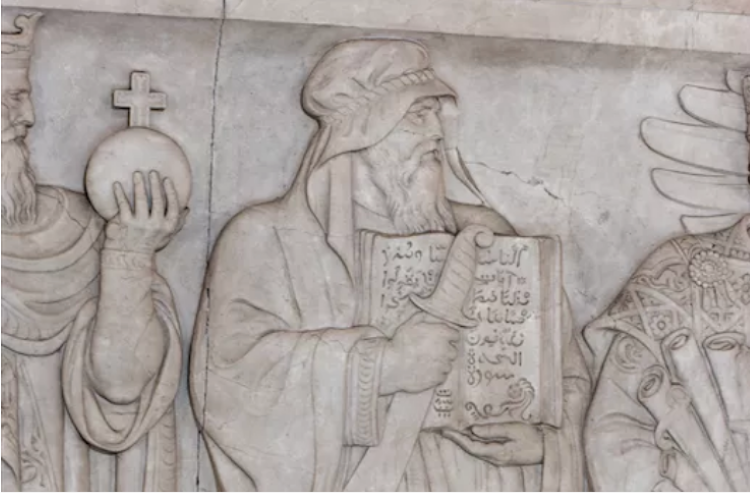
Prophet Muhammad as represented on the US Supreme Court.

5. Incarnation

Jews and Muslims have always denounced Christianity as an incomplete or downright false pretender to monotheism. They see the doctrine of the Trinity (Father, Son and Holy Spirit) as detracting from God’s unity and unicity. Leaving aside for now the Holy Spirit, it is mainly the Divine Person of the Son, God incarnate, which strict monotheists find theologically incorrect.

In Hellenistic society, people had a very fuzzy notion of “god” and didn’t mind describing remarkably spiritual people or purported miracle workers as “divine”. Ancient heroes such as Hercules were deified after their deaths in a process known as apotheosis, “transformation into a god”, and placed among the stars in the night sky. The Hindus posthumously deified their heroes Rama and Krishna by reinterpreting their lives as incarnations of Lord Vishnu. In Buddhism, the historical Buddha is gradually given the status of a divine incarnation, one in a series of enlightened beings descended on earth in order to bring liberation to all the suffering beings. Pagan Semitic cultures, e.g. in Ugarit, likewise gave a posthumous divine status to their revered kings by associating them with one of the gods, such as El or Ba’al. This process of association was called shirk, a term generalized by Mohammed to every “association” of lesser beings with the one God, Allah (“the god”). Muslims refer to all polytheists as mushrikin, “associators”, viz. of lesser beings with Allah.

In the opinion of the Muslims, the Jews and the Arian heretics of Christianity, the allotment of a divine status to Jesus Christ is not truly different from the procedure by which the Pagans gave divine status to their kings and saints, to stars and mountains, even to animal species (Egyptian cats, Hindu cows) and sculpted statues and trees, briefly to creatures instead of the Creator. They think, quite sensibly, that Christian belief detracts from monotheism by adopting as its most central dogma the highly Pagan notion that a creature, the son of a woman, could be God. On this point, Christianity is undeniably less akin to Judaism and Islam than to those sects of Hinduism and Buddhism which deify historic figures like Krishna and the Buddha.

6. Charity

Christianity’s number one selling point is its emphasis on the virtue of love (not to be misinterpreted as erotic love) or charity. Missionaries love to contrast universal Christian charity with Jewish ethnocentrism, Muslim or Marxist conflict-prone fanaticism, Hindu callous indifference to the suffering of anyone belonging to another caste, or Buddhism’s ethereal disinterest in any useful worldly work per se. However, this notion of universal fellow-feeling and its implementation in works of charity definitely predates Christianity.

Four centuries before Christ, the Chinese school of Mozi already preached jian’ai, “universal love”, and put it into practice in self-supporting communities (comparable to those established by the Epicureans in the Hellenistic world). These Mohists argued that one’s love should be distributed evenly over all fellow men, while their Confucian contemporaries contended that love should be differentiated in intensity: more love for close relatives, less for distant acquaintances, less still for unknown people. Yet, even the Confucians taught that some fellow feeling or “fellow humanity” (ren) should be extended to all mankind. Meanwhile in India, the Vedas and later the Buddha extolled fellow-feeling or compassion (daya c.q. karuna), not just towards one’s fellow men but towards all sentient beings.

It may be admitted that Christianity gave its own twist to charity. The activist streak of going out and opening orphanages or hospitals is less in evidence in Hinduism or Buddhism than in Christian settlements. Unlike Buddhist and Hindu monks, who are only expected to do their devotional or yogic duties, Christian monks of most orders are required to work. It may be conceded that Buddhist monks sometimes did take upon themselves certain charitable activities, notably in medicine, which is after all an application of the basic Buddhist vocation to relieve suffering. Among the duties of kings, Hindu scriptures include the care for the needy and the handicapped. Even so, there is just no denying that among religious personnel, Christian monks were and are encouraged far more systematically than any others to give a materially constructive expression to their sense of charity.

The reason for this difference, according to Hindus and Buddhists convinced of the superiority of their own tradition, is that Christian missionaries had to “sell” their doctrinal “product” by giving the extra bonus of material help, just like salesmen of inferior products try to make people buy them with the lure of extras. In this view, a convert to Buddhism opts for the Buddhist Way, while a convert to Christianity may take Christian beliefs in his stride while primarily seeking access to the Christian network of charity. A less polemical explanation would be that the wider family units in India could better provide for the needs of their own sick and needy members, hence requiring less help from “public” charities than the uprooted masses of the late Roman empire or the industrial-age West (note that Mother Teresa made her name in Kolkata among uprooted immigrants into the modern city, not in a traditional Hindu social setting). The reason may also be that Christianity simply happened to acquire its mature form in a pre-existing activist culture: first the Romans with their no-nonsense dynamism and their feats of engineering, later the Germanic peoples in their cold climate requiring daily labour and inventiveness for sheer survival, as contrasting with the Buddha’s Gangetic setting where the relative opulence of nature and the immense heat discourage physical exertion.

But the most fundamental reason why traditions originating in India lay less emphasis on material compassion and activist forms of charity, is simply that they pay more attention to what they perceive as a deeper human need. Clothing the naked and feeding the hungry is very fine, but as the Buddha knew from his own young days of luxury, even the well-fed and well-clad are subject to unhappiness and suffering. The highest compassion is therefore not the sharing of material things or emotional attention, but the imparting of the ethical and meditative methods leading to Nirvana.

In any case, the whole idea that man should care about his brother, that he should take responsibility for the welfare of society as a whole or for needy human beings in particular, clearly precedes Christianity. Like the Christian, though since centuries earlier, the Hindu or the Buddhist is his brother’s keeper, and is taught from childhood not to indulge in self-centred inanities and mindless self-indulgence, of course not to be confused with disciplined self-introspection. Caring for others may legitimately be called a Christian virtue, but it is not exclusively Christian and finds older models in at least Mohism, Confucianism, Hinduism and Buddhism, and no doubt in other pre-Christian teachings as well.

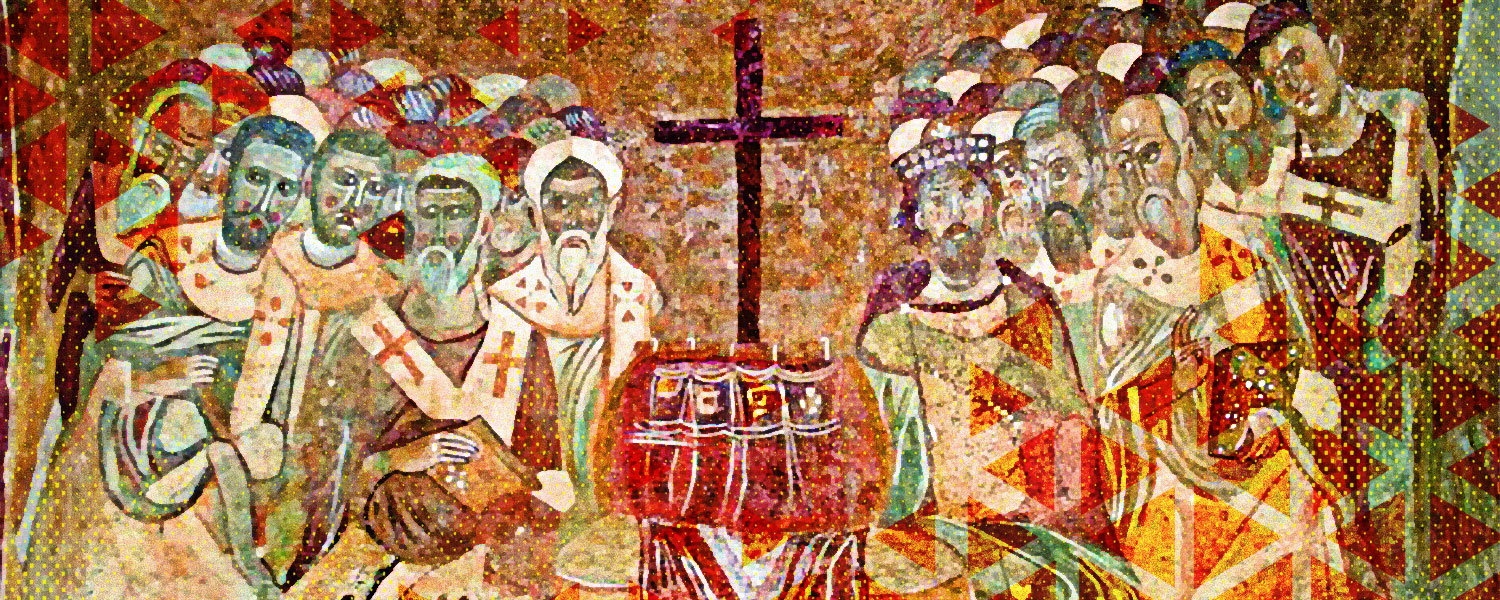
Council of Nicaea: Cult of Jesus as a god equal to Apollo was created by Emperor Constantine and some 300 bishops of the Empire at this first Christian council in Nicaea in the year 325. The first compiled Bible was published soon after.

7. Conclusion

Christianity is not as original as it flatters itself to be. Just as it is now widely accepted that the Old Testament has profusely borrowed from older Mesopotamian and Egyptian sources, the New Testament has likewise borrowed some of its core imagery and defining beliefs from the ambient Hellenistic cosmopolitan culture and from the Indic teachings which had gained a certain popularity in the Eastern Mediterranean region. This implies that rather than being a direct gift from God, Christianity is simply a human construct, just as it already believes all other religions to be. Those who are inspired by Jesus’ example and teachings might do well to study their Saviour’s own sources of inspiration. – Acta Indica, 2019

Bibliography

  1. Abhishiktananda, Swami (Le Saux, Henri): Hindu-Christian Meeting-Point, Delhi 1976.
  2. Brockington, John: Hinduism and Christianity, MacMillan, London 1992.
  3. Dayananda Swaraswati, Swami (of Coimbatore), and Girndt, Helmut: A Vedantin’s View of Christian Concepts, Arsha Vidya Gurukulam, Saylorsburg PA 1998.
  4. Derrett, J. Duncan M.: The Bible and the Buddhists, Sardini, Bornato (Italy) 2001.
  5. Goel, Sita Ram: Papacy, Its Doctrine and History, Voice of India, Delhi 1986.
    – Catholic Ashrams, Sannyasins or Swindlers?, 2nd ed., Voice of India, Delhi 1994.
    – Jesus Christ, an Artifice for Aggression, Voice of India, Delhi 1994.
    – History of Hindu-Christian Encounters (AD 304 to 1996), 2nd ed., Voice of India, Delhi 1996.
  6. Griffiths, Bede: Christ in India, Bangalore 1986.
  7. Gruber, Elmar, en Kersten, Holger: The Original Jesus: The Buddhist Sources of Christianity. Element Books, Shaftesbury 1995 (München 1995).
  8. Kattackal, Jacob: Comparative Religion, St. Thomas Apostolic Seminary, Kottayam 1990.
  9. Kersten, Holger: Jesus Lived in India. His Unknown Life Before and After the Crucifixion, Element Books, Shaftesbury 1986 (Munich 1983).
  10. Kung, Hans, en Von Stietencron, Heinrich: Christendom en Wereldgodsdiensten, 2: Hindoeïsme, Gooi en Sticht, Hilversum 1987.
  11. Leeming, Joseph: Yoga en de Bijbel, Lulof, Almelo 1963.
  12. Lindtner, Christian: Amrapali in the Gospels, Adyar Library Bulletin 46, 2000.
  13. Majumdar, R.C.: The History and Culture of the Indian People, Bharatiya Vidya Bhavan, Bombay 1963 ff.
  14. Oddie, Geoffrey: Hindu and Christian in South-East Asia, SOAS, London 1991.
  15. Parrinder, Geoffrey: Avatar and Incarnation. A Comparison of Indian and Christian Beliefs, OUP, New York 1982.
  16. Prabhavananda, Swami: De Bergrede in het Licht van de Vedanta-Leer, De Driehoek, Amsterdam n.d.
  17. Rajaram, N.S.: Christianity’s Scramble for India and the Failure of the ‘Secularist’ Elite, Hindu Writers’ Forum, Delhi 1999.
  18. Secretariatus Pro Non-Christianis: Pour un Dialogue avec l’Hindouisme, Ancora, Milano n.d.
  19. Swarup, Ram: The Word as Revelation: Names of Gods, Impex India, Delhi 1980.
    – Hinduism vis-à-vis Christianity and Islam, 3rd ed., Voice of India, Delhi 1992.
    – Pope John Paul II on Eastern Religions and Yoga: A Hindu-Buddhist Rejoinder, Voice of India, Delhi 1995.

Dr. Koenraad Elst is an Orientalist (Indology & Sinology), linguist, historian and author.

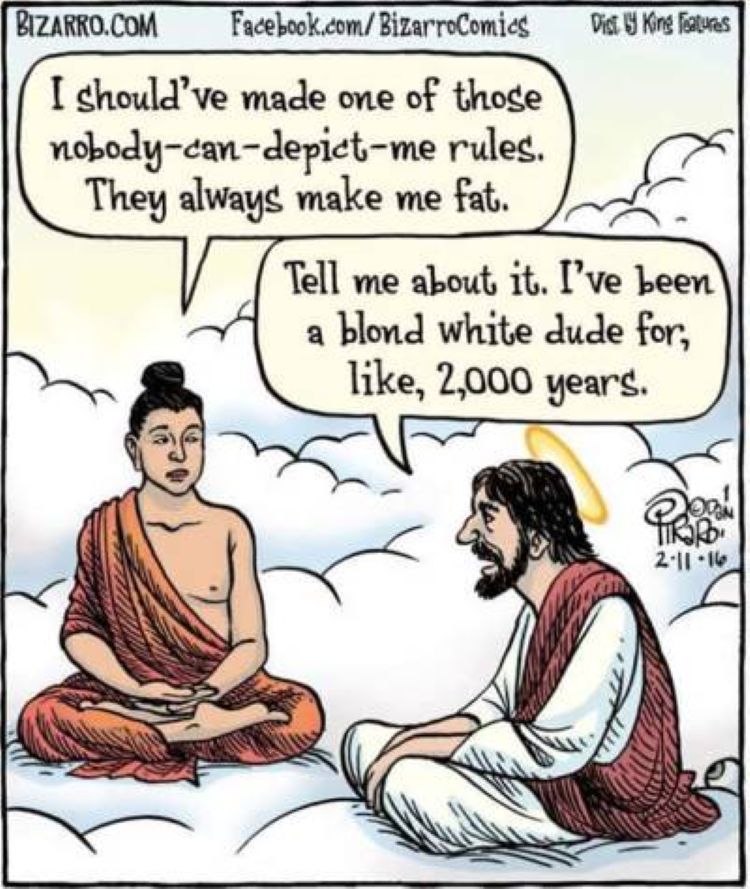
Buddha and Jesus Cartoon

Hinduism vs Hindutva: A battle of British colonial construct – Adit Kothari

Hindus in Hindustan

Hindutva is not ritualistic “Hinduism”, but when etymologically translated from Sanskrit, it simply is the essence of being Hindu—a civilisational consciousness rooted in land, memory, culture, and continuity. – Adit Kothari

The word “Hinduism” itself is not ancient. Neither is it native nor organic. The very suffix “ism” within the word “Hinduism” reeks of Western taxonomy, aiming to confine the civilisation within rigid, dogmatic lines, much like the Abrahamic religions of Christianity and Islam. Such a framework is violently alien to Sanatan Dharma, which never sought reduction into a closed creed.

The Hindu civilisational experience is fluid, plural, evolving, contradictory, and unapologetically non-dogmatic. As Atal Bihari Vajpayee observed in his 1998 interview with Javed Akhtar, India’s secularism flows naturally from Hindu civilisation itself. Hindu thought binds no one to a single prophet, a single book, or a compulsory theology. One may be astika or nastika, devotional or sceptical, ritualistic or philosophical, and still remain within the civilisational fold. There is no concept of blasphemy, apostasy, or enforced belief.

“Hinduism” was not born in Kashi or Kanchipuram. It was midwifed in colonial census offices and missionary tracts. European orientalists and British administrators required a neat category to govern, classify, and evangelise. In doing so, they lumped together diverse Indic traditions—vedic, tantric, bhakti, folk—under a single label, often distorting them to fit monotheistic templates. The term gained currency only in the early 19th century. By freezing Sanatan Dharma into “Hinduism”, colonialism hollowed out its essence, morphing it to fit within their monotheistic template.

Hindutva, contrary to hysterical propaganda, does not destroy this civilisational ethos, but it vociferously exposes the artificiality of the colonial box it was forced into. Hindutva is not ritualistic “Hinduism”, but when etymologically translated from Sanskrit, it simply is the essence of being Hindu—a civilisational consciousness rooted in land, memory, culture, and continuity. It encompasses all Indic traditions, including Buddhism, Jainism, and Sikhism, bound by culture, history, and geography, not narrow dogma. One does not need to pray to Ram to be Hindu. One does not even need to believe in God. One only needs to belong, to a civilisational inheritance that predates and outlives religious dogma.

This is precisely why Hindutva terrifies the pseudo-liberal establishment. Pseudo-liberals peddle the lie that Hindutva endangers “Hinduism”. This is inverted propaganda from a deracinated elite, conditioned by Macaulay’s education system. In truth, Hindutva is the purest secularism India has ever known. Unlike Western secularism’s hostile separation of state and faith, or India’s pseudo-secularism that panders to Muslims while demonising the Hindu, Hindutva treats all born of this soil as heirs to a common civilisation. It demands loyalty to Bharat first, allowing diverse dharmas to flourish without privileging imported exclusivism. This is true pluralism: equal cultural dignity, not appeasement.

Colonialism weaponised “Hinduism” to divide. It was deliberately marketed as superstitious Paganism ripe for “civilising”. Reformers like Raja Ram Mohan Roy, while alleviating genuine social evils, inadvertently reinforced colonial frameworks by engaging Hindu civilisation in Abrahamic terms. Ironically, this was made possible precisely because the Hindu was never a codified faith and therefore remained open to reform in a way dogmatic religions like Islam are not. Post-independence, Nehruvian secularism entrenched minorityism, alienating the majority, while left-leaning narratives painted any Hindu assertion as “communal”.

Hindutva is accused of being “majoritarian” by the very people who reduced Hindus to a religious minority within their own civilisation. They denied them cultural rights while enthusiastically funding, protecting, and politically mobilising every other faith identity.

India’s Anglophone elite, left-leaning intelligentsia conditioned by colonial education and Nehruvian secularism, loathe the term “Hindutva” not for any supposed majoritarianism—their go-to smear—but because it ruthlessly exposes their lingering colonial hangover. Hindutva asserts an unapologetic, indigenous civilisational identity tied to India as a civilisational land, history, and ethos, shattering the superiority complex these elites inherited from Macaulay’s system. Conditioned to see India’s value system as backward or in need of Western “civilising”, they embraced abstract secularism, Muslim appeasement, and cultural alienation as badges of progress. Hindutva strips that facade, reclaiming agency for the rooted majority, highlighting their detachment from the masses, unease with confident Hindu assertion, and the hollowness of power built on post-colonial mimicry rather than authentic heritage. It forces uncomfortable self-reflection on their enduring mental colonisation, and that’s precisely why they hate it.

In Bengal, this conditioning runs deep. The Bengali intelligentsia, shaped by the Bengal Renaissance and later Marxist dominance under decades of Left Front rule, has long leaned leftward. They are often virulently anti-Hindutva, viewing it through a lens of colonial-era secularism and Soviet-inspired atheism. Calcutta’s elite, influenced by British education and communist hegemony post-1947, internalised narratives dismissing Hindu civilisational pride as retrograde.

This brings us to the [recent] spectacle. On January 11, 2026, at the prestigious Calcutta Club, the Calcutta Debating Circle in association with The Telegraph, hosts a debate on the motion “Hinduism Needs Protection From Hindutva.”

For the motion are relics like Mani Shankar Aiyar and Ashutosh, feral loudmouths like Mahua Moitra, and distorians like Ruchika Sharma peddling tired pseudo-secular tropes. Against the motion stand stalwarts like Swapan Dasgupta, J. Sai Deepak, Agnimitra Paul, and Sudhanshu Trivedi, who, unlike the flustered opposition, conduct themselves armed with logic and history.

The Left-leaning intelligentsia, long cocooned in culturally alienated narratives, are in for a total feast. For decades, they’ve parroted that Hindutva is “fascist” or “majoritarian,” ignoring how it liberates Dharma from colonial chains. This event will hopefully pierce that bubble, forcing confrontation with truths, that “Hinduism” is the real threat to authentic Dharma and Hindutva its saviour. Hopefully, by the end, even the most conditioned will glimpse the propaganda they’ve swallowed, emerging informed and even perhaps awakened.

The death knell of that construct has sounded. Hindutva is not a threat but a reclamation. Not destruction, but resurrection. And it is precisely this mirror, held up to enduring mental colonisation, that its critics find impossible to face. – News18, 10 January 2026

Adit Kothari is a Calcuttan residing in London as a Pravasi Bharatiya, working to dismantle the plethora of false narratives and misinformation against India and Hindutva.

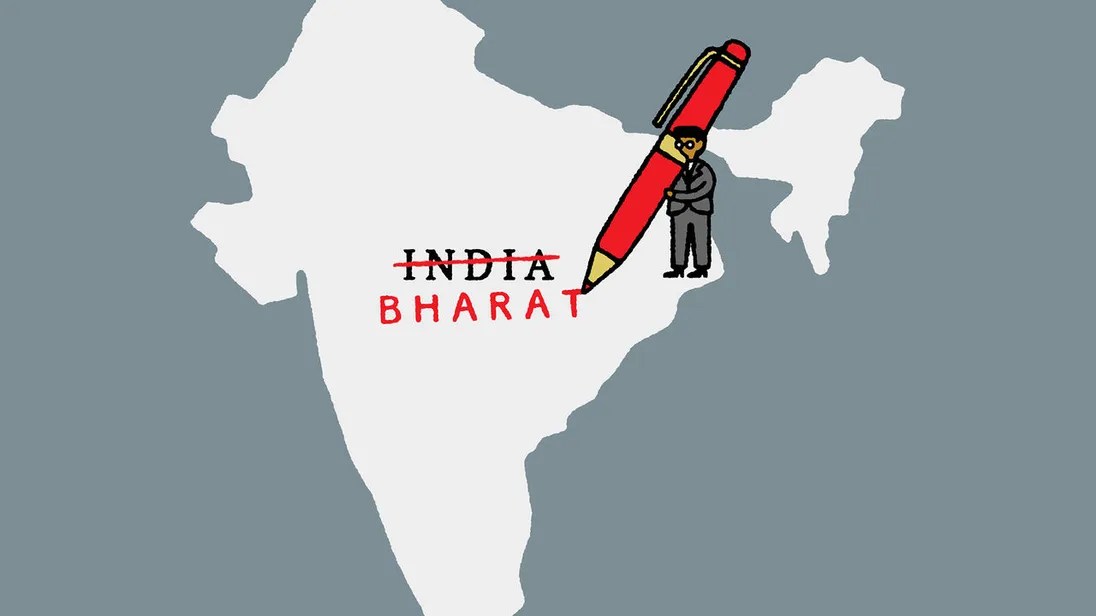
India rthat is Bharat

Without self-enquiry, rationalism is just another superstition – Acharya Prashant

Self-enquiry in practice.

Without self-enquiry, rationalism turns outward-only. It scrutinizes religion, superstition, tradition, politics, and the beliefs of others, but it never pauses to examine the psychological centre doing the scrutinizing. The ego remains untouched, and rationality becomes its armour. – Acharya Prashant

Rationalism was meant to be a method, not an identity. It was to be the discipline of honest seeing, not another tribe of the like-minded. You question, you examine, you see clearly. You hold no belief sacred, no authority exempt, including your own. Every conclusion must justify itself, and if it cannot, you let it go: that is the original promise. From the Greek sceptics to the Enlightenment philosophers to the modern scientific temper, this is what rationalism has always claimed as its essence: the courage to ask, the willingness to discard, the refusal to bow before any idea simply because it is old or revered or comfortable.

This inheritance has served humanity well: superstition loosened its grip, the tyranny of priests and kings could be challenged, and questions forbidden for centuries could finally be asked. Science, medicine, law, and political freedom all owe something to this spirit of inquiry. The courage to question rather than blindly obey, to examine rather than merely accept: this is what allows the mind to mature and society to remain free.

None of this is an argument against rationalism as method. The method works. Peer review catches errors, replication weeds out fraud, falsification disciplines speculation. The institution of science corrects what the individual scientist cannot. But the method’s virtue does not automatically transfer to the practitioner. A system can be self-correcting while the people within it remain thoroughly self-deceived. It is this gap, between what rationalism promises and what the rationalist practices, that concerns us here. Yes, there are rationalists who already practice what this essay calls for: who hold conclusions lightly, who examine their own motivations, who do not need the identity of “rational person” to feel secure. This essay is not addressed to them. It is addressed to those who have made reason into a fortress rather than a discipline.

Somewhere along the way, the rationalist method itself became an identity. Rationalism stopped being something you do and became something you are. To call oneself rational became a badge, a tribe, a source of pride and belonging. And the moment rationalism became identity, it could no longer examine itself, for the ego does not question its own hiding places.

When the questioner himself is never questioned, rationalism quietly shifts its role. It stops being an instrument of truth and becomes an instrument of the ego. What was meant to liberate becomes a fortress; what was meant to clarify becomes a tribal flag. The very capacity that could have set you free becomes a new bondage, subtler and therefore more dangerous than the old.

The Outward Gaze

Without self-enquiry, rationalism turns outward-only. It scrutinizes religion, superstition, tradition, politics, and the beliefs of others, but it never pauses to examine the psychological centre doing the scrutinizing. The ego remains untouched, and rationality becomes its armour.

Watch the rationalist in action. He will tell you precisely why the pilgrim is wasting his time at the temple, but he cannot tell you why he himself spent three hours last night arguing with strangers on the internet. He will explain the cognitive biases that make people believe in astrology, yet he has never once examined the compulsion that makes him need to correct them. He writes essays on why people cling to tradition. Still, he cannot see that his own identity as “the one who sees through tradition” is just as clung to, just as defended, just as psychologically necessary to him as any ritual is to the devotee.

Pause and ask: What were you really protecting in that argument? Truth, or self-image? What did you get from being right? What did you fear would happen if you were seen as wrong? If nobody applauded your correctness, would the compulsion still be there?

This is the fatal flaw. Reason directed only outward is not complete reason; it is half-reason, and half-reason is often more dangerous than no reason at all, because it comes with the illusion of completeness.

The religious believer at least knows he believes. The rationalist who has made reason into identity does not know he believes; he thinks he merely sees. And so his beliefs operate unchecked, unexamined, all the more powerful for being invisible to himself.

Here, rationalism becomes belief in reason, not the use of reason. The distinction is crucial. The use of reason is alive, flexible, self-correcting; it holds conclusions lightly, knowing that new evidence or deeper insight may require revision. It is comfortable with uncertainty, because it does not need conclusions to provide identity. It can say, “I do not know,” without feeling diminished.

Belief in reason is something else entirely. It is reason frozen into dogma, producing certainty rather than clarity, positions rather than understanding, debates rather than insight. The believer in reason has made rationality into a flag, and he will defend that flag as fiercely as any religious zealot defends his scripture. His positions are not held because they are true but because they are his; his arguments are not aimed at understanding but at victory. His rationalism has become, in everything but name, a faith.

This is why so many rationalist spaces feel like battlegrounds, not laboratories. The atmosphere is not shared inquiry but competing certainties. People do not come to learn; they come to win. They do not listen to understand; they listen to rebut. The form is rational, but the substance is tribal.

The Psychology Beneath the Logic

Such rationalism is often loud, combative, and moralistic; it seeks victory, not truth. The vocabulary has changed: we now speak of “evidence-based” and “peer-reviewed” instead of “revealed” and “ordained.” But the psychological posture is identical.

It replaces gods with data, scriptures with graphs, priests with experts. The structure remains the same; only the vocabulary has been updated.

Rationalism without self-enquiry cannot see its own motivations. Fear, insecurity, superiority, the need to be right: these operate freely beneath the language of logic. The rationalist believes he is defending truth, but he does not see that he is defending himself. He believes he is exposing others’ irrationality, but he does not see the irrationality of his own emotional investment in being the one who exposes.

Reason is then used to justify psychological compulsions rather than dissolve them. The ego learns to speak in syllogisms; it marshals data the way a lawyer marshals precedents, not to find truth but to win the case. And the case is always the same: I am right, I am rational, I am superior to those who are not.

This is why the most aggressive rationalists so often resemble the fundamentalists they oppose. The content differs: God versus no God, scripture versus science, tradition versus progress. But the structure is the same. Both need certainty, both need enemies, both cannot tolerate ambiguity, and both derive identity from their conclusions. In this condition, rationalism becomes collective prejudice in modern dress.It calls itself progressive, but it is deeply conformist; any community that prides itself on rational thinking quickly develops orthodoxies as rigid as any religious sect.

In certain Western rationalist circles, approved conclusions function as membership tests. Deviate, even carefully and with evidence, and you are not refuted but reclassified: you become a denialist, a bigot, someone who has “revealed their true colors.” The argument is not answered; the arguer is diagnosed. Among several Indian rationalists, the pattern mirrors. One must hold the correct contempt for all religion and the “correct” suspicion of all tradition. Suggest that an ancient text contains genuine philosophical insight, and you risk being treated as a communal apologist; question whether one particular civilizational model is the only path to human flourishing, and you become intellectually untouchable.In both cases, the permitted conclusions are known in advance, and argument no longer exists to discover truth but to police boundaries. This is not reason at work; it is the ego defending its shelter, now speaking the language of rationality.

It calls itself free, but it is bound to identity, group approval, and intellectual fashion. The rationalist who prides himself on thinking independently often thinks exactly what his intellectual community thinks. He reads the same sources, reaches the same conclusions, expresses the same outrage, and dismisses the same enemies. He has not escaped the herd; he has joined a different herd, one that flatters itself as a gathering of independent minds.

This is not the failure of rationalism; it is the predictable outcome of rationalism that refuses to examine the rationalist. When the ego is never questioned, it will use any tool, including reason, to do what the ego always does: seek security, belong to a group, feel superior, and avoid the terror of standing alone.

The Inward Turn

True rationality is inseparable from self-enquiry.

This is what separates genuine reason from its counterfeit. The moment reason turns inward and asks, “Why do I need this conclusion? What does this belief give me psychologically?”, rationalism regains its original power.The question is not merely “Is this true?” but “Why do I want it to be true? What fear would arise if it were false? What image of myself depends on this position? What would remain of me if I surrendered this certainty?”

Try it now. Pick a position you hold dear, one you have defended publicly, one that feels obviously correct. Ask: what do I get from holding this? Not what is true about it, but what does it give me? Watch what arises. If the mind rushes to justify the position, that rush is the answer. If irritation arises at the question itself, that irritation is the answer. Self-enquiry does not require you to abandon your conclusions; it only asks you to see who is clinging to them, and why.

This is the questioning the ego cannot survive. It can survive any external argument; it can change positions, update beliefs, switch tribes, and remain fundamentally intact. What it cannot survive is being seen. The moment awareness turns on the one who argues, the game is exposed: the certainties are revealed as defences, the positions as props for identity. The rationalism that seemed so solid turns out to be a house built on the shifting sand of psychological need.

This is why self-enquiry is so rare, and why it is so essential. The rationalist who has never asked, “What am I really doing when I argue?”, who has never noticed the pleasure in being right, the fear of being wrong, the satisfaction of superiority, has never used reason fully. He has used reason the way a child uses a stick: to hit things, defend territory, feel powerful. He has not yet used reason the way a surgeon uses a scalpel: to cut through illusion, beginning with his own.

When self-enquiry accompanies rationalism, everything changes. Positions become lighter and can be revised without trauma. Disagreement becomes information rather than attack. Uncertainty becomes tolerable, even interesting, because identity no longer depends on knowing. The rationalist stops performing and starts inquiring, stops defending and starts seeing, stops winning and starts learning.

This is reason restored to its original purpose: not a weapon for victory but a light for seeing. And that light must fall on the one who holds it, not only on the objects he chooses to examine.

Without that inward turn, rationalism is not liberation; it is merely a sophisticated cage.

The bars are elegant, the locks are logical, and the prisoner is convinced he is free because he can critique the cages of others. But he remains inside, for he has never questioned the one who built the cage, who maintains the cage, who is terrified of life outside the cage. His cage has a sign on it that says “No Cage,” and he believes the sign.

This is the final irony: the one who prides himself on questioning becomes the one who cannot be questioned. The identity of “questioner” becomes the most protected possession of all.

Liberation is not a change of content; it is freedom from the need to cling to any content. The liberated mind can hold positions without being held by them, can use reason without being used by the ego’s need for reason, can think without needing thought to tell it who it is.

This liberation is not achieved by abandoning rationalism; it is achieved by completing it, by turning the light that has illuminated so much of the external world, finally, uncompromisingly, on the one who holds the light.

The question is not whether you can question religion, tradition, politics, or superstition; you have already demonstrated that capacity. The question is whether you can question the questioner. Can you ask, with genuine not-knowing: What am I defending? What am I afraid of? Who would I be if I could no longer call myself rational?

You have spent years examining everything except the examiner. That exemption is the source of your bondage. The rationalist who cannot examine his own rationalism is no different from the believer who cannot examine his own belief; both are prisoners, and one is simply more articulate about the prison walls.

Begin there. That is the only beginning worth the name. Refuse, and you remain what you have always been: an ego armed with arguments, a prisoner who has memorised every book on liberation but never bothered to look at his own chains. – The Pioneer, 24 january 2026

Acharya Prashant is a teacher, author, and founder of the PrashantAdvait Foundation. 
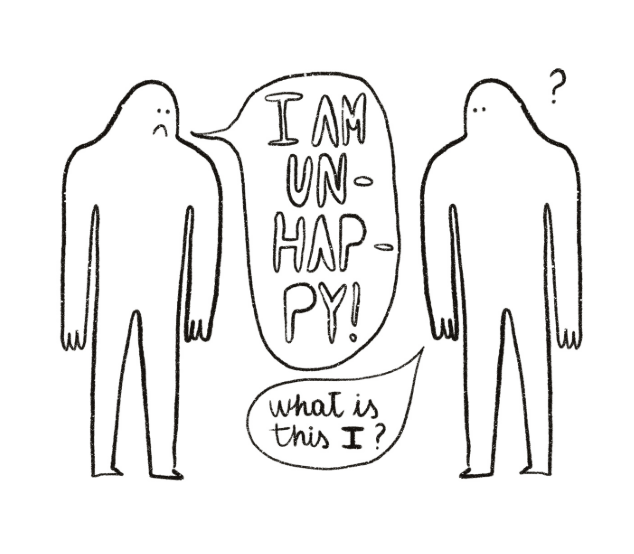
Self Enquiry Cartoon

USA: Seven stages of imperial decline – Samannay Biswas

Empires

The United States, as the world’s leading superpower since the mid-20th century, exhibits many hallmarks of late-stage economic and imperial decline, patterns already seen in Spain, Britain, and the Soviet Union. – Samannay Biswas

All throughout history, major empires and superpowers have followed recurring patterns of economic decline, often resulting in collapse. This framework, popularised in analyses of Spain, Britain, and the Soviet Union, identifies seven stages driven by overextension, financial mismanagement, and societal shifts.

The “seven stages of empire” was a theory conceived by Lieutenant General Sir John Bagot Glubb, also known as “Glubb Pasha.” Glubb was a soldier in World War I and a long-time commander of the Arab Legion in Jordan until his retirement in 1956. During his retirement, he became a historian and an author.

In 1976, he wrote the essay The Fate of Empires and Search for Survival based on research of over a dozen empires over a period of 3,000 years, including the Assyrians and the British Empire. His observations were that the life span of most empires is typically around 250 years, with all empires following a cyclic pattern consisting of seven parts: the pioneers, the conquest, the commerce, affluence, intellect, decadence, and decline.

In his view, whether in a culture and technology-dominated world or a materialistic and fragmented one, the moral and social trajectory of an empire draws upon a same pattern of duty, discipline, and then materialism, fragmentation, and loss of unity. Though not a deterministic theory, Glubb’s idea was a caution, and it influences current arguments regarding an imperialism ascent and fall, including an America one.

With evidence drawn from historical data and current trends related to the US economy, as of January 2026, this article explores these phases, how they appeared within previous empires, and why it appears to be moving through these phases faster than projected. With evidence drawn from historical data and current trends related to the US economy, as of January 2026, this article explores

Stage 1: Military Overextension

It’s also a fact that the fall of many empires started with the thinning out of resources around the world.

There are many examples throughout history. Spain during the 16th century had military forces deployed on four different continents, with military expenditures accounting for half of its spending. The British Empire, which extended to six continents by 1900, had costs it couldn’t sustain during World War I, with expenditures reaching $40 billion, or $1 trillion in today’s currency. The Soviet Union supported wars ranging from Afghanistan to Africa with 15-20% of its spending.

Meanwhile, military expenditures for the U.S. recorded $900.6 billion during fiscal year 2026, surpassing the total military spending of the next 10 countries combined. Furthermore, despite maintaining more than 750 bases in 80 countries and deployed troops in 150 countries, the US is facing difficulties in maintaining its presence through aged military hardware and manpower deficiencies. Others see this repeating the same mistakes of the past.

Stage 2: Currency Debasement

To finance themselves, empires have no choice but to debase their currency.

Spain also brought a lot of copper into the silver currency; thus, the purity level of the silver currency fell from 100% to nearly 0% by the end of 1600. This increased inflation. Britain left the gold standard by 1931. This reduced the value of the pound by 25%. The ruble in the Soviet Union was not convertible, meaning that it relied on the exports of gold and oil.

The US lost the gold standard in 1971, and the fiat currency has been used since. But the US dollar has lost 98% of its value since then. The value of the money supply in the US has increased by 400% since the year 2000, and nearly $6 trillion has been printed since 2020. The decline of the US dollar currency in the modern era may cause potential inflation risks given the structure of the economy.

Stage 3: Debt Spiral

If left uncheckded, borrowing translates to defaults or unaffordable interest payments.

There were four bankruptcies between 1557 and 1596. Britain had $30 billion in debt by 1945, which was above GDP. Reserve depletion was a result of economic stagnation in the 1980s.

As of the data cut off of January 18, 2026, the US national debt was recorded at $38.62 trillion, with its debt-to-GDP ratio recorded at 123.6%. The interest payments are inching closer to $1 trillion, which even surpasses spending on the military. Also, the deficit for 2025 was recorded at $1.74 trillion, which is 5.9% of GDP, and it is forecasted to increase to 6.1% in 2035.

Stage 4: Loss of Productive Capacity

Wealth influxes result in deindustrialization.

The import of gold from Spain undermined the manufacturing industries in Spain. Britain’s relocation of industries after World War II undermined industries in Britain. The USSR’s central planning system led to inefficiencies in grain production, causing the USSR to import grains.

There has been a decrease of 49,000 factory jobs in the US between February and September 2025, marking the 70,000th job cut since April 2025, leading the overall employment level to 12.69 million, the lowest level since March 2022. The trade gap of the country has also escalated by 14% or 95.2 billion dollars in the first nine months of 2025, registering an acceleration of 131.3 billion dollars for goods imports. Importation of medications and electronics is still a notable component.

Stage 5: Social Decay

Economic strain manifests in societal breakdowns.

Spain experienced rising crime and emigration. Britain’s post-empire period was marked by inequality. The USSR faced disillusionment and brain drain.

In America, homelessness increased by 18% to 771,480 in 2024, with an increase of 23% in initial incidents since 2019. Drug overdose deaths decreased by 21% to approximately 73,000 in the year to August 2025, yet they continue to be high. Birth rates will also be lower, with slower growth in population due to an increase in overdose and suicide deaths. Trust in institutions has reached an all-time low with a rise in crime levels.

Stage 6: Loss of Reserve Currency Status

Countries that are allied start diversifying away from the dominant currency.

The loss of global acceptance was even worse for Spain. “The British pound depreciated from $4.03 in 1940 to $1.27 today. The ruble never became a reserve currency.”

“Dedollarization is gathering pace.” Countries within the BRICS are lining up alternatives, with central banks buying more gold than ever before for five straight years as of 2022. The value of China’s yuan-denominated trade is increasing, and Saudi Arabia has started accepting funds for oil exports in something other than US dollars. The dollar’s role in international reserves is at a two-decade low. This may heighten US vulnerabilities.

Stage 7: Total Collapse

Sudden crises frequently precede final collapse.

Spain became a secondary power by the year 1700. An empire was lost by Britain within two decades after the year 1945. The USSR fell apart in 1991, after about 900 days of acute crisis.

The US is arguably already in Stage 5, with warnings of Stage 6. The forces pushing for acceleration are rapid growth of debt, evidence of dedollarization, and increased societal stresses. Debt is projected to close in on 118% of GDP by 2035. But there are arguments opposing it, pointing to collapses that never occurred and with growth running at 1.8 to 1.9% CAGR.

The Decline of the Spanish Empire

The Spanish Empire reached its peak in the 16th century under rulers like Charles V and Philip II, controlling territories across Europe, the Americas, Africa, and Asia. At its peak around 1580, it dominated global gold and silver production, with the Spanish real serving as a reserve currency.

The Spanish Empire had decayed into a financially drained, non-preeminent state by the end of the 17th century. The decline was the result of economic neglect, military overextension, domestic rebellions, and inefficiency.

Spain waged warfare relentlessly, such as the Eighty Years’ War waged against rebels from the Netherlands or wars fought against the Ottoman Empire and the English or the French. By 1580, troops were spread across four continents, absorbing over fifty-percent of government expenditures.

The inflow of silver caused inflation, followed by bankruptcy and the collapse of domestic industry due to imports. The forced expulsion of Jews and Moriscos reduced the skilled workforce. Poor leadership and corruption exacerbated the decline of Spain, resulting in an empire that was large in terms of appearance but shallow in reality.

The Decline of the British Empire

At its height, the British Empire controlled 25% of the planet’s land surface and populations, and the pound sterling was the world’s reserve currency.

The decline accelerated following World War I and became irrevocable following World War II. Overextension of the military, war debts, decline of industry, and the rise of colonial nationalism contributed to the inability of the imperial power to maintain control. Britain went bankrupt following World War II with its debt level exceeding its GDP.

Currency devaluation, loss of colonies such as India, and geopolitical setbacks like the Suez Crisis confirmed Britain’s diminished status. By the late 20th century, the empire had dissolved into the Commonwealth, marking the end of Britain’s imperial era.

The Decline and Collapse of the Soviet Union

The Soviet Union found itself a superpower after World War II but disintegrated in 1991. Expenditures due to military build-up, economic stagnation, inefficiency in central planning, and a drop in oil prices were factors in its disintegration.

Reforms of Gorbachev revealed faults in the system that brought relaxation in control in politics and prompted movements for independence in Eastern Europe as well as the USSR. Factors such as ethnicity conflicts, corruption, decay in institutions, and poor governance led to dissolution without a major war.

Where The US Stands?

Even so, there are some traits indicative of a further six stages of decline which the United States shares with Spain, Britain, and the USSR. These include a powerful global position, but still some key advantages, such as innovation, flexibility, well-developed capital markets, or military might, that the United States has vis-à-vis its putative competitors. It is possible to trace signs of growing weaknesses in each stage.

What these trends foretell is that a possible decline might emerge sooner than the historical precedents had indicated in the past since the magnitude of global interdependence, debts, and new geopolitics are all involved.

Stage 1: Military Overextension

Military overextension has persisted, with the US maintaining the world’s largest defense budget. The Department of Defense’s fiscal year 2026 budget request is approximately $892.6 billion—near-flat from prior years but still above the combined spending of the next several major powers.

Commitments range from more than 750 bases in over 80 countries, NATO obligations in Europe, relationships in Asia such as Japan, South Korea, and the Philippines, to deterrence in China, Russia, and Iran. Recruitment difficulties, aging inventory, and possible multiple front situations such as Taiwan, Ukraine crises, and the Middle East war zones keep stretching their capacity.

These pressures mirror the unsustainable military burdens that exhausted prior empires.

Stage 2: Currency Debasement

Currency debasement has continued through fiat mechanisms. The dollar has lost about 98% of its purchasing power since the gold standard ended in 1971.

The massive monetary expansion-especially since 2020-has been a given source of sustained inflationary pressures, even if partly moderated in recent times. This is a similar dynamic to Spain’s coin debasement and Britain’s post-war struggles with currency stability, though it comes on a far larger scale given the dollar’s role as the global reserve currency.

Stage 3: Debt Spiral

The debt spiral has never been higher. As of January 7, 2026, the gross national debt is at $38.43 trillion, an increase of $2.25 trillion from last year, averaging a daily increase of a staggering $8.03 billion.

This translates to 120% of GDP and interest payments that are approaching and surpassing $1 trillion a year. The deficit impact for fiscal year 2026 has shown borrowing of $602 billion for the first three months.

In contrast to sovereign bankruptcies in Spain or the debt crises in post-WWII Britain, the US has the “benefit of being able to borrow in its own currency because its dollar is widely held as a foreign exchange reserve currency.” Still, the rising cost of borrowing and fiscal risk of “debt monetization”—monetary policy being used to pay debt—“may push the system to its tipping point sooner than before.”

Stage 4: Loss of Productive Capacity

Decreased productivity can also be seen in the deindustrialization of the economy. Factory employment plummeted in 2025, posting its eighth consecutive monthly decline in December, reaching around 12.692 million, which is the lowest in several years.

The industry lost tens of thousands of employment positions due to tariffs, supply chain shifts, and global forces, despite government policy initiatives targeting reshoring. Though the trade gap for the goods and services trade declined slightly late in 2025, deficits remain.

Heavy reliance on imports for electronics, pharmaceuticals, and critical components parallels Spain’s historical import dependence and Britain’s erosion of its industrial edge.

Stage 5: Social Decay

The various indicators are where social decay manifests. Homelessness reached record highs, with over 771,000 people affected in 2024, as housing costs and a widening inequality led to this movement.

New drug overdose deaths, despite recent declines, are elevated, and the fertility rate is continuing to trend downward. Population growth increasingly relies on immigration, and under current projections, natural decline is possible by 2030.

With political polarization, crime issues in urban centers, and emigration of skilled talent in certain sectors, confidence in institutions is at historic lows. These dynamics echo social fragmentation in previous empires under economic stress.

Stage 6: Loss of Reserve Currency Status

A loss of reserve currency status is already exhibiting visible, but increasing, trends. Central banks are stockpiling gold, alternative currencies, such as the yuan, are finding increasing use in the settlement of trades, and the BRICS countries are making progress in new systems.

The dollar’s holding in global reserves has been gradually reduced over two decades, but it remains around 57-60%. However, it remains dominant in global foreign exchange transactions. The move by Saudi Arabia away from dollar-denominated oil contracts, as well as attempts by China, Russia, and India to avoid dollar-based payment systems, show that there is momentum.

Stage 7: Total Collapse

While complete collapse is still a prospect rather than an imminent danger, the coincidence of the above factors, as well as possible external shocks in the form of large-scale geopolitical turmoil, sudden interest rate spikes, or speeded-up dedollarization, may start a abrupt collapse.

Historical cases of collapse have differed greatly in the speed of collapse: its taking several decades in Spain, its taking perhaps two decades in Britain following World War II, in contrast to the few years in the Soviet Union. The highly interconnected nature of the US’s role in the world means that whatever crisis emerges—whether debt ceiling crisis, a serious default scare, or a run on reserves—the US’s finance sectors are likely to be more susceptible to a faster cascade in a crisis.

While resilience factors such as innovation and policy flexibility remain, the arithmetic of compounding debt, eroding productive capacity, and shifting alliances suggests the window for course correction is narrowing, potentially leading to significant economic reconfiguration sooner than many anticipate. Times Now, 18 January 2026

›  Samannay Biswas writes financial stories for Times Now Digital. 

Uncle Sam

Christianity in the Congo: The myth of salvation through religious conversion – Prosenjit Nath

Catholic missionary leads Mass in Sogno, Congo (ca. 1740).

In Congo, missionaries were not peripheral actors. They ran schools, hospitals, food distribution systems, and civil institutions. Access to education, safety, and even medicine was conditional on baptism. Indigenous belief systems were systematically destroyed. Local authority structures were dismantled. Traditional leadership was delegitimised. Submission replaced sovereignty. – Prosenjit Nath

For more than a century, a powerful civilisational myth has been sold to the world’s poorest societies: convert to Christianity, get educated, become modern, and eventually grow rich “like America.” It is a narrative aggressively promoted by missionaries, amplified by Western media, and internalised by post-colonial elites. Africa was told this story repeatedly. The Democratic Republic of the Congo is what happened next.

Today, over 95 per cent of Congolese identify as Christian. This has been the case for nearly a hundred years. Yet in 2026, the country remains among the poorest on earth. Its GDP per capita hovers between $800 and $900. More than 70 per cent of the population lives in extreme poverty. A staggering 97 per cent of children are unable to read and understand a simple text. This outcome is often framed as a “failure” of Christianity, as if the faith promised prosperity and somehow failed to deliver. Others blame “residual paganism” for the stagnation. Both framings are wrong.

Christian theology never promised wealth, material success, or worldly flourishing. In fact, it does the opposite. It elevates suffering, sanctifies poverty, warns against riches, and places salvation firmly outside this world. “Blessed are the poor,” not the prosperous. “It is easier for a camel to pass through the eye of a needle than for a rich man to enter heaven.” The Christian worldview sees deprivation not as a problem to be solved, but as a spiritual condition to be endured.

So what promised education, dignity, prosperity, and “development”? Not theology. It was missionary propaganda. Congo did not misunderstand Christianity. It was sold a claim Christianity never doctrinally made.

The Christian Experiment Began With A Gun

Christianity did not enter Congo peacefully. It arrived tied to the boot of King Leopold II of Belgium, a devout Christian monarch who ruled Congo as his personal colony. Under his regime, rubber quotas were enforced through terror. Failure to meet them meant mutilation. Severed hands were collected as proof of punishment. By conservative estimates, over 10 million Congolese died during this period.

This was not a deviation from Christian rule; it was its colonial expression. Churches were built alongside forced-labour camps. Priests blessed the system. The cross stood next to the whip.

Nsala of Wala in the Nsongo District, Congo.

The most famous photograph from this era shows Nsala, a Congolese man staring at the severed hand and foot of his five-year-old daughter, cut off because his village failed to meet rubber quotas. Was this “Christian charity” at work? Was this civilisation? Or was it extraction disguised as salvation?

Missionaries Didn’t Just Preach, They Governed

In Congo, missionaries were not peripheral actors. They ran schools, hospitals, food distribution systems, and civil institutions. Access to education, safety, and even medicine was conditional on baptism. Indigenous belief systems were systematically destroyed. Local authority structures were dismantled. Traditional leadership was delegitimised. Submission replaced sovereignty.

The message was simple: abandon your gods, abandon your customs, abandon your identity, and you will be uplifted.

But after all that, did “Jesus save” Congo from disease, hunger, and poverty? No. The people complied, converted, and surrendered their civilisational backbone. What they received was dependency.

A society cannot stand upright when its cultural spine is removed. What replaced it was not empowerment but obedience. Not self-rule but subservience.

A Christian Nation Without Power

Congo today is a Christian nation without the ability to exploit others. And we are told that this is “true Christianity.” Europe and America, we are told, are rich not because of Christianity but because they deviated from it. So what happens when a country follows Christianity sincerely? Congo happens.

Despite being one of the most mineral-rich regions on earth, Congo remains desperately poor. It holds vast reserves of cobalt, copper, gold, and coltan—minerals essential for the global green economy. Yet Congolese children mine cobalt with their bare hands so Western electric cars can run clean. Seven million people are displaced. Over twenty-five million face chronic hunger.

Christian Congo did not colonise anyone. It did not enslave other societies. It followed the gospel of submission and patience. And it was stripped bare.

The Real Lesson

The failure is not that Christianity did not make Congo rich. It never promised to. The failure is that Congo was sold a lie that faith would deliver development. That baptism would bring dignity. That abandoning its civilisation would result in prosperity.

The West did not become rich because it was Christian. It became rich by colonising, extracting, and enslaving—often justified using Christian language. Congo followed the moral code, not the power code. And paid the price.

This is the uncomfortable truth: Christianity works very differently for the coloniser and the colonised. For the powerful, it is a tool. For the powerless, it is a chain disguised as comfort.

Congo is not a failure of faith. It is the outcome of believing a civilisational lie—a lie that told a people to kneel when they should have stood. – News18, 12 january 2026

Prosenjit Nath is a technocrat, political analyst, and author. He pens national, geopolitical, and social issues.

King Leopold II of Belgium and Other Imperial Powers at Berlin Conference 1884.

Leopold II Letter to Missionaries in the Congo (1883).

Makar Sankranti: When did we first celebrate Surya? – Raj Vedam

Surya

Makar Sankranti would have coincided with the Winter Solstice approximately in 143 BCE. By simulation in planetarium software, we find that anywhere from 400 BCE to the opening centuries of the Common Era, the Winter Solstice date would have coincided with the Sun rising approximately in Makar Rashi. Based on synchrony of the solstice with Makar Sankranti, we propose the festival to have been celebrated since 400 BCE. – Dr. Raj Vedam

The widespread celebration of the Makar Sankranti festival and its many regional variations hint at great antiquity. In this article, we will take a journey through time, weaving together history, astronomy, calendars, seasons, agriculture and common customs, to find connections and understand the antiquity of the festival, and as an outcome, we will examine three different synchronisms for Makar Sankranti.

We first discuss points of astronomical significance, to appreciate the antiquity of the festival.

1. As the Earth rotates on its 23.5 degree tilted axis from west to east, it would appear that celestial bodies that rise in the eastern horizon set in the western horizon, except for the stars closer to the celestial North (South) Pole that would appear to circle it.

2. Earth’s annual revolution around the Sun while tilted at 23.5 degrees gives the phenomenon of seasons, due to the changing amounts of sunlight in each hemisphere, in each quarter segment of the revolution.

3. The visible stars are so distant from our solar system that they appear to be fixed with respect to the Earth’s revolution. As the Earth makes progress in its revolution each day, it would appear that the familiar constellations also change in the sky. Thus the constellations that appear in the night sky in a given month will repeat in a year’s time (ignoring the slow effect of precession, discussed in point 7). The situation is analogous to looking outside a train window on a circular track—the same scenery will appear at the same point on the circular track.

4. Due to Earth’s tilt at 23.5 degrees, from an Earth-bound observation point, it would appear that the sunrise is offset by a small amount daily, and reaches a southernmost point—the Winter Solstice, and reverses course, and reaches a northernmost point, the Summer Solstice. Ancient Indians recognised the six-month southern journey of the Sun as Dakshinayana, and the 6-month northern journey as the auspicious Uttarayana. The epic Mahabharata, recounts Bhishma who could control the time of his death, and lay on a bed of arrows, waiting for the start of Uttarayana, for more than 92 days (Nilesh Nilakanth Oak, When Did the Mahabharata War Happen?), hinting ancient observance of the Winter Solstice occurrence.

5. Indian astronomical work divided the sky into twenty-seven Nakshatras that each occupies 13 and 1/3 degree segments, approximately the distance travelled by the Moon in a 24 hour period against the fixed stars. Each Nakshatra was identified by the principal stars in that segment of the sky. The Nakshatra model forms part of the earliest corpus of Indian works on astronomy, dating to the Vedic era.

6. In addition to the twenty-seven Nakshatras, ancient Indians also divided the sky into 12 equal parts of thirty degrees each, called the Rashis. While there have been some Western assertions that ancient Indians borrowed the Rashi model from Babylon, Subhash Kak shows otherwise in his book, Astronomical Code of the Rgveda, about the Vedic origin of the Rashis evolving from the twelve Adityas.

7. Due to the gravitational effects of Sun and Moon (and to a lesser extent, Venus, Jupiter and Saturn), the Earth wobbles on its axis, and completes a non-uniform cycle in about 25,771 years, referred to as Precession of Equinox. Due to this wobble, the celestial North Pole (and South Pole) appears to change over time, and the Rashis appear to drift slowly over the years. More than 2500 years ago, ancient Indians had observed and measured the wobble at a degree for every 100 years. This translates to a measure of 36,000 years, a figure repeated by Hipparchus around 150 BCE. One of the best estimates of precession was made by Bhaskara II of Ujjain in the 12th century, to 25,461 years, and not improved upon till modern times. It is very interesting that ancient Indians had noted a time when Abhijit (the star Vega) was once the pole star, and also a time when it was no longer the pole star. Abhijit was at the celestial North Pole approximately 14,000 years ago. Around 7000 years ago, it would have appeared to have “fallen” in the sky, as noted by Dr. P. V. Vartak (Scientific Dating of Ramayana and the Vedas), calling out a reference to a passage in the Mahabharata.

We now define Makar Sankranti as the date when from an Earth-bound observation point, the Sun enters the Makar Rashi, also called Capricorn.

Ancient Indians noted the Winter Solstice as the start of the auspicious Uttarayana. At some point in the past, Uttarayana coincided with Makar Sankranti, and constitutes our first point of synchrony. We can determine the time period when the two coincided by considering the effects of precession. Prior to that, it is instructive to note how ancient Indians and Europeans recorded the passage of time.

Subhash Kak notes that even before Vedanga Jyotish, ancient Indians’ 27 Nakshatra and 12 Rashi system used a luni-solar calendar where every 5 years, an additional month called Adhika Masa was added, synchronising the lunar and solar years. Ancient Indians also estimated the tropical year, defined as the period when the Sun enters the same seasonal point—say, a solstice point.

Aryabhata and Bhaskara II had estimated the tropical year at 365 days, 6 hours, 12 minutes, and 30 seconds, the same figure as estimated in the ancient Indian text, Surya Siddhanta. The modern figure for the tropical year is approximately 365 days, 5 hours, 48 minutes and 45 seconds.

In the Western system, Julius Caesar instituted the Julian calendar in 46 BCE, dividing the year of 365 days to 12 months, and adding a day every 4th year, thus averaging to 365 days, 6 hours—a figure less accurate than the Surya Siddhanta. Due to this approximation, this calendar accumulated errors over the years, causing a “slip” in the dates of the equinoxes and solstices. The modern Gregorian calendar introduced in 1582, introduced a correction, where if a year is integer-divisible by 4, it is considered a leap year, except for those centurial years that are integer-divisible by 100, and with further overruling exception to those centurial years that are integer-divisible by 400, which were considered as leap years. With the modern Gregorian calendar, the equinoxes and solstices occur on approximately the same date each year, and considering precession, has an error of about 1 day every 7700 years.

Considering the first synchrony, the Winter Solstice today coincides with the Dhanus Sankranti—one Rashi away from Makar. This slip has happened due to the precession noted earlier.

Assuming a uniform precession rate of 25,771 years for a full circle of 360 degrees, each degree is about 71.5861 years. Rounding the figures and noting that each Rashi occupies 30 degrees, we multiply 72 by 30 to get 2160—the approximate number of years in the past, when due to precession, Makar Sankranti would have coincided with the Winter Solstice approximately in 143 BCE. By simulation in planetarium software, we find that anywhere from 400 BCE to the opening centuries of the Common Era, the Winter Solstice date would have coincided with the Sun rising approximately in Makar Rashi. Based on synchrony of the solstice with Makar Sankranti, we propose the festival to have been celebrated since 400 BCE.

Sesame Laddus

Sesame harvest

Our second dating of the antiquity of the Makar Sankranti festival is by considering the synchrony of Makar Sankranti with the sesame / til / gingelly crop harvest. We notice an India-wide common aspect of celebrating Makar Sankranti—the widespread use of til in traditional sweet preparation. Til is a drought-resistant Rabi crop in India, planted currently around mid-November and harvested in April, before the monsoons, taking about 90 to 120 days to grow. Paleo-botonical records suggest an antiquity of at least 3000 BCE for the multi-crop cultivation of til in Rakhigarh sites and a few centuries later for domestic rice, and a trade with Mesopotamia and Egypt in til in 2000 BCE. Up to the medieval period, Indian farmers encoded agricultural wisdom with references to Nakshatras to help time their planting and reaping activities. It is fascinating to investigate a period of time when Makar Sankranti coincided with the harvest of the til crop, say in southern India, and was therefore used in celebratory sweet preparation.

Contrary to popular thought, the seasons do not change with precession. The Milankovitch cycles predict long-term climate changes due to precession, Obliquity and tilt cycles of the Earth, but these do not impact the periodical seasons (might make seasons more or less severe, though!). However, if we peg our measurement of time to a Nakshatra/Rashi, that observation can change over time due to precession. Thus an observation that “rainy season starts in Ashada Masa” can change over time due to precession.

Our clue is that traditionally, Makar Sankranti is considered as a harvest festival. In Tamil Nadu, there are two planting seasons for til—Thai Pattam (Jan/Feb) and Adi Pattam (July/August). Considering a 4-month growing period, the Adi Pattam crop harvest would coincide with December. Thus again, the date of about 400 BCE synchronizing the Winter Solstice, til harvest, and Makar Sankranti makes sense.

Makar Sankranti date

The final synchrony we examine is to ask the question, when did Makar Sankranti last coincide with January 13th or 14th (or 15th on a leap year)? By direct simulation on planetarium software, we find this date to be around 1500s CE. This period is startlingly, the exact period of the famous Kerala astronomer, Nilakantha Somayaji (1444-1544), author of Tantrasangrama, who would have been aware of the length of the tropical year and the effect of precession from works of Aryabhata, Bhaskara II as well as Surya Siddhanta, and might have computed the date accordingly. This date was probably left untouched since.

We have examined three synchronies regarding Makar Sankranti. The first, based on synchrony with the Winter Solstice gives a date of about 400 BCE. The second, based on a synchrony of til harvest in Tamil Nadu with Makar Sankranti also suggests 400 BCE. The third, based on a synchrony with the tropical calendar, gives a date of 1500s CE.

As we celebrate Makar Sankranti, we should also celebrate the strong traditions of astronomy and mathematics, indelibly tied with the shared experience of the nation, over thousands of years. – Swarajya, 13 January 2017

Dr Raj Vedam is a co-founder of the think tank, Indian History Awareness and Research, and resides in Houston, Texas. His research interests include Engineering Applied Mathematics, Artificial Intelligence, and the scientific validation of Indian History.

Arunachala Hill

Adolf Hitler’s views on Hindu cremation rituals in Benares – Roshni Chakrabarty

Adolf Hitler's Table Talk

Adolf Hitler’s views on cremation rituals in Benares reveals cultural arrogance and a deep colonial prejudice. We examine what his comment tells us about Nazi ideology and how a partisan power viewed non-European societies. – Roshni Chakrabarty

In the middle of World War II, while Europe was burning and Nazi Germany was deep into its campaign of genocide, Adolf Hitler spent many evenings talking.

These were not public speeches or radio broadcasts, but private monologues—rambling conversations over dinner with close aides, secretaries, and senior officials.

Decades later, some of these conversations would be published under the title Hitler’s Table Talk. And buried in those pages is an interesting passage about India, specifically about the cremation of bodies at Benares, now Varanasi, on the banks of the Ganges.

The quote is jarring, offensive, and revealing. But before treating it as a historical curiosity or viral fact, it needs to be understood properly: who recorded it, how reliable it is, and what it actually tells us.

Quote comes from Hitler’s Table Talk (Tischgespräche im Fhrerhauptquartier), a collection of notes on what Hitler allegedly said, taken between 1941 and 1944.

About Hitler’s Table Talk

The text quoted above comes from Hitler’s Table Talk (Tischgespräche im Fhrerhauptquartier), a collection of notes on what Hitler allegedly said, taken between 1941 and 1944.

These notes were recorded by several people in Hitler’s inner circle, most notably Heinrich Heim and Henry Picker, and later edited and published after the war.

The English edition was prepared by British historian Hugh Trevor-Roper in the 1950s. It presented the conversations as near-verbatim records of Hitler’s private views on politics, race, religion, culture, colonialism, and war.

However, historians have long debated the accuracy and reliability of Table Talk. It remains one of the most controversial historical sources of World War II—cited cautiously, debated fiercely, and used mainly to study ideology rather than facts.

The cited conversations were not tape-recorded. They were written down from memory or shorthand notes, sometimes hours later, then translated and edited across languages.

As a result, scholars generally treat the book as a valuable but imperfect historical source—useful for understanding Hitler’s mindset, but not always precise in wording.

The passage about Benares appears in this context: Hitler reacting to accounts he had read about Hindu cremation practices along the Ganges.

What the quotation actually says and why it matters

In the passage, Hitler expresses disgust at the idea of partially cremated bodies being placed in the river, mocks the notion of ritual purity, and claims that Western “hygiene experts” would have imposed harsh controls if they ruled India.

He contrasts this with British colonial rule, which he claims merely banned sati (widow immolation), and ends by suggesting Indians were “lucky” not to be ruled by Germany.

This is not an offhand comment but reflects several deeper ideas central to Nazi ideology.

First, it depicts racial and cultural hierarchy. Nazi thinking placed European civilisation, especially a mythologised German one, at the top, while non-European cultures were seen as primitive, irrational, or unhygienic.

Second, it shows colonial arrogance. Although Nazi Germany criticised British imperialism in public, Hitler admired the idea of ruthless colonial control. His comment imagines an even harsher regime than British rule, enforced through surveillance, punishment, and state power.

Third, it shows Hitler’s pseudo-scientific obsession with “hygiene”. The language of cleanliness, contamination, and disease runs through Nazi ideology. The same mindset that framed Jewish people as a “biological threat” is visible here in how religious practices are reduced to sanitation problems.

Benares, cremation and the colonial gaze

For centuries, Varanasi has been one of Hinduism’s holiest cities. Cremation along the Ganges is not merely a method of disposing of the dead; it is a sacred ritual tied to beliefs about moksha, the release of the soul from the cycle of rebirth.

Colonial officials often misunderstood or deliberately misrepresented these practices. British administrators and missionaries frequently described them using the language of filth, superstition, and moral decay, while ignoring their religious meaning.

Hitler’s remark fits squarely into this colonial gaze, even though Germany never ruled India.

What makes the quote striking is not that it criticises a cultural practice, since many outsiders also did the same, but that it reveals how easily “hygiene” became a justification for authoritarian control.

How historians read this quotation today

Most historians do not cite Hitler’s Table Talk to learn about India. They cite it to understand Hitler himself.

The Benares passage is valuable because it shows how Nazi leaders viewed non-European societies, how colonial thinking influenced even regimes that opposed British power, and how cultural difference was reframed as a problem needing coercive “solutions”.

It is also a reminder that racism does not need direct rule to exist. Even without colonies, Nazi ideology imagined domination, control, and “correction” of other societies.

Why this quote still cirtculates

The passage on what Hitler said about Benaras often resurfaces on social media today for several reasons. It shocks, provokes outrage, and unsettles comfortable narratives that frame Hitler as interested only in Europe.

But stripped of context, it can also mislead. The quote does not describe Indian society accurately. It describes European prejudice, filtered through one of history’s most violent ideologies.

This is not a quote about India, but rather about how power talks about culture.

From colonial administrators to totalitarian regimes, history shows a repeated pattern: sacred practices are labelled “backward”, science is weaponised as morality, and control is justified in the name of order.

The Benares passage in Hitler’s Table Talk is a stark example of that mindset — one that helps explain not just Nazi thinking, but the broader dangers of cultural arrogance dressed up as rationality. – India Today, 9 January 2026

Roshni Chakrabarty writes columns on education, environment, science and the  changemakers in history.

Manikarnika Ghat

When the RSS is indifferent to its media image – Koenraad Elst

RSS Sarsanghchalak Mohan Bhagwat

This article was first published in Pragyata in 2017 and some of its observations are dated. However, the subject matter is still of interest to Hindus and the article is reposted here – Editor

On Friday  Nov. 3, 2017, the Flemish broadcaster VRT Canvas, in its programme Terzake (“To the point”), presented a Dutch documentary from the series De Westerlingen (“The Westerners”), in which young Dutchmen meet youngsters in countries across the world to explore the differences in culture. In the past, the impression was that all cultural differences were on the way out because the non-Westerners were simply westernising. Now, it has become clear that some differences are here to stay, and that even in non-Muslim countries, there is a tough resistance against too much westernisation.

This time around, we were taken to India where a Dutch youngster called Nicolaas was meeting young Hindu nationalists. According to the announcement on the TV station’s website: “In India extremist associations acquire ever more influence. Nicolaas Veul meets activist young Hindu nationalists in the holy city of Allahabad. He goes around with Divya, Ritesh and Vikrant. They fight for a Hindu India, and against influences from outside.”

Hindu-baiting

At the outset, in the car on the way to an event of the Rashtriya Swayamsevak Sangha (National Volunteer Corps, RSS), he was quickly briefed by an Indian secularist about the Hindu nationalists. These were said to be “increasingly powerful”, to be issuing for use in schools “textbooks rewritten in a pro-Hindu sense”, and to be “openly linked with the Nazis”.

This was a nice summary of the power equation in the reporting on India worldwide and in all the different segments of the media: all press correspondents in and “experts” on India look at Indian society and especially the communal conflict through the glasses that a handful of secularists have put on their noses, reproducing the latter’s anti-Hindu bias and disinformation. For the average viewer, every topic in the ensuing meetings came under the cloud of these initial “revelations”, even though nothing in the RSS performance, effectively filmed, confirmed or illustrated any of them.

Since the 1980s, I have never heard the term “Hindu nationalists” without the addition that they are “emerging” or “increasingly powerful”. They should have been all-powerful by now. The only (partial) exception was the few years after the 2009 elections when the BJP had been defeated even worse than in 2004, so that supporters of the socialist-casteist parties, including partisan experts like Christophe Jaffrelot, concluded that Hindu nationalism was on the way out. However, instead of building on the existing power equation to push Hindutva deeper into oblivion, the secularist Congress wasted its chance because it got too wrapped up in driving corruption to unprecedented levels, too much for the electorate to stomach. Once the next electoral campaign got underway, even the secularists soon conceded that a BJP victory was becoming inevitable.

However, contrary to what the observers all think or say, the present BJP government under Narendra Modi, while numerically strong, is ideologically extremely weak. It is not in any way Hinduising or “saffronising” the polity or the education system. It is continuing the Congressite-Leftist anti-Hindu policies mandated by the Constitution, or at best looking the other way but not changing the Constitution to put a definitive stop to such policies. Thus, subsidised schools can be Christian or Muslim, but not Hindu: in the latter case, either they get taken over by the state and secularised, or at best, they have to do without subsidies. Temples are nationalised and their income channelled to non-Hindu purposes, a treatment against which the law protects churches and mosques. And this is no less the case in BJP-ruled states, where the Government could have chosen not to avail of the opportunities given to it by the Constitution.

Nowhere in this documentary would you pick up any hint to the main communal reality in India: the anti-majority discrimination. It is admittedly hard to explain to outsiders, and therefore easy to conceal or deny, but Hindus are indeed second-class citizens in their native country. I am aware that right now, many non-Indian readers will refuse to believe me, but it is really like that. Anywhere is the world you can download the text of the Indian Constitution, so please verify for yourself, starting with Article 25-30.

So, what did you get to see? Many people in the city were on the streets converging on an open ground where a meeting of a local RSS unit (shakha, branch) with physical and ideological training was about to take place. They were wearing (or in the case of newcomers, buying) the RSS outfit with white shirt and black cap and brown trousers. It was the new uniform, for till recently the brown trousers would have been khaki shorts, even more a colonial style. Their military style was highlighted, though everyone could see for himself that all the “weapons training” they did was with sticks, rather harmless in the age of the Kalashnikov. Naturally, there was no hint that an endless series of murders of RSS men has been committed by Kerala Communists, Khalistanis in Panjab, and others. The RSS youngsters also did not bring it up, or if they did, that part was not shown. The persistent suggestion was that they were the perpetrators of violence, not its victims, though no such violence was actually shown.

When interviewing these RSS activists, Nicolaas repeatedly remarked that this or that guy was actually impeccably friendly and quite nice. Not at all how we would picture the fascists announced initially by the secularist. Then what was wrong with them?

St. Valentine’s Day

The real topic of this documentary series was the culture clash and the native resistance against westernization. And indeed, these young people refused to absorb the flood of westernising influences. One example of a pernicious influence was Valentine’s Day, taken straight from the existing western commercial pop culture. More ideologised people denounce it also as a “Christian” holiday. Valentine was a Roman Catholic priest who performed tabooed weddings, and when martyred and sainted, the Church gave him a day in the Saints’ Calendar, 14 February, coinciding with the pre-Christian fertility feast presided over by the goddess Juno Februata (“clean, purifying”) of 13-15 February. It took a thousand years, to the age of the troubadours and courtly love, before he graduated to patron-saint of romanticism.

As such, commerce catapulted him to the fore, and made the saint’s day into an occasion pious Christians would frown upon: the feast of sentimentalism and getting carried away with infatuation. Since the late 18th century, there is a whole literature, and later movies, about youngsters following their hearts and overcoming the resistance of their unfeeling narrow-minded parents. This is now re-enacted in India, where commerce and the secularist-promoted fondness of all things western is spreading the highly artificial celebration of Valentine’s Day. This has become the symbol of western decadence, in which the pursuit of emotional kicks takes precedence over long-term institution building, marriage, and the resulting children’s well-being. Nicolaas’s Indian interlocutor wants to spare his country the breakdown of family life that has come to characterise the modern West.

But in the documentary, in the interview with the RSS activist, we only see a humourless spoil-sport’s jaundiced rant against a day of innocent fun. The Dutch lad just doesn’t see that there is another side to it, and that the Hindu critique of Valentine has its legitimacy. This RSS fellow was voicing a very positive viewpoint, one in favour of the precious fabric of traditional social values, of the time-tested mos maiorum (ancestral custom), which is being undermined by modernist influences symbolised by Valentine’s Day. Possibly it is not good enough to overrule modernisation, but that remains to be seen, and the traditionalist view deserves a proper hearing.

In the streets, the Dutch newcomer to India saw westernisation all over the place. Western fashion, neon lights, shopping malls, Kentucky Fried Chicken, young couples kissing in public. Even an RSS spokesman admitted he sometimes goes to the McDonald’s. So, the final impression that the viewers will take home is that, in India at least, westernisation is unstoppable. It is not uncontested, true, but the nativists, though not convincingly put down as “fascists” anymore, are not very competent and are at any rate unable to stop it.

Communication

But then, come to think of it, the RSS fellow didn’t have the required communication skills to overturn an anti-Hindu bias instilled in the western public for decades. And by “anti-Hindu”, I do not mean the kind of grim animus seen in the missionaries or the secularists, but a background conditioning: Nicolaas has no quarrel with the Hindus as such, and he is probably not even aware of his implicit anti-Hindu bias, but like most Westerners with an interest in India, he has innocently absorbed the partisan view of India fostered by the really hostile people.

It is unrealistic to expect this one fleeting television conversation to change a bias built up over decades. Still, the RSS spokesman could have defended his position better. On the other hand, his peaceful and civilised but weak argumentation was a logical illustration of a deliberate policy pursued since the 1920s. It was in line with the old RSS’s boy-scout mentality of disdain for all communication (“do well and don’t look back”). Founder K.B. Hedgewar, who had started out as a member of a revolutionary wing of the Freedom Movement, with secretive and purely oral communication to avoid discovery by the police, installed in his new organisation a hostility to any concern for outside approval, and to the media and their narrative. A consequence today is that RSS spokesmen are gravely lacking in communication skills. On average, they have a far better case than their clumsy performance in interviews and TV debates would suggest.

Twice the RSS refused a media presence. I was somewhat surprised to see this. In the early nineties, when I went around to RSS/BJP centres to interview Hindu nationalist leaders, there was still plenty of distrust for outsiders, and communication was largely excluded. I knew then that I was exceptionally privileged to be allowed access, as a result of my lone pro-Hindu conclusions in my book on the Ayodhya temple/mosque conflict. But then private TV stations conquered India, gaining entry in the remotest villages, and finally the internet made communication unavoidable, even for the RSS. I had thought that this seclusion had by now become a thing of the past, but the RSS appears to have retained some of it.

The result is that RSS spokesmen, while not at all the “fascists” of secularist mythology, come across as village bumpkins. In this case, an interviewed RSS man suffered from a lack of serious historical knowledge, or of a chauvinist type of gullibility. He explained that India has invented plastic surgery and, as proven by the Ramayana, the air plane. This story has two related drawbacks: as far as evidence can tell, it is not true; and it is bad publicity, for while it may make a handful of gullible folk admire Hindu culture, it turns Hinduism into a superstitious laughing-stock for many more. When the Dutchman brought up homosexuality, the RSS man said: “That doesn’t exist in our country.” Just like it didn’t exist in the Soviet Union—“a symptom of bourgeois decadence”—nor in Africa according to Robert Mugabe—“they may be gay in America, but they will be sad people in Zimbabwe”. Again, even those Westerners who condemn odd sexual behaviour will laugh at these clumsy attempts to make it stop at your country’s border. This way the RSS tendency is particularly weak in the prime precondition for communication, viz. seeing things also through the eyes of your interlocutor.

Grim

Today, the image of Hinduism is less grim than when Hindu Nationalism realistically coveted power or for the first time came to power in the 1990s. One reason is reality: all the grim doomsday predictions about the Hindu nationalists “throwing all Muslims into the Indian Ocean” and “turning the clock back regarding Dalit emancipation”, failed to come true. Recently, Narendra Modi has conducted a very successful foreign policy, and the Western powers can only dream of the economic growth figures India takes for granted. Less importantly but tellingly, the Hindu parents are making progress in the California textbook affair, where some negative portrayals of Hindu culture will be amended, contrasting with the total defeat inflicted on the Hindus in 2006. The anti-Hindu lobby in American academe, largely consisting of NRIs and Indologists, has lost considerable steam.

Postscript

The same impression could be had from Sona Datta‘s documentary about Hindu art and temple architecture, broadcast a few days later. Over-all quite informative as well as full of awe for Hindu brilliance, it nonetheless started out with familiar secularist lies about pluralist Moghuls who “built their magnificent mosques next to Hindu temples” and presided over a peaceful and tolerant empire “when Europe was ravaged by wars of religion”. But unlike in the recent past, this propaganda was not that obtrusive. – Pragyata, 15 November 2017

Dr. Koenraad Elst is a Belgium author, linguist and historian.

Hindus protest celebration of St. Valentines's Day.

What Mahmud of Ghazni did must not be forgotten – Reshmi Dasgupta

Somnath temple converted to mosque ca 1931.

What happened during this week 1,000 years ago was not a one-off assault by a greedy Central Asian despot who just incidentally happened to be Muslim. Mahmud’s destruction of Somnath set off a millennium-long assault on it by men who definitely had one thing in common apart from Islam: an animus towards the Jyotirlinga. – Reshmi Dasgupta

From January 6 to 9, 1026, the army of Mahmud of Ghazni lay siege to the wondrous temple of Somnath near the port city of Veraval. The defenders of the fortified shrine eventually could not repel the troops of the Central Asian invader and Somnath was captured. It was Mahmud’s 16th raid on India and loot was not the only target. Contemporary sources mention that Hindu merchants offered more money if he spared the idol; he refused and struck the first blow.

For that act, Mahmud earned the title “Butshikan” or idol-breaker, from an admiring Islamic world and his renown for the desecration of Somnath and other major Hindu temples in India persisted for centuries. Sultan Sikandar Shah earned the same Butshikan title in the 14th century for destroying temples in Kashmir in pursuance of the precepts of the Sufi preacher Mir Mohammad Hamadani. Even 600 years later, Aurangzeb appreciated Mahmud’s Islamic fervour.

It is inevitable that Prime Minister Narendra Modi’s commemoration of the 1000th anniversary of the first destruction (as opposed to the misleading word “sacking” commonly used for the violent actions of Mahmud of Ghazni) of the Somnath temple will be countered with supposed “proof” of either “Arab” heroism or Hindu perfidy or both. It is now almost an article of faith among certain sections in India and abroad that Mahmud was more maligned than malevolent.

As has been often pointed out in recent times, the assertions of the high priestess of the secular camp Romila Thapar on the destruction of Somnath lack basis in actual facts even if delivered with withering condescension in impeccable upper class accented English. But there are plenty of willing believers in Thapar’s argument that Mahmud was not communal—merely venal—and that his destruction of the magnificent Shiva lingam at Somnath was incidental.

Indeed, the PM calling the repeated rebuilding of Somnath after each brutal destruction and plunder a symbol of the “unbreakable courage of countless children of Bharat Mata who protected our culture and civilisation” will be met with predictable counters. First, that “Arabs”—mainly traders who had settled in the area and married local women—died protecting Somnath from Mahmud’s marauders. Second, that there were many Hindus in Mahmud’s army.

There were indeed Hindus in Mahmud’s army, including battalion commanders, and he used them with varying effectiveness in campaigns on the subcontinent and even further north in Central Asia. But the phenomenon of mercenaries—soldiers of fortune who fight for the best paymaster—is well known. The presence of Hindus in his army cannot be taken to mean Mahmud was “secular” or that his actions were not intended to attack and diminish India’s majority faith.

There is no dependable account of Arabs dying while defending Somnath, but they could well have been miffed by their co-religionists from Ghazni disturbing their livelihoods. Arabs had all been Islamised by then although earlier traders and sailors may have adhered to pre-Islamic faiths including Christianity. So, it would be a stretch to imagine they would risk irking Allah by actually fighting alongside local Hindus kafirs to save Somnath from his holy warriors.

The Veraval Inscriptions (so named for the ancient port town next to the Somnath, which had a bustling mercantile trading business) dated to about 250 years after Mahmud’s destruction of the great Shiva lingam, highlight the dynamic between the two communities in the last millennium. The bilingual inscriptions from the reign of the Vaghela king Arjundev, records an agreement for the financing of the upkeep of a mosque at Somnath Patan built by a resident of Hormuz.

Curiously, the longer Sanskrit inscription lists the Hindu king and hierarchy but mendaciously describes the lord of the mosque as Vishwanatha and Shunyarupa and even calls Prophet Mohammed a “prabodhak” or preceptor. The Muslim shipowner donor from Hormuz Nuruddin Firoz is called a “dharmabandhav” of Sri Chhada who seems to be the mosque’s chief administrator. But in the shorter Arabic notation, there is no attempt to Indianise Allah or his Prophet.

The twin inscriptions seem to indicate that Hindu rulers bore no lasting animus against all Muslims—especially the Arab and Persian merchants from the Gulf—for the depredations of the Turkic invader from Ghazni 200 years before, and allowed them to set up mosques near the temple. But one sentence of the Arabic inscription points to the thinking of the Muslims even if they attempted to couch their initial outreach to the Hindus with seemingly syncretic gestures.

The Arabic inscription expresses the hope that Somnath will one day become a city of Islam, and that infidels and idols will eventually be banished from it. Why did the officials of the Vaghelas (the last Hindu kingdom of the region) allow that explicit expression of intent to pass unchallenged? Could they not read Arabic? Or were they persuaded, as indeed are some academics reading it 750 years later, that it was a “pro forma” statement and did not constitute a threat?In the event, though Somnath was revered enough for the 11th century Chalukya ruler Bhima I to rebuild it after Ghazni’s desecration, local inhabitants naively seemed to have borne no permanent suspicion of Muslims as the Veraval inscriptions two and a half centuries later seems to confirm. But a mere 35 years after those twin plaques were incised, the army of Delhi’s Sultan Alauddin Khilji under Ulugh Khan pillaged and destroyed Somnath yet again.

And that deed was approvingly chronicled by no less than the much-admired (even today) Persian poet Amir Khusro. In Khazain-ul-Futuh (Treasures of Victory), he gleefully wrote in 1310 (after Khilji’s armies attacked again in 1304 and annexed all of Gujarat):

“So the temple of Somnath was made to bow towards the Holy Mecca; and as the temple lowered its head and jumped into the sea, you may say that the building first said its prayers and then had a bath.”

He also added:

“It seemed as if the tongue of the imperial sword explained the meaning of the text: ‘So he (Abraham) broke them (the idols) into pieces except the chief of them, that haply they may return to it.’ A pagan country, the Mecca of the Infidels, now became the Medina of Islam. The followers of Abraham now acted as guides in place of the Brahman leaders. The robust-hearted true believers rigorously broke all idols and temples wherever they found them.”

Khusro also dispelled doubts about the intent of the Arabic Veraval inscription:

“Owing to the war, ‘takbir,’ and ‘shahadat’ was heard on every side; even the idols by their breaking affirmed the existence of God. In this ancient land of infidelity, the call to prayers rose so high that it was heard in Baghdad and Madain while the Khutba resounded in the dome of Abraham and over the water of Zamzam. The sword of Islam purified the land as the Sun purifies the earth.”

That Khusro described Somnath as the “Mecca of Infidels” underlines its primacy as a Hindu centre of worship, reiterating its pride of place as the first of the 12 Jyotirlingas listed in the Shiva Purana. So it is not surprising that every Muslim ruler thereafter who wanted to assert his religious cred and supremacy attacked Somnath, from Muzaffar Shah to Mahmud Begada to Aurangzeb. But it was restored, rebuilt, reconsecrated faithfully by Hindu rulers each time.

What is glossed over by apologists is that Somnath was not considerately left to resume worship. It was converted into a mosque by several Islamic attackers and then reconstructed repeatedly as a temple by Hindu monarchs. It was turned into a domed mosque by Aurangzeb in 1665. And the final rebuild happened in 1951, thanks to the determined efforts of Sardar Patel, KM Munshi and Dr Rajendra Prasad in the teeth of opposition from Prime Minister Jawaharlal Nehru.

In 1783, the formidable Maratha queen Ahilyabai Holkar had another Shiva temple constructed 200 metres from the original site of Somnath, whose added dome and minaret can be seen in late 19th century photographs now in the British Library. She had done the same three years earlier in Varanasi where the original Kashi Vishwanath temple had been mostly destroyed (only one wall left standing) and rebuilt as “Gyanvapi” mosque, also on Aurangzeb’s orders.

So, what happened during this week 1,000 years ago was not a one-off assault by a greedy Central Asian despot who just incidentally happened to be Muslim. Mahmud’s destruction of Somnath set off a millennium-long assault on it by men who definitely had one thing in common apart from Islam: an animus towards the Jyotirlinga. That it is standing proudly again is indeed a testament to the quiet determination and faith of the children of Bharat Mata, as PM Modi said. – News18, 7 January 2026

›  Reshmi Dasgupta is a freelance writer formerly with the Times of India Group. 
Somnath Temple

Somnath: A thousand years of unbroken faith – Narendra Modi

Narendra Modi at the Somnath Temple.

If the Somnath Temple, which was attacked a thousand years ago and faced continuous attacks thereon, could rise again and again, then we can surely restore our great nation to the glory it embodied a thousand years ago before the invasions. – PM Narendra Modi

Somnath … hearing this word instils a sense of pride in our hearts and minds. It is the eternal proclamation of India’s soul. This majestic temple is situated on the western coast of India in Gujarat, at a place called Prabhas Patan. The Dwadasha Jyotirling Stotram mentions the 12 Jyotirlings across India. The stotram begins with “सौराष्ट्रे सोमनाथं च…” symbolising the civilisational and spiritual importance of Somnath as the first Jyotirling.

It is also said:

सोमलिङ्गं नरो दृष्ट्वा सर्वपापैः प्रमुच्यते ।

लभते फलं मनोवाञ्छितं मृतः स्वर्गं समाश्रयेत्॥

It means: Just the sight of Somnath Shivling ensures that a person is freed of sins, achieves their righteous desires and attains heaven after death.

Tragically, this very Somnath, which drew the reverence and prayers of millions, was attacked by foreign invaders, whose agenda was demolition, not devotion.

The year 2026 is significant for the Somnath Temple. It has been 1,000 years since the first attack on this great shrine. It was in January of 1026 that Mahmud of Ghazni attacked this temple, seeking to destroy a great symbol of faith and civilisation, through a violent and barbaric invasion.

Yet, one thousand years later, the temple stands as glorious as ever because of numerous efforts to restore Somnath to its grandeur. One such milestone completes 75 years in 2026. It was during a ceremony on May 11th 1951, in the presence of the then President of India, Dr. Rajendra Prasad, that the restored temple opened its doors to devotees.

The first invasion of Somnath a thousand years ago in 1026, the cruelty that was unleashed upon the people of the town and the devastation that was inflicted upon the shrine have been documented in great detail in various historical accounts. When you read them, the heart trembles. Each line carries the weight of grief, cruelty and a sorrow that refuses to fade with time.

Imagine the impact it had on Bharat and the morale of the people. After all, Somnath had great spiritual significance. It was also on the coast, giving strength to a society with great economic prowess, whose sea traders and seafarers carried tales of its grandeur far and wide.

Yet, I am proud to state unequivocally that the story of Somnath, a thousand years after the first attack, is not defined by destruction. It is defined by the unbreakable courage of crores of children of Bharat Mata.

The medieval barbarism that began a thousand years ago in 1026 went on to ‘inspire’ others to repeatedly attack Somnath. It was the start of an attempt to enslave our people and culture. But, each time the temple was attacked, we also had great men and women who stood up to defend it and even made the ultimate sacrifice. And every single time, generation after generation, the people of our great civilisation picked themselves up, rebuilt and rejuvenated the temple. It is our privilege to have been nurtured by the same soil that has nurtured greats like Ahilyabai Holkar, who made a noble attempt to ensure devotees can pray at Somnath.

In the 1890s, Swami Vivekananda visited Somnath and that experience moved him. He expressed his feelings during a lecture in Chennai in 1897 when he said:

“Some of these old temples of Southern India and those like Somnath of Gujarat will teach you volumes of wisdom, will give you a keener insight into the history of the race than any amount of books.

“Mark how these temples bear the marks of a hundred attacks and a hundred regenerations, continually destroyed and continually springing up out of the ruins, rejuvenated and strong as ever! That is the national mind, that is the national life-current. Follow it and it leads to glory. Give it up and you die; death will be the only result, annihilation, the only effect, the moment you step beyond that life current.”

The sacred duty of rebuilding the Somnath Temple after independence came to the able hands of Sardar Vallabhbhai Patel. A visit during Diwali time in 1947 moved him so much that he announced that the temple will be rebuilt there. Finally, on May 11th 1951, a grand temple in Somnath opened its doors to devotees and Dr. Rajendra Prasad was present there. The great Sardar Sahib was not alive to see this historic day, but the fulfilment of his dream stood tall before the nation.

The then Prime Minister, Pandit Jawaharlal Nehru, was not too enthused with this development. He did not want the Honourable President as well as Ministers to associate with this special event. He said that this event created a bad impression of India. But Dr. Rajendra Prasad stood firm and the rest is history. No mention of Somnath is complete without recalling the efforts of K.M. Munshi, who supported Sardar Patel very effectively. His works on Somnath, including the book, Somanatha: The Shrine Eternal, are extremely informative and educative.

Indeed, as the title of Munshiji’s book conveys, we are a civilisation that carries a sense of conviction about the eternity of spirit and of ideas. We firmly believe that that which is eternal is indestructible, as outlined in the famous Gita verse “नैनं छिन्दन्ति शस्त्राणि….” There can be no better example of our civilisation’s indomitable spirit than Somnath, which stands gloriously, overcoming odds and struggles.

It is this same spirit that is visible in our nation, one of the brightest spots of global growth, having overcome centuries of invasions and colonial loot. It is our value systems and the determination of our people that have made India the centre of global attention today. The world is seeing India with hope and optimism.

They want to invest in our innovative youngsters. Our art, culture, music and several festivals are going global. Yoga and Ayurveda are making a worldwide impact, boosting healthy living. Solutions to some of the most pressing global challenges are coming from India.

Since time immemorial, Somnath has brought together people from different walks of life. Centuries ago, Kalikal Sarvagna Hemchandracharya, a respected Jain monk, came to Somnath. It is said that after praying there, he recited a verse, “भवबीजाङ्करजनना रागाद्या: क्षयमुपगता यस्य।”. It means: “Salutations to That One in whom the seeds of worldly becoming are destroyed, in whom passion and all afflictions have withered away.” Today, Somnath holds the same ability to awaken something profound within the mind and soul.

A thousand years after the first attack in 1026, the sea at Somnath still roars with the same intensity as it did back then. The waves that wash the shores of Somnath tell a story. No matter what, just like the waves, it kept rising again and again.

The aggressors of the past are now dust in the wind, their names synonymous with destruction. They are footnotes in the annals of history, while Somnath stands bright, radiating far beyond the horizon, reminding us of the eternal spirit that remained undiminished by the attack of 1026. Somnath is a song of hope that tells us that while hate and fanaticism may have the power to destroy for a moment, faith and conviction in the power of goodness have the power to create for eternity.

If the Somnath Temple, which was attacked a thousand years ago and faced continuous attacks thereon, could rise again and again, then we can surely restore our great nation to the glory it embodied a thousand years ago before the invasions. With the blessings of Shree Somnath Mahadev, we move forward with a renewed resolve to build a Viksit Bharat, where civilisational wisdom guides us to work for the welfare of the whole world.

Jai Somnath! – The New Indian Express, 5 January 2026

Narendra Modi is the Prime Minister of India and Chairman of the Shri Somnath Temple Trust.

Ruins of Somnath as viewed in 1869